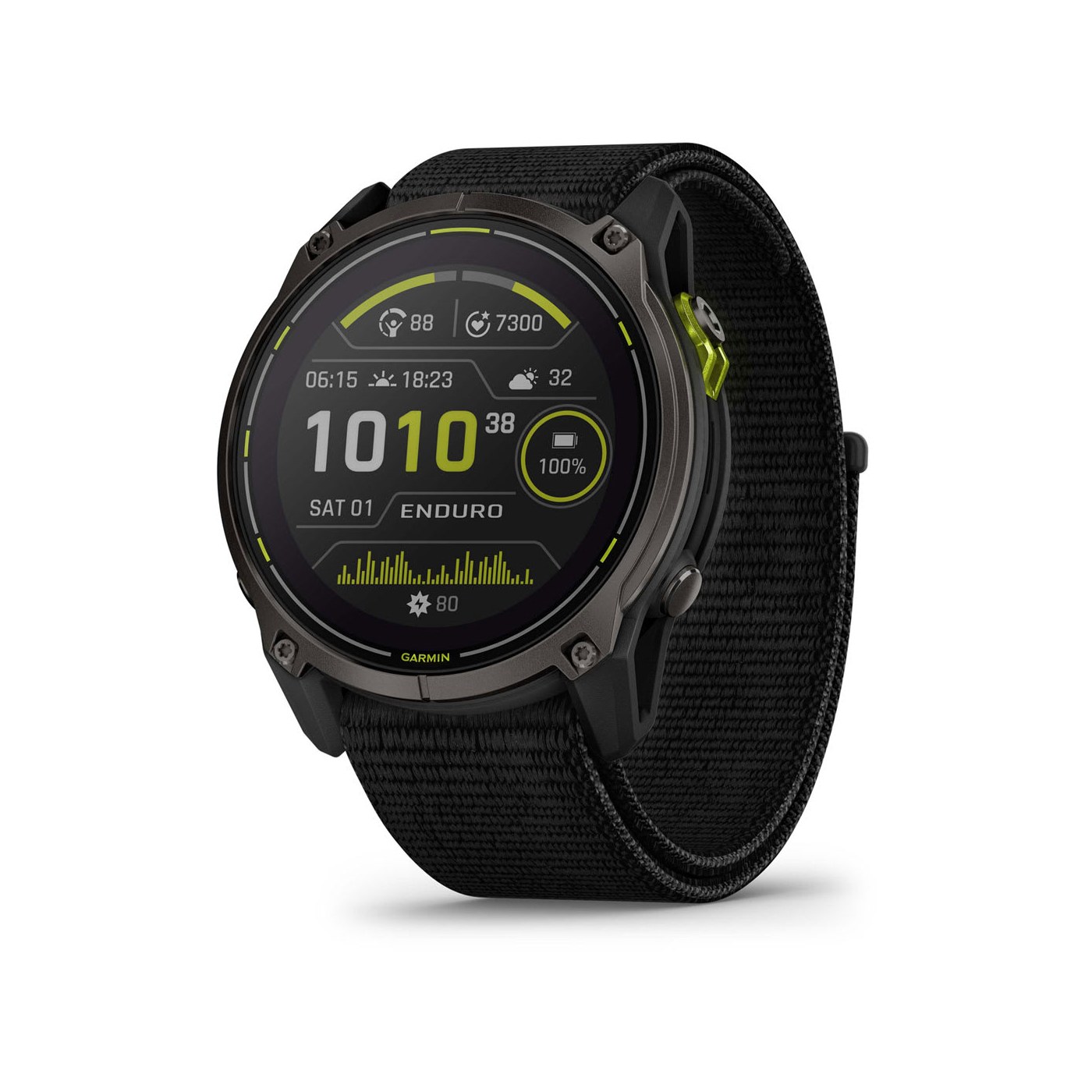
In August 2024, Garmin made an almost provocative move: it launched a watch priced at 899 euros with no AMOLED display. While every competitor lines up bright, glowing panels, the American brand sticks with a transflective MIP screen and beats every battery life record on the market. The Enduro 3 is not a stripped-down fenix 8. It's a war machine built for people who run more than 24 hours straight and want their watch to outlast the race.
© Garmin, official photo used for editorial purposes
Garmin's strategy: the Enduro 3 is not a stripped-down fenix 8
When Garmin launches an 899-euro watch in 2024 without AMOLED, there has to be a good reason. It's called Power Sapphire Solar. The solar lens turns the watch into a self-sufficient power station: no more hunting for an outlet during a multi-day race. The Enduro 3 replaces the Enduro 2 released in 2022 and moves upmarket across the board: Elevate Gen 5 sensor with ECG, adaptive SatIQ for multi-band GPS, and preloaded worldwide TopoActive mapping.
Garmin's strategy is easy to read: don't duplicate the Garmin fenix 8 (AMOLED, 40 m dive rating, LED flashlight, also 899 euros), but give ultrarunners a radical tool. The Enduro 3 weighs 63 g versus 72 g for the fenix 8. It lasts 36 days in smartwatch mode without solar, versus 16 days for the fenix 8. It's built for UTMB, the Diagonale des Fous and multi-day alpine traverses. Not for the runner who wants to check notifications between two meetings.
Garmin Enduro 3 specs: titanium, MIP Solar and multi-band GPS
| Brand | Garmin |
|---|
| Model | Enduro 3 |
|---|
| Release | August 2024 |
|---|
| Case size | 51 mm (DLC titanium) |
|---|
| Weight | 63 g with Ultrafit nylon strap / 69 g with silicone strap |
|---|
| Display | Transflective MIP 35.56 mm (1.4") / 280 x 280 px / Power Sapphire Solar |
|---|
| Smartwatch battery life | 36 days (no solar) / 90 days (with solar) |
|---|
| Standard GPS battery life | 45 h (no solar) / 84 h (with solar) |
|---|
| Multi-band GPS battery life | 27 h (no solar) / 52 h (with solar) |
|---|
| UltraMax GPS battery life | 120 h (no solar) / 320 h (with solar) |
|---|
| GNSS | Dual-frequency multi-band GPS L1+L5 (GPS/GLONASS/Galileo/BeiDou/QZSS) + SatIQ |
|---|
| Sensors | Elevate Gen 5 (optical HR + ECG + SpO2 + skin temp.), barometric altimeter, 3-axis compass, gyroscope, thermometer |
|---|
| Mapping | Worldwide offline color TopoActive + turn-by-turn navigation |
|---|
| Sport profiles | 30+ (trail, road, triathlon, ski touring, cycling, snowshoeing, swimming...) |
|---|
| Music storage | 32 GB (Spotify, Deezer, Amazon Music) |
|---|
| Contactless payments | Yes (Garmin Pay) |
|---|
| Water rating | 10 ATM (100 m) + MIL-STD-810H |
|---|
| Connectivity | Bluetooth 5.0 + ANT+ + Wi-Fi |
|---|
| Strap | 26 mm QuickFit (Ultrafit nylon included) |
|---|
| Price | €899.99 |
|---|
© Garmin, official photo used for editorial purposes
Power Sapphire Solar: 320 hours of GPS, really?
The 320-hour figure needs context. It applies to UltraMax GPS mode (reduced track recording frequency) with optimal sunlight of 50,000 lux for 3 hours a day. In real trail or mountain expedition conditions (alternating shade and forest, overcast skies), you'll get between 80 and 120 hours in standard GPS with solar active. That's already two to three times the GPS battery life of a Suunto Vertical 2 (65 h multi-band) or a COROS Vertix 2S (140 h UltraMax without solar).
In practice, on a 24- to 36-hour race such as a 100-miler, battery worries disappear completely. On a 5-day alpine traverse, solar charging almost fully offsets overnight consumption in smartwatch mode. The Power Sapphire lens, harder than standard mineral glass, does two jobs at once: scratch resistance and photovoltaics. Neither the fenix 8 AMOLED nor the COROS Vertix 2S offers that advantage.
RunMorph tip: To get the most out of solar, expose the Enduro 3 to the sun on climbs and ridge traverses. In dense woodland or under cloud cover, base your planning on the no-solar battery life (45 h standard GPS) as your minimum safety net. Turn on SatIQ: it automatically switches between dual-frequency and single-frequency GPS based on signal quality, maximizing battery life and accuracy with no manual input.
GPS accuracy and heart rate sensor in ultra-endurance
The multi-band L1+L5 GPS chip with SatIQ is the same as in the Garmin Forerunner 970. On technical terrain (granite canyons, alpine ridges, dense forest), tracks stay accurate, with measured deviations under 1.5% on total distance. SatIQ automatically adjusts GNSS acquisition based on how much open sky is visible: in open terrain it saves battery; in tough terrain it switches on full L1+L5 dual-frequency to maintain accuracy.
The Elevate Gen 5 sensor adds wrist ECG (a 30-second reading to detect signs of arrhythmia), SpO2 and overnight skin temperature. On long, low-intensity ultra-trail efforts, optical heart rate is reliable and stable. Above 170-180 bpm (short explosive climbs), a 5 to 10 bpm gap versus a reference chest strap can appear, which is standard for today's optical sensors. For 50 km, 100 km or longer formats, this sensor is perfectly suited to the physiology of ultra efforts.
Mapping and navigation on the Enduro 3
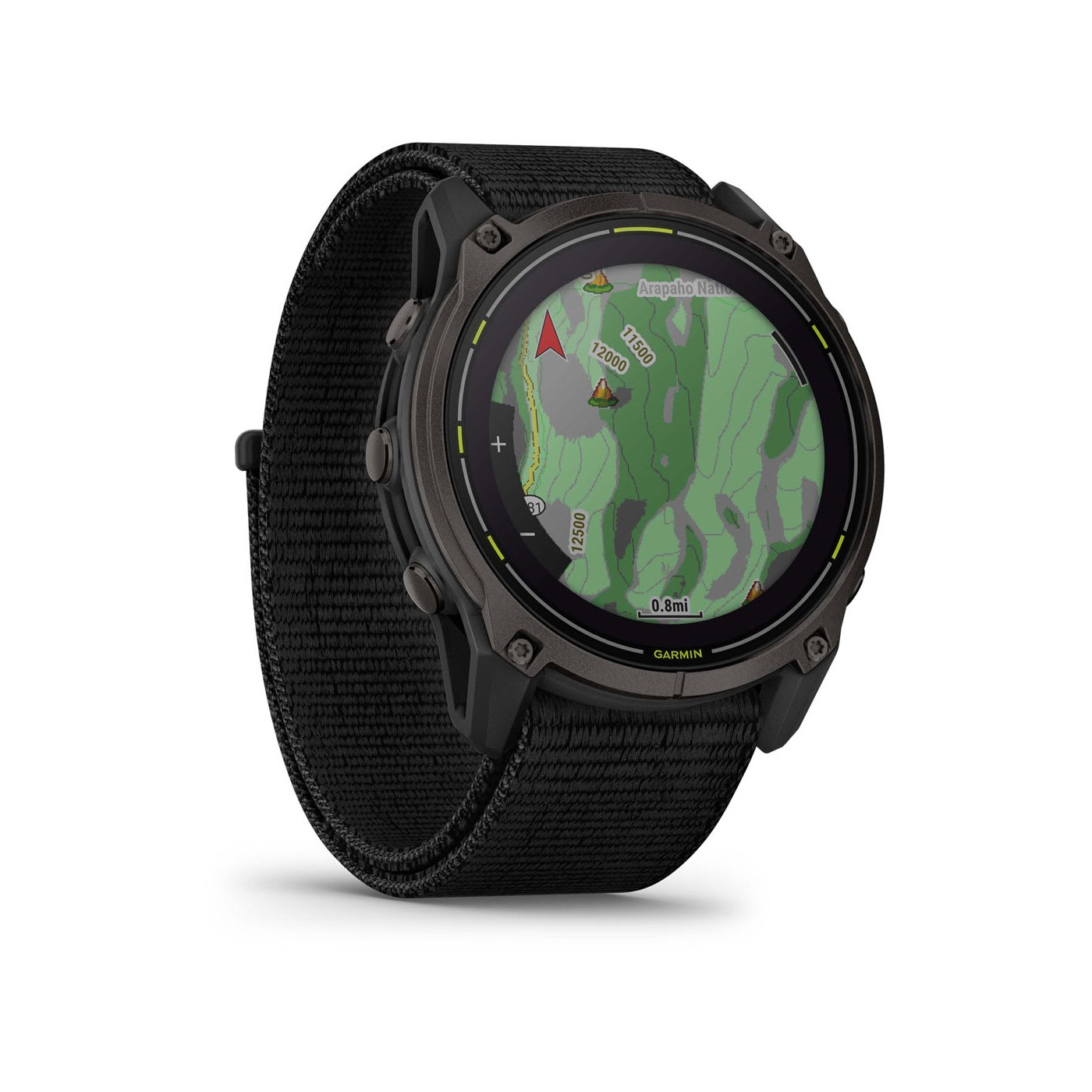
Like the fenix 8 and the Forerunner 970, the Enduro 3 comes with Garmin's worldwide offline TopoActive maps, with shaded relief and contour lines. Turn-by-turn navigation with automatic rerouting works without an internet connection. You can load GPX routes via Garmin Connect or Garmin Explore, follow dynamic out-and-back routes, and get back to your starting point with Back to Start.
The 280 x 280 px MIP display is less detailed than a 454 x 454 px AMOLED (fenix 8 or Forerunner 970), but it stays readable in every lighting condition, including bright mountain sun. At night, however, the Enduro 3 has no built-in flashlight, unlike the fenix 8 or the Garmin Instinct 3 AMOLED. Reading the map at night means turning on the backlight manually: that's the main limitation of the MIP choice for night trail running.
© Garmin, official photo used for editorial purposes
Training and recovery metrics
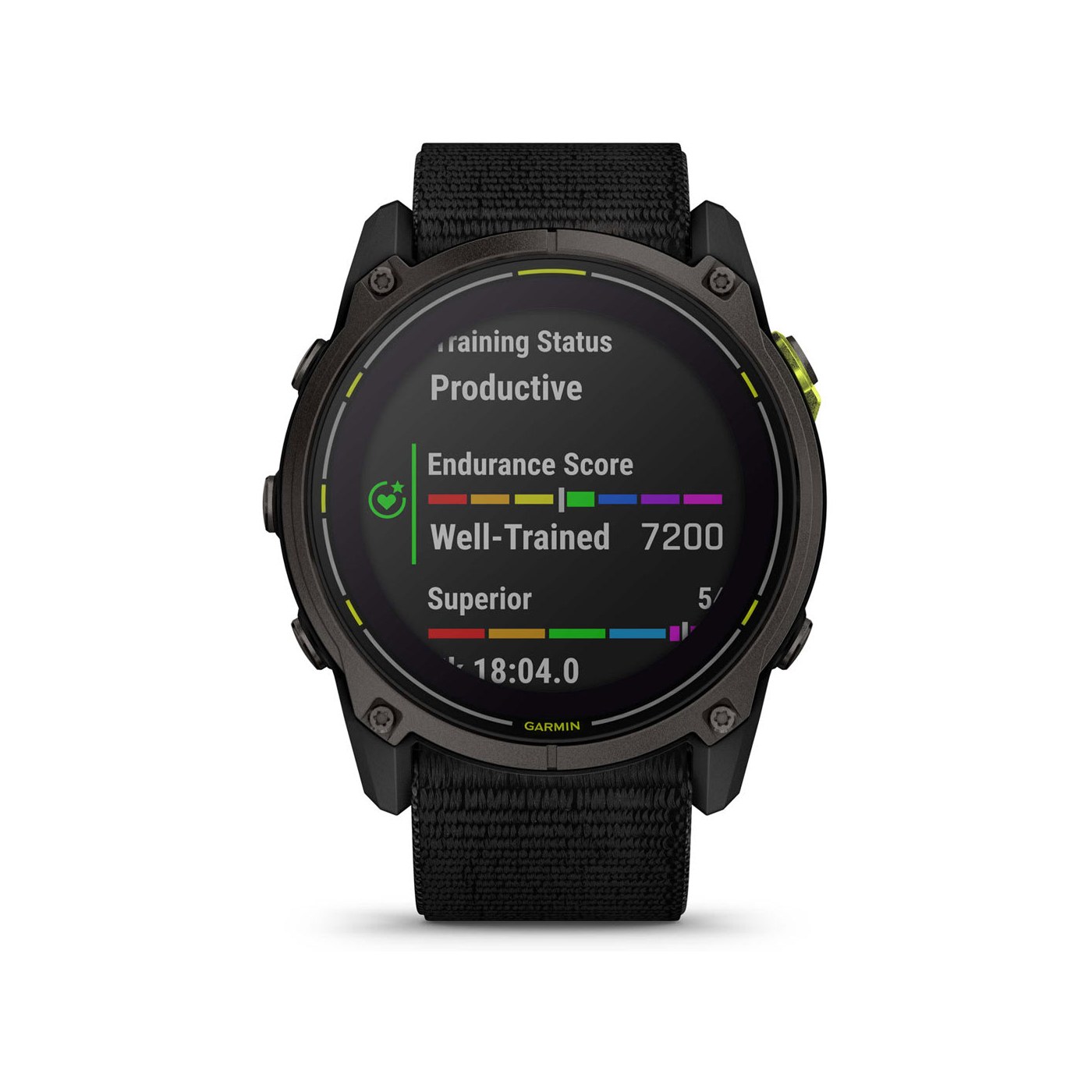
The Enduro 3 packs Garmin's full training suite: Training Readiness (daily readiness score), HRV Status, Body Battery, 5-stage sleep tracking, altitude-adjusted VO2max, aerobic and anaerobic Training Effect, and cumulative 7-day training load. These tools are identical to those on the fenix 8 and the Forerunner 970.
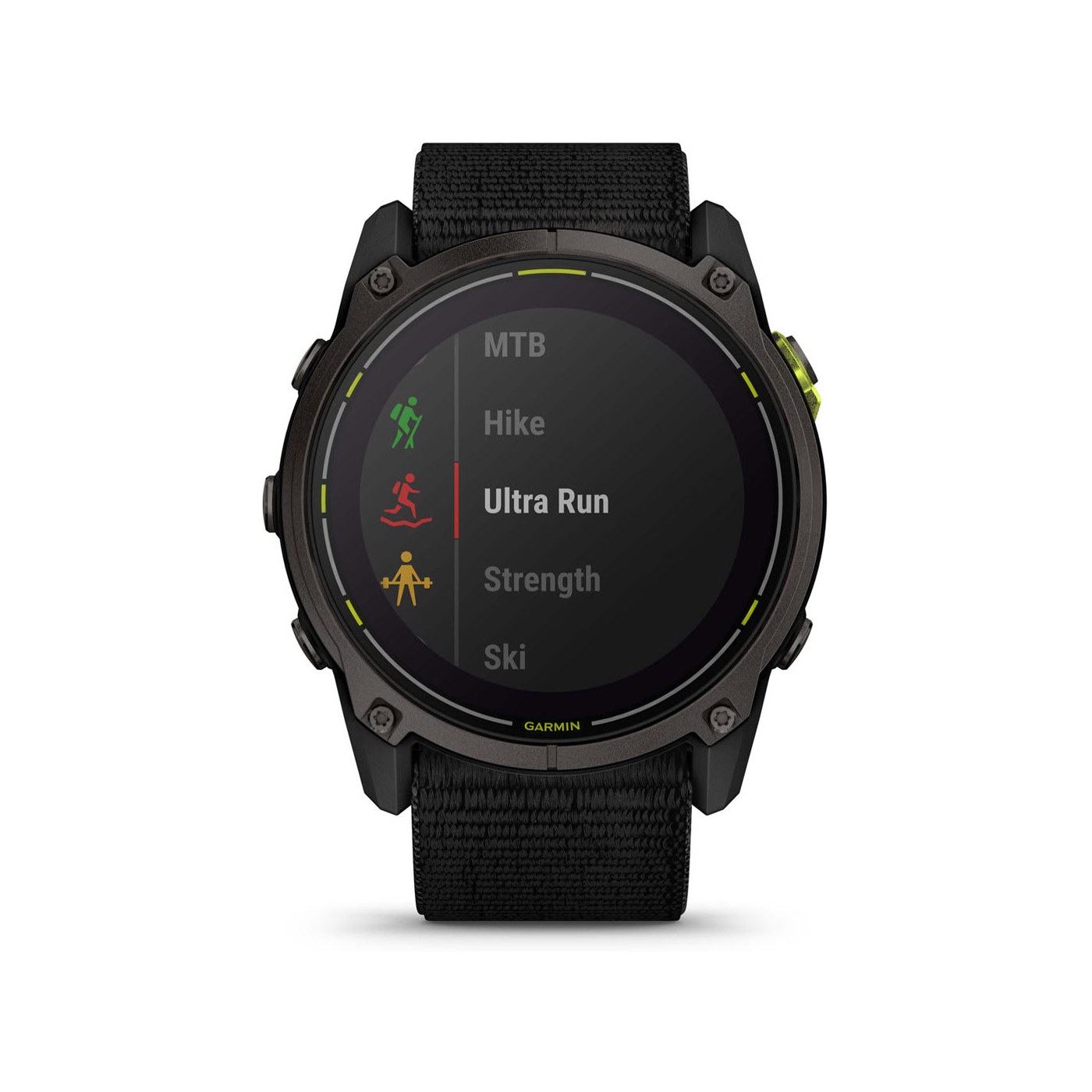
Grade-adjusted pace (PacePro) is the key tool for trail runners: it calculates your flat-ground equivalent pace by factoring in elevation gain and loss in real time. In an ultra, it's one of the most useful tools for spreading your effort, starting with your course recon. Garmin Coach plans for marathon or trail preparation are available directly on the watch. Garmin Messenger lets you exchange short messages via a connected smartphone, handy during team races.
Real-world battery life: what to expect for your use
Here are realistic figures based on your profile:
- Everyday smartwatch: 36 days without solar, up to 90 days with solar and regular outdoor time.
- Standard GPS (single-band): 45 h without solar / 84 h with solar. Enough for overnight 100 km races.
- Multi-band GPS (All-Systems L1+L5): 27 h without solar / 52 h with solar. The precision mode for technical terrain.
- UltraMax GPS (reduced accuracy): 120 h without solar / 320 h with solar. The multi-day mode for expeditions.
In practice, on a 24-hour ultra with multi-band GPS active, the watch uses about 46% of its battery (24 h / 52 h). Solar charging wins some of that back depending on sunlight. For a 100-miler (22 to 36 h of racing), standard GPS at 45 h without solar guarantees enough battery even under cloud cover. For a 5- to 7-day Tour du Mont-Blanc, UltraMax mode with solar is the ideal scenario.
Garmin Enduro 3 vs COROS Vertix 2S vs Suunto Vertical 2: the ultra-trail comparison
| Criteria | Garmin Enduro 3 | COROS Vertix 2S | Suunto Vertical 2 |
|---|
| Price | €899.99 | €699 | €799 (Titanium) |
| Weight | 63 g (nylon) | 89 g (titanium) | 85 g (titanium) |
| Display | MIP 35.56 mm / 280 px | MIP 46 mm | AMOLED 1.5" 2000 nits |
| Max GPS battery life | 320 h (solar UltraMax) | 140 h UltraMax | 65 h multi-band |
| Smartwatch battery life | 36 days / 90 days solar | 60 days | 40 days |
| Mapping | Worldwide TopoActive | Offline color | Worldwide offline |
| ECG | Yes | No | No |
| Solar | Yes (Power Sapphire) | No | No |
| Flashlight | No | No | Yes (LED) |
| Onboard music | Yes (32 GB) | No | Yes (32 GB) |
The takeaway is clear. The COROS Vertix 2S costs 200 euros less and offers 140 h of UltraMax without solar: the pragmatic choice for ultrarunners who never race more than 5 days without recharging. The Suunto Vertical 2 brings a spectacular 2000-nit AMOLED and an LED flashlight, but tops out at 65 h of multi-band GPS. The Enduro 3 only makes sense if you need more than 140 hours of GPS, or if passive solar charging is a deciding advantage for your multi-day races.
© Garmin, official photo used for editorial purposes
Who is the Garmin Enduro 3 for?
The ultrarunner and multi-day expedition runner
This is the target profile. You run 100 km races, 100-milers, multi-day traverses or 3- to 7-day alpine raids. You have no access to an outlet during your race. The Enduro 3 is made for you: solar offsets overnight consumption, TopoActive maps guide you through untracked terrain, and the 63 g won't weigh on you after 40 hours. The 320-hour UltraMax mode is your safety net for extreme scenarios.
The ambitious trail runner tackling their first long distances
If you're preparing for your first UTMB, your first Diagonale des Fous or a tough 100 km, the Enduro 3 is an investment that will last 5 to 7 years. It will stay with you through your whole ultra progression, from your first overnight 50 km races to alpine raids. The Garmin suite (Training Readiness, HRV Status, PacePro) will guide your preparation just like the Forerunner 970, but with GPS battery life the FR970 will never reach over several days of racing.
The hiker and mountaineer looking for a tough, versatile watch
The 10 ATM DLC titanium, worldwide TopoActive maps, 90 days in smartwatch mode with solar and the 3-axis compass make the Enduro 3 a complete adventure watch for summits and remote areas. If AMOLED is your top priority, the fenix 8 at the same price is the right alternative. If battery life trumps everything else, the Enduro 3 has no rival.
How to fit the Garmin Enduro 3 into your RunMorph training plan
The Enduro 3 is built for big volume and ambitious training blocks. Its Training Status and Training Readiness give you a precise view of your cumulative load, whether you're preparing for a 100 km ultra or an alpine traverse. Climbing blocks, 6- to 12-hour long runs and overload weeks are tracked accurately. HRV Status tells you which days pushing hard will pay off, and which days recovering is the best decision of your week.
Whether you're preparing for your first ultra-trail or chasing a podium, a structured plan makes the difference between finishing and performing. Explore RunMorph training plans built around your ultra-trail goals, from overnight 50 km races to 100-mile mountain races.
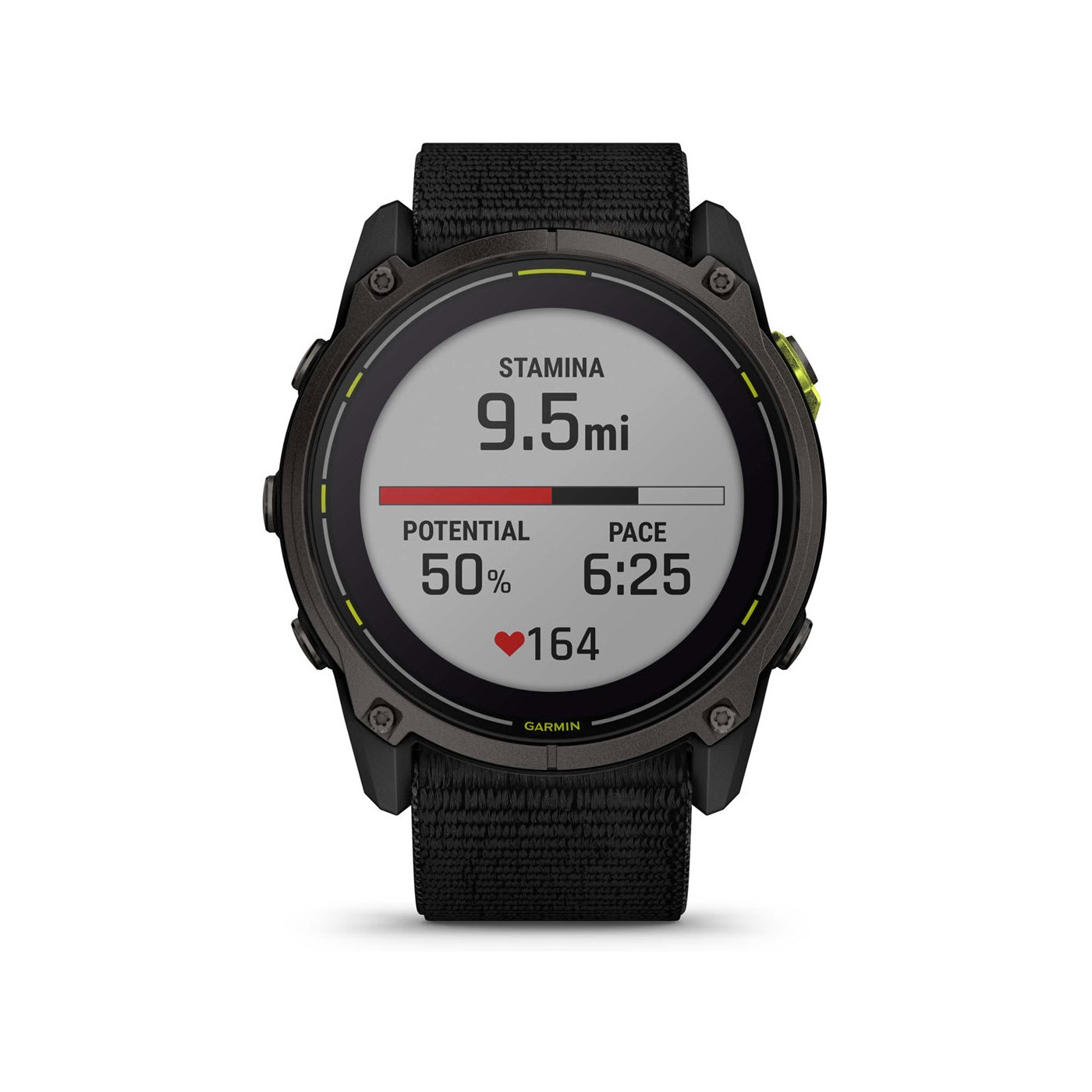
© Garmin, official photo used for editorial purposes
RunMorph Coach verdict
The Garmin Enduro 3 is the most coherent product in Garmin's lineup for ultra-trail. It does exactly what it promises: unmatched battery life, a light and tough DLC titanium case, complete worldwide mapping and the best training tools on the market. It never trades ultra performance for lifestyle appeal: no gorgeous AMOLED, no built-in flashlight, a spartan 5-button interface.
At 899 euros, it sits at the same level as the fenix 8 while serving a radically different purpose. If you run distances where battery becomes a planning variable (beyond 36 h of racing), the Enduro 3 is Garmin's answer. If you want the everyday versatility and AMOLED of the fenix 8, the two share the same price for different audiences. The COROS Vertix 2S offers 140 h of UltraMax without solar for 200 euros less: the serious alternative for those who never race more than 5 days.
RunMorph score: 8.5/10. An absolute benchmark for ultra-trail and expeditions, held back only by its MIP display with no flashlight and its premium price.