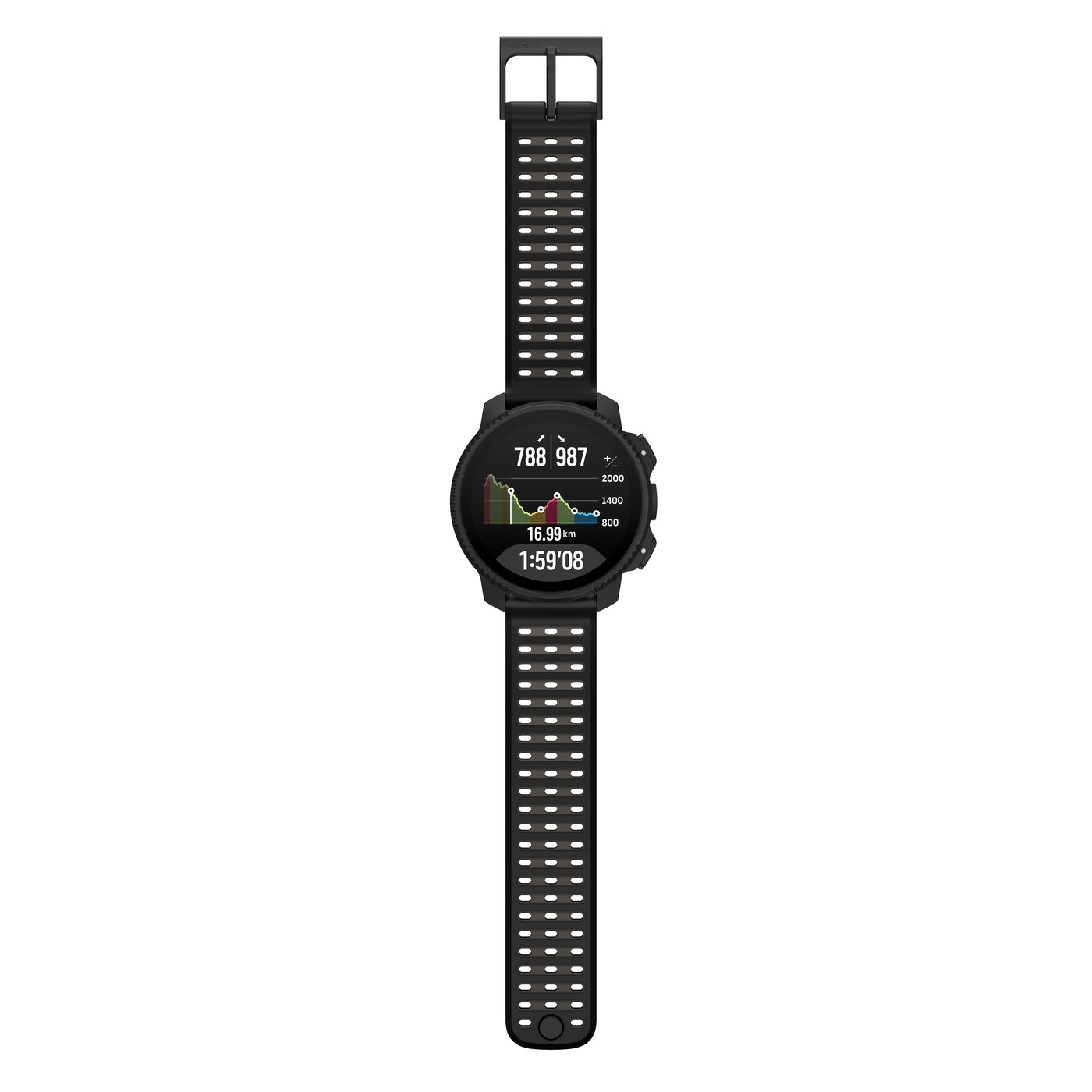
Suunto announced the Vertical 2 on September 30, 2025 and put it on shelves on October 15, exactly 17 months after the original Vertical launched. The bet behind this second generation is clear: move Suunto's adventure line to AMOLED without giving up any battery life, and add a built-in LED flashlight that changes everything when night falls on the trail. At €599 in steel and €699 in titanium, the Vertical 2 goes straight after the premium trail-expedition segment. Here's our verdict after cross-checking the long-term French reviews.
Suunto Vertical 2 Review: AMOLED, LED Flashlight and 65 h GPS
9/10
Suunto's new adventure flagship goes AMOLED
The original Suunto Vertical caught everyone off guard in 2023. A 49 mm watch built for multi-day efforts, with a transflective MIP display, free worldwide offline maps and battery life that took on the Enduro 3. The Vertical 2 sticks to exactly that brief but adds two major building blocks: a 1.5" AMOLED LTPO display that makes transflective screens obsolete in this segment, and a three-color LED flashlight built into the case. The rest is controlled evolution: a redesigned heart rate sensor, dual-frequency GPS on every model, ZoneSense and an upgraded Suunto Coach.
Against its direct rivals, the positioning is sharp. The Suunto Race 2 (€599 titanium) remains the more versatile big sister, equally at home in the city and on the trail. The Vertical 2 adds the flashlight, 10 ATM water resistance (versus 5 ATM on the Race 2) and an Ultra mode that stretches GPS tracking to 110 hours. Next to an AMOLED Garmin Forerunner 970 (€749), the steel Vertical 2 saves you €150 and wins on dive-grade water resistance, but loses music support. This is a mission watch more than an everyday one.
RunMorph's advice. If your goal is a multi-day ultra-trail, a 100 km trail race or a season of self-supported adventure races, the Vertical 2 is the first watch to look at. If you're a road and marathon runner, the COROS Pace Pro at €349 or the Polar Vantage V3 at €599 give you a better weight-to-price ratio, without paying for 100 m dive-grade toughness you'll never use on asphalt.
© Suunto, official photo used for editorial purposes
Objective technical specs
| Brand | Suunto |
| Model | Vertical 2 (tested in All Black steel) |
| Official release | October 15, 2025 |
| Case size | 49 mm (fiber-reinforced polyamide + steel or titanium bezel) |
| Weight | 87 g steel / 74 g titanium (with strap) |
| Display | 1.5" AMOLED LTPO touchscreen, 466x466 px, 2000 nits, sapphire glass |
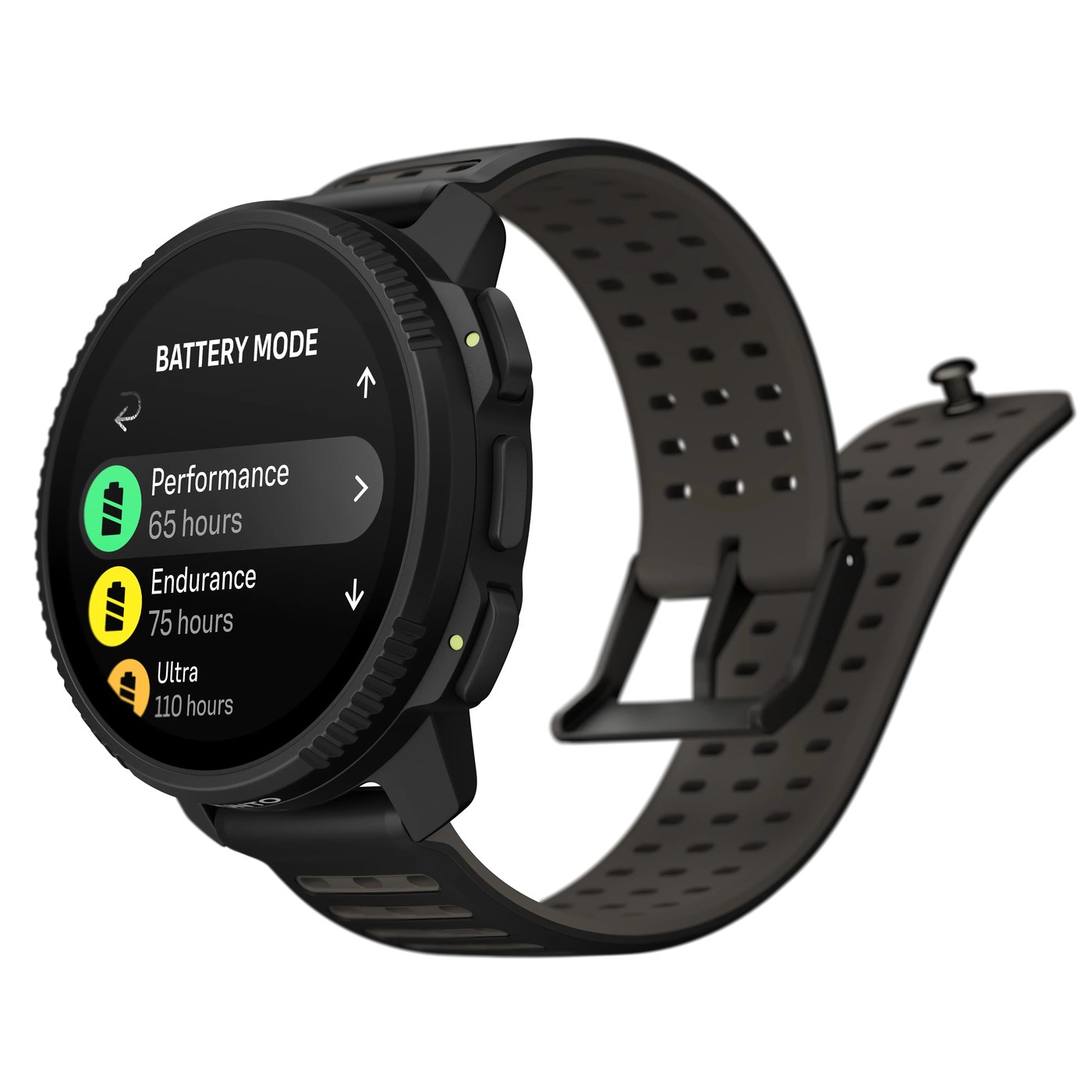
| Battery life | 20 days daily use / 65 h Performance multi-band GPS / 75 h Endurance / 110 h Ultra / 250 h Tour |
| GNSS | Dual-frequency L1+L5 GPS (GPS, GLONASS, Galileo, BeiDou, QZSS) |
| Sensors | Next-generation optical heart rate sensor, SpO2, barometer, compass, accelerometer, gyroscope, thermometer |
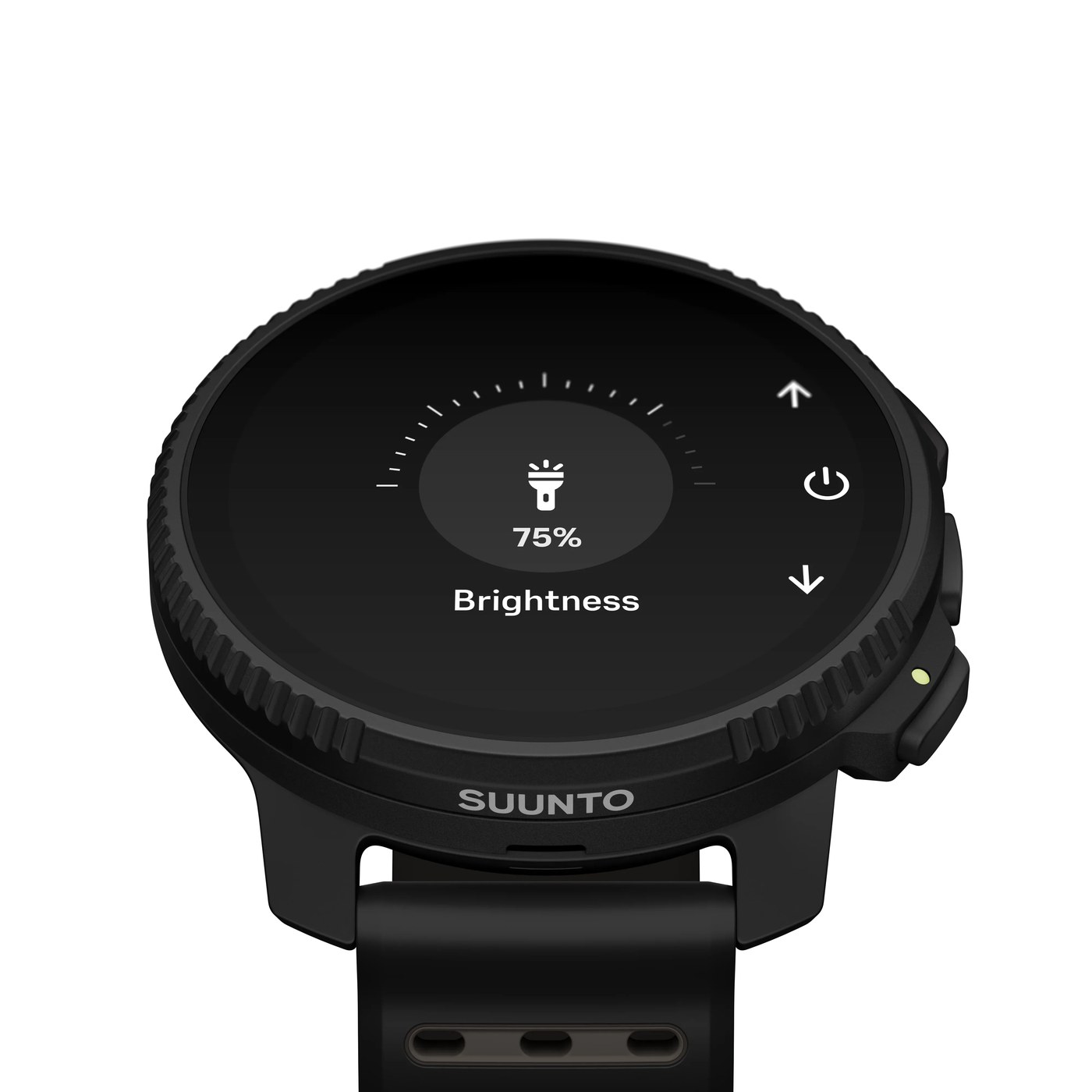
| LED flashlight | 3 built-in LEDs (2 white + 1 red), 4 brightness levels, red night-vision mode |
| Mapping | Free worldwide offline topo maps, Heatmaps, Climb Guidance, turn-by-turn, 32 GB storage |
| Sport profiles | 115+ modes |
| Onboard music | No (smartphone control only) |
| Contactless payments | No |
| Water resistance | 10 ATM (100 m), dive depth gauge down to 10 m |
| Smartphone connection | Bluetooth + 2.4 GHz Wi-Fi, USB-C, Suunto app, 300+ partners (Strava, Komoot, TrainingPeaks) |
| Price | €599 (steel) / €699 (titanium) |
Who is the Vertical 2 for?
The long-distance trail runner who never knows how long they'll be out there
This is the Vertical's historic core audience, and the Vertical 2 doesn't change the picture. 65 hours of multi-band GPS tracking, 110 hours in Ultra mode, 250 hours in Tour mode: on a single charge, you can finish a UTMB, a Diagonale des Fous or a GR20-style FKT without battery anxiety. The free worldwide offline topo maps (downloaded by region over Wi-Fi) cover the Alps, the Pyrenees, the Sahara and the Andes. Climb Guidance shows the gradient, distance and elevation profile of every climb still ahead of you. That's exactly what an ultrarunner wants: the freedom to head out without a plan B.
The multisport adventurer who switches between running, mountaineering and diving
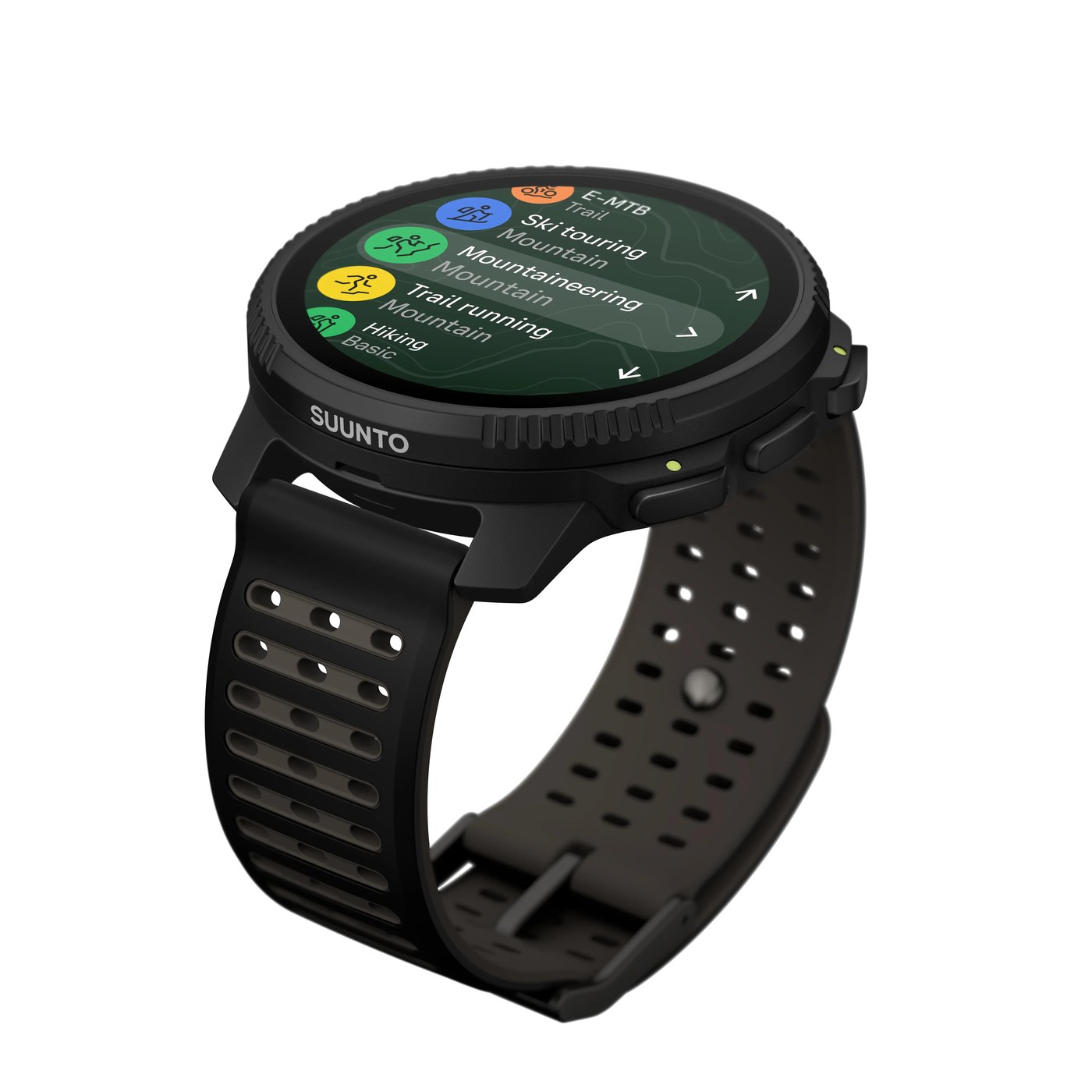
The Vertical 2 inherits the 115+ sport profiles of Suunto's new platform, including ski mountaineering, mountain biking, kitesurfing, trail running, mountaineering and recreational diving down to 10 m. The 49 mm fiber-reinforced polyamide case, with its steel or titanium bezel and sapphire glass, shrugs off knocks on rocky sections, and 10 ATM water resistance handles open-water swims and post-race recovery dips. If you juggle vertical and horizontal disciplines, the consistency of the ecosystem (training, recovery, sleep, menstrual cycles, Heatmaps route planning) makes it a credible command center.
The runner who wants a useful flashlight, not a marketing gimmick
The built-in LED light deserves to be taken seriously. 3 LEDs (2 white + 1 red), 4 brightness levels you adjust from the wrist, and a red mode to protect your night vision at camp: this isn't a courtesy light, it's lighting you can actually use. Finishing a run at dusk, digging for keys at the bottom of your pack, reading a paper map in the tent: the reflex comes fast. Long-term French reviewers all report the same shift: what looked like a gimmick at unboxing becomes indispensable after two weeks.
© Suunto, official photo used for editorial purposes
GPS accuracy and heart rate sensor
Dual-frequency L1+L5 GPS as standard on every sport profile is the most tangible navigation upgrade. On the original Vertical, multi-band only kicked in with Performance mode. Here it becomes the default setting in Endurance, Performance and Ultra modes. Independent measurements put the Vertical 2 among the leaders of 2026 multi-band GPS watches, with a distance error on a certified course of around 0.03 mile over 2 miles, or less than 1% error. On this criterion, it matches the Garmin Forerunner 970 and the COROS APEX 4.
On heart rate, this is the promised breakthrough. Suunto has long struggled with an optical sensor that lagged behind on variable-intensity efforts. The Vertical 2 gets a next-generation sensor, with a new flat caseback that improves skin-to-sensor contact. The long-term French reviews (Sport-Passion, Reference-Trail, Runpack, Montre-Cardio-GPS) agree: reliability climbs sharply on short intervals and stays solid on endurance efforts. It's a major credibility milestone for the brand. For heart rate purists, the Polar Vantage V3 keeps the edge with Elixir Gen 4 and wrist ECG, but the gap is shrinking fast.
Mapping and navigation
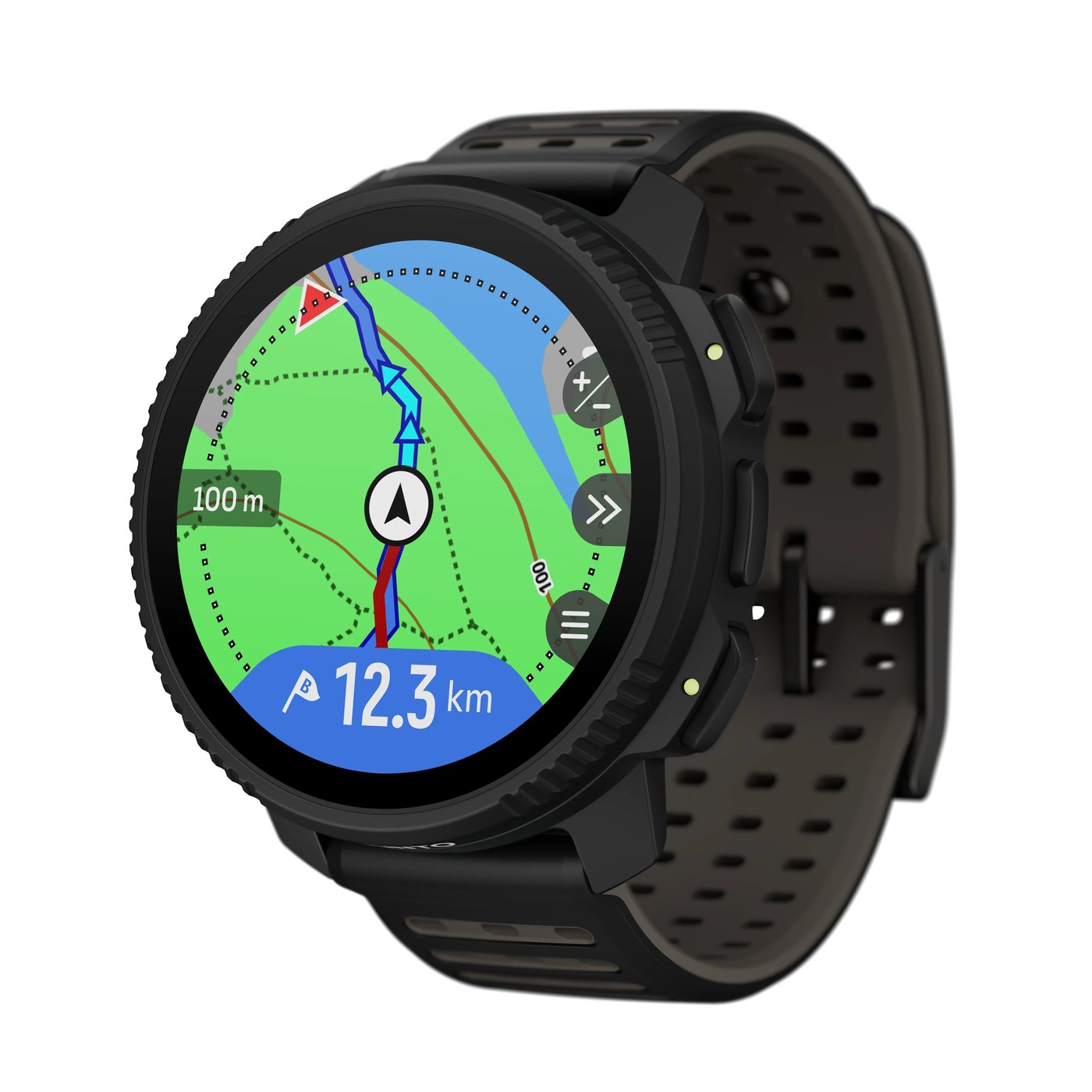
Free worldwide offline maps remain Suunto's historic strength, and the Vertical 2 pushes them further. You download by region over 2.4 GHz Wi-Fi, up to 32 GB of color topo maps with contour lines, trails, roads and points of interest. On the 1.5" 2000-nit AMOLED display, they're far more legible than on the transflective Vertical 1, especially in bright summer sun or under dense forest canopy. Panning and zooming are now smooth thanks to the new, faster processor.
Suunto Heatmaps are still the best trail route-planning tool on the market in 2026: you see where other runners have gone, by sport, so you can tell a smooth, runnable trail from a rough mountain-bike track. Climb Guidance shows the gradient, elevation and remaining distance of every upcoming climb in real time, point by point. Turn-by-turn navigation works on routes imported from Komoot, Strava or GPX. "Back to Start" kicks in with two button presses, handy when a storm hits 15 km from the parking lot.
Training and recovery metrics
The new Suunto Coach and ZoneSense suite is the other big project on the Vertical 2. ZoneSense replaces raw heart rate readings with a real-time read of metabolic intensity, based on heart rate variability and cadence. In practice, during intervals, the watch detects when you cross your threshold without waiting for your heart rate to plateau, and shows it as a colored zone. If you run your sessions by feel, that's useful feedback.
Suunto Coach now offers adaptive 5K, 10K, half marathon and marathon plans, calibrated to your training history and fitness level. The recommended recovery window adjusts to your load over the last 7 days and to the sleep quality picked up by the overnight heart rate sensor. It's not yet as mature as Polar Coach or Garmin Running Coach, but the gap is closing quickly. Sleep tracking with overnight SpO2 and heart rate variability, daily stress tracking and Body Resources (Suunto's answer to Body Battery) round out the physiological ecosystem.
© Suunto, official photo used for editorial purposes
Real-world battery life
This is where the Vertical 2 remains the benchmark. In daily use with the heart rate sensor on and the screen waking on wrist raise (but without Always-On), you get 18 to 20 days, in line with the official claim. With AOD enabled, battery life drops to around 6-8 days according to long-term French reviews. That's the classic AMOLED trade-off: gorgeous when it lights up, power-hungry when it never goes dark.
With GPS, Performance mode on multi-band L1+L5 delivers 65 real-world hours, confirmed by independent measurements. That's enough for a self-supported UTMB, a 100-miler or a GR20 traverse over 4-5 days. Endurance mode (L1 only, GPS All Systems) climbs to 75 hours, and Ultra mode to 110 hours (simplified sport logic, more widely spaced GPS points). Tour mode, rated at 250 hours, switches off heart rate and spaces GPS points as far apart as possible: ideal for a multi-week trek where all you want is the track. A full USB-C charge takes under 90 minutes.
© Suunto, official photo used for editorial purposes
How it stacks up against the competition
The Vertical 2 sits in the premium trail-expedition segment, where it faces three direct rivals.
Against the Suunto Race 2 (€599 titanium, released August 2025), the choice stays within the brand but splits opinion. The Race 2 is more versatile for city use, lighter (67 g titanium versus 74 g) and has a rotating crown. The Vertical 2 adds the flashlight, 10 ATM water resistance versus 5 ATM, 10 more hours of multi-band battery life and a 110-hour Ultra mode. If you run 70% road + 30% smooth trail, the Race 2 is still the better pick. If you run 70% trail + ultra + mountains, the Vertical 2 wins.
Against the COROS APEX 4 (€499.99 in 46 mm, released October 2025), the call is more nuanced. The APEX 4 keeps a transflective display (readable in full sun without a backlight, with near-zero power draw) and 65 h in GPS All Systems mode. The Vertical 2 switches to AMOLED (better readability everywhere except harsh midday sun, higher contrast for navigation). The APEX 4 has a microphone + speaker for calls, the Vertical 2 doesn't. The Vertical 2 has the LED light and denser Heatmaps mapping. At €100 less, the APEX 4 remains an excellent transflective choice. The Vertical 2 is worth the extra if you insist on AMOLED.
Against the Garmin Forerunner 970 (€749 titanium, released May 2025), the steel Vertical 2 saves you €150. The FR970 stays ahead on onboard music (32 GB MP3 + Spotify/Deezer/YouTube Music), Garmin Pay contactless payments, the Garmin Connect ecosystem and its community. The Vertical 2 takes the lead on 100 m dive-grade water resistance, Ultra mode battery life (110 h versus 30 h), free worldwide offline maps (with Garmin, you have to buy TopoActive Asia, Africa and South America) and the three-color LED light with red mode.
How to fit it into your RunMorph training plan
The Vertical 2 is in its element on the RunMorph trail plans, especially the ultra and 80 km+ blocks. On long, easy endurance runs (3 to 6 hours), multi-band Performance mode gives you a reliable track even in dense forest or deep gorges, and Body Resources accurately gauges the load you've put your body through. Suunto Heatmaps help you vary your training loops on your usual terrain.
During pre-race taper weeks, ZoneSense sharpens how you run threshold and max aerobic speed sessions: you see in real time when the effort tips over, and you adjust your pace without waiting for your heart rate to plateau. On race day (ultra-trail, 100 km, adventure trek), offline maps + Climb Guidance + 65 h of multi-band battery life turn the watch into an onboard navigator. If you're a road runner training for a marathon, it's probably the wrong watch: too big, too expensive, too many features left unused. Look instead at the RunMorph marathon plans paired with a COROS Pace Pro at €349 or a Garmin Forerunner 170 at €299.
RunMorph Coach verdict
The Suunto Vertical 2 is the best adventure-trail watch of 2026 for anyone who can justify real multi-day use. The combination of a 1.5" 2000-nit AMOLED display + dual-frequency GPS + three-color LED flashlight + worldwide offline maps + 110 h of battery life in Ultra mode is unique on the market at €599. The redesigned heart rate sensor finally fixes Suunto's longstanding weakness. The new processor's smoothness erases the sluggishness the Vertical 1 was criticized for. This is a mission watch, built for specific goals.
The trade-offs are deliberate: no onboard music, no contactless payments, no ECG. For a casual runner doing 4x40 minutes a week on the road, it's oversized and underused. At this price, stretching your budget only makes sense if you're after record battery life, 10 ATM water resistance or the LED light. For everyone else, the COROS Pace Pro at €349 or the Polar Vantage V3 at €599 are the smarter buys.
RunMorph score: 9/10. A trail-expedition benchmark that owns its premium niche positioning, with an AMOLED execution Suunto has finally mastered. Worth considering if you know exactly why you're buying it.
Key takeaways for your training
- The 2000-nit AMOLED changes how you read the watch on the move: no more squinting under the canopy or on a climb straight into the sun.
- The three-color LED light isn't a gimmick: useful at camp, during night transitions and for finding gear after a technical descent.
- The 110-hour Ultra mode covers every trail race distance in France: you can start a 100-miler with no charging plan B.
- ZoneSense is the real training differentiator: you pace by metabolic intensity instead of lagging heart rate, for more precise threshold and max aerobic speed work.
- The weight-to-battery ratio is still unbeatable: 87 g in steel for 65 h of multi-band GPS, and no rival does better at this price.