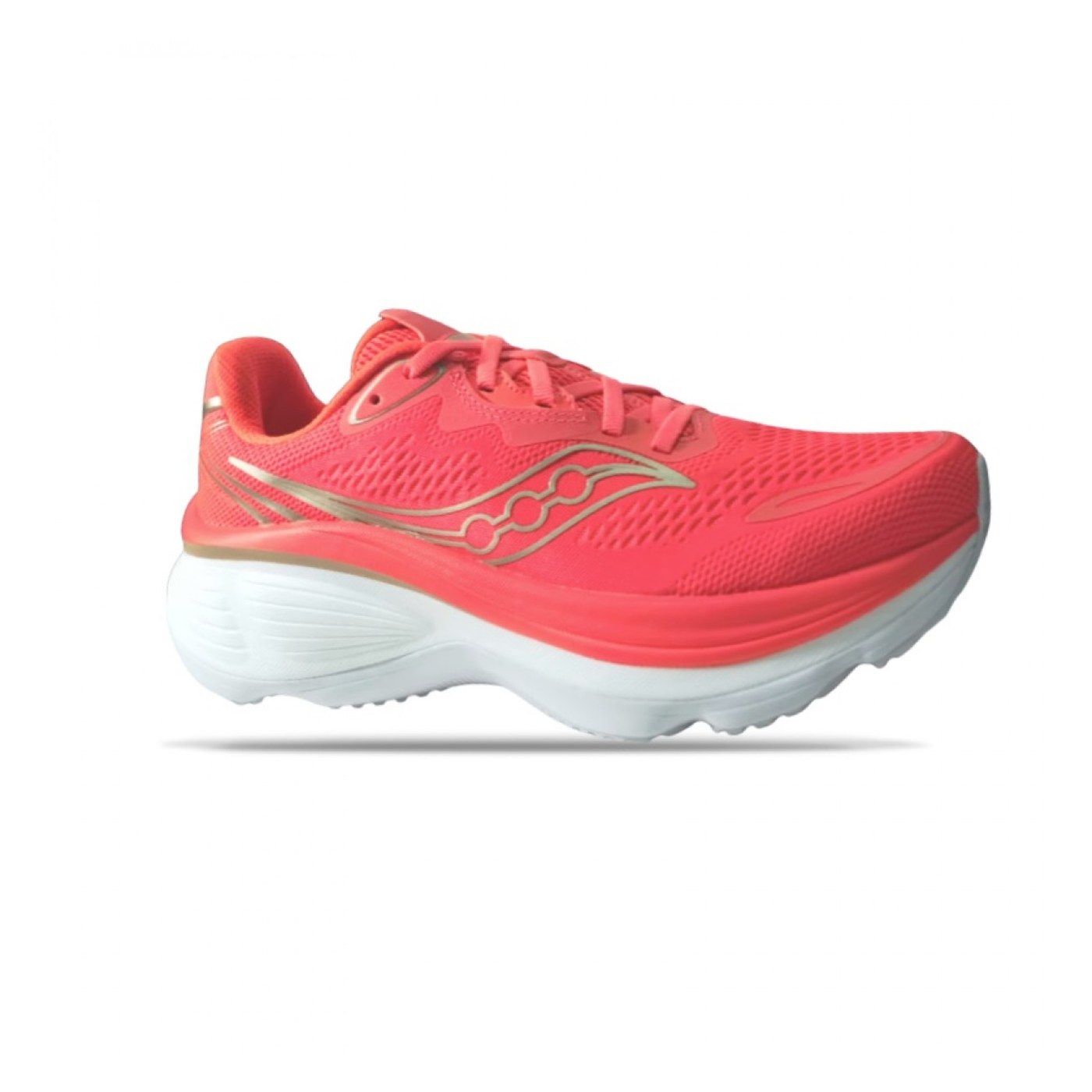
The Saucony Hurricane hasn't always had a great reputation. For years it was the shoe for runners who wouldn't admit they overpronated: a bit heavy, a bit stiff, sensible without ever being exciting. The Hurricane 26 changes all that. With IncrediLUX, Saucony's new ATPU foam, and the PowerRun Frame, a rethought stability architecture, it becomes the most ambitious premium stability shoe Saucony has ever built. 265 g, 6 mm drop, generous stack height: stability no longer has to make sacrifices.
Saucony Hurricane 26 Review: IncrediLUX Meets Premium Stability
8.5/10
The essentials in 3 sentences
The Saucony Hurricane 26 debuts IncrediLUX, the ATPU foam that brings the premium technology of the Endorphin Elite to an everyday stability shoe, paired with the PowerRun Frame to guide your stride without locking it down. It's the first truly modern Hurricane: 6 mm drop, 265 g, and surprisingly lively behavior for a shoe in this segment. At €170, it sets the benchmark in road stability for overpronators who refuse to trade responsiveness for comfort.
8.5
/ 10 · RunMorph overall score
Who is it for?Overpronators who want responsiveness without giving up stability. A road daily trainer from 5K to marathon when you need support. Runners moving on from the old rigid stability shoes to something more modern.
Who should skip it?Neutral runners (get the Ride 19 or the Triumph 24). Anyone chasing maximum cushioning above all else (Paramount Max). Tight budgets under €120 (Guide 19 at €130).
Saucony Hurricane 26: when stability meets IncrediLUX
The Hurricane line was created for overpronators who need strong medial support. For a long time, that meant heavy, stiff, flat-feeling shoes. The stability market always made the same unspoken trade-off: you want support, so you accept running in something heavier and less responsive.
The Hurricane 26 challenges that trade-off. IncrediLUX is Saucony's next-generation ATPU foam (a foamed thermoplastic polyurethane), developed to bring the liveliness of carbon-plated shoes into the stability daily trainer segment. You'll find it in the Saucony Endorphin Elite 3 in its IncrediRUN form. The Hurricane 26 uses a version recalibrated for daily training (IncrediLUX): softer and more shock-absorbing, but still significantly more responsive than the PWRRUN+ foam of earlier generations.
The PowerRun Frame is the second pillar of the Hurricane 26. It's the stability architecture that replaces the old rigid medial posting systems. Instead of blocking pronation with a denser foam zone, the PowerRun Frame shapes the sole geometry to steer your stride naturally toward the center, with no noticeable stiffness. The result: dynamic rather than static stability, which works with your stride instead of restricting it.
RunMorph tip: if you're coming from a rigid stability shoe (like the Asics Gel-Kayano 33 or an older Guide), the Hurricane 26 will surprise you with how lively it feels. Expect a short adjustment period if you're used to relying entirely on static support. For mild overpronators, the Saucony Guide 19 remains a lighter, more affordable alternative at €130.
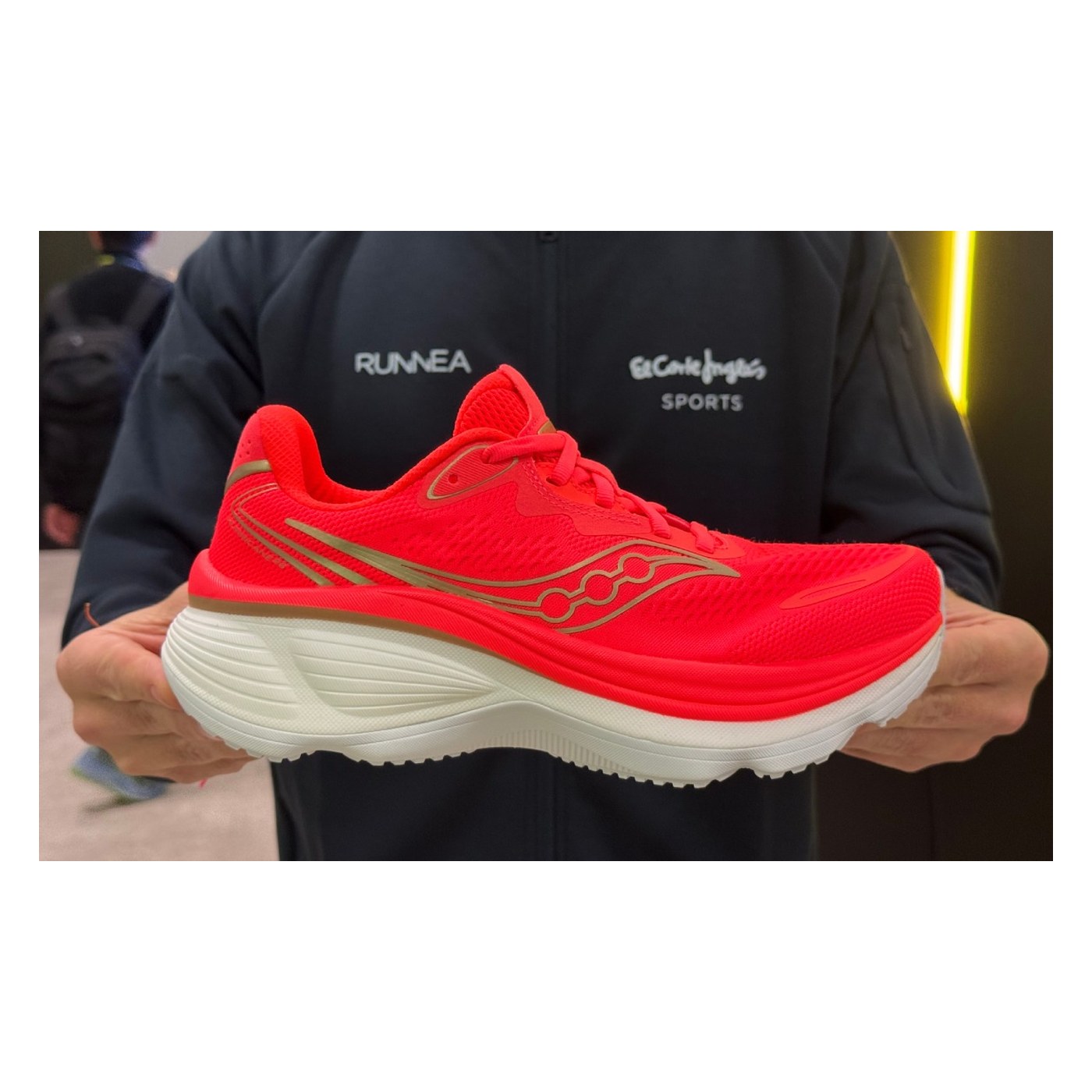
© Saucony, official photo used for editorial purposes
Objective technical specs
| Brand | Saucony |
| Model | Hurricane 26 |
| Official release | December 2025 |
| Type | Stability daily trainer, road |
| Drop | 6 mm |
| Stack height heel / forefoot | ~41 / 35 mm |
| Weight (EU 42) | 265 g (men's) / ~235 g (women's) |
| Foam | IncrediLUX ATPU (midsole) + PowerRun Frame (stability) |
| Plate | None |
| Upper | Engineered mesh, structured heel counter |
| Outsole | High-durability PWRGRIP rubber in strategic zones |
| Profile | Medial stability, moderate to severe overpronation |
| Recommended distance | 5 km to marathon |
| MSRP | ~€170 |
Three technical points stand out. First, the 6 mm drop is a major shift for the Hurricane line. Previous generations often sat at 8-10 mm, which made them a poorer match for modern runners. Moving to 6 mm brings it in line with current market standards and eases the transition for runners coming from modern neutral shoes.
Second, 265 g for a full-cushion stability shoe is remarkable. Older stability shoes of this type often weighed 290-320 g. You feel the weight savings over time, especially on long runs when fatigue builds up.
Third, the IncrediLUX ATPU stack is a breakthrough in this segment. ATPU delivers more energy return than classic EVA and less than pure PEBA, but with far better durability than the latter. That makes it the ideal choice for a stability daily trainer that has to hold up under high mileage.
Who is the Saucony Hurricane 26 for?
The overpronator who wants responsiveness
You overpronate moderately to severely, and until now your stability shoe supported you well but always felt a little flat. The Hurricane 26 breaks that compromise. IncrediLUX gives you real energy return with every stride, and the PowerRun Frame guides you without stiffening you up. If you've always wondered why neutral runners seem to run lighter than you, this shoe will change how you see it.
The high-mileage stability runner
You run 50-80 km a week and need a shoe that holds up to the mileage and doesn't wreck your legs on long runs. The Hurricane 26 is built for exactly that: the IncrediLUX foam stays consistent over time, the medial support is always there with no hard spots, and the PWRGRIP outsole is designed to last beyond 800 km.
The runner moving to dynamic stability
You overpronate but never liked classic stability shoes because they felt too restrictive. You compensated with neutral shoes and ended up dealing with medial pain as your mileage grew. The Hurricane 26 is the ideal bridge: it gives you the support you need without the "orthotic" feel you dislike in rigid stability shoes. The PowerRun Frame guides without forcing.
On the run
On easy runs between 5:30 and 6:30 per kilometer, the Hurricane 26 is unexpectedly generous. IncrediLUX soaks up impacts perfectly, the medial stability fades into the background (a sign it's doing its job), and the 6 mm drop geometry encourages a natural, efficient footstrike. You can run in this shoe for a long time without tiring: it does the work for you.
Pick up the pace to between 4:30 and 5:15 per kilometer and the Hurricane 26 surprises. It's not as explosive as a Saucony Endorphin Speed 5 or an Asics Novablast 6, but for a stability daily trainer, its responsiveness is well above anything the Hurricane has offered before. It lets you slot in moderate tempo work (marathon and half-marathon pace) without feeling like you're fighting your shoe.
Long runs of 20-28 km are where the Hurricane 26 proves its worth. The foam stays stable, the support never fades, and the well-built heel counter prevents irritation over long distances. The catch: on mixed surfaces (slight cambers, broken asphalt), the PowerRun Frame takes a little getting used to. This isn't a shoe for forest trails.
Saucony Hurricane 26 vs. the competition
Saucony Guide 19 (€130, 249 g, 8 mm drop): the Hurricane's little sister in Saucony's stability lineup. The Guide 19 is lighter, more affordable, and enough for mild overpronation. The Hurricane 26 wins on cushioning (IncrediLUX vs. PWRRUN), modern drop (6 vs. 8 mm) and stability for severe overpronators. For mild overpronators, the Guide 19 at €40 less remains an excellent choice.
Asics Gel-Kayano 33 (€180, 272 g, 10 mm drop): the icon of road stability. The Kayano 33 is more protective, and its FluidSupport wraps severe overpronators more securely. But it's heavier and pricier, and its 10 mm drop makes it a poorer match for modern strides. The Hurricane 26 is livelier and lighter; the Kayano 33 is more reassuring and more enveloping.
Saucony Triumph 24 (€160, 285 g, 8 mm drop): Saucony's premium neutral daily trainer. For runners with no pronation issues, the Triumph 24 is the better fit: softer, with superior max-cushion comfort. But if you overpronate, the Hurricane 26 is the right pick in Saucony's lineup.
Brooks Adrenaline GTS 24 (€128, 260 g, 12 mm drop): the budget stability benchmark. The GTS 24 is significantly cheaper and has a proven track record. Its 12 mm drop makes it less ideal for today's runner. The Hurricane 26 costs more but is more technologically advanced and better positioned for 2026.
How to fit the Hurricane 26 into your RunMorph training plan
In a two-shoe rotation, the Hurricane 26 ideally becomes your main mileage shoe: easy runs, long runs, moderate threshold sessions. A light shoe without stability features (for recovery days on controlled surfaces) rounds out the rotation well if you can handle 15-20 km without stability.
As your only pair, the Hurricane 26 works for almost everything except sub-4 min/km intervals. It covers the full range of the serious stability runner (40-80 km/week) with no pace restrictions below fast tempo.
For marathon builds, the Hurricane 26 excels throughout the volume-building phase (weeks 1 to 14 of an 18-week plan). In the peak phase, a racing shoe takes over for goal-pace work. Check out the RunMorph training plans for gear recommendations matched to your goal.
RunMorph coach's verdict
The Saucony Hurricane 26 modernizes a segment that badly needed it. IncrediLUX is a real step forward, the PowerRun Frame is a genuine innovation, and moving to a 6 mm drop is the right call. For moderate to severe overpronators, it's the most responsive and most modern road stability shoe available at €170 in 2026.
It loses half a point for the projected durability of IncrediLUX ATPU (still to be confirmed past 1000 km) and a point for its price positioning: at €170, it goes head-to-head with premium neutral daily trainers that don't have to deliver stability. But for runners who need stability, the Hurricane 26 is the best option in its segment today.
RunMorph score: 8.5/10. RunMorph's top road stability pick in 2026.
Key takeaways for your training
- IncrediLUX ATPU: the first ATPU foam in a Hurricane, more responsive and lighter than the old PWRRUN+, more durable than pure PEBA.
- PowerRun Frame: dynamic medial stability that guides without stiffening, a clean break from the old static correction systems.
- 6 mm drop (vs. 8-10 mm on previous generations): the Hurricane finally aligns with modern standards and suits today's runners.
- 265 g, 25-50 g less than comparable traditional stability shoes: the weight savings are real and noticeable over long distances.
- Road daily trainer for overpronators, 5K to marathon: covers the full training range of the overpronating runner, except sub-4 min/km intervals, where a racing shoe is the way to go.