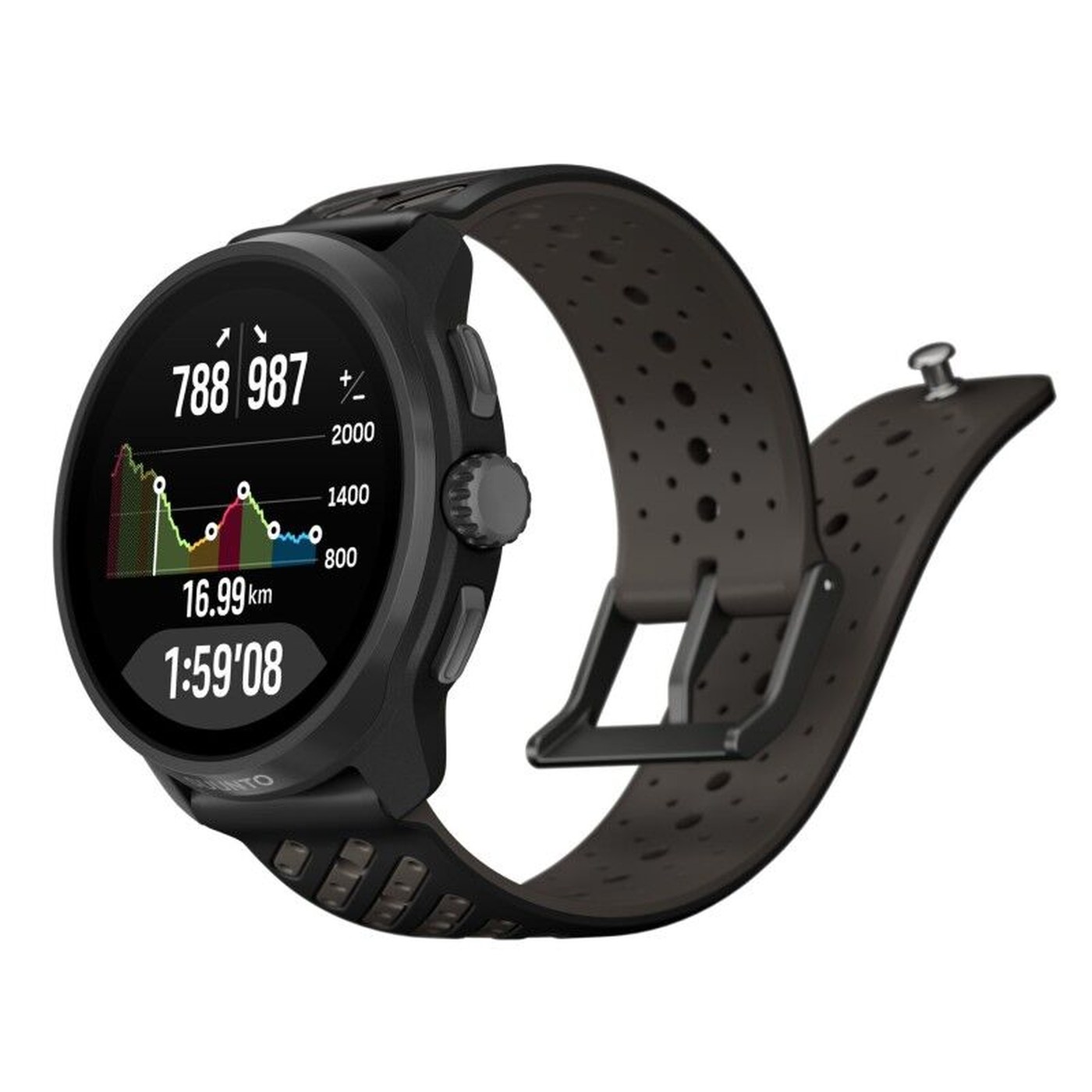
Suunto has long let Garmin and Coros fight it out on sheer AMOLED brightness. With the Race 3S, the Finnish brand changes tack: titanium, sapphire glass and a screen twice as bright as the Race S, all for 499 €. The question is whether that price gap holds up once the real-world numbers are checked against the claims.
© Suunto, official photo used for editorial purposes
A Race that moves up, not down, the lineup
Suunto's Race lineup was built on a simple pitch: AMOLED and dual-frequency GPS at a lower price than Garmin. The Race 3S breaks with that logic. It replaces the Race S, launched in June 2024 at 349 €, but lands at 499 €, a 150 € jump over that launch price. Even against the titanium version of the Race S, sold at 449 € at the time, the gap is still 50 €.
What's meant to justify the increase: a titanium case and sapphire glass where the Race S made do with steel and Gorilla Glass, a screen twice as bright (2,000 nits versus 1,000), and a higher claimed battery life. But the brand also lists 38 hours of battery life in best-GNSS mode, a figure that an independent test run under heavy use with active navigation doesn't match. That's the angle of this review: what holds up, and what's mostly a good marketing line.
What Suunto claims versus what was measured on battery life
On paper, 38 hours in best-GNSS mode is 8 hours more than the Race S. An independent test tracked a 98-minute session with active navigation. It measured battery drain of about 5% over that time. The result: a projected real-world battery life of around 28 hours under those conditions, well short of the claimed 38. The gap comes mainly from on-screen navigation and the always-on display, two very common settings on a long trail outing.
| Metric | Claimed by Suunto | Measured in real use (active navigation) |
|---|
| Best-GNSS battery life | 38 h | around 28 h |
| Always-on display, daily GPS | 7 days (60 min of GPS per day) | around 5 days |
In short: the Race 3S holds its 38 hours if the screen stays asleep between checkpoints and map navigation isn't running constantly. Turn both on at once over a long outing, and the safety margin shrinks fast. A trail runner aiming for a 24-hour ultra is better off switching off always-on than trusting the spec-sheet number.
Field testing: GPS accuracy and wrist-based heart rate
On GPS accuracy, the reports line up. A French test run on a reference course just over 10 km recorded a distance error of around 0.7%, a solid result. In everyday use, the gap against other watches sits around 0.2 to 0.6%, or roughly 20 meters over 12 km: a margin comparable to a Garmin Forerunner 570. A lab measurement confirms errors under 5 meters in open terrain, but notes that downtown, none of the watches tested cut corners noticeably better than the others: an environmental limit, not a weakness specific to the Race 3S.
The optical heart rate sensor improves clearly over the Race S: several testers recorded an average gap of barely 1 beat per minute against a chest strap on endurance runs, and a gap of 1 to 3 bpm on maximum heart rate. One test tracking a 98-minute session confirms a gap of 3 to 5 bpm, limited to 20-second peaks. Opinions diverge on hard efforts, though: one tester explicitly recommends a chest strap for intervals and hill work, since the optical sensor underestimates heart-rate peaks in that kind of effort. RunMorph's advice is simple: the Race 3S is enough for easy runs and long runs, a chest strap is still better for threshold work.
RunMorph's advice: for interval or hill sessions, pair the Race 3S with an external chest strap. On an easy run or a long run, the wrist sensor is plenty, just as on the Suunto Run 2.
© Suunto, official photo used for editorial purposes
Mapping and navigation
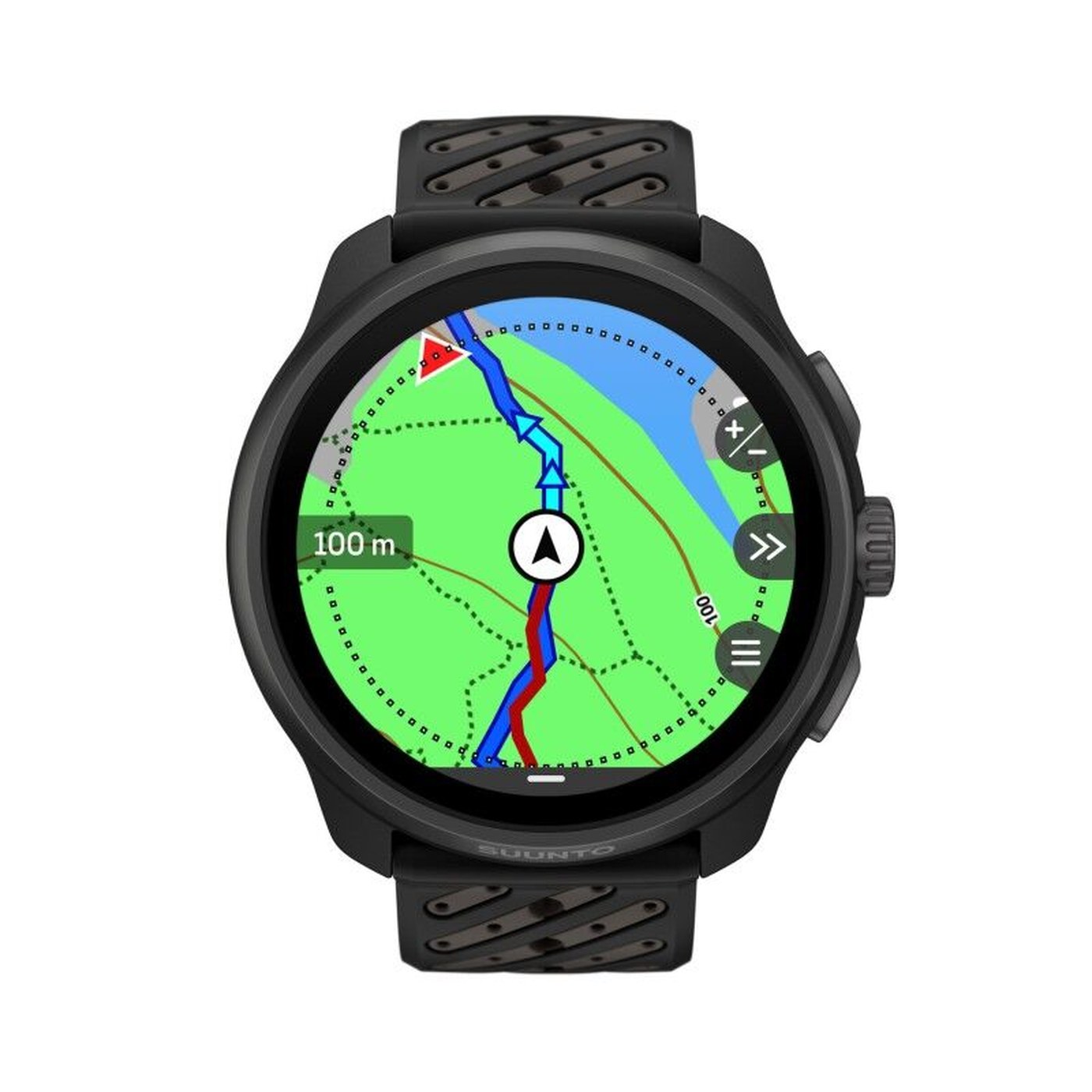
The Race 3S ships with free offline maps, including street names, points of interest and contour lines, across four display modes. They aren't routable: you can't request a point-to-point route directly on the watch, you need to prepare the track beforehand in the app. On the ground, rendering stays smooth, with instant map rotation, though tile loading briefly flashes black for one or two seconds when zooming. Against a fenix, which offers more advanced route calculation, the Race 3S stays a track-following watch rather than a full hiking GPS.
Real-world battery life, use case by use case
For a weekly run with no active navigation, the claimed 38 hours hold up comfortably, and even the 55 hours of Endurance mode stay realistic with light screen use. For a 3-to-5-hour long run with the map opened now and then, expect roughly two to three times the drain of simple use. For a 15-to-24-hour ultra with continuous navigation and an always-on screen, the theoretical safety margin all but disappears, as the measured gap above shows: better to carry a charger or turn off the always-on display. For everyday non-sport use, 12 days stays realistic with the always-on display switched off.
Suunto Race 3S versus the Race S: the comparison
| Spec | Suunto Race S | Suunto Race 3S |
|---|
| Launch | June 2024 | October 2026 |
| Launch price | 349 € (steel) / 449 € (titanium) | 499 € |
| Case | 45 mm, stainless steel | 46 mm, titanium |
| Glass | Gorilla Glass | Sapphire |
| Brightness | 1,000 nits | 2,000 nits |
| Best-GNSS battery life | 30 h | 38 h claimed (around 28 h measured with active navigation) |
| Daily battery life | 9 days | 12 days |
| Storage | 32 GB | 64 GB |
| Offline music | No | Yes (local MP3) |
The simple read: if you already own a Suunto Race S and have never run out of battery or missed titanium over steel, the upgrade isn't worth much. If bright sunlight has already given you trouble reading the screen, or you want a tougher case for ultra-trail, the Race 3S fills a real gap.
Suunto Race 3S versus the Coros Pace 4 Pro: the comparison
| Spec | Suunto Race 3S | Coros Pace 4 Pro |
|---|
| Price | 499 € | 449 € |
| Screen | 1.32", 2,000 nits | 1.47", 3,500 nits |
| Daily battery life | 12 days | 21 days |
| Dual-frequency GPS battery life | 38 h claimed | 30 h (screen on) |
| Mic and speaker | No | Yes |
| Sport profiles | 100+ | Not precisely disclosed |
Against the Coros Pace 4 Pro, the Suunto loses on nearly every raw number: a dimmer screen, half the daily battery life, and a 50 € price gap against it. Its edge comes down to more subjective points: the titanium-and-sapphire case, and the Suunto software base (mapping, training zones) already familiar to anyone who has used the brand since the Race or the Race 2.
© Suunto, official photo used for editorial purposes
Our field verdict: who is it for?
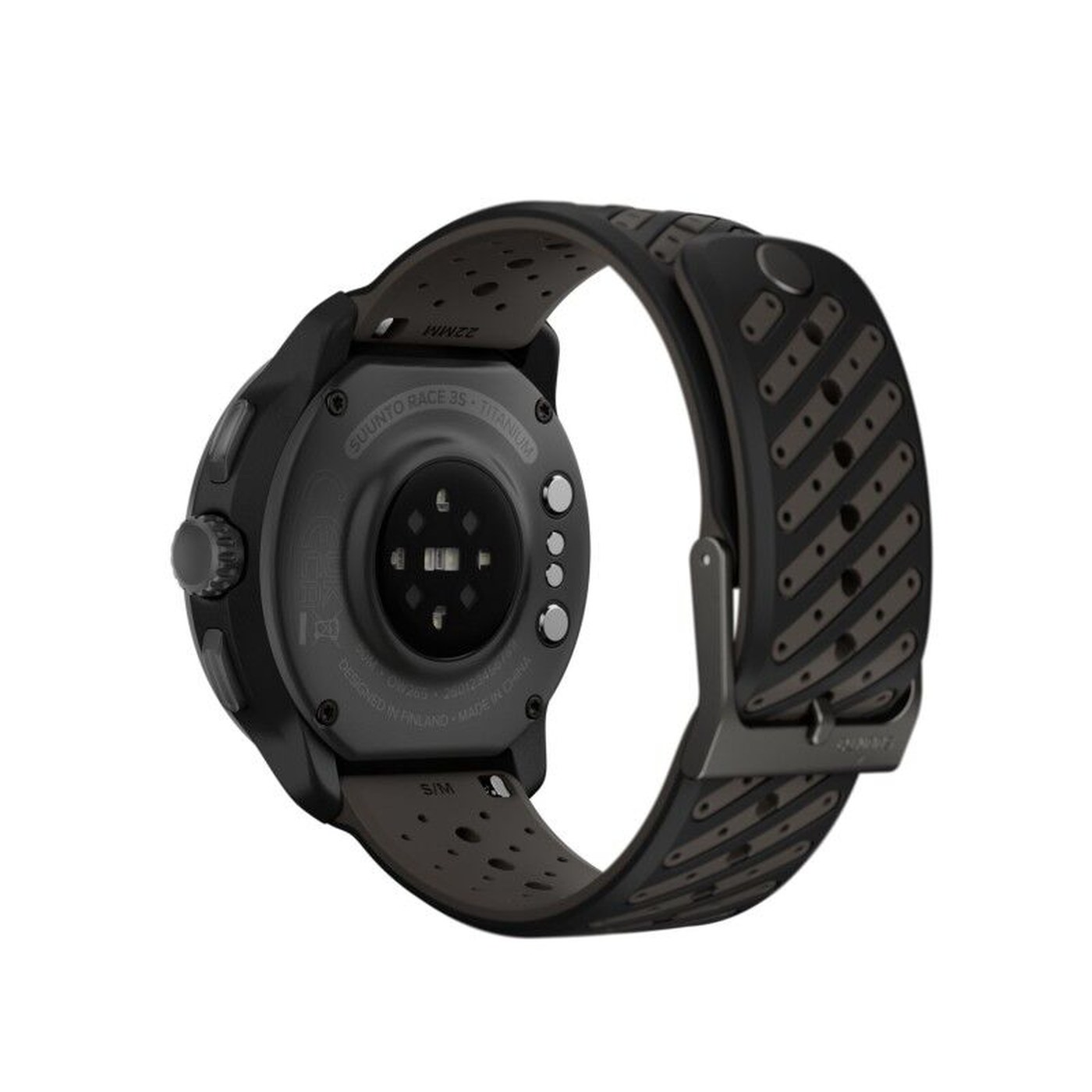
The Race 3S speaks to three specific profiles, not runners in general. The trail runner stacking up multi-hour outings in the mountains benefits from the titanium case and a screen that's readable in bright sun. The triathlete who swims, bikes and runs with the same watch gains water resistance and sensor versatility. And anyone already invested in the Suunto ecosystem, used to Suunto Coach and custom training zones, gets an immediate, familiar experience. For everyone else, the features-to-price ratio leans clearly toward the Coros Pace 4 Pro or the Race S, still on sale and more than enough for a 10K or a half marathon.
Training for a long mountain outing or a first trail race? The Race 3S handles an irregular training load well, with onboard mapping to keep outings in unfamiliar terrain safer.
👉 Pair it with the RunMorph Trail training plan to structure your progress before race day.
RunMorph Coach's verdict
The Suunto Race 3S delivers on most of its promises: reliable GPS, an optical heart rate sensor that's finally trustworthy on endurance efforts, a screen that's genuinely readable in bright sun. But the number that sells the watch, 38 hours of battery life in best-GNSS mode, doesn't hold up under heavy navigation use, where the measured gap drops to around 28 hours. Add a 499 € price tag, 50 to 150 € above the Race S depending on which version you compare, and a direct rival (Coros Pace 4 Pro) that's brighter and lasts longer for less.
7,3/10: a solid, honest-in-the-field product, but one whose price only makes sense if you really value titanium, sapphire and the Suunto ecosystem. For everyone else, the Race S or the Pace 4 Pro cover the essentials for less.
FAQ
Is the Suunto Race 3S suitable for an ultra-trail of more than 20 hours?
With active navigation and an always-on screen, measured battery life drops to close to 28 hours rather than the claimed 38: plan for an external charger beyond 20 hours of effort.
Is the Suunto Race 3S's heart rate sensor reliable?
Yes for endurance efforts, with an average gap of around 1 beat per minute against a chest strap. On intervals and hill work, the gap widens: a chest strap is still recommended for that kind of session.
What's the price difference between the Suunto Race 3S and the Race S?
499 € versus 349 € at launch for the steel version of the Race S, a 150 € gap, or 50 € against the titanium version at 449 €.
Does the Suunto Race 3S support contactless payment?
No, outside China. For payment on the wrist, a Garmin with Garmin Pay is still the way to go.
How much does the Suunto Race 3S weigh on the wrist?
56 grams with its silicone strap, a weight close to a Coros Pace 4 Pro and lighter than a titanium Suunto Race 2.