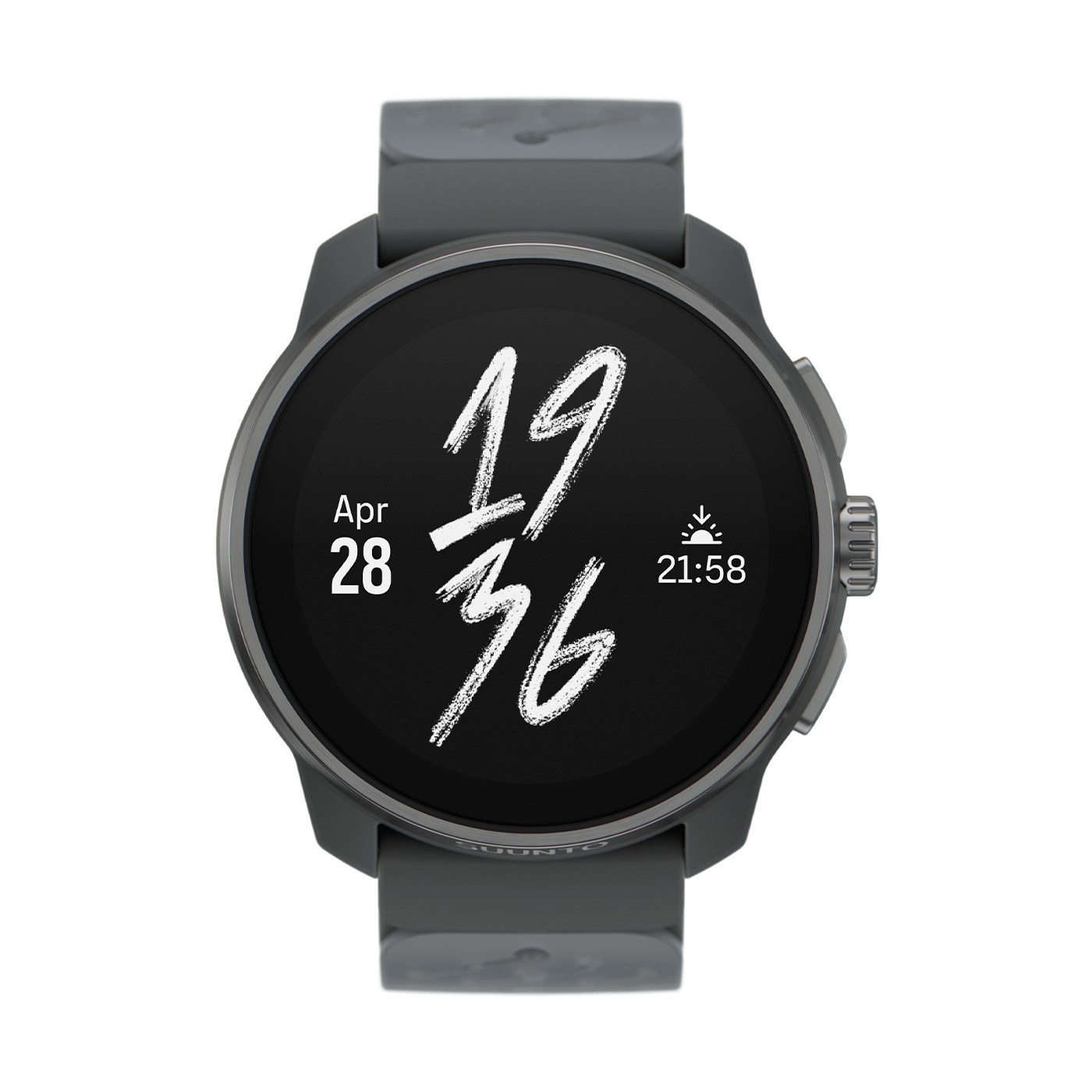
The Suunto Race S comes with a clear brief: deliver the Finnish AMOLED experience in a 45 mm, 60 g case, with 32 GB of storage, free offline maps and 30 hours of GPS battery life. At €449, it goes head to head with the Garmin Forerunner 265 and the Polar Street X. At RunMorph, we wore it for several months to give you a no-nonsense verdict.
Suunto Race S Review: AMOLED, 32 GB Music, Free Offline Maps
8.2/10
The essentials in 3 sentences
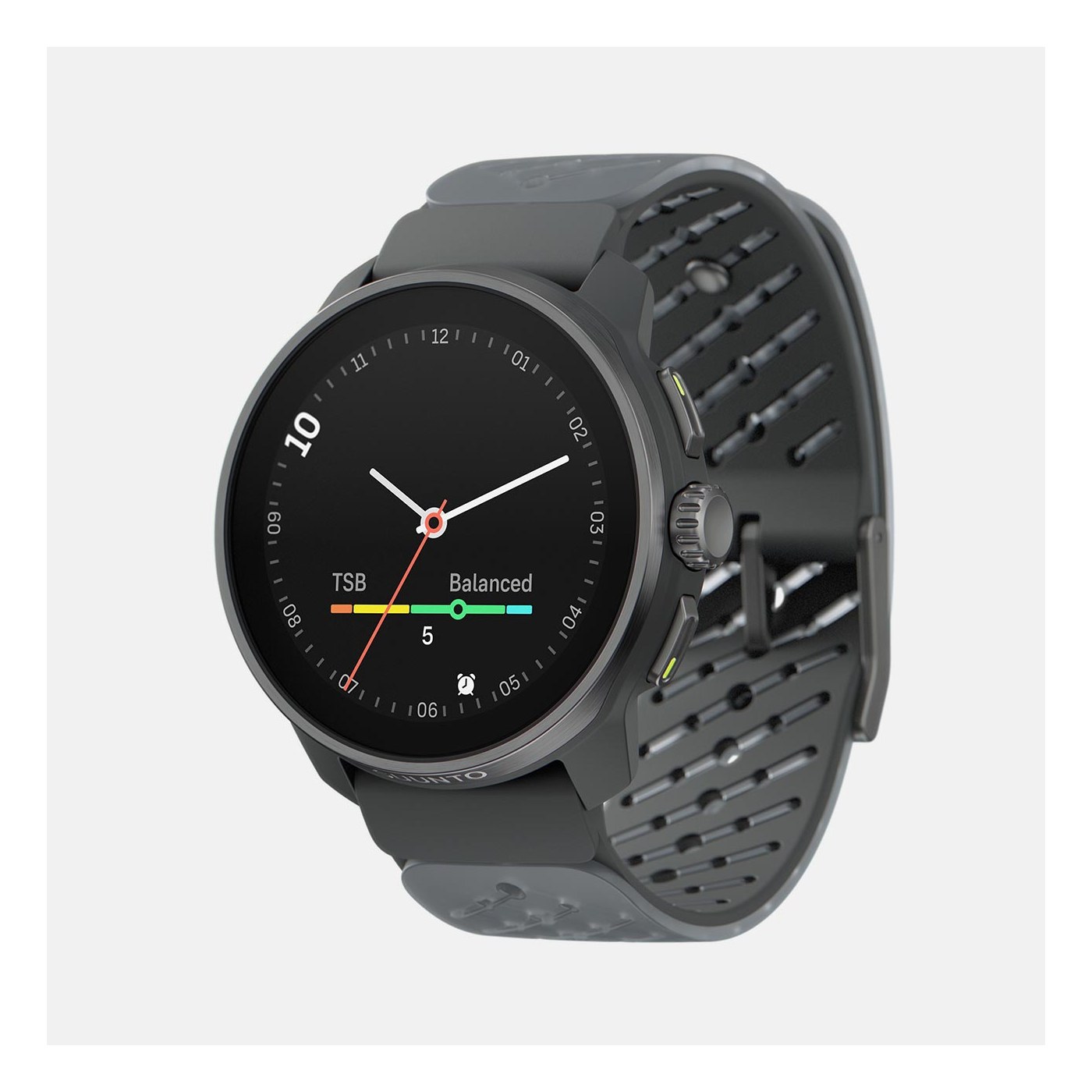
The Suunto Race S is the compact entry point to the Race lineup: a 1.32-inch 466×466-pixel AMOLED, 30 hours of multi-GNSS GPS and 32 GB of offline music in a 45 mm polymer case for €449. Its SuuntoPlus interface and free offline maps set it clearly apart from the competition in this price bracket. The catch: GPS battery life falls short of the Race 2, and there's no dual-band GPS in performance mode.
8.2
/ 10 · RunMorph overall score
Who is it for?
Road and trail runners who want a premium AMOLED, music and offline maps with no subscription, in a compact and versatile package.
Who should skip it?
Trail runners on long expeditions that demand maximum battery life (see the Race 2 with 55 h of GPS) or runners chasing the absolute lowest weight (see the Suunto Run at 36 g).
Suunto Race S: the compact AMOLED for demanding runners
Suunto has always stood for one philosophy: tough watches, free maps and an ecosystem with no mandatory subscription. The Race S carries those values forward and adds a bright 466×466-pixel AMOLED, 32 GB of music storage and strong multi-GNSS GPS. It sits below the Suunto Race 2 in the Race lineup, which offers more battery life and a 49 mm case for ultra-focused runners.
RunMorph tip: if you regularly go beyond 25 hours of activity (ultras, expeditions), go for the Suunto Race 2 and its 55 h of GPS, or the Suunto Vertical 2. For road running and short trail runs with music, the Race S is the right pick at this budget.
Objective technical data
| Spec | Value |
|---|---|
| Brand | Suunto |
| Model | Race S |
| Release | 2024 |
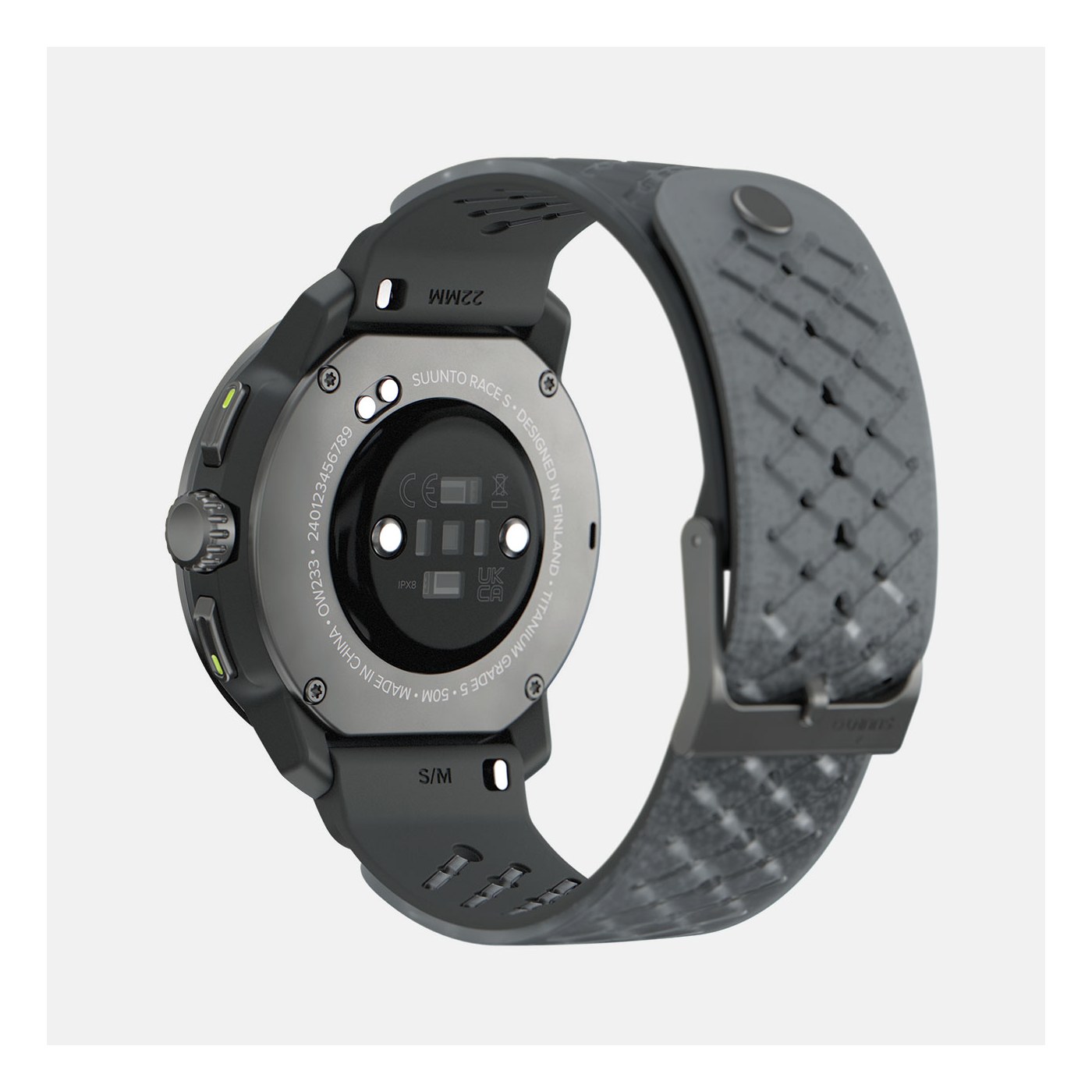
| Case | 45 mm, glass-fiber-reinforced polyamide |
| Display | 1.32-inch AMOLED touchscreen, 466×466 px, Gorilla Glass |
| Weight | 60 g (with silicone strap) |
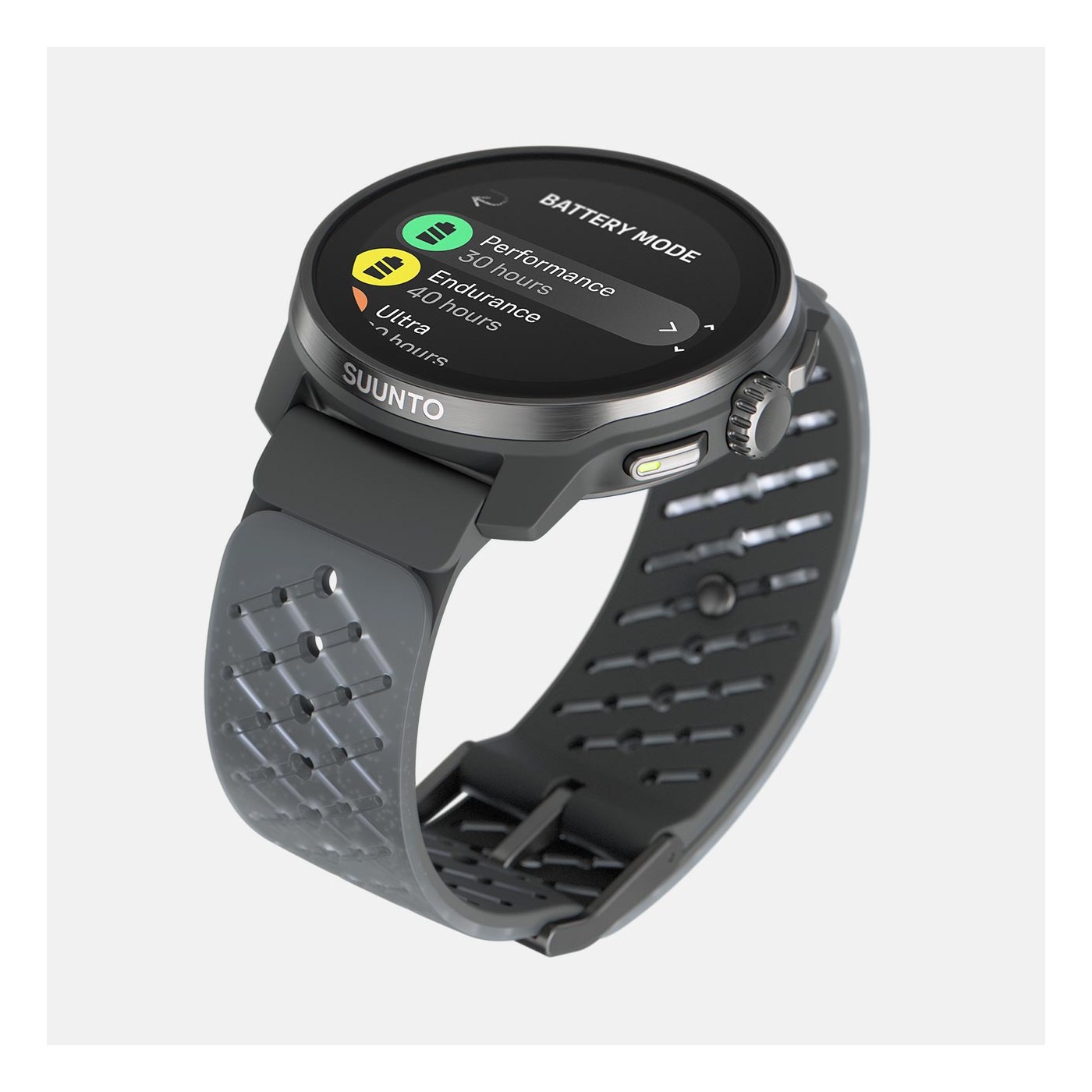
| GPS | Multi-GNSS (GPS, GLONASS, Galileo, BeiDou) · 30 h performance / 40 h endurance |
| Standby battery life | 13 days |
| Storage | 32 GB (music without a smartphone) |
| Sensors | Optical wrist heart rate, barometric altimeter, pulse oximeter, barometer, thermometer |
| Sport modes | 95+ |
| Water resistance | 5 ATM (50 m) |
| Connectivity | Bluetooth 5.1, Wi-Fi, magnetic charging |
| Suggested price | €449 MSRP (€360-415 on marketplaces) |
Who is the Suunto Race S for?
Road runners who want a benchmark AMOLED
The 1.32-inch, 466×466-pixel AMOLED display rivals what Garmin offers on its AMOLED Forerunners. With 1,000 nits of peak brightness, it stays readable in direct sunlight and makes following your map and live metrics a real pleasure. If the display is your priority, the Race S delivers with no compromise.
Versatile trail runners on 6- to 25-hour efforts
With 30 hours in performance GPS mode and 40 hours in endurance mode, the Race S comfortably covers 50 to 80 km trail races, one-day adventure races and short to mid-distance trail formats. Beyond that, you move up to the Race 2 and its 55 hours of GPS. In practice, 13 days of standby mean you don't have to think about charging between weekly sessions.
Music and map lovers who leave the phone at home
32 GB of storage holds roughly 6,000 tracks at standard quality or 1,500 at high quality. You sync via Spotify, Deezer or local transfer. Combined with Suunto's free offline maps, this watch lets you head out on an exploratory trail run with no phone and no paid app: a rare offer at this price.
Comfort, navigation and accuracy in the field
The 45 mm, 60 g format is well judged for slim wrists and standard builds alike. The silicone strap that ships with it is supple, well ventilated and stays put even after 3 hours of hard effort. The SuuntoPlus interface offers configurable training views, a recovery coach and weekly load tracking. Nothing revolutionary, but the ergonomics are well thought out and never force you to dig through submenus.
On the GPS side, multi-GNSS mode (GPS + GLONASS + Galileo + BeiDou) produces clean tracks in dense forest and in urban canyons. In performance mode, power draw goes up and battery life drops to 30 hours: an acceptable trade-off if you race formats shorter than a day. The optical wrist heart rate sensor is reliable at a steady pace. As always with this type of sensor, pair it with a chest strap for interval sessions to get the best accuracy.
The barometric altimeter responds quickly to altitude changes and handles thermal drift well. The built-in barometer lets you track weather trends over a few hours, which is useful in the mountains. The pulse oximeter runs on demand or in overnight mode to track recovery at altitude.
How it stacks up against the competition
The Race S lands in a hotly contested segment between €350 and €500.
Suunto Race S vs Suunto Race 2: the Race 2 is larger (49 mm) and offers 55 h of GPS with a more accurate dual-band mode. It targets ultra trail runners. If your efforts stay under 30 h and you prefer a compact format, the Race S is enough and saves you about €150.
Suunto Race S vs Suunto Run: the Suunto Run weighs just 36 g (24 g less) and has dual-band L1+L5 GPS, which makes it more accurate at fast paces. It's built for pure running: no offline music, and its offline maps are less developed. For trail and versatility, the Race S is clearly ahead.
Suunto Race S vs Garmin Forerunner 265: the FR265 offers dual-band GPS, Garmin's load metrics (Body Battery, Morning Report) and the proven Connect ecosystem. It has no built-in music as standard and its maps are less detailed. Garmin holds the edge on data analysis; Suunto answers with more complete free maps and offline music.
Suunto Race S vs Polar Street X: the Polar Street X sells for around €249 with 43 h of GPS and a built-in LED light. It has no AMOLED, no offline music and no offline maps. If your budget is tight, the Street X is still a good base; at €449, the Race S steps up in every area.
How to fit the Suunto Race S into your RunMorph training plan
The Race S follows your RunMorph training plans through SuuntoPlus sync, which adjusts your load based on measured fatigue (resting heart rate, heart rate variability, load history). In practice, load your week of workouts every Sunday, sync over Wi-Fi, and the watch guides you in real time through heart rate zones and target paces.
The built-in recovery coach tells you when to push and when to back off, so you don't pile up fatigue ahead of a race. For exploratory trail runs, download the map of your area before you leave, switch the GPS to endurance mode and head out without your phone. With 13 days of standby, the battery will never be flat on race morning as long as you charged it two days before.
The RunMorph Coach's verdict
The Suunto Race S pulls off what few watches at this price offer: a 466×466-pixel AMOLED, 32 GB of offline music and free offline maps in a 45 mm, 60 g case. Its multi-GNSS GPS holds up across all common formats, and its 30 h of GPS battery life covers 95% of running and short trail use.
As coaches, we recommend the Race S to versatile runners who want a complete watch without paying top-tier premium prices. If you run anything from 10 km to the half marathon on the road and venture onto trails now and then, it's a solid buy. The only real drawback is the lack of dual-band in performance mode, which costs accuracy at fast paces in tough environments. Score: 8.2 / 10.
Key takeaways for your training
- 466×466-pixel AMOLED: one of the best displays in the segment at this price, readable in direct sunlight and responsive to touch for on-the-run adjustments.
- 32 GB of music: leave your smartphone at home and run with Spotify offline or your local library to stay motivated on long runs.
- Free offline maps: Suunto charges no subscription for topographic maps, a real competitive edge over Garmin and Polar in this segment.
- 30 to 40 h of GPS battery life: plenty up to an 80 km trail race, not enough for ultras of 24 h or more (go for the Race 2 instead).
- 45 mm and 60 g: compact and discreet for everyday wear, and a better match for slim wrists than 49 to 51 mm trail watches.