For years, the Adios was Adidas's all-purpose road shoe, the one you grabbed for a 10K just as readily as a marathon. The Adios Pro line, its carbon plate and its 250 euro price tag changed that, and left a gap: runners who want the same foam as the pros without paying for a plane ticket, or giving up a light upper built for interval work. The Adizero Adios 9 fills that gap directly, and it does so with a number that bites: 140 euros, nearly half the price of an Adios Pro 5.
Adidas Adizero Adios 9: the full RunMorph review
8.5/10
The essentials in 3 sentences
The Adizero Adios 9 swaps the Adios 8's dual-foam setup for a full-length Lightstrike Pro midsole, the same material used across the Pro lineup, but with no carbon plate. The result is a very light, very lively shoe for interval sessions and 10K racing, but one that gets clearly unstable once the pace drops or the surface gets uneven. At 140 euros, it delivers a value proposition few direct rivals can match.
8,5
/ 10 · RunMorph overall score
Who it is forRunners who string together intervals, hill repeats and 10Ks and do not want to spend on a carbon-plated racing shoe, and who weigh under 75 kg.
Who it is not forHeavier runners, heel strikers who land hard, or anyone looking for a single pair to cover everything from easy jogs to long runs.
Adizero Adios 9: where it sits in the lineup
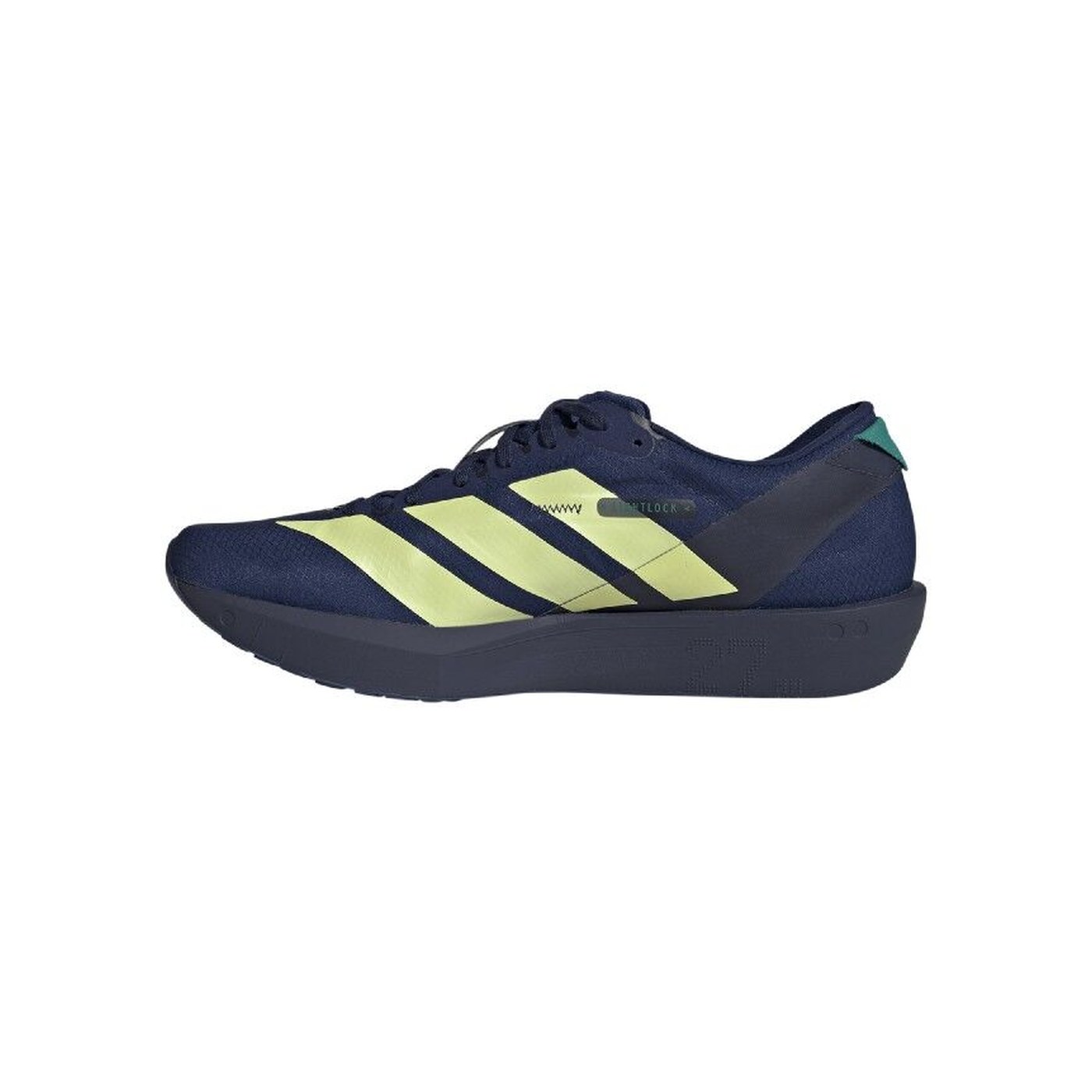
Adidas used to run two Adios shoes side by side: the original, which drifted over the years into a fairly generic trainer, and since 2023 the Pro line, built around a carbon plate and sub-2-hour marathon ambitions. The Adios 9 closes that gap by going straight back to the 2010 formula: a flat, light road shoe built for speed work rather than mileage. At RunMorph, this reads as a direct answer to a segment that has gotten a lot more crowded over the last two years, the plateless fast-training shoe, sitting between the Asics Magic Speed 5 and the Nike Streakfly 2.
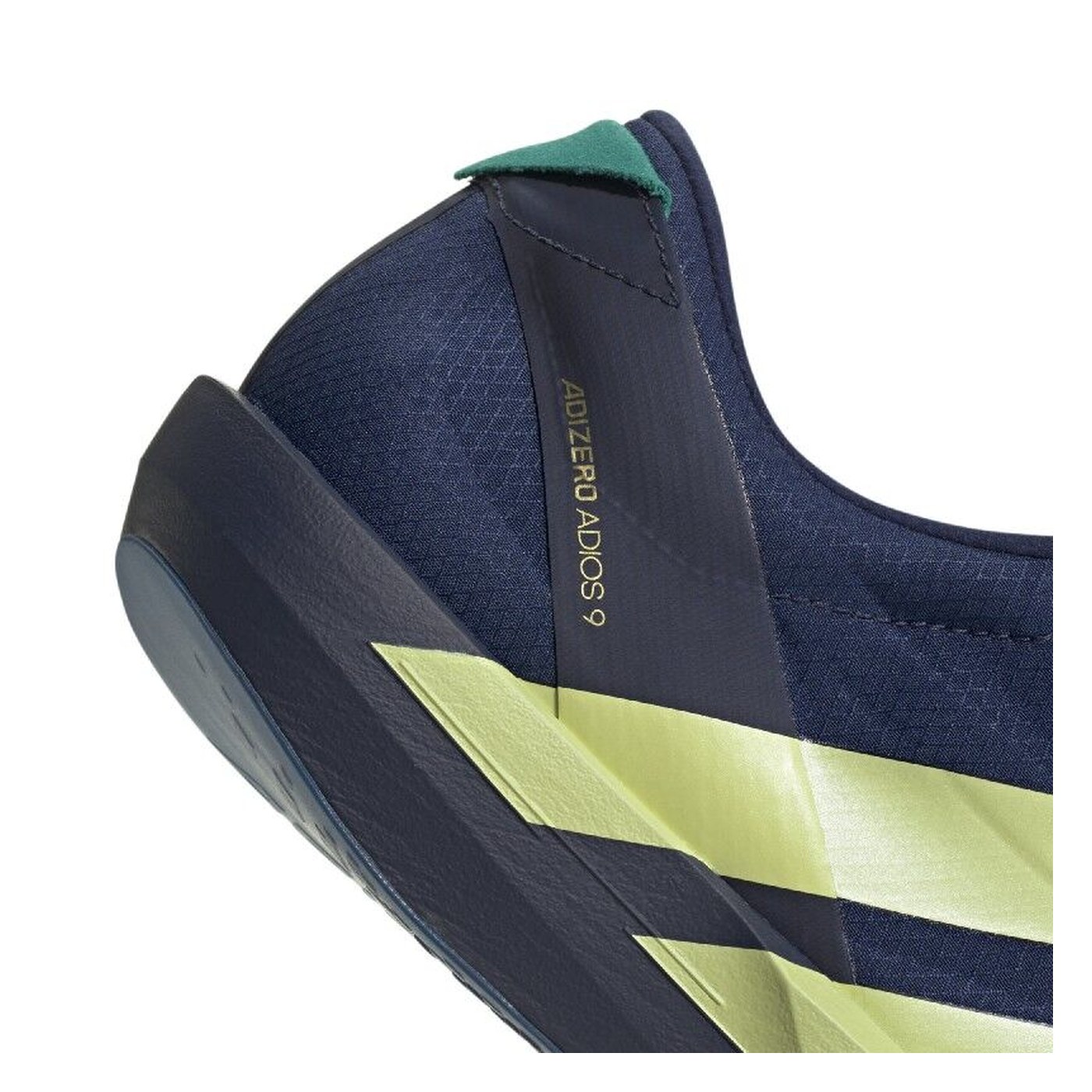
The engineering call is clear: the entire midsole is now cast in Lightstrike Pro, the supercritical foam previously reserved for the Adios Pro 5, but without the carbon plate and with a noticeably lower stack. Adidas replaces the plate with a simple nylon stiffening insert in the heel. The bet: deliver the feel of the premium foam to runners who want neither a daily trainer's comfort nor a marathon personal best.
RunMorph's advice: if you want one shoe for fast running without the carbon-plate upgrade, the Adios 9 answers that need directly. If you are chasing a marathon PB or need more cushioning for everyday miles, look instead at the Adidas Adizero Adios Pro 5 or the Adidas Adizero Boston 13, both noticeably more stable over distance.
Adizero Adios 9 spec sheet
| Spec | Value |
|---|---|
| Brand | Adidas |
| Model | Adizero Adios 9 |
| Type | Road, fast training and short-distance racing shoe |
| Claimed weight (size 42 / US 9) | 168 g |
| Independent lab-measured weight | 176 g, 8 g (4.8%) heavier than claimed |
| Claimed drop | 7 mm |
| Independent lab-measured drop | 6.2 mm, a 0.8 mm gap |
| Claimed heel / forefoot stack | 28 mm / 21 mm |
| Measured heel / forefoot stack | 25.0 mm / 18.8 mm, 3 mm and 2.2 mm under claim |
| Foam | Full-length Lightstrike Pro |
| Carbon plate | No, nylon stiffening insert in the heel |
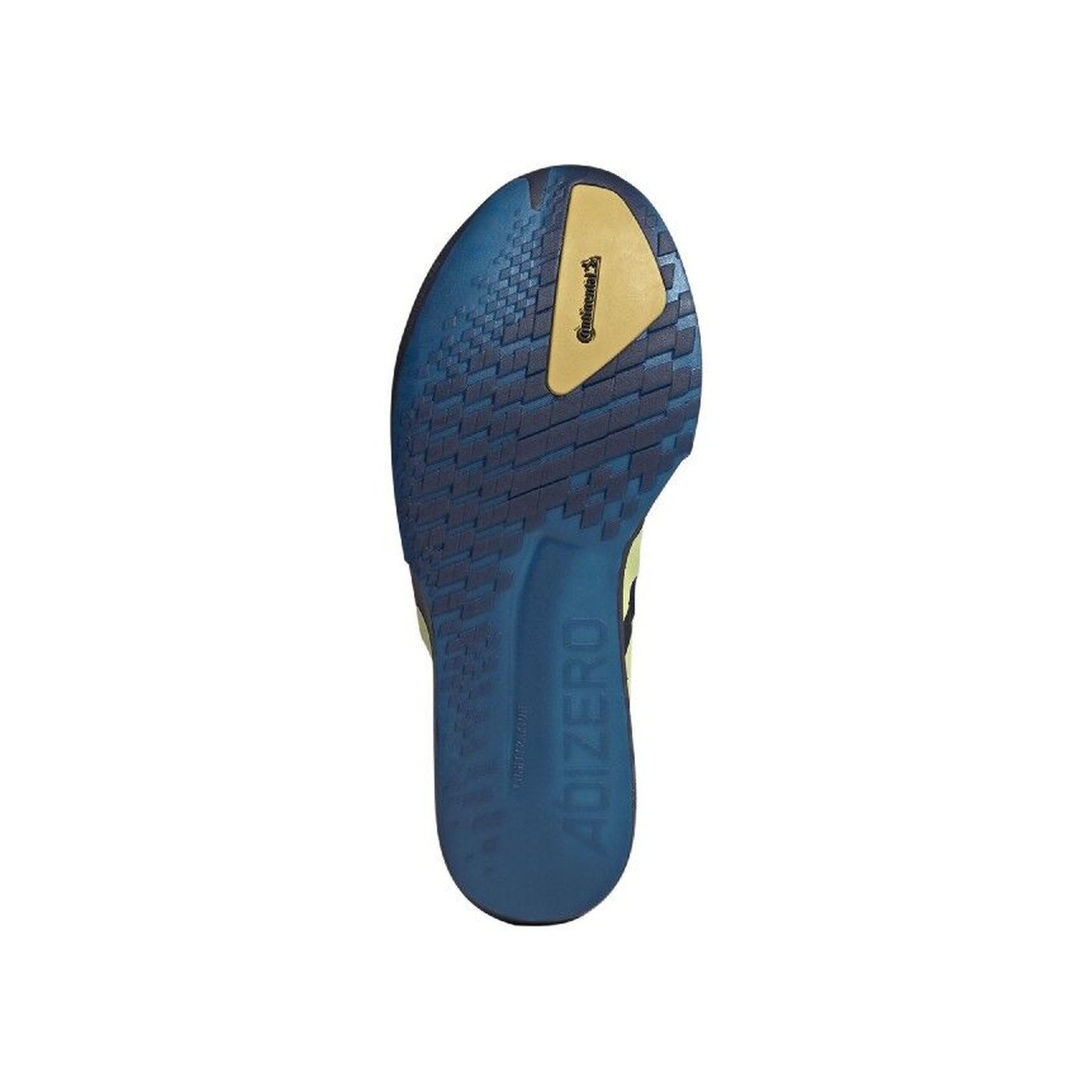
| Outsole | Continental rubber + Lighttraxion technology |
| Claimed durability | Fast training and short races, not built for daily mileage |
| Sizes | US 7 to US 15 (men), US 5 to US 11 (women) |
| Official price | 140 € |
The gap between claim and measurement is not trivial: a real stack height 2 to 3 mm below what is advertised brings the Adios 9 close to a near-minimalist shoe, closer to a 4-5 mm drop model than the advertised 7 mm. Independent tests flag this gap consistently, not as an isolated measurement fluke.
Full-length Lightstrike Pro: what it changes underfoot
Through the Adios 8, Adidas kept its most reactive foam, Lightstrike Pro, confined to the center of the midsole, filling out the edges with firmer standard Lightstrike. The Adios 9 now casts the premium foam the full length of the shoe. The lab result is clear: heel energy return climbs to 76.2%, up from 63.5% measured on the Adios 8, a 12.7-point jump, one of the largest generational gains recorded on this lineup.
Shock absorption (119 SA at the heel, per the ASTM F1976 standard) sits above the average for road shoes tested independently, which cuts against the firm feel many assume from a thin midsole. In plain terms, the foam cushions well, but the reduced stack (25 mm measured at the heel) leaves little buffer before impact starts to transmit upward, especially past 30 km accumulated in a week.
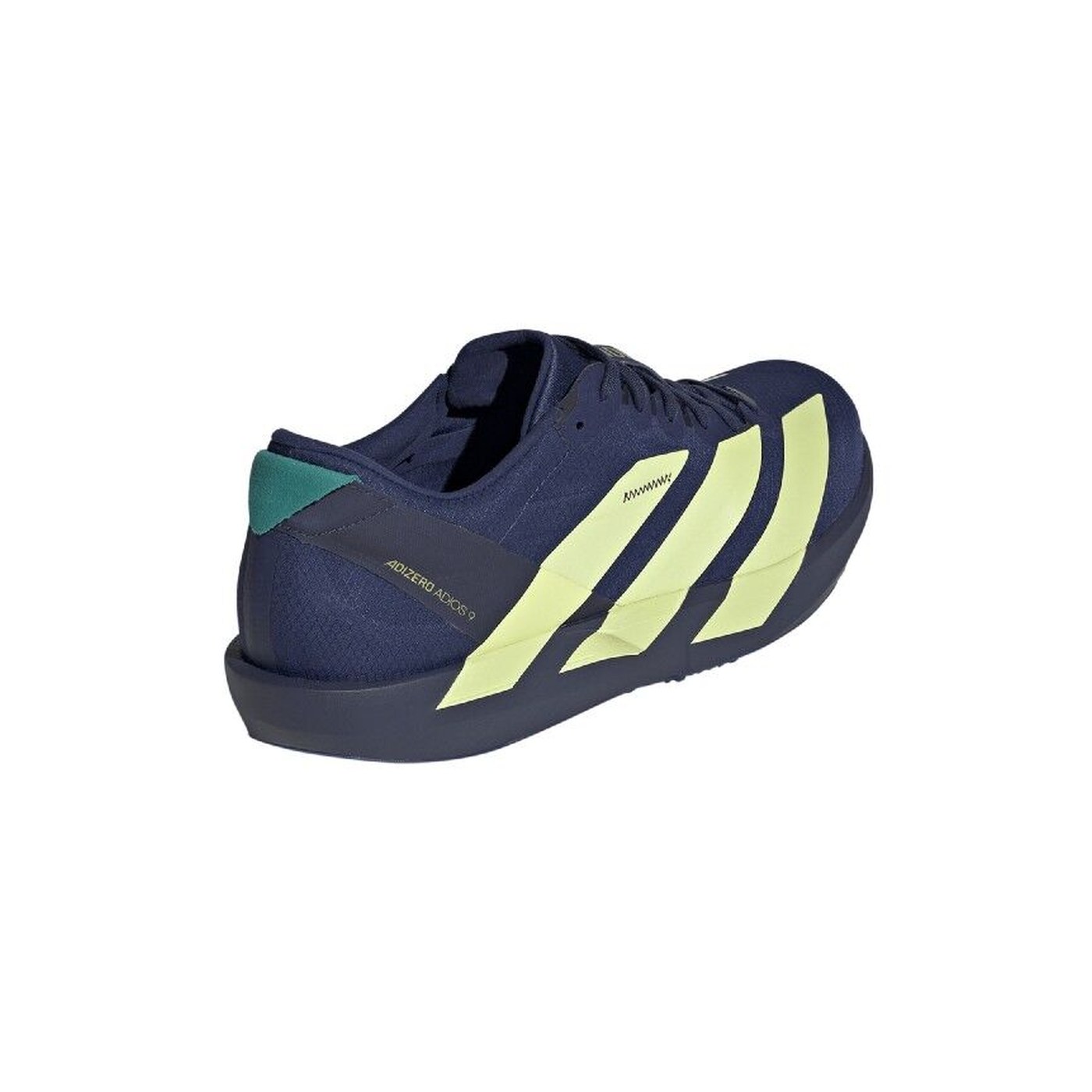
The trade-off for a single foam compound: more torsional give. The measured score is 2 out of 5, and heel counter stiffness drops to 1 out of 5, one of the lowest scores recorded on a shoe in this price bracket, which explains much of the stability concerns detailed further down.
Fit of the Adizero Adios 9
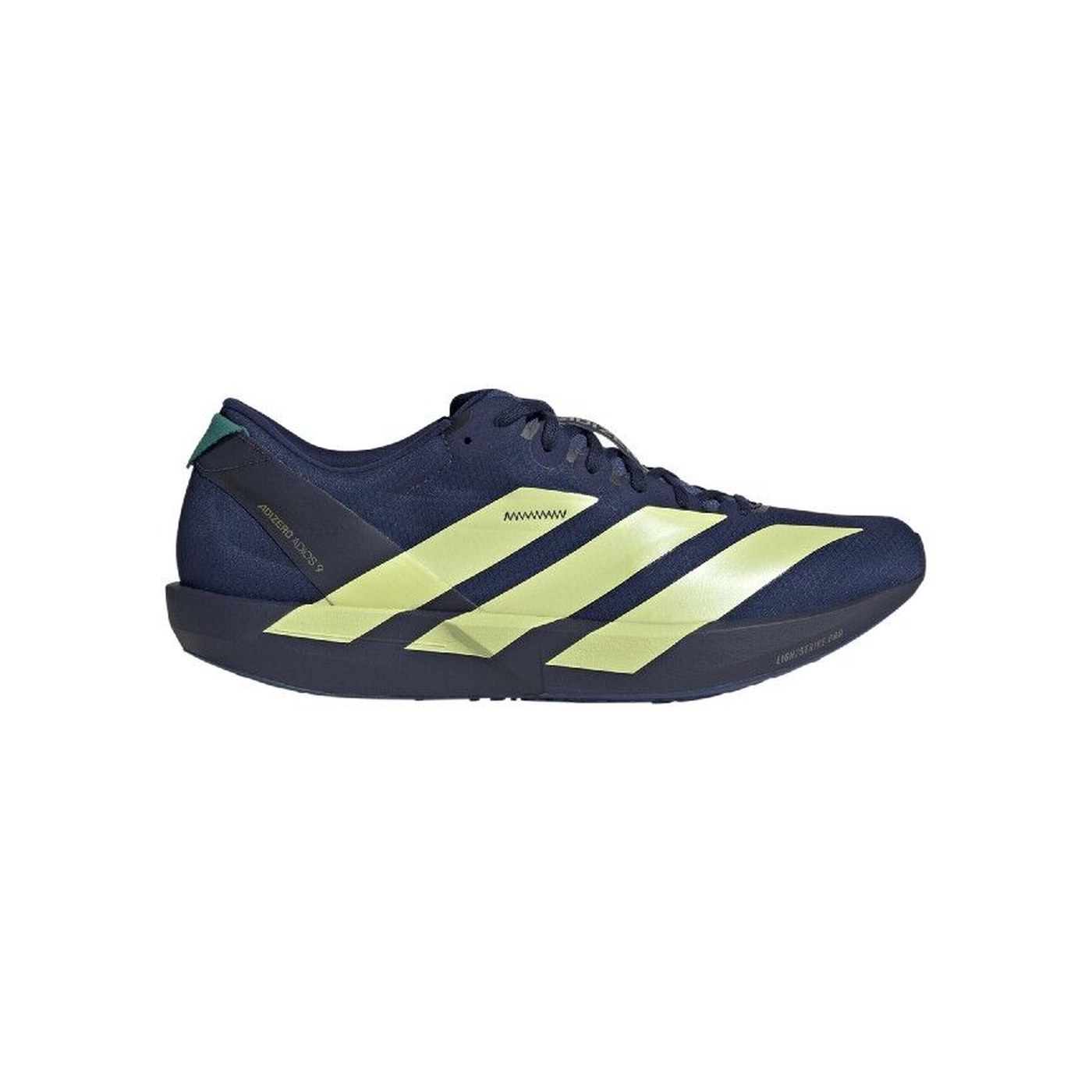
The Lightlock 2.0 upper borrows the construction already seen on the Adios Pro 4, and it is the single point every test agrees on most strongly: the jump over the Adios 8 is described as dramatic, to the point that one independent tester said they struggled to understand how they had put up with the old version's fit once the two were compared side by side. The heel collar is reworked, the tongue gains padding, and overall hold is described as noticeably more structured.
The downside: measured forefoot width comes in at 70.6 mm, with a toe box height of 27.5 mm. That is a snug last, roughly 2 to 3 mm narrower than the average for road shoes tested independently, which tends to sit closer to 72-73 mm wide. Wide-footed runners should expect a tapered fit from the first kilometers, a point every independent test reviewed here raises in near-identical terms, with no real disagreement this time around.
On breathability, the measured score stays low (2 out of 5), matching field reports of limited airflow on hot outings despite the technical mesh. On the plus side, the gusseted tongue's snug seal keeps grit and gravel out entirely, a detail that matters on a track or an unpaved path.
Field test: what runners who actually wore it say
The reviews agree on the big picture: the Adios 9 is a speed shoe, not an all-purpose trainer. Independent tests describe a ground-contact feel close to an old-school spike-less racing flat, a sensation some compare explicitly to pre-carbon-plate racing shoes. At tempo pace, responsiveness is rated clearly superior to the Adios 8, with a stride transition described as smoother and more even between heel and forefoot, the single foam compound erasing the disconnect created by the old dual-density build.
The consensus splits on stability, though. Several testers describe a softer, less locked-down landing than on the Adios 8, a trade-off accepted in exchange for more agility at speed. For a heel striker or a runner fatigued late in a session, that reduced lockdown translates into footstrikes that drift slightly off-line, a flaw the measured stability score (31 out of 100, very low on the reference scale) confirms without ambiguity.
On grip, the consensus is unanimous and positive: the Continental rubber and Lighttraxion compound is praised in every test read, including on wet ground, with testers reporting close to zero slippage even on wet road markings. It is one of the areas where the margin over direct rivals is widest.
At RunMorph, the read is blunt: the Adios 9 keeps a very specific promise, that of an affordable speed tool, and it misses entirely the moment it is asked to be an all-rounder. That is not a failed compromise, it is a shoe that does not try to please everyone.
Where it works, where it falls apart
Easy running and base endurance: it falls apart right away. The measured 25 mm heel stack and the very low heel counter stiffness (1 out of 5) give little back on a relaxed recovery stride, where the foot looks for cushioning the midsole simply does not supply at that pace.
Long run: not advisable past a solid hour. The measured daily-running score (58 out of 100) confirms the shoe was not built to absorb accumulated mileage at a moderate pace.
Marathon pace: workable for a light runner used to minimal shoes, but outside its target use. It lacks the stability and cushioning reserve to hold up over 3 to 4 hours of continuous effort without added muscular fatigue.
Threshold and half-marathon pace: this is where the Adios 9 starts to earn its keep. The measured race score (86 out of 100) and the 76.2% heel energy return translate into a clear sense of glide once the pace drops below marathon effort.
Short intervals: this is the shoe's natural home turf. The measured tempo score (92 out of 100), among the highest in its price bracket, confirms a shoe built for 200 to 1000 m repeats and short hill efforts.
Major flaw: a forefoot locked at 70.6 mm
This is not a footnote on a spec sheet: 70.6 mm of width at the toes is 2 to 3 mm below the average for road shoes tested independently, and it is the single most cited complaint across every review read. A wide foot simply has no room to splay at toe-off, which produces recurring pressure points at the big toe joint past 10 km. Adidas owns this choice (it is the same philosophy as on the Adios Pro), but flagging it clearly spares anyone with wide feet on a standard daily trainer from buying blind.
Major flaw: a stability score measured at 31 out of 100
With a measured stability score of 31 out of 100, the Adios 9 ranks very low on the road-shoe reference scale, well behind the Adios 8, which several testers judge more locked-down despite its less reactive midsole. The cause is measurable: torsional rigidity of 2 out of 5 and heel counter stiffness of 1 out of 5, two of the lowest scores recorded on a shoe in this price bracket. In practice, an uneven footstrike (a broken sidewalk, a tight turn, fatigue late in a 10K) produces lateral foot torsion that nothing in the build holds in check. A runner with marked overpronation, or a newcomer to this type of shoe, needs to factor in that risk before jumping straight into a full interval session without gradually building up to it.
Adizero Adios 9 vs Nike Streakfly 2: which shoe should you pick?
| Metric | Adidas Adizero Adios 9 | Nike Streakfly 2 |
|---|---|---|
| Price | 140 € | around 170 € |
| Measured weight | 176 g | lighter, positioned as a pure racing flat |
| Measured stack (heel) | 25.0 mm | lower, an even more minimal profile |
| Best use | Intervals, hills, 10K to half | 5K, hills, track-style racing |
| Stability | Low (31/100) | Also low, but a more wrapping fit |
The simple read: the Streakfly 2 pushes further into minimalism (closer to a track spike than a road shoe), while the Adios 9 keeps a bit more comfort and an accessible price for regular weekly use. For a 10K or a club half-marathon, the Adios 9 is the more versatile of the two.
Adizero Adios 9 vs Asics Magic Speed 5 and New Balance FuelCell Rebel v5
| Metric | Adizero Adios 9 | Asics Magic Speed 5 | New Balance FuelCell Rebel v5 |
|---|---|---|---|
| Price | 140 € | 180 € | around 150 € |
| Plate | No, nylon insert | Nylon plate | No |
| Stability | Low (31/100) | Better, more wrapping | Average |
| Responsiveness | Very high (92/100 in tempo use) | High | High (close overall score, 86/100) |
The decision rule: above 180 euros, the Magic Speed 5 offers more stability and earns its price for a runner unsure of their technical footing. Below that, the Adios 9 and the FuelCell Rebel v5 sit neck and neck on paper (nearly identical overall score, 85 against 86), but the FuelCell Rebel v5 stays more versatile over the long run, while the Adios 9 saves its best performance for intervals and short-distance racing.
Pros and cons
Pros
Energy return measured at 76.2% at the heel, 12.7 points above the Adios 8. Continental grip rated excellent even on wet ground across every independent test read. Upper substantially reworked from the previous generation. Price of 140 euros, among the lowest in the plateless segment.
Cons
Stability measured at only 31/100. Narrow forefoot at 70.6 mm, unsuited to wide feet. Low breathability score (2/5) on hot outings. Real stack height (25.0 mm / 18.8 mm) 2 to 3 mm below the official claim.
Grip and durability: the cost per kilometer
Measured wear in independent lab testing (0.6 mm of material lost on the outsole) places the Adios 9 among the most durable soles tested in this segment to date, despite its lightweight positioning. It is the test's most counter-intuitive upside: you would expect a 176 g shoe to wear out fast, and that is simply not the case for the outer rubber. The real limitation sits in the upper, whose thin mesh means rocks and thorny trailside brush are best avoided to preserve its lifespan.
Assuming a reasonable 500 km lifespan for this kind of shoe (interval and race use, not everyday mileage), the Adios 9's cost per kilometer works out to 0.28 euros. By comparison, a Nike Streakfly 2 at around 170 euros, amortized over 400 km, a mileage consistent with its even more race-focused use, comes out to around 0.43 euros per kilometer. The gap is clear: the Adios 9 costs less upfront and wears at a comparable rate, making it the better value of the two for a runner training at high intensity every week.
Our verdict from the field: who is it really for?
The Adios 9 earns its place with runners training for a 10K or a half-marathon who need a dedicated shoe for intervals, hill repeats and threshold sessions, without wanting to invest in a carbon plate. Paired with a structured plan, this type of shoe makes the most sense during speed-focused weeks: at RunMorph, our 10K training plan builds in exactly this kind of session, where the midsole's responsiveness pays off, without ever becoming the only pair in the rotation.
On the flip side, a heavier runner, a hard heel striker, or anyone looking for a single pair to do it all should look elsewhere: the measured stability (31/100) and the reduced stack give no room for use outside its intended range.
RunMorph Coach's verdict
The Adizero Adios 9 earns 8,5/10. The score rewards responsiveness and grip that rank among the best in its price category, and genuine value for money at 140 euros against competitors that often charge more for a comparable service. It is weighed down by a measured stability score that remains the model's most serious weak point, and by a quantified gap between the marketing claim and the independent measurement (stack, weight, drop) that is worth knowing before purchase rather than discovering through use. This is not a shoe for everyone, it is a genuinely strong speed tool for anyone who knows exactly why they are buying it.
What to remember for your training
- A measured responsiveness gain: energy return climbs from 63.5% to 76.2% at the heel compared with the Adios 8, a 12.7-point improvement.
- Stability to watch: the measured score of 31/100 means this shoe should stay reserved for runners with an already solid stride.
- A narrow fit: 70.6 mm wide at the forefoot, worth trying in store if you usually need wide sizing.
- A controlled cost per kilometer: around 0.28 euros/km over an estimated 500 km lifespan, one of the best ratios in the plateless segment.
- A precise use case: short intervals, hills and 10K to half-marathon, best left out of easy runs and long runs.
FAQ
Is the Adidas Adizero Adios 9 suitable for beginners?
No, the measured stability score (31/100) and the reduced 25 mm heel stack call for an already confident stride. A runner with under 6 months of experience should look at a more stable shoe first.
What is the durability mileage of the Adizero Adios 9?
For interval and race use, a 500 km lifespan is a reasonable estimate given very low measured lab wear of 0.6 mm on the outsole, even though the thin upper calls for extra care.
Does the Adizero Adios 9 run big or small?
Length is judged standard, but the forefoot measures 70.6 mm wide, 2 to 3 mm under the market average: consider going up half a size if you have wide feet.
What is the difference between the Adizero Adios 9 and the Adios 8?
Lightstrike Pro foam now covers the full midsole instead of a central section, measured weight drops by around 30 g, and energy return gains 12.7 points. In exchange, stability drops noticeably compared with the Adios 8.
Is the Adizero Adios 9 suitable for marathon racing?
No, the measured daily-running score of 58/100 and the stability shortfall make 3 to 4 hours of effort risky for most runners: save the marathon for a more stable pair like the Adidas Adizero Boston 13 or the Adios Pro 5 with its carbon plate.