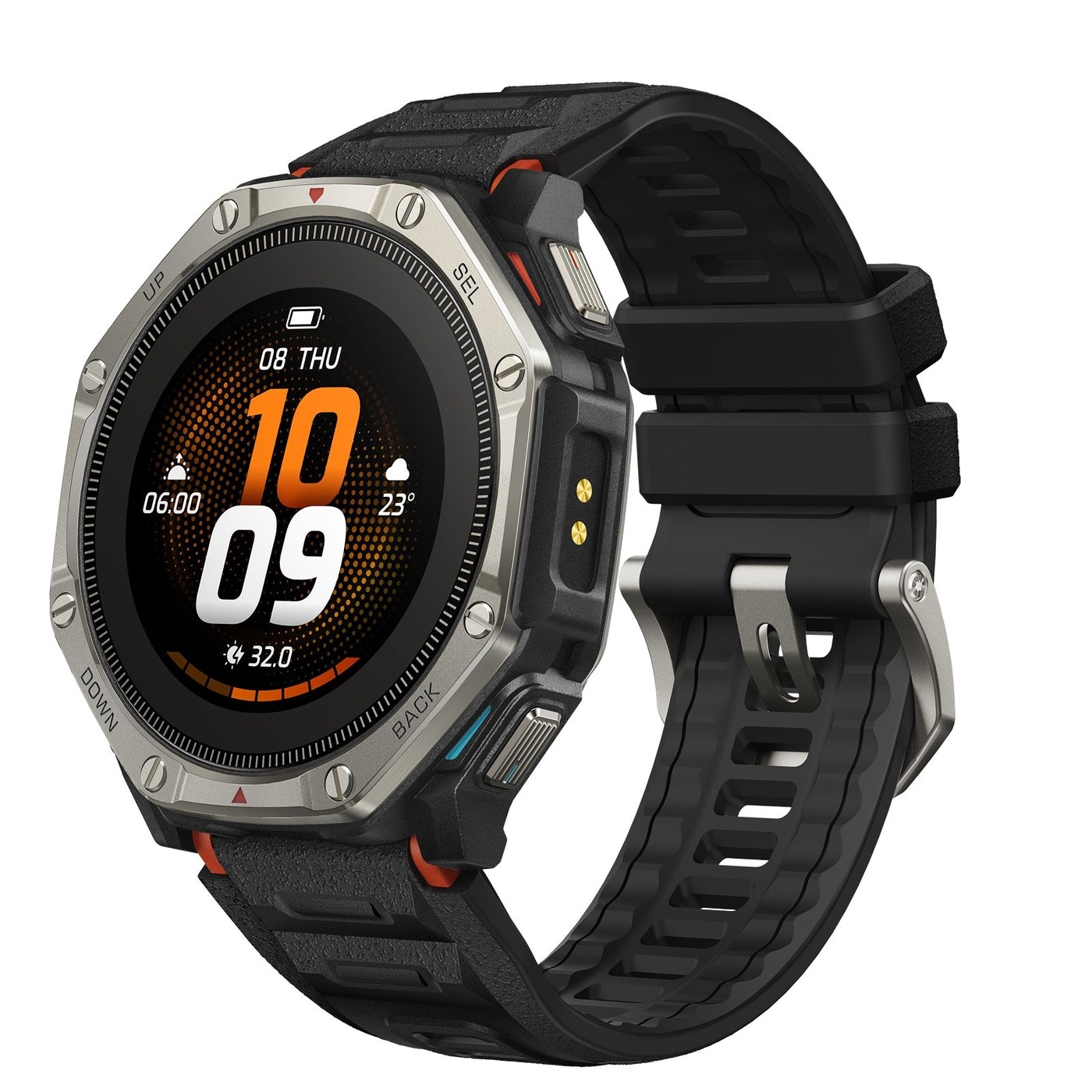
On September 22, 2026, Amazfit announced a technical breakthrough with the T-Rex Dual Solar, an outdoor watch that combines an AMOLED display with two solar panels for the first time. At RunMorph, we went through the press releases, the official product page, and the first French-language hands-on previews to sort out what's a genuine advance and what still needs verifying once the watch is on your wrist, in the mountains, in the cold, in the rain.
© Amazfit, official photo used for editorial purposes
Amazfit T-Rex Dual Solar, positioning
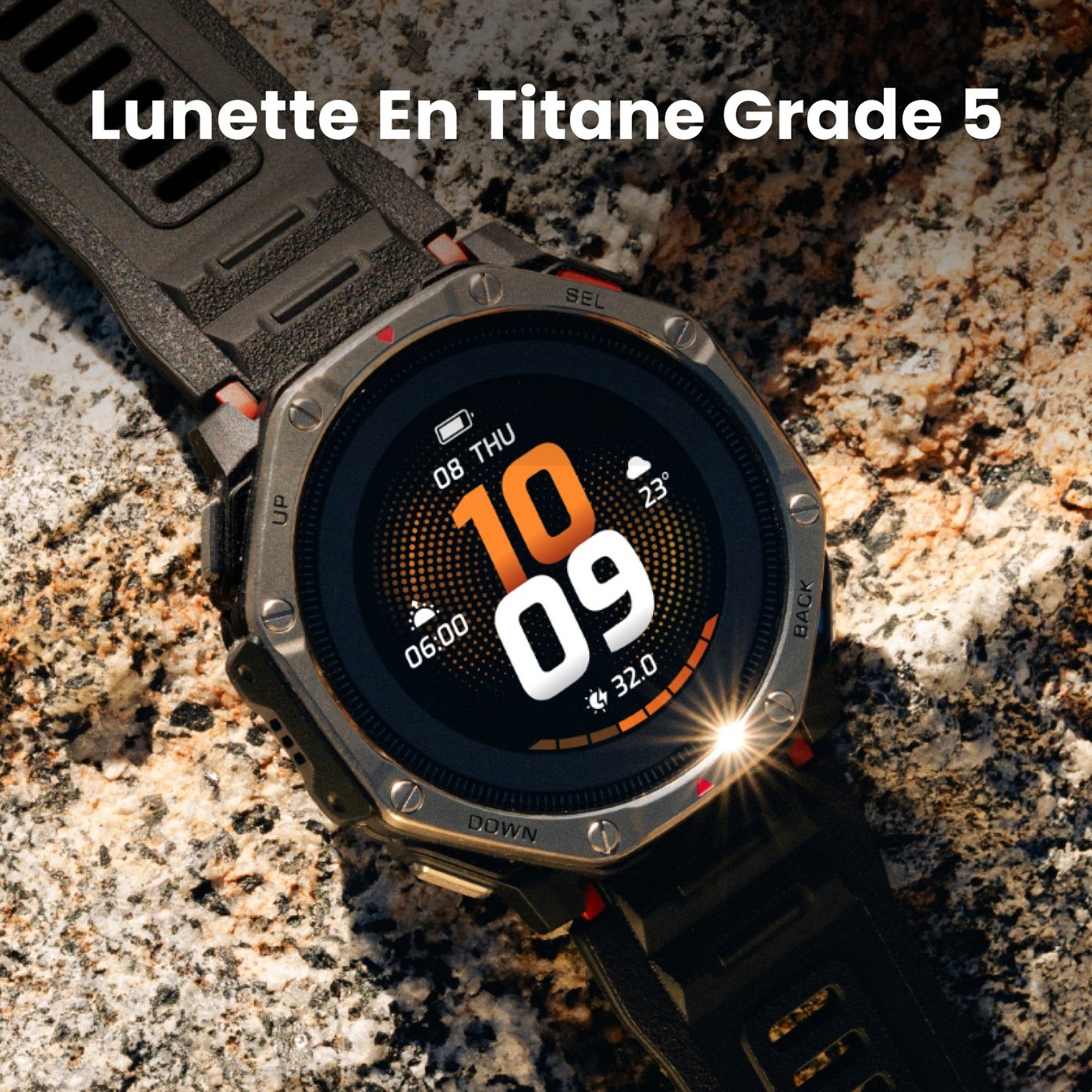
Amazfit has spent several years building out the T-Rex line around a simple pitch: a rugged outdoor watch at a price well below Garmin or Suunto. With the Dual Solar, the brand is shifting strategy. The case moves to grade 5 titanium, the display gains sapphire glass and a peak brightness of 3,000 nits, and the price climbs to 649,90 €. At RunMorph, we note that this price puts the watch directly up against the Garmin Instinct 3 Solar and Amazfit's own Cheetah 2 Ultra line, territory the brand had never entered before.
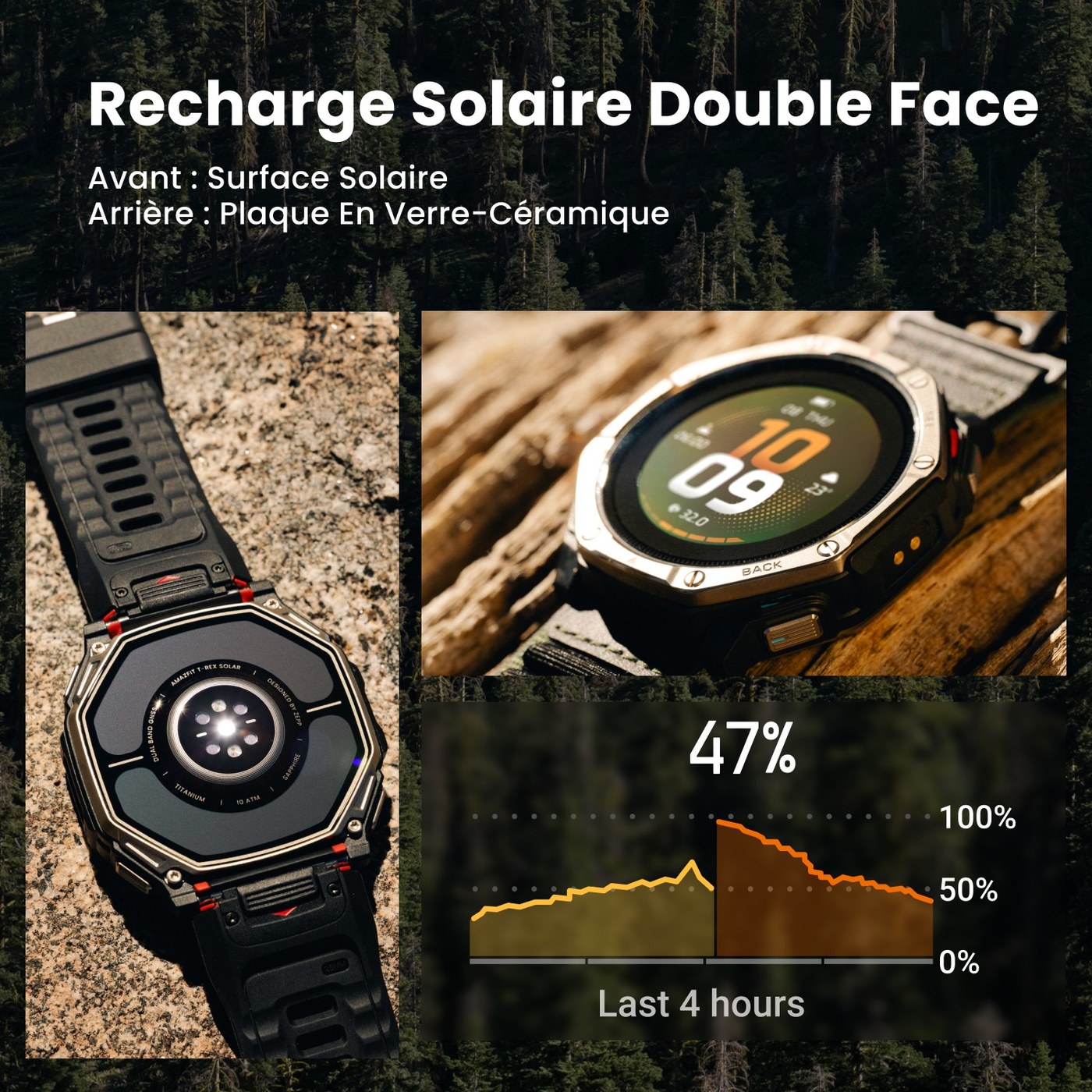
The headline argument remains the dual solar charging. A first panel sits on the front, built into the AMOLED display, and a second covers the vitro-ceramic back. Amazfit claims 25 days of battery life in typical use with no sun, and up to 180 days in Outdoor Extreme mode with three hours of daily exposure at 50,000 lux. That last figure assumes very limited use of connected features, a point RunMorph unpacks further down in this review.
RunMorph's advice: before comparing the T-Rex Dual Solar to its predecessor, read our full T-Rex Ultra 2 review, which gives you a solid benchmark for what Amazfit already knew how to do in terms of ruggedness. If budget matters more to you than solar, the Cheetah 2 Ultra remains a serious alternative for road running and short trail. And to weigh the solar promise against a brand that's already proven itself on that front, our Garmin Instinct 3 Solar review serves as a reference point throughout this article.
Objective technical data
| Feature | Claimed value |
|---|
| Display | 1.32-inch AMOLED, 466 x 466 pixels, sapphire glass |
| Brightness | 3,000 nits peak |
| GPS | Dual-frequency, six satellite positioning systems (including GPS and Galileo) |
| Heart rate sensor | BioTracker 6.0 (5PD, 2LED), continuous SpO2 |
| Water resistance | 10 ATM, recreational diving up to 50 meters per the official spec sheet |
| Weight | 69 grams for the case, 25,5 grams for the standard strap |
| Battery life | 25 days typical use, up to 51 days with solar charging, 180 days in Outdoor Extreme mode |
| Price | 649,90 € |
© Amazfit, official photo used for editorial purposes
Who is the Amazfit T-Rex Dual Solar for?
The ultra-trail runner who dreads a dead battery
On an ultra lasting more than twenty-four hours, battery life becomes as serious a concern as your shoes or your nutrition. Amazfit claims forty-one hours in high-precision GPS mode, and fifty-seven hours with solar input depending on how much sun you get during the race. For a runner tackling UTMB-format races or the Diagonale des Fous, those extra hours could potentially change the equation, provided the course actually gets some light.
The hiker or expedition trekker heading far off the grid
Outdoor Extreme mode is clearly aimed at big crossings, multi-week treks, and expeditions where no power outlet is in sight. Amazfit claims 180 days in this mode, with three hours of daily sun and reduced use of connected features. That's an argument neither Coros nor Suunto currently offers with a color display of this quality.
Anyone who wants solar ruggedness without the Garmin price tag
At 649,90 €, the T-Rex Dual Solar is still roughly two hundred euros cheaper than the 50mm Garmin Instinct 3 Solar with equivalent color mapping. For a runner who wants an AMOLED display rather than Garmin's monochrome, and solar without stepping up to the Fenix line, Amazfit is occupying a spot nobody else really holds right now.
GPS accuracy and mapping
Amazfit claims dual-frequency GPS compatible with six satellite positioning systems, a technical setup comparable to what Garmin calls multi-band on its Instinct 3 and Fenix models. On paper, this dual frequency should improve track accuracy in dense urban areas, under forest cover, and in steep terrain, three situations where single-frequency GPS regularly loses reliability.
That said, neither u-Trail nor L'Heure Passion, the two French-language specialist outlets that got hands-on time with the watch before launch, have yet reported accuracy measurements in real trail conditions. L'Heure Passion actually raises the question directly in its hands-on preview, wondering whether the promises will hold up in real mountains, in the cold, with GPS running continuously for hours on end. At RunMorph, we share that caution, a dual-frequency GNSS on a spec sheet doesn't yet guarantee a clean track through the switchbacks of a ridge trail.
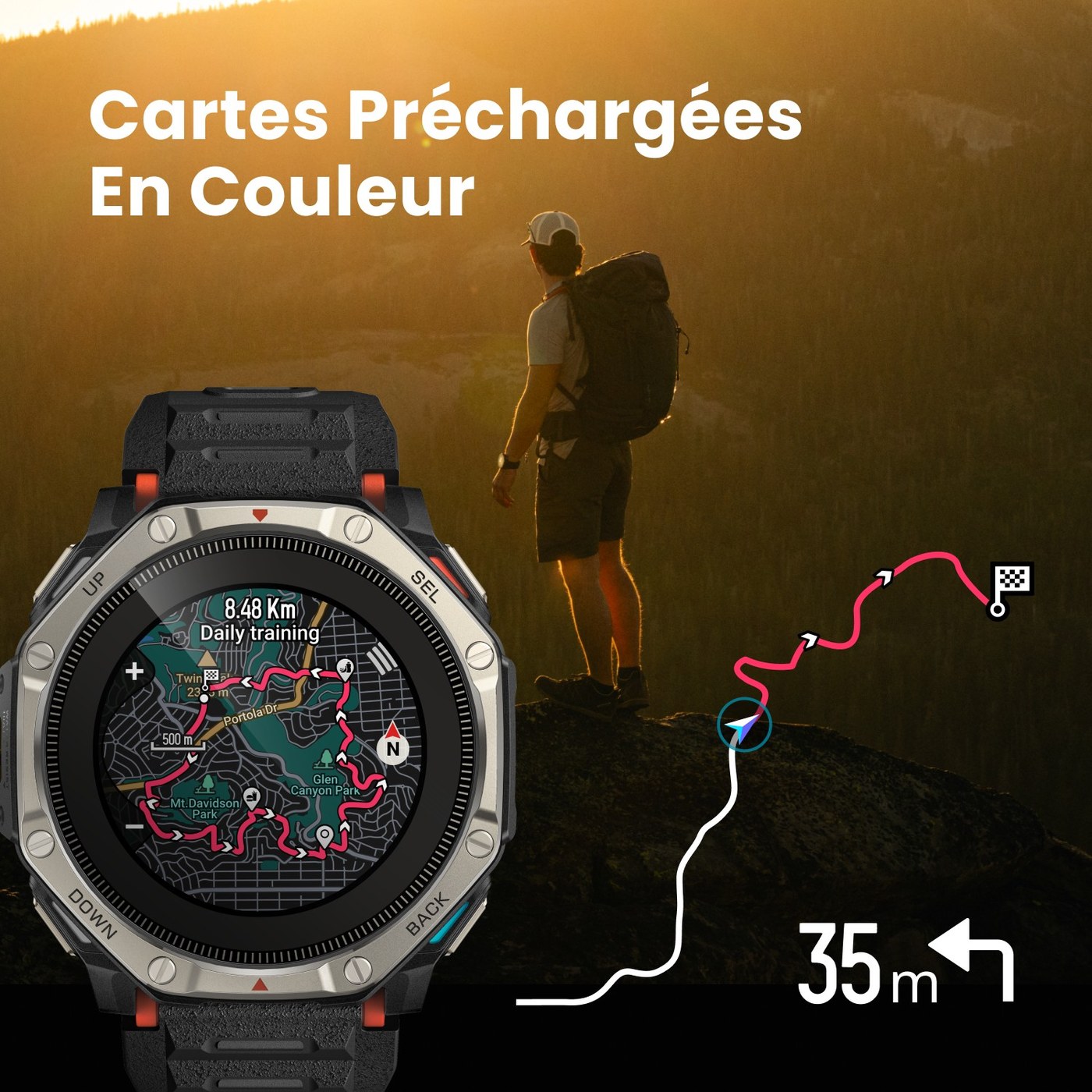
On the mapping side, Amazfit provides preloaded color maps with major road networks, downloadable contour maps and ski resort maps, plus turn-by-turn navigation with automatic recalculation if you stray off course. This level of onboard mapping matches what Garmin offers on the Instinct 3 Solar with TopoActive, and goes well beyond what most Amazfit watches have offered until now.
Training metrics and tracking
The T-Rex Dual Solar packs in more than 180 sport modes and calculates real-time VO2max for outdoor running, trail, and track. Amazfit adds two tools already seen on the Cheetah line: Training Balance, which splits your load between endurance and strength work, and Weekly Focus, which suggests which sessions to prioritize during the current week.
The BioTracker 6.0 heart rate sensor combines five photodiodes and two LEDs, the same architecture as the latest Cheetah 2 Ultra models. Blood oxygen saturation is now measured continuously rather than only on demand, useful if you're tracking recovery at altitude or after a long run. The built-in flashlight, with a claimed intensity of 300 lux in boost mode and a red-light option, rounds out the kit for pre-dawn or after-dark sessions, a common need during ultra prep.
On paper, this set of metrics is close to what the T-Rex Ultra 2 and Cheetah 2 Ultra already offer. The real question, still unresolved at this stage, is how reliable the optical heart rate sensor is during intense effort, something only extended field testing will settle.
© Amazfit, official photo used for editorial purposes
Real-world battery life: putting the dual solar charging to the test
This is the heart of the marketing pitch, and also the point that deserves the most nuance. Amazfit puts out several figures depending on the source and the mode, and they're worth reading carefully rather than just remembering the most spectacular one.
With no sun at all, the watch lasts twenty-five days in typical use and thirteen days in heavy use, on a 660 mAh battery. In high-precision GPS activity mode, battery life drops to forty-one hours. Those figures alone, with zero solar input, are already solid and comparable to what the competition offers at this price point.
Solar input then changes things depending on the setup. With only the front panel active, three hours of daily exposure at 50,000 lux extends battery life to thirty-four days. Turning on the vitro-ceramic back panel as well pushes that figure to fifty-one days, according to Amazfit's own communications as relayed by u-Trail. Outdoor Extreme mode, which sharply cuts back active features, is what finally gets you to the 180 days featured in the official press release's headline.
But that 50,000-lux figure corresponds to a clear day in the height of summer, not an outing under a hazy November sky or a stretch under forest cover. L'Heure Passion stresses this point in its hands-on preview, noting that these figures rest on specific exposure conditions that don't always show up on the ground. A trail runner who mostly runs under tree cover, or who trains in the shoulder seasons at our latitudes, should expect a solar gain well below the 180 days splashed across the press coverage.
At RunMorph, we come away with two takeaways. Without sun, the base battery life already holds its own against the direct competition. With sun, the gain is real and can prove valuable on a summer expedition or a multi-week crossing under a sunny climate, but the 180-day figure remains a theoretical ceiling reached under optimal conditions, not an average you should expect in everyday use.
Pros- Solid base battery life even with zero solar input
- Bright AMOLED display with tough sapphire glass
- Grade 5 titanium case, dual-frequency GPS, full color mapping
- Cheaper than the equivalent Garmin Instinct 3 Solar
Cons- Priced well above older Amazfit models, the budget argument is gone
- No independent field review available at launch
- Real solar gain heavily dependent on daily sunlight
- Multi-band GPS accuracy not yet measured by independent testing
Amazfit T-Rex Dual Solar vs Garmin Instinct 3 Solar: the comparison
| Criteria | Amazfit T-Rex Dual Solar | Garmin Instinct 3 Solar (45mm) |
|---|
| Battery life, no sun | 25 days typical use | 28 days in smartwatch mode |
| Battery life, with solar | Up to 51 days, 180 days in Outdoor Extreme mode | Near-unlimited in restricted use, depending on exposure |
| GPS | Dual-frequency, six constellations | Multi-band L1+L5 with SatIQ |
| Display | Color AMOLED, 1.32 inch, 3,000 nits | Monochrome MIP, 0.9 inch, non-touch |
| Price | 649,90 € | 399 € (399 to 449 € depending on size) |
The comparison reveals two distinct philosophies. Garmin bets on a power-sipping monochrome display and solar technology already validated by independent measurements, with multi-band GPS that field tests often report as outlasting the claimed figures. Amazfit goes the other way, offering a color display that's far more pleasant day-to-day and full mapping, at the cost of higher base consumption that the solar surface has to make up for.
How it stacks up against the competition
Within Amazfit's own lineup, the T-Rex Ultra 2 remains a solid option for anyone who doesn't need double-sided solar and wants to save several hundred euros. The Cheetah 2 Ultra shares some sensors with the Dual Solar but leans more toward pure performance on road and short trail than long-haul battery life.
Against Garmin, the Instinct 3 Solar remains the benchmark for proven solar, backed by a track record of independent measurements confirming the technology isn't just a marketing line. The T-Rex Dual Solar still has to prove itself on that exact front, reliability that's been confirmed, not just announced.
© Amazfit, official photo used for editorial purposes
How to fit it into your RunMorph training plan
For a trail runner prepping for an ultra, the T-Rex Dual Solar naturally earns its place on weekend long runs, exactly where battery life becomes a real concern after six or eight hours of effort. Training Balance and Weekly Focus plug directly into the load blocks laid out in RunMorph's trail programs, especially during prep cycles for a race over fifty kilometers, where managing weekly load matters as much as raw mileage. The built-in flashlight also makes early-morning or nighttime sessions in mountain-specific plans easier to handle.
RunMorph Coach's Verdict
The T-Rex Dual Solar marks a genuine technical step forward for Amazfit, with a quality AMOLED display, dual-frequency GPS, and base battery life that's already solid before you even factor in solar. Outdoor Extreme mode and its claimed 180 days remain a strong argument for long expeditions, as long as you keep in mind that figure assumes generous sunlight and very limited use of the watch's features.
The real shift here is mainly in pricing. At 649,90 €, Amazfit is giving up the value-for-money argument that built its reputation, and going head-to-head with Garmin on its own turf: high-end outdoor solar. At RunMorph, we're giving it a 7,9 out of 10, a score that reflects an impressive spec sheet, but one we're keeping cautious about until an independent field review confirms the battery life and GPS accuracy figures in real trail conditions.