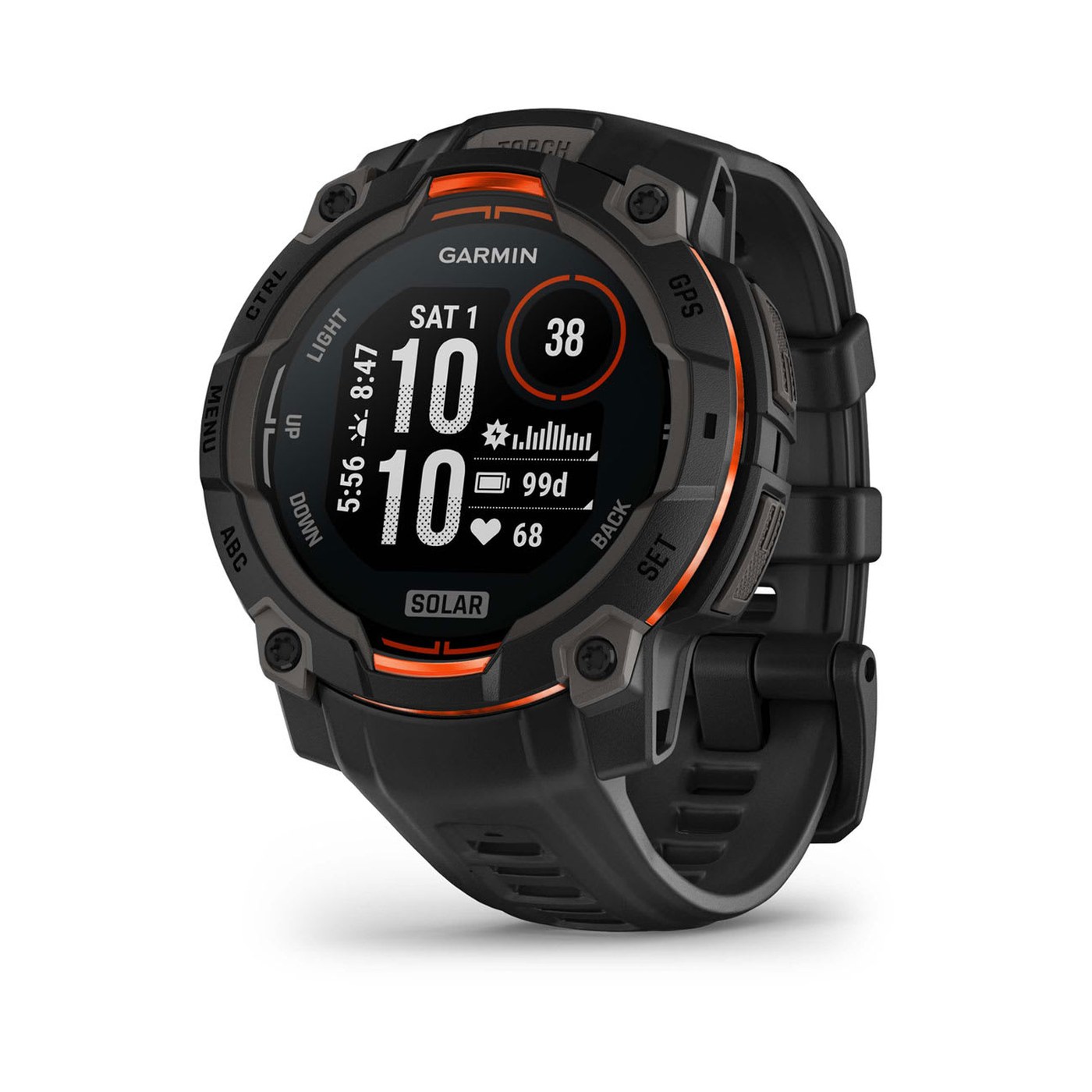
In the outdoor watch market, the Solar label has become a worn-out marketing tag, slapped on dials that gain three extra hours of battery life at best. The Garmin Instinct 3 Solar claims the opposite: a memory-in-pixel display so frugal that, in good conditions, solar charging means you almost never plug in a cable again. Next to the AMOLED version of the same range, already reviewed by RunMorph, this Solar edition remains the one most sought after by trail runners, hikers and adventurers who would rather have an indestructible watch than a color screen. What's left is to check, with field tests to back it up, whether the promise of near-unlimited battery life really holds up.
© Garmin, official photo used for editorial purposes
Garmin Instinct 3 Solar: the rugged watch that bets everything on battery life
The Instinct series was born in 2018 with a simple idea: a military-grade GPS watch, readable in sunlight and able to last several days without a charge, priced below the fenix. For seven years, Garmin iterated on that concept with a monochrome memory-in-pixel display and discreet solar charging. In 2025, the brand split the range in two: a colorful, power-hungry AMOLED version, already reviewed by RunMorph, and this Solar version, which stays true to the original DNA. The bet is clear: sacrifice color to protect battery life, even if that means looking austere next to rivals that keep getting brighter and more touch-driven.
At RunMorph, we see nothing outdated in this choice. In the outdoor segment, battery life is still the number one criterion for anyone heading out to bivouac, on a multi-day trek or into an ultra-trail with no outlet in sight. Independent tests agree on this point: the Instinct 3 Solar isn't built to win you over with its screen, but to never run out of battery at the worst possible moment. So the question this watch raises is simple: does that promise really hold up in the field, and what does it cost you in day-to-day usability?
Memory-in-pixel display and solar charging: what changes compared with AMOLED
Memory-in-pixel shows only black and white, at 176 x 176 pixels on 0.9 inch in the 45 mm version. Next to the 416 x 416 color pixels of the Instinct 3 AMOLED, the gap looks stark on paper. Real-world tests tell a more nuanced story, though. In full sun, several testers rate the MIP as more readable than some AMOLED screens, precisely because the technology relies on ambient light instead of a backlight that has to fight against it. Indoors or at night, on the other hand, the monochrome display clearly loses out to the vivid colors of the AMOLED.
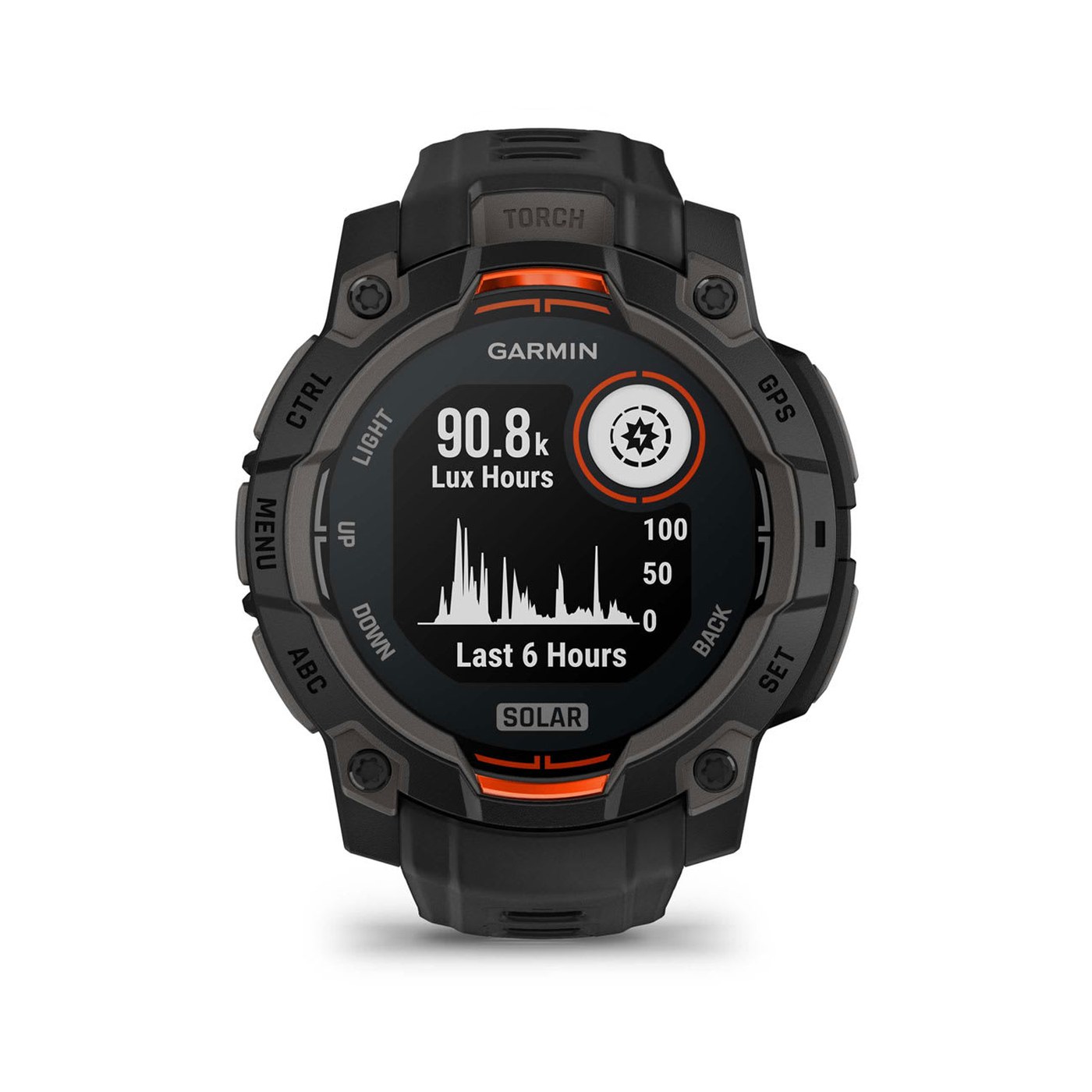
The second technical pillar is the Power Glass solar lens, which covers the entire watch face. Garmin claims charging is five times more efficient than on the Instinct 2 Solar. In the field, the effect is spectacular in GPS-only use: independent measurements report battery drain below 1% per hour on trail runs lasting 75 to 90 minutes in full sun, to the point where the gauge barely moves on screen. In multi-band GPS mode with SatIQ enabled, the solar boost is less dramatic but still clear, with measured battery life between 50 and 80 hours depending on sunlight, versus 40 hours claimed without light. One caveat flagged by the same measurements: solar charging speed varies noticeably from one unit to another and with battery level. Garmin deliberately caps charging speed above 80% to extend the battery's lifespan.
© Garmin, official photo used for editorial purposes
Field test: from dense forest to multi-day outings
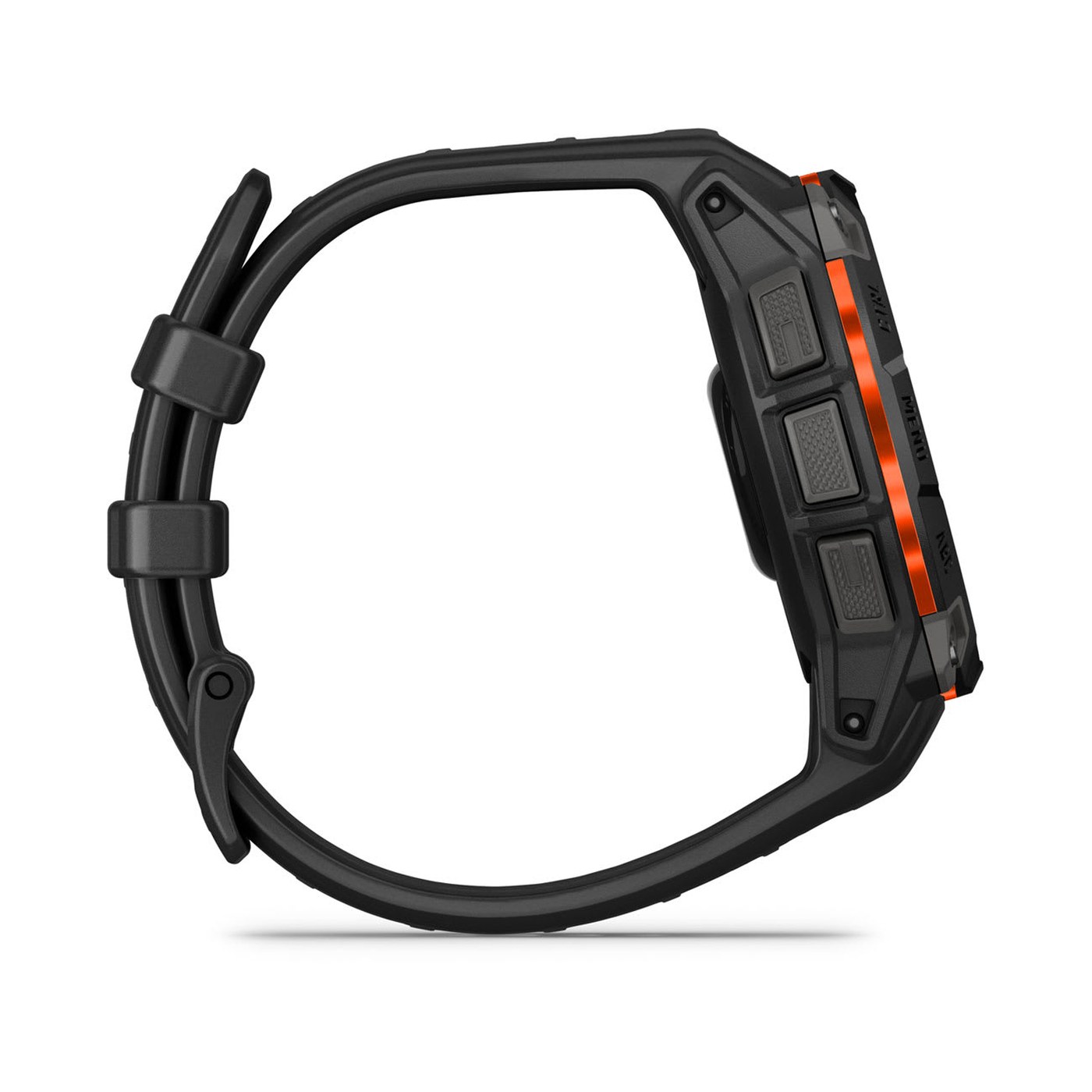
Real-world, independent tests agree on the essentials: the Garmin Instinct 3 Solar delivers on its promise of battery life and toughness. One tester who spent several weeks with the watch trail running and hiking in mountainous terrain reports reliable positioning even under dense forest cover, with consistent distance and elevation data on familiar routes. TracBack breadcrumb navigation feels reassuring on poorly marked trails, even if it doesn't replace a detailed map. Another test, based on heavy daily use across trail running, hiking and water sports, confirms toughness in line with the MIL-STD-810 standard: impacts, immersion and temperature swings, all shrugged off.
On heart rate accuracy, reviewers also agree, with one shared caveat. The onboard Elevate Gen4 optical sensor (not the newer generation 5 already found on other Garmin watches) delivers reliable data during steady efforts, but lags slightly during sudden changes in intensity. That's a classic optical sensor flaw, and independent measurements on intervals confirm it. Heart rate purists will keep reaching for a chest strap for sessions with highly variable pace.
Opinions split, however, on the monochrome display. Some testers find it perfectly suited to outdoor use, with better readability in full sun than they expected. Others, coming from an AMOLED watch, find it downright unappealing and miss having a touchscreen, which the color version of the same range lacks too. At RunMorph, we see this split mostly as two different buyer profiles: if battery life is your priority, monochrome won't bother you; if you're coming from the smartwatch world, you'll adapt less easily. The one point no tester compromises on is the lack of detailed mapping: at this price, several reviewers find it hard to justify against competitors that now offer maps for under 500 euros.
RunMorph's tip: if solar battery life is your number one criterion but you're still on the fence, compare the Instinct 3 Solar with the Garmin Enduro 3, more expensive but with mapping, or the Suunto Vertical, which offers free offline maps for a similar budget. If you never need a detailed map and already know your trails, the Instinct 3 Solar is still the market benchmark for battery life and toughness.
© Garmin, official photo used for editorial purposes
Garmin Instinct 3 Solar vs Garmin Instinct 3 AMOLED: head to head
Both watches share the same chassis, the same heart rate sensor and the same lack of mapping. The difference comes down entirely to the trade-off between screen and battery life. Here's how they compare, size for size:
| Instinct 3 Solar 45 mm | Instinct 3 AMOLED 50 mm |
|---|
| Display | Memory-in-pixel 0.9", 176 x 176 px, non-touch | AMOLED 1.3", 416 x 416 px, non-touch |
| Weight | 52 g | 59 g |
| Smartwatch battery life | 28 days (unlimited with solar) | 24 days |
| Multi-band GPS battery life | 40 h claimed (up to 80 h measured) | 40 h |
| Power-saving GPS battery life | up to 300 h+ (solar UltraTrac) | 110 h |
| Mapping | No | No |
| Heart rate sensor | Elevate Gen4 | Elevate Gen4 |
| Official price | €399 (45 mm) / €449 (50 mm) | €449.99 |
The choice comes down to this: the Solar version costs less, weighs less and pushes battery life much further, at the price of a monochrome screen that's less pleasant day to day. The AMOLED gains in visual comfort what it loses in raw battery life. For pure outdoor use (trail, hiking, expeditions), the Solar remains the most coherent choice; for mixed everyday use where the screen matters more, the AMOLED takes the edge.
Our field verdict: who is it for?
The Garmin Instinct 3 Solar is a perfect fit for runners who string together long runs without regular access to an outlet: ultra-trail prep, multi-day treks, bikepacking or expeditions. Its toughness and battery life make it a reliable companion for sessions that go far beyond the demands of urban running. For indoor intervals or everyday smartwatch use where visual comfort comes first, the monochrome screen and the lack of multimedia features make it less relevant than its AMOLED rivals.
To rack up the kilometers of a long-distance trail build or secure your long runs on the way to an ultra without ever worrying about the battery, pair the Instinct 3 Solar with a RunMorph training plan tailored to your goal.
© Garmin, official photo used for editorial purposes
The RunMorph Coach's verdict
The Garmin Instinct 3 Solar delivers on its main promise: battery life that goes well beyond what most running GPS watches offer, backed by toughness proven in real field tests. The Power Glass solar lens is no marketing gimmick. Independent measurements confirm it in black and white, with near-zero drain in GPS-only mode in good sunlight.
But at €399-449, the complete lack of mapping is still a real weak spot. Rivals like the COROS APEX 4 or the Amazfit T-Rex Ultra 2 offer offline maps for under €500. Garmin could have included them without abandoning the Instinct DNA. The deliberate choice not to creates a commercial blind spot that even the excellent battery life doesn't fully make up for.
So who should pick the Instinct 3 Solar anyway? Someone who already knows their trails, doesn't need a detailed map and wants the best rugged battery life on the market under €450. Everyone else should think hard about the mapping-capable rivals before buying.
RunMorph score: 7.8/10