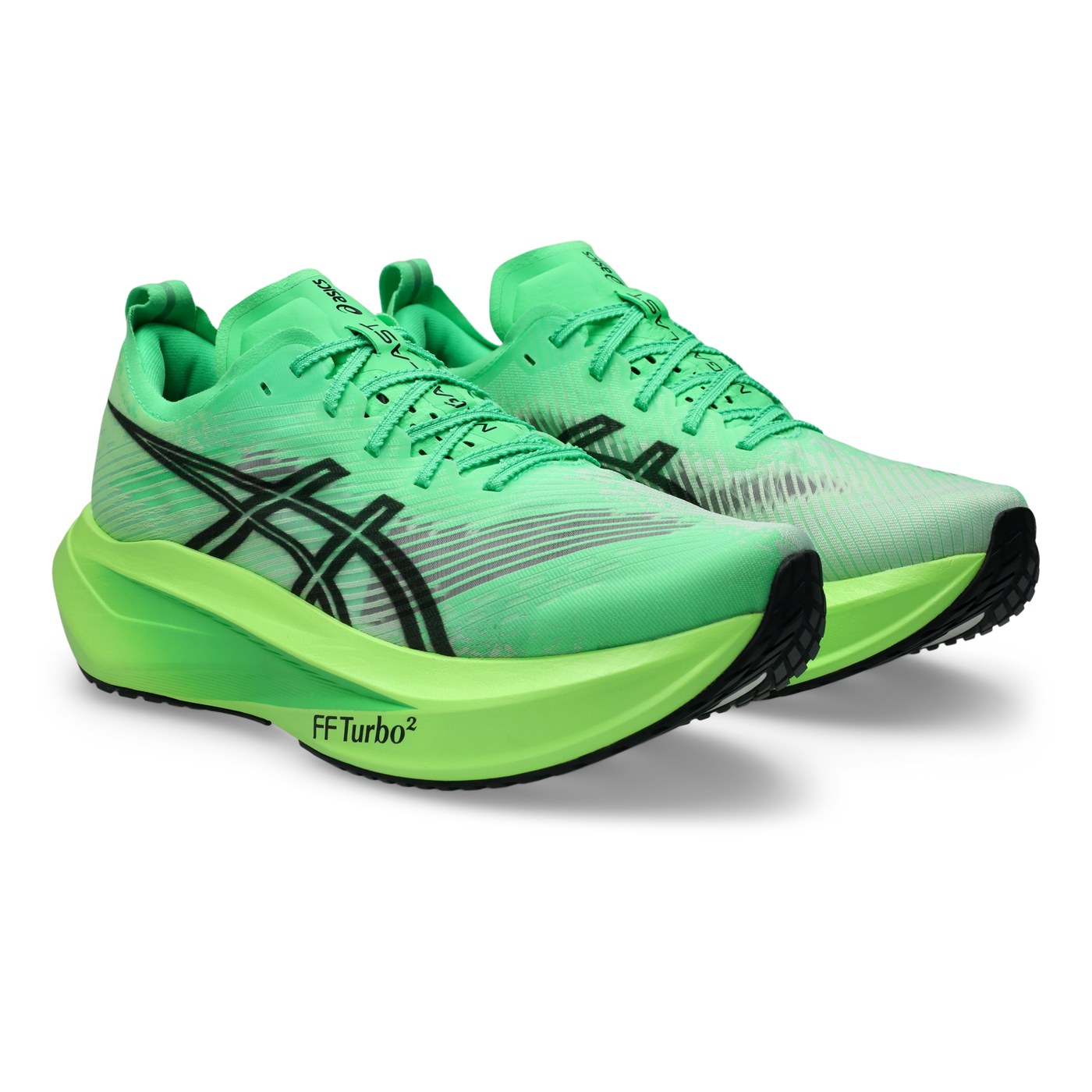
September 2025: Asics tops off its Blast family. After the Novablast for everyday miles, the Sonicblast for tempo work and the Superblast for maximalism, the Megablast promises to roll it all into one shoe. A year on, the independent lab measurements are in, and they are spectacular: record shock absorption, 218 g on the scale, grip among the best ever measured. What stings is the price: €240. At RunMorph, we cross-checked the lab data with French field tests to find out whether the Megablast deserves its crown as king of super trainers.
Asics Megablast review: record cushioning measured in the lab, 218 g with no plate, the unfiltered test
9.5/10
The bottom line in 3 sentences
The Asics Megablast is the most accomplished super trainer in the Blast family: full-length supercritical FF Turbo² foam, 218 g measured, no plate, and record cushioning in the lab. It soaks up long runs, snaps back at tempo pace and even handles race day, with surprising stability for a 45 mm stack. Its real flaws: a €240 price tag, a fragile forefoot mesh and a stiffness that can get in the way at very fast paces.
9.5
/ 10 · RunMorph overall score
Who is it for?The runner who wants one pair to do it all, from easy jogs to the marathon, and is willing to pay top dollar for the best-performing plateless foam around.
Who should skip it?The runner on a tight budget, the fan of close-to-the-ground feel, or anyone who only ever runs slow and will never tap into the energy return.
Asics Megablast: the fourth Blast, gunning for the super trainer throne
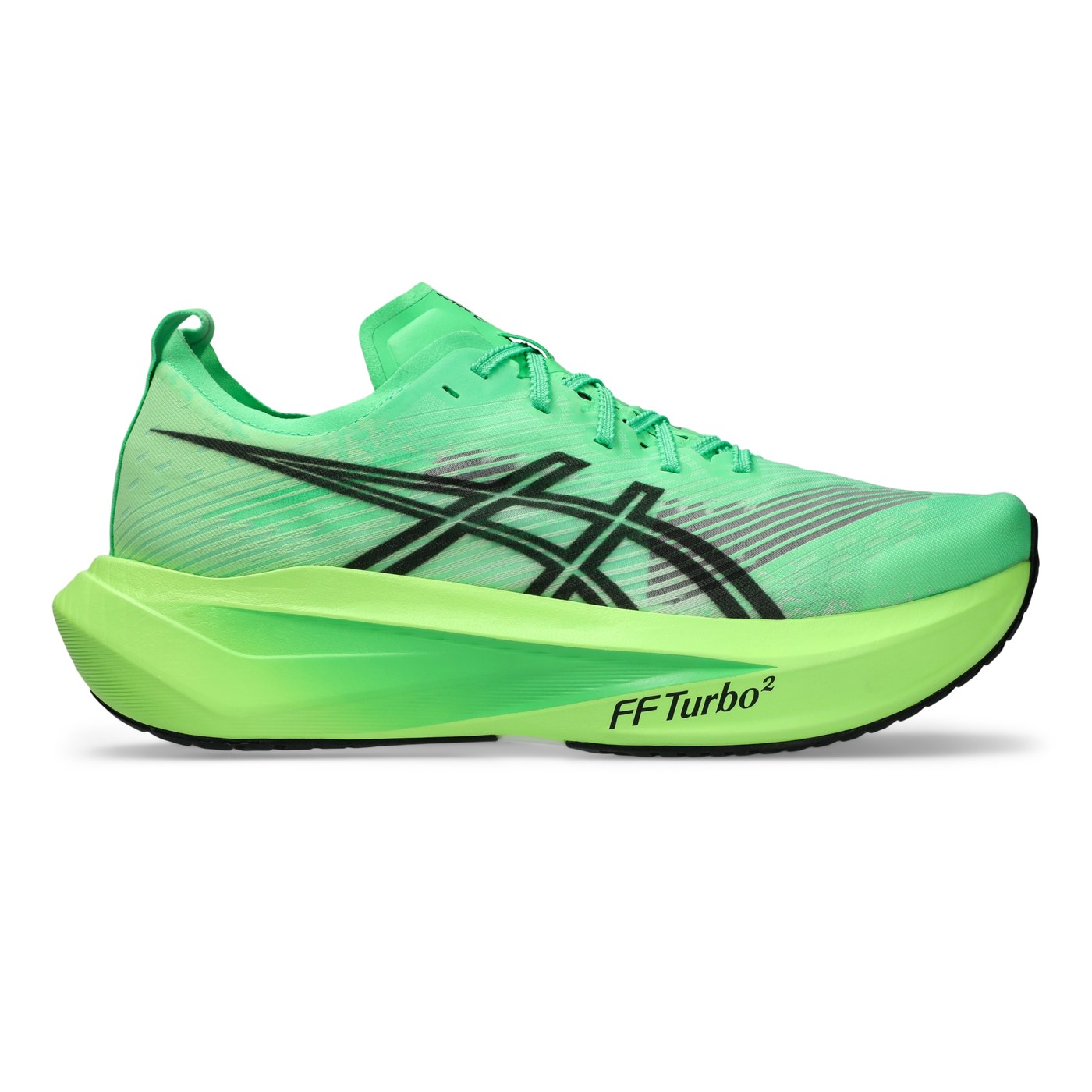
In two years, the Asics Blast family has become the clearest lineup on the market: the Novablast for daily training, the Sonicblast for uptempo sessions, the Superblast for long-distance maximalism. The Megablast, launched in September 2025, sits at the top of that pyramid with a simple promise: pack the brand's most explosive foam, FF Turbo², into a plateless shoe that does everything, every day.
A year after launch, the independent verdict leaves no room for doubt: the benchmark lab that took the shoe apart gave it the highest score ever awarded to a super trainer, with record forefoot cushioning and a featherweight 218 g measured. But that excellence comes at a price: €240 in France, €40 more than the Superblast 3 and €80 more than the Novablast 6. So the question is not whether the Megablast is good (it objectively is) but who the extra cost actually makes sense for.
RunMorph's advice: if you want a daily trainer for running easy most of the time, the Novablast 6 at €160 is more than enough. The Megablast earns its keep when you genuinely mix paces within the same week: easy runs, tempo and fast long runs.
© Asics, official photo used for editorial purposes
Asics Megablast: the objective technical data
| Spec | Value |
|---|---|
| Brand | Asics |
| Model | Megablast (ref. 1013A170) |
| Official release | September 2025, available in France |
| Use | Road, versatile super trainer |
| Men's weight | 224 g claimed, 218 g measured by an independent lab (size 42) |
| Women's weight | 193 g (size 39) |
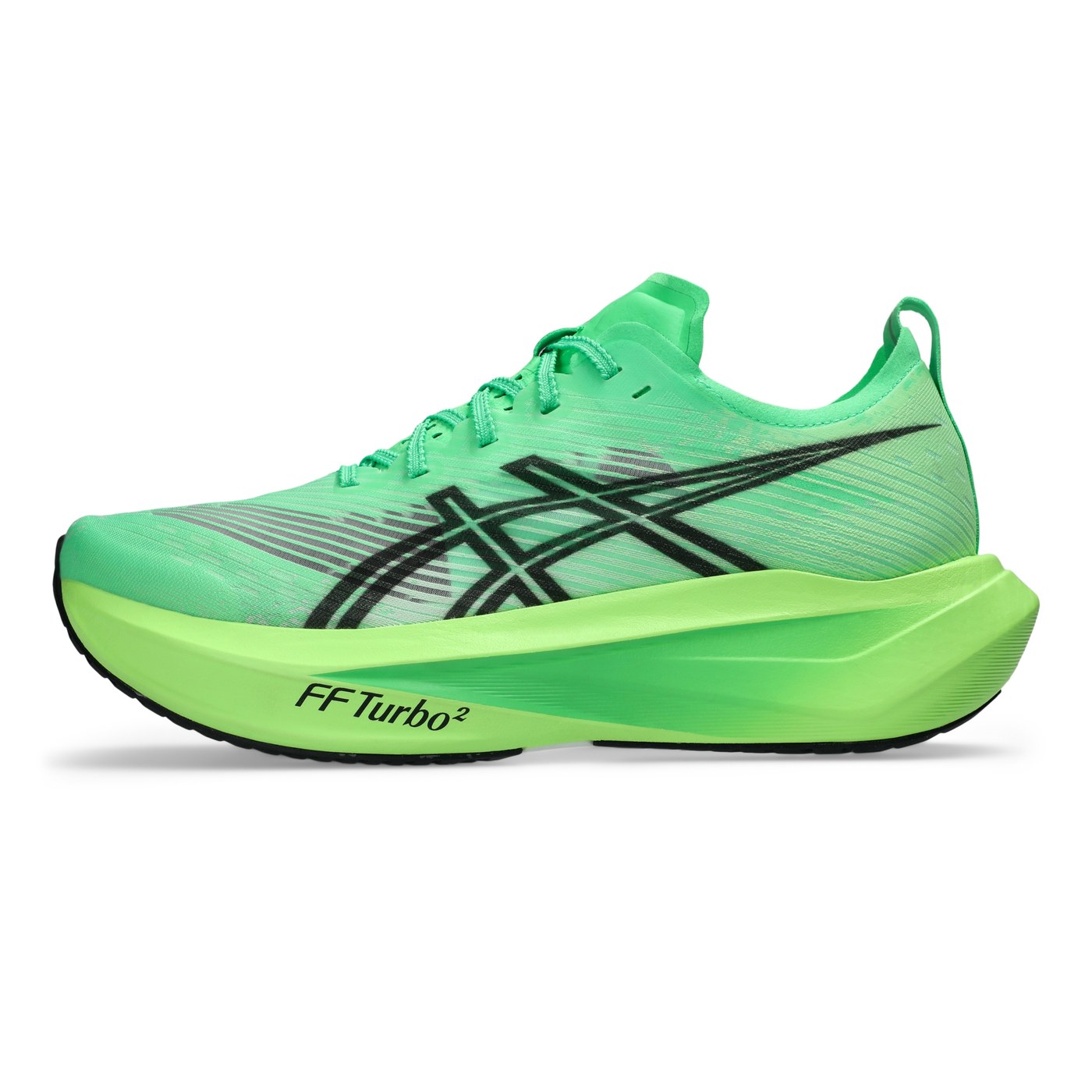
| Heel / forefoot stack | 45 / 37 mm claimed, 45.1 / 35.2 mm measured |
| Drop | 8 mm claimed, 9.9 mm measured by an independent lab |
| Foam | Full-length supercritical FF Turbo², no plate |
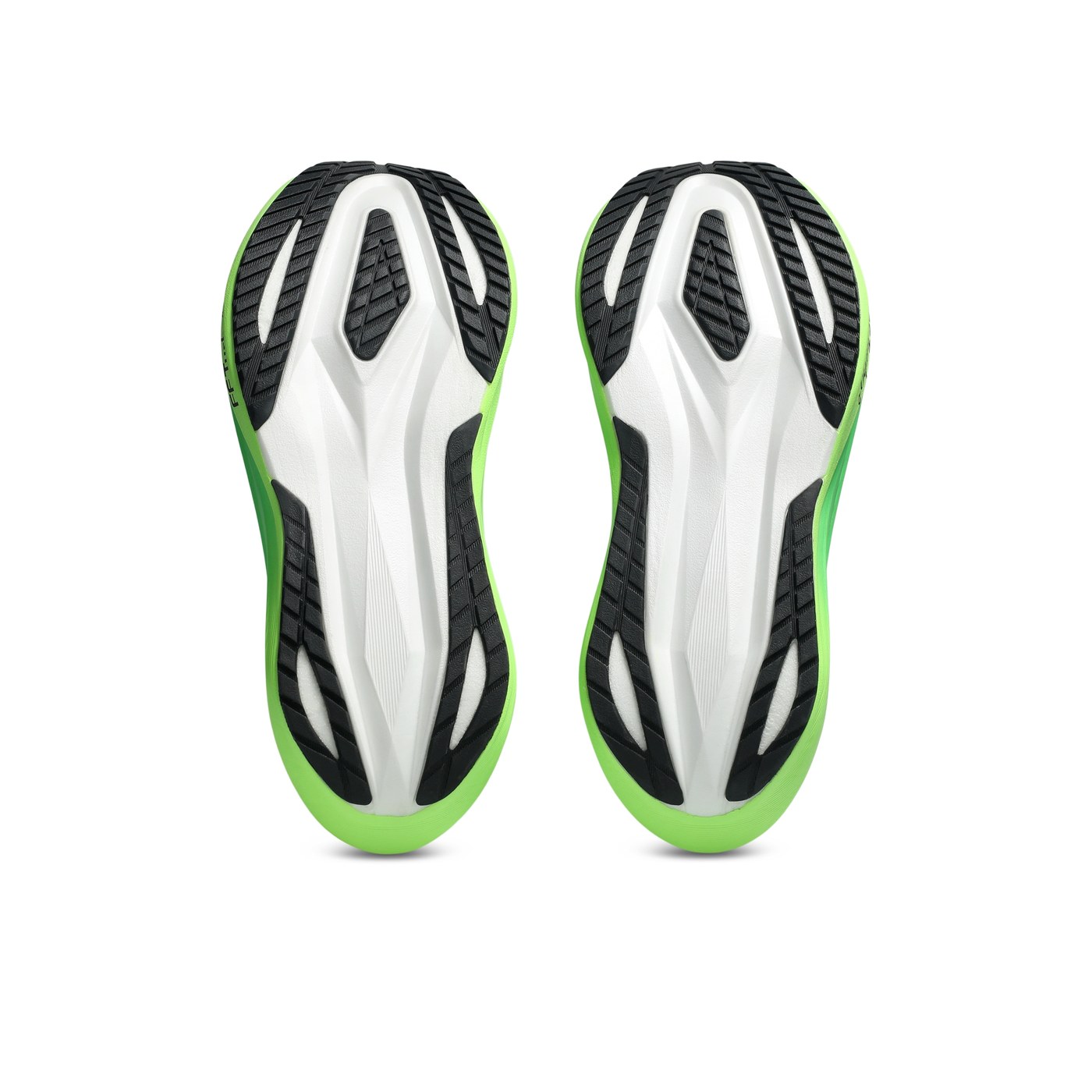
| Outsole | ASICSGRIP rubber, partial coverage |
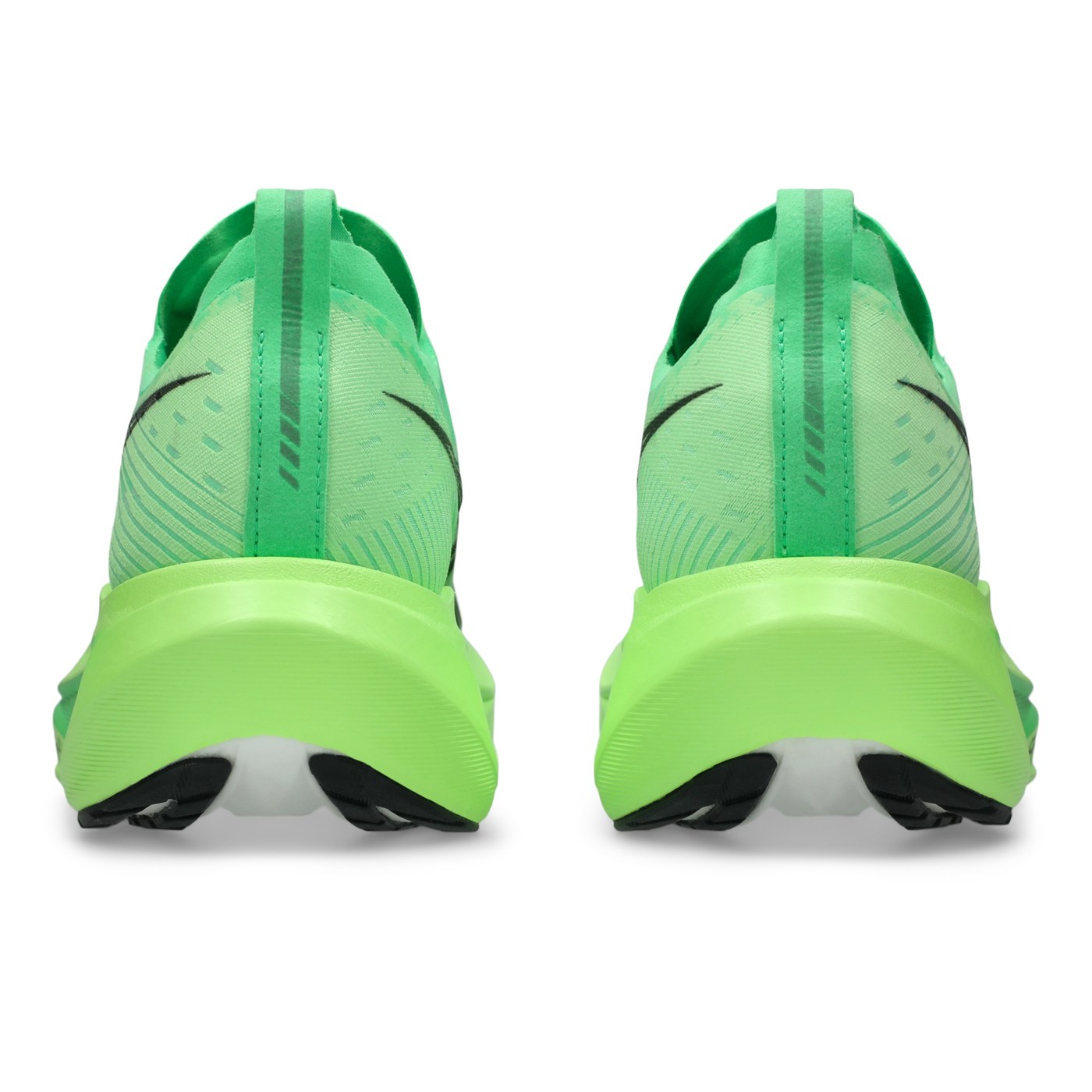
| Upper | Ultra-thin engineered mesh, semi-gusseted tongue |
| Retail price | €240 (France), sometimes €199 on sale |
Claimed vs measured: what the lab adds to the Asics pitch
Unlike models where the official figures match to the millimeter, the Megablast has two notable gaps once it hits the independent test bench. The first is good news: the shoe weighs 218 g measured versus 224 g claimed, which puts it among the lightest super trainers on the market, lighter even than some plated race shoes. The second concerns the drop: 9.9 mm measured versus 8 mm claimed. In practice, that difference makes the Megablast a little more forgiving for heel strikers than its spec sheet suggests, without penalizing midfoot strikers thanks to the 35.2 mm of foam under the forefoot.
Cushioning is where the Megablast enters another dimension. The independent lab measured 160 SA at the heel and 144 SA at the forefoot, an all-time record across more than 400 models tested, against a category average of around 131 SA. What that means on the road: whatever your stride, your weight or the distance, the foam absorbs the load without ever bottoming out. Grip follows suit with a traction score of 0.96 versus a 0.53 average, among the best readings in the protocol, on dry and wet roads alike. On the other hand, rubber coverage is only partial: the exposed foam under the midfoot rules out trails. This is a pure road shoe.
One last measured point you need to know: at 45.1 mm at the heel, the Megablast exceeds the 40 mm limit World Athletics sets for official road races. Irrelevant for the vast majority of runners, but technically a dealbreaker for a sanctioned elite competition. For official racing, the Metaspeed Sky Tokyo remains the brand's pick.
© Asics, official photo used for editorial purposes
Who is the Asics Megablast for?
The one-shoe-for-everything runner with the budget to match
This is the core target. You want a single shoe that can handle Sunday's long run, Tuesday's threshold session and Thursday's recovery jog without ever holding you back. The independent protocol's sub-scores back it up: 92 for daily training, 95 for tempo, 87 for racing. No other super trainer tested shows that kind of consistency across all three uses.
The Superblast fan who wanted it lighter
If you loved the max-stack philosophy of the Superblast but found it a bit bulky, the Megablast delivers exactly what you were after: the same spectacular foam height, a livelier feel, weight kept in check. Testers who know both generations of Superblast find the same family of sensations, with an extra notch of responsiveness.
The runner who wants super shoe foam without the plate
FF Turbo² belongs to the family of supercritical foams found in world record shoes. The Megablast gives you that bounce without a carbon plate, which makes it more comfortable at moderate pace and more versatile day to day than a Metaspeed. The trade-off: at very fast paces, the massive slab of foam can feel a bit monolithic. That is the price of going plateless.
The field test: what runners who wore it out are saying
On the French side, Runnea published a full review of the shoe and praises a rare versatility, able to hold marathon pace as well as easy jogs, with one recurring theme: the energy return blows you away from the very first kilometers. Runninglab, in its video review, stresses the surprising stability of such a tall shoe, a point confirmed by the independent measurements with a stability sub-score of 89. Internationally, a panel of testers logged more than 160 kilometers across three different runner profiles: their consensus confirms the all-round versatility and the durability of the foam, which does not pack out after the first runs.
The criticisms line up too, and they are fair. At the fastest paces, below roughly 4:00/km, the very stiff platform (18.8 N measured in the flex test, versus a 15.6 N average) gives a somewhat single-block feel that puts off some testers. The very thin forefoot mesh is rated fragile for durability by the lab protocol, the model's only real hardware weak spot. And the midfoot lockdown can lack bite for narrow feet on the first runs, until you find the right lacing. Finally, the price comes up in every analysis: at €240, the Megablast is edging into plated super shoe territory.
© Asics, official photo used for editorial purposes
Asics Megablast vs Superblast 3, Novablast 6 and Adidas EVO SL: the comparison
| Criterion | Asics Megablast | Asics Superblast 3 | Asics Novablast 6 | Adidas EVO SL |
|---|---|---|---|---|
| Price | €240 | €200 | €160 | €150 |
| Men's weight | 218 g measured | Heavier max-stack | 253 g | About 224 g |
| Foam | Full-length FF Turbo² | FF Turbo² + maximal stack | FF Turbo² forefoot + FF Blast Max heel | Lightstrike Pro |
| Plate | No | No | No | No |
| Positioning | One pair for everything, premium | Long runs and maximalism | Lively daily trainer | Versatile on a controlled budget |
RunMorph's take on this table fits in two sentences. The Megablast is objectively the best performer of the four, but it charges €40 to €90 more than its direct alternatives for that edge. If budget is your priority, the Adidas EVO SL offers a similar philosophy, supercritical foam with no plate, for €90 less with less premium materials. If you mostly run easy, the Novablast 6 is still the smart pick. And if you prefer a nylon-plated option for fast days, the Saucony Endorphin Speed 5 at €200 rounds out a rotation nicely.
Pros and cons
Pros
- Record cushioning measured in the lab: 160 SA at the heel, 144 SA at the forefoot
- 218 g measured, lighter than plenty of plated race shoes
- Total versatility: easy runs, tempo, long distance, even unofficial races
- ASICSGRIP traction among the best ever measured, on dry and wet surfaces
- Remarkable stability for a 45 mm stack, foam that does not pack out
Cons
- €240, super shoe money for a training shoe
- Fragile forefoot mesh according to independent durability tests
- Stiff platform, single-block feel at very fast paces
- Partial outsole coverage: road only, trails not recommended
- 45 mm stack exceeds the World Athletics limit for official competition
© Asics, official photo used for editorial purposes
How to fit it into your RunMorph training plan
The Megablast is the kind of shoe that simplifies a rotation: it covers long runs, marathon pace and fast easy runs without fading. In a RunMorph marathon training plan, use it for the key sessions where you want to stack volume without residual fatigue: its record protection is invaluable in the high-load weeks before a marathon. If you like, keep a lighter or plated pair for pure speed sessions below 4:00/km, where its stiffness makes itself felt.
The RunMorph Coach's verdict
The Asics Megablast is, with the measurements to prove it, the most complete super trainer tested to date: record cushioning, featherweight build, premium grip, flawless versatility. It has only one real problem, and it is on the price tag: €240, a price that pits it against plated race shoes when it is still a training shoe. If your budget allows and you want a single pair for almost everything, it is the best option on the market today. If not, the Novablast 6 or the EVO SL do 80 to 90% of the job for far less.
9.5/10. The highest score RunMorph has ever given a training shoe, backed by independent lab measurements that smash the category records. Only the price, the fragile forefoot mesh and the stiffness at top speed keep it from perfection.
© Asics, official photo used for editorial purposes
Key takeaways for your training
- Record cushioning: 160 SA at the heel and 144 SA at the forefoot, never before measured across more than 400 models tested by an independent lab.
- 218 g measured: lighter than its claimed weight, and lighter than many race shoes.
- Real drop of 9.9 mm: more forgiving for heel strikers than the claimed 8 mm.
- Road only: partial outsole coverage, the exposed foam rules out trails.
- €240: the best super trainer of the moment, but the Novablast 6 at €160 remains the sensible choice if you mostly run easy.
FAQ
Is the Asics Megablast good for beginners?
On paper, yes: its stability and record cushioning forgive a lot. But at €240, a beginner who mostly runs easy will get better value from the Novablast 6.
Can you run a marathon in the Asics Megablast?
Yes, and it is actually one of the uses testers recommend. Just watch out for official road races: its 45.1 mm measured at the heel exceeds the World Athletics 40 mm limit for sanctioned performances.
What is the difference between the Megablast and the Superblast 3?
The Megablast is lighter, livelier and €40 more expensive. The Superblast 3 keeps the edge in maximalist comfort over very long distances at moderate pace. Both share the plateless philosophy.
Does the Asics Megablast fit true to size?
Yes, user feedback confirms it fits true to your usual size, with a medium-width toe box, slightly roomier than on previous Superblast models.