Suunto Vertical Review: MIP Display, Solar and Free Offline Maps
8.5/10
For years, picking an expedition watch meant accepting a frustrating trade-off: either a screen you could read in full sun with weeks of battery life, or a modern panel that gave up after two days of GPS. The Suunto Vertical, released in spring 2023, refused that dilemma. The Finnish brand's first mapping watch bet on a transflective display that sips almost no power, solar charging and free worldwide topographic maps. Three years later, with the 2026 summer sales slashing its price, it remains one of the soundest deals in the adventure segment.
The Suunto Vertical is an adventure and ultra-trail GPS watch built around a transflective display that puts battery life and sunlight readability ahead of AMOLED flash. It targets long-distance runners, hikers and mountaineers who want full mapping with no subscription and a battery that lasts a week-long expedition. At €599 for the steel version (and much less on sale), it delivers on toughness and endurance, at the cost of training metrics a notch less advanced than its Garmin or COROS rivals.
8.5 / 10 · RunMorph overall score
GPS accuracy
Battery life
Mapping
Metrics
Value for money
Who it is for
Long-distance trail runners, hikers and adventurers who want multi-day battery life, free offline mapping and a screen you can read under a scorching sun.
Who it is not for
Road runners who dream of an ultra-sharp AMOLED panel, or who want onboard music or contactless payments on the wrist.
Suunto Vertical: the Finnish brand's first mapping watch, built to last
When Suunto launched the Vertical in May 2023, the brand was late to onboard mapping, a field Garmin and COROS already owned. But it came in with a clear angle: make battery life and toughness the selling points, not the pixel race. While the trend was heading toward AMOLED, Suunto went all in on a 1.4-inch color transflective MIP display. That choice could pass for conservative, but it is the heart of the pitch: an always-on screen that draws a fraction of what a bright panel demands, and perfect readability under a midday sun on a ridge.
At RunMorph, we've seen this positioning age better than expected. The Suunto Vertical 2 replaced it with a switch to AMOLED, but the original hasn't become obsolete: it targets a different profile, one that puts battery endurance and simplicity ahead of visual comfort. With the price drops seen across the market in 2026, it now sits in a price bracket where it has almost no rival this complete.
RunMorph's advice
If you're torn between the original Vertical and the new one, ask yourself one question: is AMOLED a whim or a need? For a 30-hour ultra or a week-long adventure race, this Vertical's transflective screen and battery life remain unbeatable. If you want the detail of a modern panel, check out our review of the Suunto Vertical 2 or the COROS Vertix 2S.
Suunto Vertical specs: a transflective display built for endurance
Brand
Suunto
Model
Vertical (tested version: All Black steel)
Release
May 2023
Case size
49 mm
Weight
86 g (steel) / 74 g (Titanium Solar)
Display
1.4" (35.5 mm) color transflective MIP touchscreen, 280 x 280 px, always-on
Glass
Mineral (steel) / sapphire (Titanium Solar)
GNSS
Dual-frequency L1+L5 (GPS, GLONASS, Galileo, BeiDou, QZSS), FusedTrack and FusedAlti
Battery life
30 days in smartwatch mode (steel), up to 60 days on Titanium Solar; 60 h dual-band L1+L5 GPS; 90 h all systems; 140 h Endurance; 500 h Tour. Solar boost up to +30% (Titanium Solar)
Transflective display and solar charging: what does it really change?
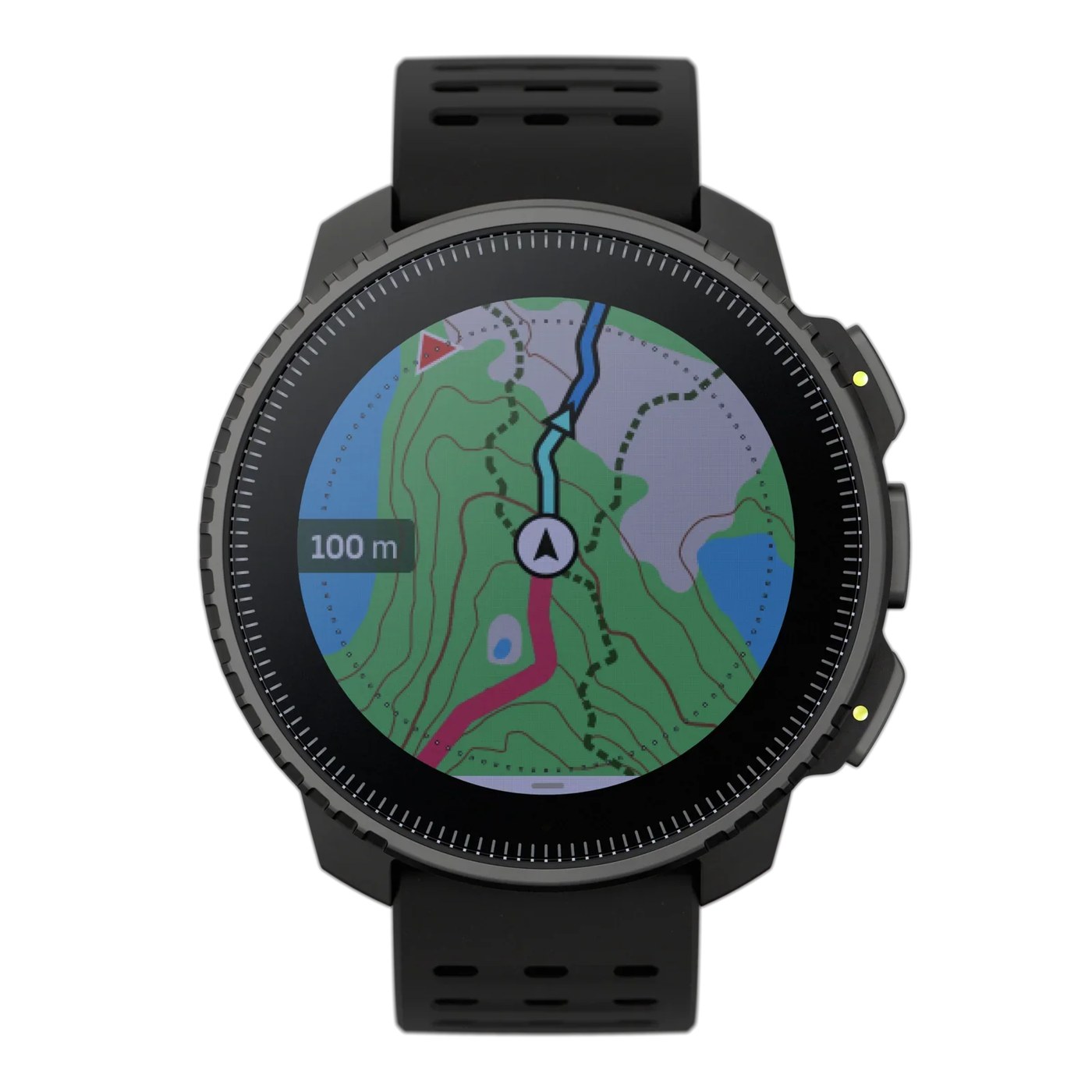
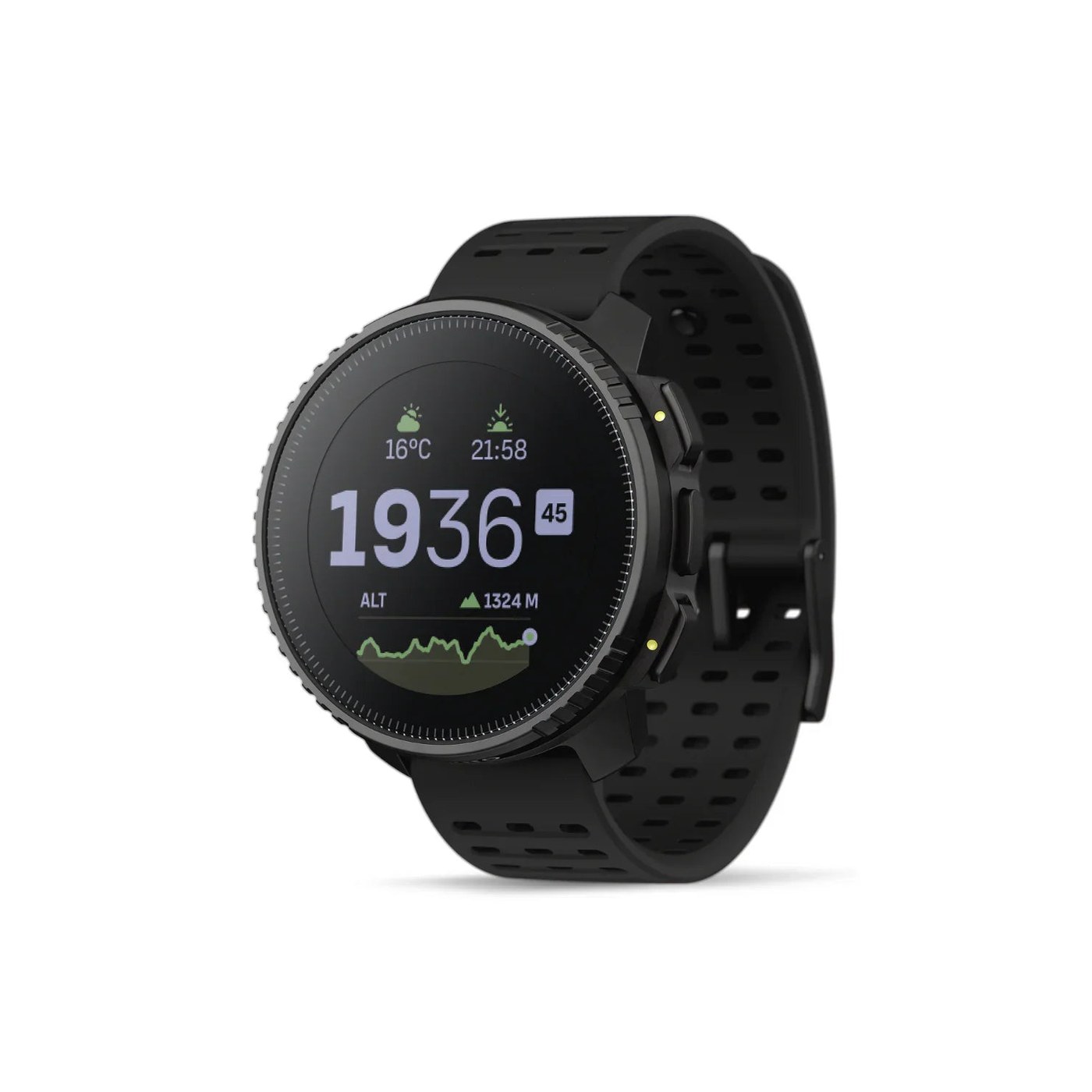
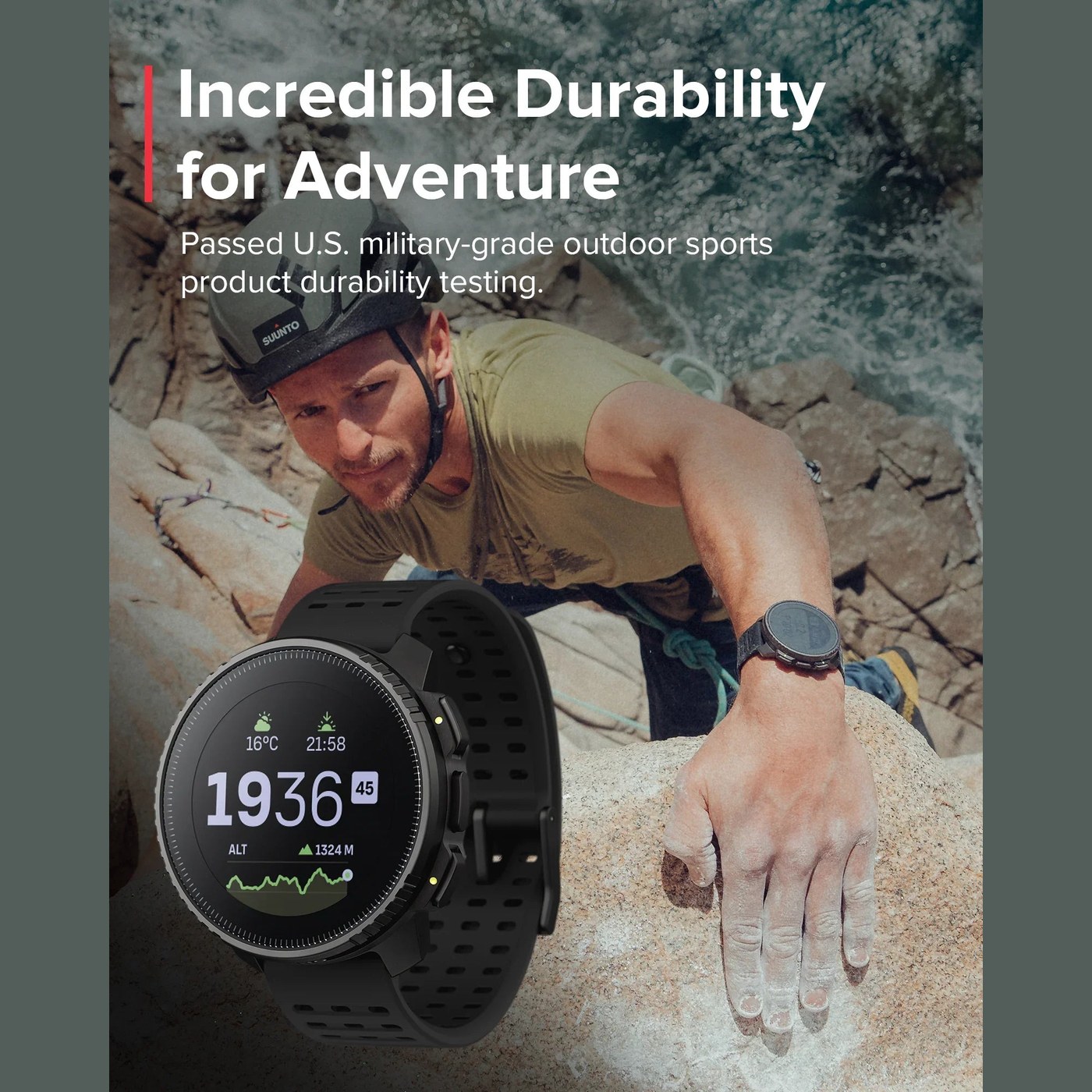
This is the crux. A transflective MIP display emits almost no light: it reflects ambient light, like an analog watch. The direct result: it stays on permanently without draining the battery, and the more sun there is, the more readable it gets, the exact opposite of an AMOLED panel that has to crank up its brightness to stay visible. On an exposed ridge at noon or in the middle of the desert, the difference is striking: the Vertical shows your track and altitude without you having to squint.
You have to accept the downside: the 280 x 280 px resolution and slightly dull colors lack the crispness of a modern panel. The mapping stays perfectly usable, but it looks dated next to the Vertical 2's screen or a Polar Grit X2 Pro. On the Titanium Solar version, the photovoltaic ring around the dial harvests energy continuously and can extend battery life by about 30% in heavy outdoor use. The All Black steel version we have on hand has no solar, but its 30 days in smartwatch mode and 60 hours of dual-band GPS already cover almost every adventure.
Field test: from long runs to multi-day expeditions
In the field, we put the Suunto Vertical through everything from recovery runs at 6'00/km to 4- to 6-hour long trail runs, plus demanding days of hiking. The verdict is clear: it's a watch you forget on your wrist, in the best sense. You head out in the morning with zero battery anxiety, because you know it will last the whole weekend without a charger. For long-distance runners, that's peace of mind few AMOLED watches deliver.
This generation's optical heart rate sensor fixes some of Suunto's historic weaknesses without fully matching a chest strap. On steady endurance work, tracking is accurate to within a few beats. For short, punchy intervals, you're better off pairing it with an external sensor like the COROS HR Monitor or the Garmin HRM 600. Navigation is a real strength: the offline topo map with contour lines, the colored breadcrumb trail and the route back to start made every run on unfamiliar ground safer, without ever asking for a subscription.
GPS accuracy and metrics: how good are the tracks?
The dual-frequency L1+L5 chip does the job you'd expect in this segment. In dense forest and deep valleys, independent tests confirm clean tracks, without the gross errors older Suunto watches were criticized for. The FusedTrack algorithm fills in the route between two GPS points using heart rate and accelerometer data, which smooths the track in power-saving mode. Accuracy doesn't quite reach the benchmark set by a Garmin Forerunner 970, but it sits in the leading pack.
On the training side, the Vertical offers solid tracking: training load, body resources, sleep tracking with overnight SpO2 and weekly progress. The Suunto platform has matured since, notably with ZoneSense, which reads metabolic intensity in real time. It's complete for managing effort, but the physiological analysis stays a notch below the depth of the COROS EvoLab suite or Garmin's metrics. At RunMorph, our takeaway is that the Vertical helps you run smart without turning every run into a lab dashboard.
Suunto Vertical vs Suunto Vertical 2: the comparison to help you choose
It's the question every buyer asks in 2026. Here's how the two generations stack up.
Criterion
Suunto Vertical
Suunto Vertical 2
Display
Transflective MIP 280 x 280 px
AMOLED 466 x 466 px 2000 nits
Dual-band GPS battery life
60 h
65 h
LED flashlight
No
Yes (three-color)
Solar charging
Yes (Titanium Solar)
No
Free offline mapping
Yes
Yes (+ Climb Guidance)
Readability in full sun
Excellent
Very good
Official price (steel)
€599
€599
The Suunto Vertical 2 brings AMOLED, an LED flashlight and climb guidance, but loses solar. At the same list price, the 2 is the logical pick if you want visual comfort. But as soon as the original Vertical goes on sale (which is massively the case during the 2026 summer sales), the price gap makes it compelling again: you get the mapping, expedition battery life and toughness for much less. Against the COROS Vertix 2S or the Amazfit Cheetah 2 Ultra, it stands for a more understated approach and a transflective display that many ultra-trail runners still prefer.
Expedition battery life: a week in smartwatch mode, days on GPS.
Always-on transflective display, perfectly readable in full sun.
Free worldwide offline topographic maps, no subscription at all.
Accurate dual-frequency L1+L5 GPS on tough terrain.
Solar charging on the Titanium version, and unbeatable value on sale.
What we liked less
Screen resolution looks dated next to the next generation's AMOLED.
No onboard music or contactless payments.
Physiological metrics less in-depth than Garmin or COROS.
The 49 mm case is bulky on small wrists.
Our field verdict: who is the Suunto Vertical for?
Long-distance trail runners Yes. This is its natural target. Battery life, mapping and sunlight readability tick every box for ultras and demanding outings.
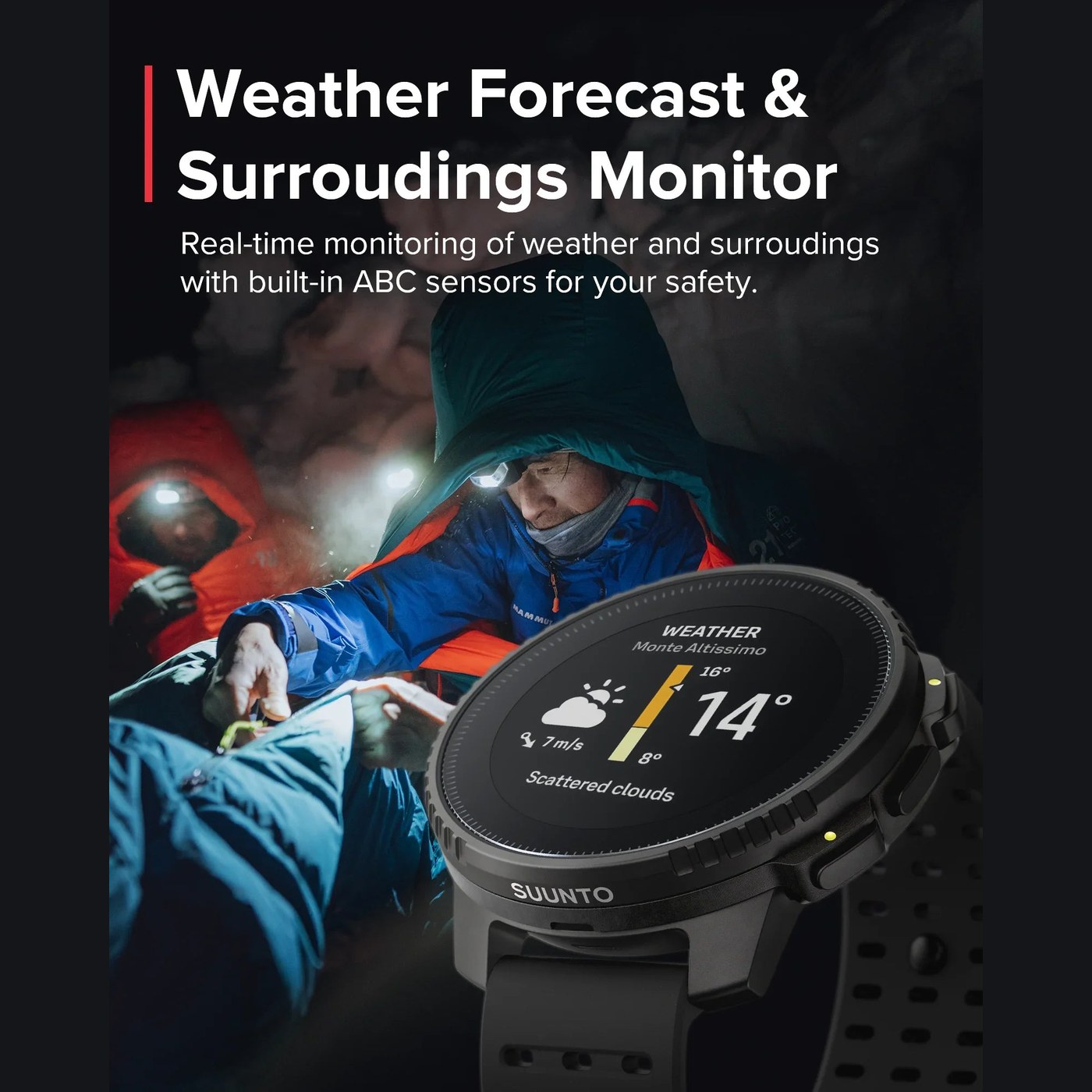
Hikers and mountaineers Yes. The 500 h Tour mode, barometric altimeter and route back to start make it a reliable expedition companion.
Road runners who want a great-looking screen With reservations. If you mostly run on pavement and want a beautiful panel, look at an AMOLED watch instead.
An adventure watch is only as good as the training it supports. Whether you're preparing your first ultra or a mountain trail race, or making your long runs safer on the way to a distant goal, the Suunto Vertical reaches its full potential when it is backed by a real session structure.
Build your progression with a RunMorph training plan tailored to your trail or ultra goal, and let the watch handle navigation while you handle the effort.
How to fit it into your RunMorph training plan
The Vertical shines on high volume. In a trail or ultra build, its battery life lets you string together a Saturday long run and a Sunday course recon without going back to the charger. Use the load and body resources tracking to dose your weeks, and the offline mapping to turn every long run into a course recon. Pair it with a RunMorph trail or ultra plan and you get a coherent duo: structure from the plan, freedom on the terrain.
The RunMorph Coach's verdict
The Suunto Vertical never tried to be the most spectacular watch on the market, and that's exactly what keeps it relevant three years after launch. By betting on a transflective display, solar and free mapping, it built an endurance proposition that the AMOLED trend hasn't made obsolete. It remains an excellent choice for anyone who puts battery life, sunlight readability and toughness ahead of flash.
Its limits are clear-cut: a less sharp screen, no music or payments, and metrics a notch behind the benchmarks. But at its list price, and even more on sale, its feature-to-price ratio is one of the best in the adventure segment. RunMorph score: 8.5/10.