Garmin launched the Instinct E in January 2025 as the cheapest way into its outdoor lineup, built on the architecture of the very first Instinct. On paper, the pitch is simple: Garmin's military-grade toughness at a price that now dips below €200. Over time, the story gets messier. A full year of real-world testing shows battery life sliding from 17 days to 12-14, an optical heart rate sensor that loses the plot under hard efforts, and a price that has already dropped by more than €100 since launch.
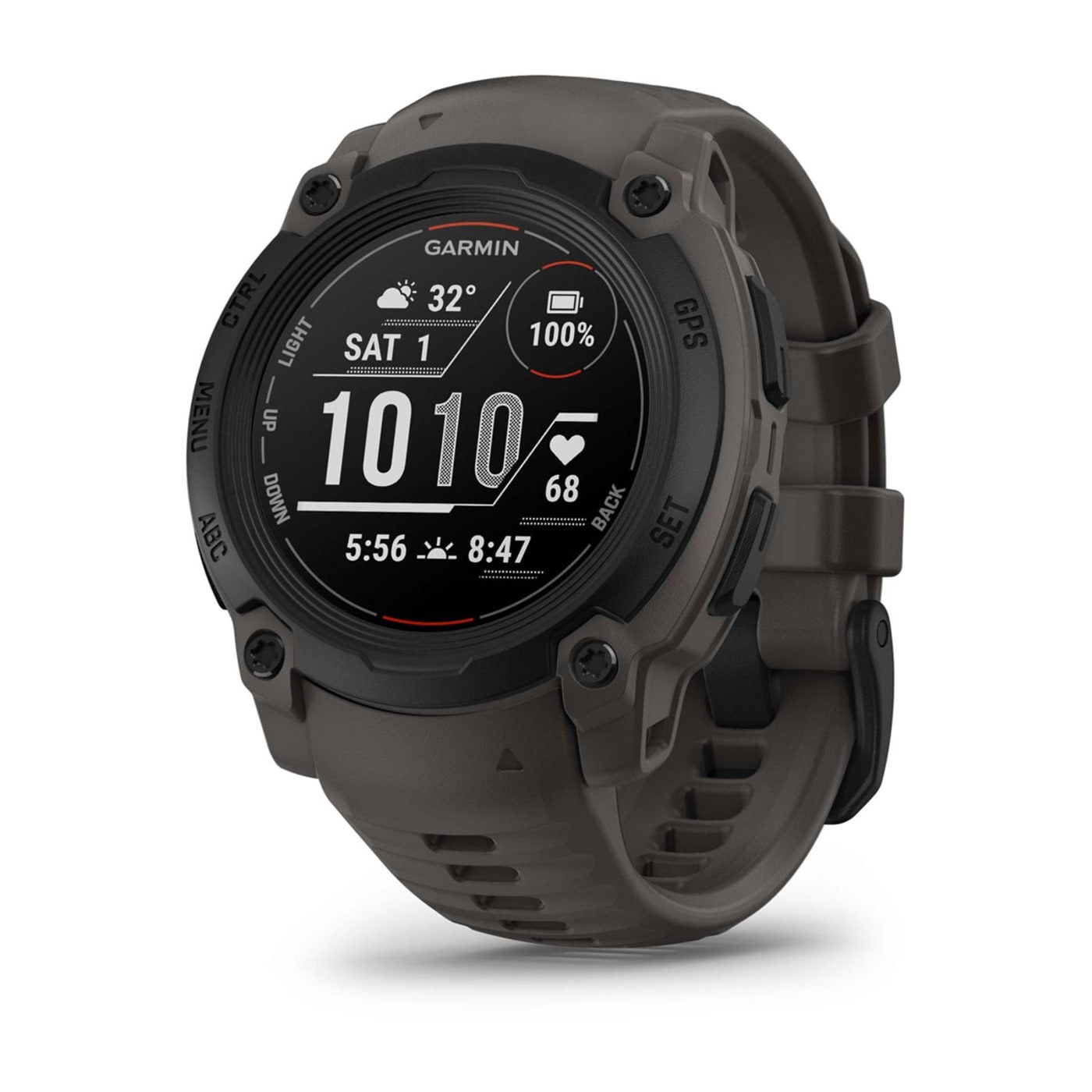
© Garmin, official photo used for editorial purposes
Garmin Instinct E: the entry-level model that reopens the first Instinct's file
Garmin covers the outdoor segment with three families: the Forerunner for pure running, the Fenix for high-end multisport, and the Instinct in between, built for toughness at a reasonable price. The Instinct E slots in at the bottom of that last family, below the Instinct 3 AMOLED and the Instinct 3 Solar that RunMorph has already reviewed. Despite what the name suggests, the Instinct E isn't built on the Instinct 3 platform: it reuses the architecture of the very first Instinct, released years earlier, with an updated processor and a minor software refresh.
That choice comes at a direct cost: no LED flashlight, no AMOLED display, no solar charging, no multi-band GPS, and a full polycarbonate case where the Instinct 3 gets a metal-reinforced chassis. In return, the launch price landed under the symbolic $250 mark in the US, with a French price of €299.
RunMorph's advice: if your budget can stretch another €100 to €150, the Instinct 3 AMOLED or the Instinct 3 Solar deliver a real step up in toughness and features. If money is genuinely tight, the Instinct 2, regularly on sale, gives you more for a price close to what the Instinct E cost at launch.
Garmin Instinct E: what's claimed vs. what holds up over time
On battery life, Garmin officially claims 16 days in smartwatch mode and 24 hours of continuous GPS for the 45 mm case, a figure confirmed by the US product page. Some comparison sites quote far more generous numbers, up to 28 days and 70 hours of GPS, most likely mixing them up with the most aggressive power-saving modes. The most useful test on this point doesn't come from a running site, but from a professional fighter who wore the watch 24/7 for 365 days: his finding is that battery life drops to 12-14 days after a year of heavy use, versus 17 days when new on his unit.
| Metric | Claimed (Garmin) | Measured (365-day field test) |
|---|
| Smartwatch battery life, new | 16 days | 17 days (consistent) |
| Smartwatch battery life, after 1 year | Not disclosed | 12-14 days (-18 to -30%) |
| Price in France | €299 at launch (January 2025) | €197 to €222 in 2026, i.e. -26 to -34% |
On price, the gap is sharp and fast: less than two years after launching at €299, the Instinct E is commonly found between €197.99 (Amazon) and €222 (Decathlon). That's an unusually quick price drop for Garmin, which tends to hold its prices over time, and it raises questions about how the product was positioned against the Instinct 2 that was already on the market.
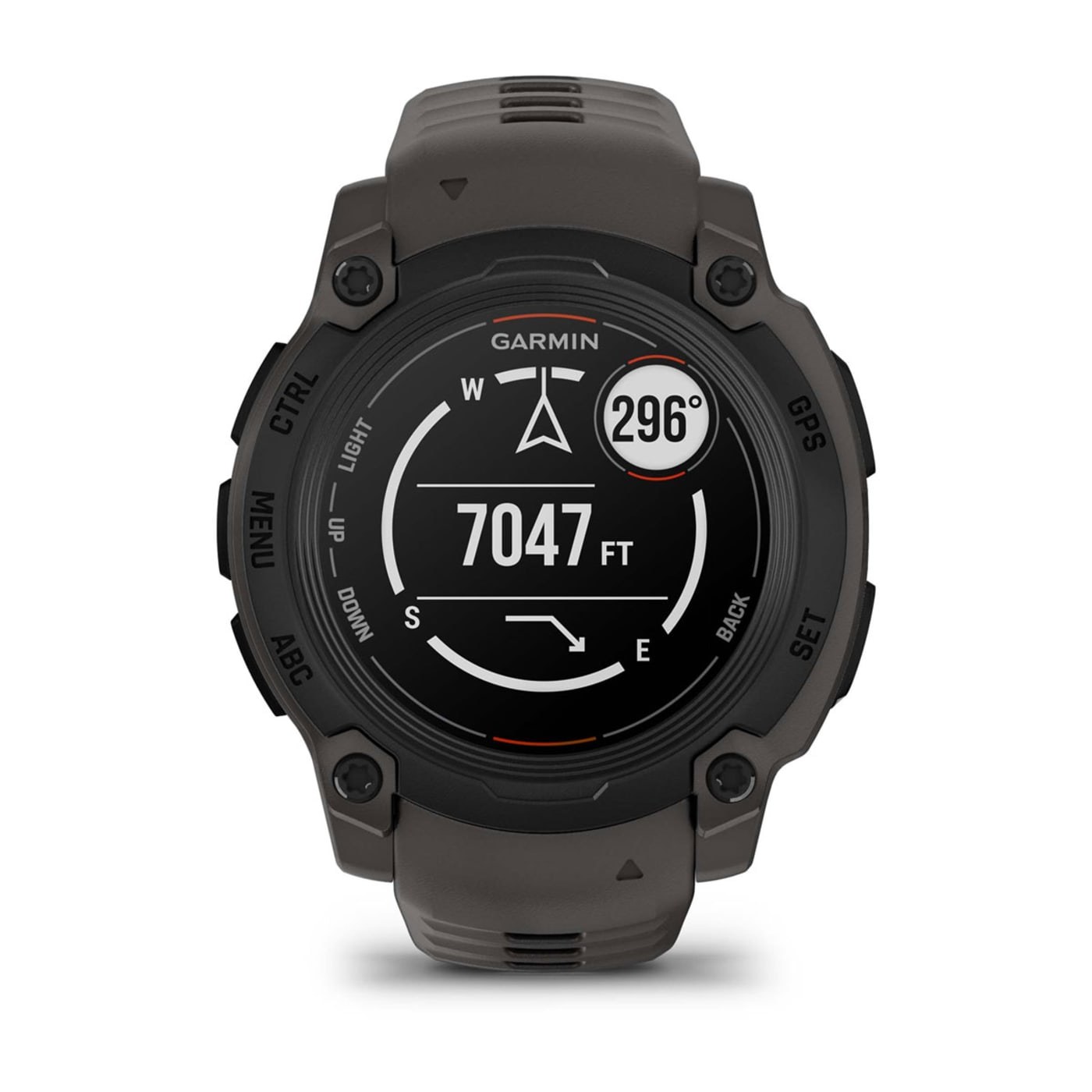
© Garmin, official photo used for editorial purposes
Comfort and handling: a watch you forget you're wearing
Available in 40 mm (42 g) and 45 mm (52 g), the Instinct E suits both slim and larger wrists. The reinforced polycarbonate case takes hits without marking, which the tester who wore it for a year of boxing and MMA confirms: after dozens of heavy bag and weight sessions, not a single visible mark on the case. The silicone strap is the first thing to wear out: it stiffens and warps along the edges after long exposure to sweat, so plan on replacing it around the 12-month mark, at a low cost.
The transflective MIP display stays readable in direct sunlight, a real plus for mountain outings or summer runs, but it looks dull next to an AMOLED screen indoors or in the evening. The chemically strengthened glass (not sapphire) picks up light micro-scratches over time: a screen protector costing a few euros solves that from day one.
Field test: reliable day to day, struggling under hard efforts
Everyday health tracking, continuous heart rate, sleep broken down by stage, Body Battery, stands out as the unanimous strength across available feedback. One tester who wore it for a year says he changed how he manages training after ignoring a low Body Battery score on a hard sparring day: poor performance and a long recovery, a lesson he now applies systematically to his running and strength sessions.
The best-documented limitation concerns the Elevate optical HR sensor during intense, stop-and-go efforts. On sudden accelerations followed by short recoveries, similar to 30/30 or 400 m intervals, the sensor lags 10 to 20 seconds behind your actual heart rate, and can drop out completely on the most violent surges before resyncing on its own. This finding comes from combat sports rather than running, but the optical sensor is exactly the same: the limit applies just as much to a VO2max session as to a sparring round. For demanding intervals, pairing the watch with a chest strap remains the only reliable option.
On navigation, the lack of maps limits the Instinct E to a simple breadcrumb trail with no map background. For road running or familiar marked trails, that's not a problem. For serious trail running in unknown terrain, you need a model with full mapping.
Where it works, where it falls short
Easy runs and aerobic base sessions: the watch's comfort zone. Single-band GPS is good enough, HR is reliable at steady effort, and battery life is never a concern.
Long runs and hiking: very much at home, thanks to the battery life and the tough case. Without maps, stick to a route you already know or one that's marked.
Daily health tracking (sleep, stress, recovery): the watch's strongest point according to all available feedback, with Body Battery leading the way.
Short intervals and VO2max work: this is exactly where the optical HR sensor's weakness shows, with a display lag that throws off real-time reading of your intensity zones.
Technical trail in unknown terrain: off the table without onboard maps; look at a Fenix or an Instinct 3 Solar with full mapping instead.
Flaw #1: an optical HR sensor that drops out on stop-and-go efforts
On a sudden acceleration followed by a short recovery, the Elevate sensor takes 10 to 20 seconds to reflect your actual heart rate, and can lose contact on the most violent surges. On an easy run or a long run at steady pace, you'll never notice. For demanding short intervals, it's a physical limit of the optical sensor, not a software bug: pairing the watch with a chest strap is the only reliable fix identified by testers who push the intensity.
Flaw #2: dated specs and questionable positioning within the lineup
No multi-band GPS, no maps, a transflective screen instead of AMOLED, a plastic case instead of reinforced metal: the Instinct E's spec sheet is lifted from the very first Instinct generation. The real problem isn't so much the missing features at this price point, but the in-house competition from the Instinct 2, regularly discounted to a similar price and offering more advanced features. The Instinct E's rapid price drop since launch, from €299 to €197-222 in under two years, confirms that its original positioning didn't convince.
Garmin Instinct E vs. Instinct 2, the generation it's supposed to replace
The Instinct 2 is still in Garmin's catalog and regularly sells at a price close to, or even below, the Instinct E. On paper, the Instinct E gets a newer processor and a minor software update, but the Instinct 2 keeps features the Instinct E doesn't all offer as standard depending on the configuration. For the same budget, comparing the two before you buy is essential: the newest model isn't always the one that gives you the most for your money.
Garmin Instinct E vs. its direct rivals
Against the Coros Pace 3, the Instinct E loses ground on weight and display (the Pace 3 offers an AMOLED option), but wins back the edge on sheer case toughness and the indestructible philosophy that built the Instinct line's reputation. The Pace 3 stays more focused on pure running performance, the Instinct E more versatile outdoors.
Against the Polar Pacer Pro, the difference comes down to the ecosystem: Polar Flow offers finer training load analysis, while Garmin Connect bets on breadth and community. On heart rate, both models share similar limits on very stop-and-go efforts, and neither is designed to replace a chest strap for hard intervals.
Strengths
- MIL-STD-810 toughness proven over time, not a mark after a year of heavy use
- Comfortable battery life even after degradation (12-14 days after 1 year)
- Complete and reliable daily health tracking (sleep, stress, Body Battery)
- Transflective display that's highly readable in direct sunlight
- 10 ATM water rating, rinse it straight off after every session
Weaknesses
- Optical HR sensor that drops out on short, intense intervals
- No maps and no multi-band GPS
- Rapid price drop since launch, which raises questions about the original price
- Direct in-house competition from the Instinct 2, often just as good a deal
Find the training plan that fits your watch on RunMorph →
RunMorph verdict: 6.8 / 10
The Garmin Instinct E does what you expect from an entry-level Garmin outdoor watch: it takes hits, holds its battery life over time and tracks your health day to day without fail. It stumbles on two documented points: an optical HR sensor that isn't built for demanding intervals, and a spec sheet that quickly justified a price drop of more than 25% since launch. For a regular runner who wants a reliable Garmin for easy runs, long runs and hiking without paying for maps, it earns its place. If you're doing serious VO2max sessions or want to navigate unknown terrain, look elsewhere in the Garmin lineup.
Key takeaways
The Garmin Instinct E is an entry-level outdoor GPS watch at €299 at launch (€197-222 in 2026), with a MIL-STD-810 polycarbonate case, 10 ATM water rating, and no maps or multi-band GPS. Its claimed 16 days of smartwatch battery life drops to 12-14 days after a year of heavy use according to the longest field test available. The optical HR sensor drops out on short, intense intervals, with a 10 to 20 second display lag on sudden accelerations.
Garmin Instinct E FAQ
What's the real battery life of the Garmin Instinct E?
Garmin claims 16 days in smartwatch mode for the 45 mm case. After a year of heavy daily use, one field test measured 12 to 14 days instead, versus 17 days when new.
How much does the Garmin Instinct E cost in 2026?
Launched at €299 in early 2025, it's commonly found between €197.99 and €222 in 2026 depending on the retailer, a drop of 26 to 34% in under two years.
Is the Garmin Instinct E's heart rate sensor reliable for intervals?
At steady effort, yes. On sudden accelerations followed by short recoveries, the Elevate optical sensor lags 10 to 20 seconds and can drop out on the most violent surges before resyncing.
Does the Garmin Instinct E have maps?
No. It only shows a simple breadcrumb trail, with no map background. For serious trail running in unknown terrain, go for a model with mapping like the Fenix or the Instinct 3 Solar.
What's the difference between the Garmin Instinct E and the Instinct 2?
The Instinct E gets a newer processor, but uses an architecture close to the very first Instinct. The Instinct 2, often discounted to a similar price, offers more features: compare the two before you buy.