Hoka Speedgoat 7 Review: Hoka's Trail Icon, Refined a 7th Time
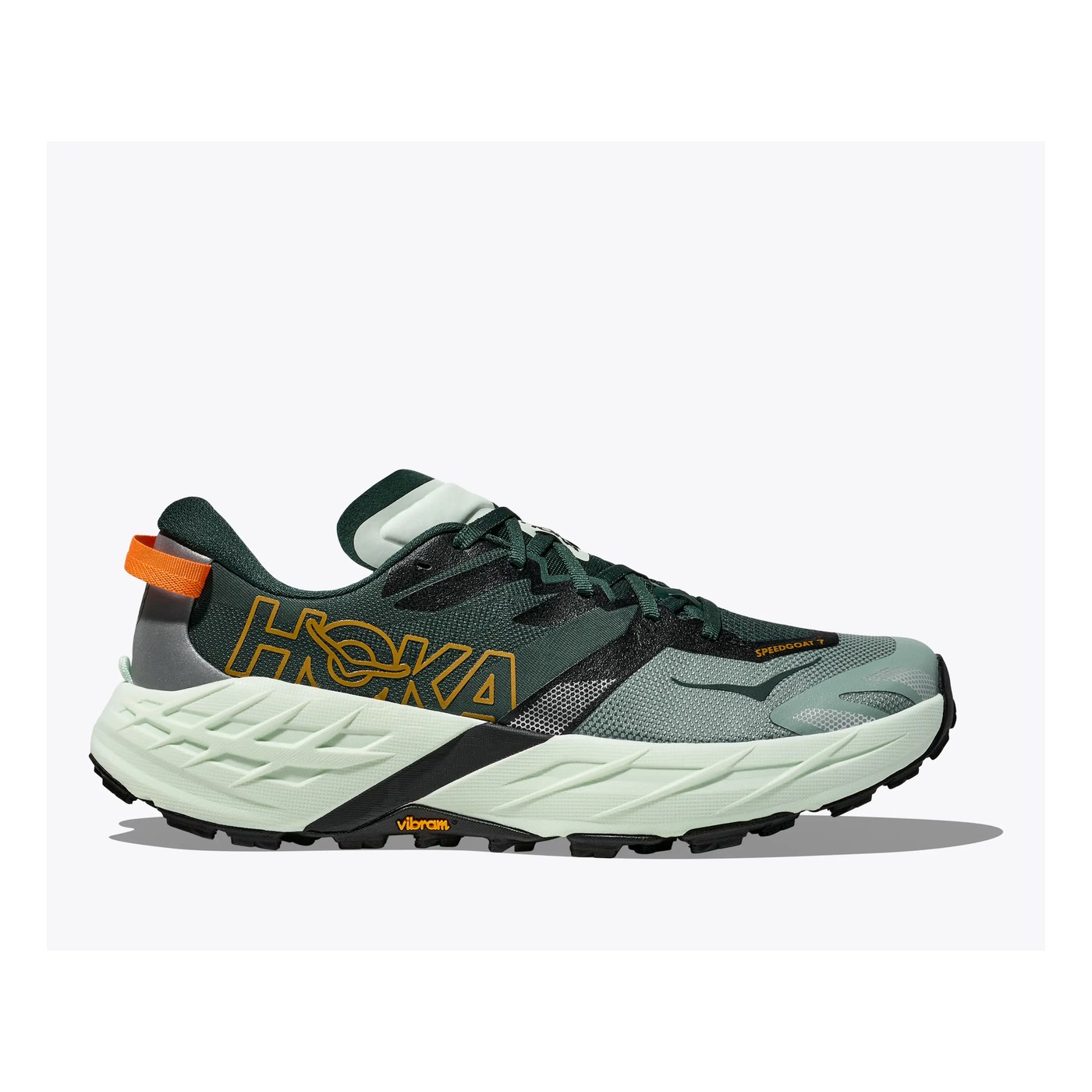
The Speedgoat 7: the trail shoe everyone owns (for good reasons).
If you've been trail running for more than two years, you've definitely crossed paths with a Speedgoat. It's probably the best-selling trail shoe in the world, across every category. Why? Because it pulls off a rare feat: it's versatile, beginner-friendly and still fast enough for experienced runners. This seventh version keeps the line's DNA (Vibram Megagrip, generous cushioning, Hoka geometry) but refines several details that matter.
Hoka reworked the foam, redesigned the outer mesh and tweaked the geometry. Let's dig into whether the Speedgoat 7 keeps its crown as the king of versatile trail shoes, or whether the competition (Salomon Sense Ride, Saucony Peregrine) has finally caught up.
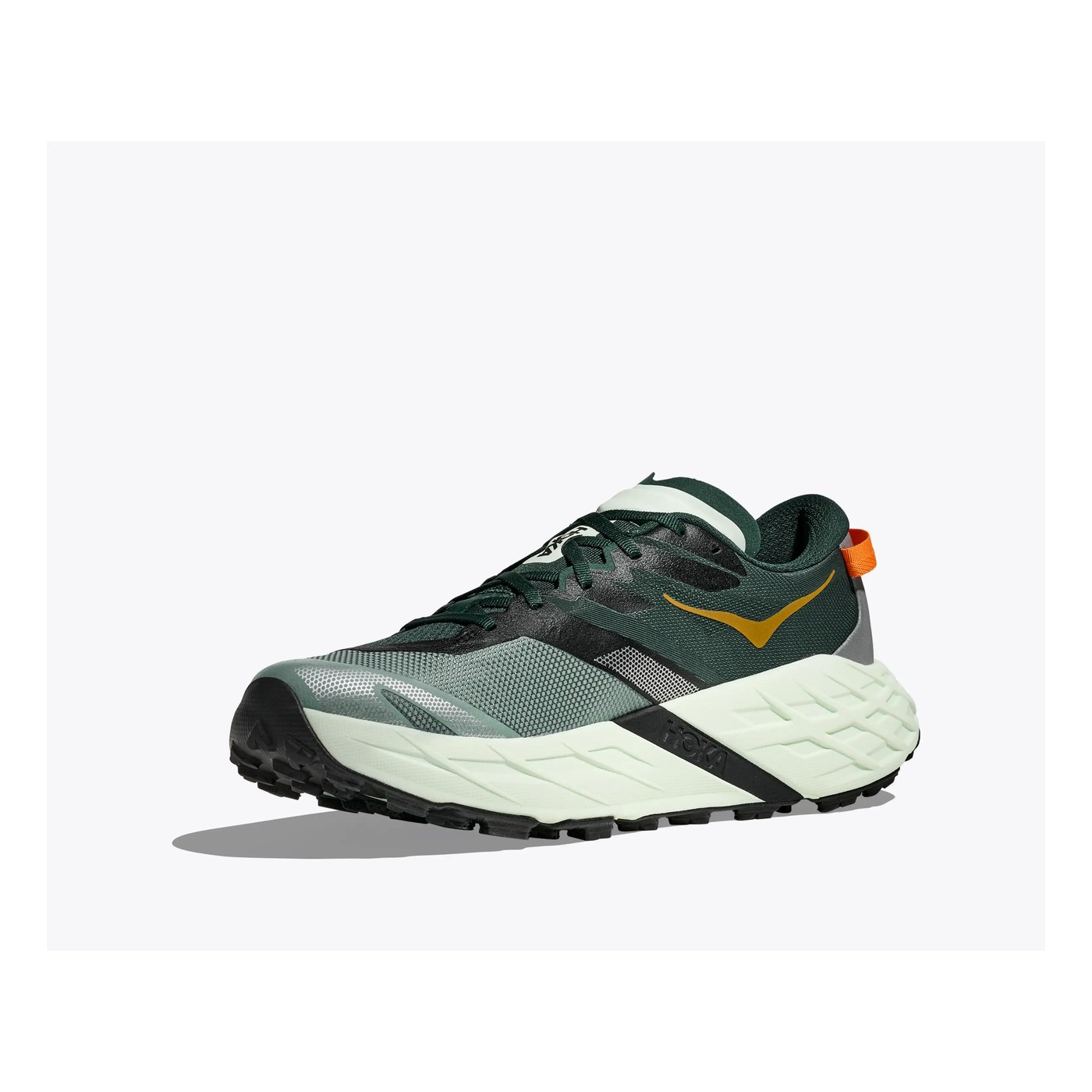
Hoka Speedgoat 7 specs
| Brand | Hoka |
| Model | Speedgoat 7 |
| Release date | March 15, 2026 |
| Intended use | Trail, all-rounder (short to long, moderately technical) |
| Drop | 5 mm |
| Stack height (forefoot / heel) | 35 mm / 40 mm |
| Weight (men's size 42) | 280 g |
| Foam | Reworked supercritical CMEVA |
| Carbon plate | No |
| Outsole | Vibram Megagrip, 5 mm lugs |
| Upper | Breathable engineered mesh |
| Recommended distance | 10 km to ultra trail |
| Suggested retail price | €165 |
| RunMorph score | 9.1 / 10 |
The Speedgoat 7: the Swiss Army knife of trail running
Why did the Speedgoat become the best-selling trail shoe? Because it does everything, and does it well. Here's what defines it:
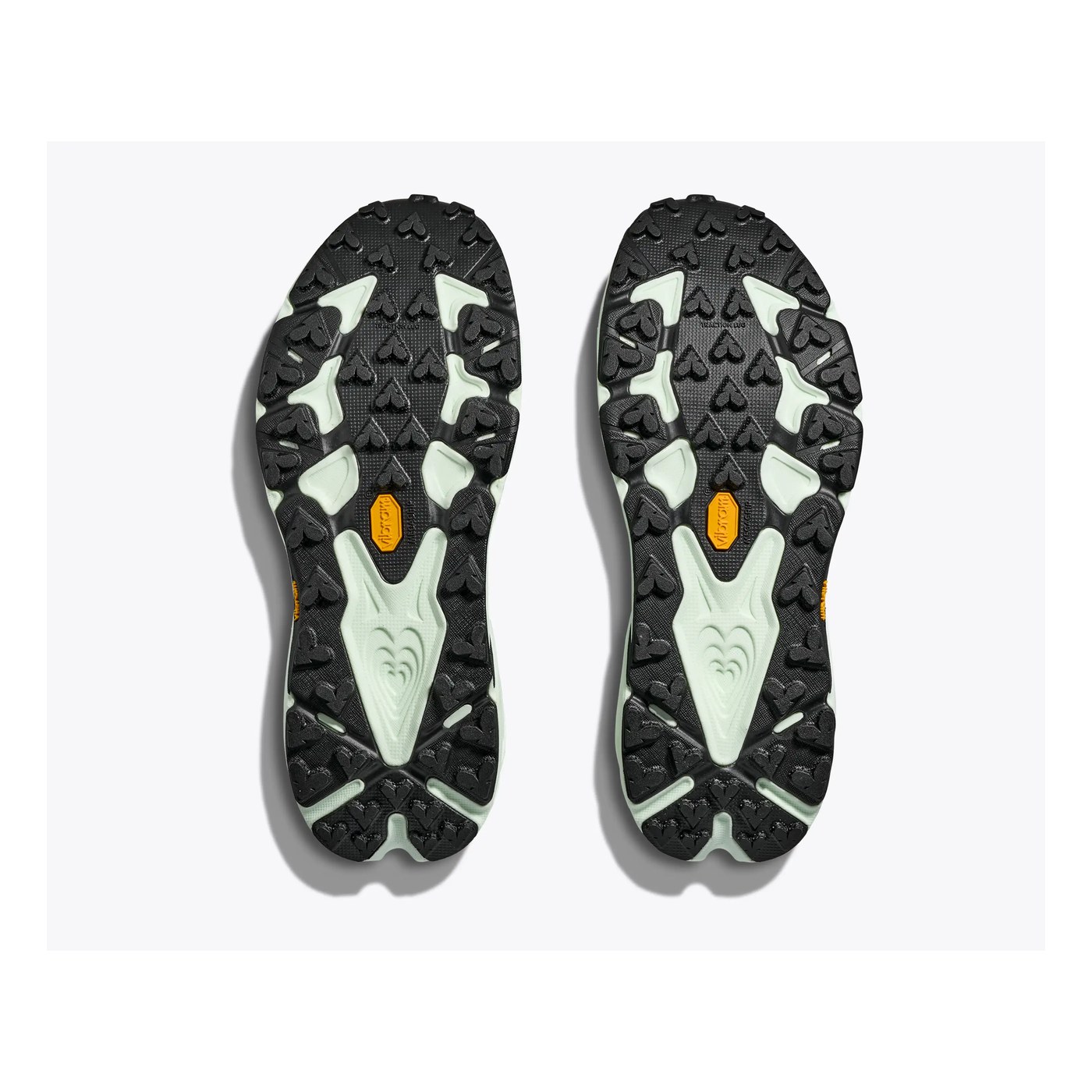
- Benchmark Vibram Megagrip traction: 5 mm lugs, Vibram's exclusive rubber compound and a reworked tread pattern built to maximize grip on every type of surface. Dry trails, rocks, moderate mud, wet roots: the Speedgoat 7 gives you confidence everywhere. That alone justifies the price gap with budget competitors.
- Maximum cushioning for the category: 40 mm of stack height at the heel is rare in a trail shoe. On a long rocky descent or a 4-5 hour run, you can feel that generous cushioning protecting your joints. It's Hoka's DNA carried over to the trail.
- Trail-tuned Meta-Rocker geometry: unlike the road version, the rocker on the Speedgoat is less aggressive. Hoka doesn't want you to be "carried" on technical trails; you need to stay in control of your stride. That's why the shoe stays stable even on tricky sections.
RunMorph's advice: the Speedgoat 7 is the shoe I recommend for 90% of amateur trail runners. It forgives technical mistakes, protects you over distance and grips on every terrain. You can buy it without pinning down your exact trail runner profile. It will adapt to you.
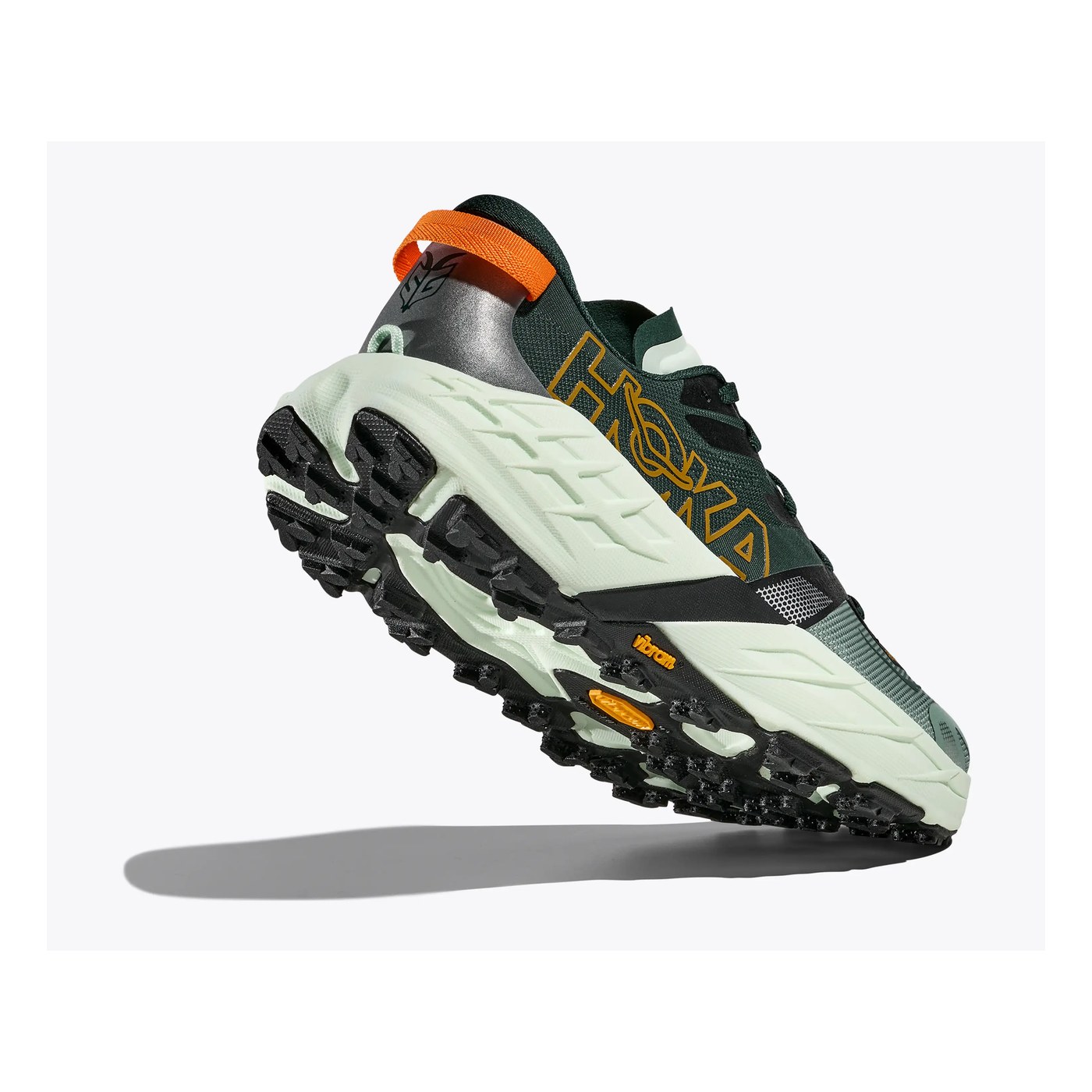
Who is the Hoka Speedgoat 7 for?
Here's our coach's take, profile by profile.
Verdict: the Speedgoat 7 is one of the few trail shoes that works for every profile. From the beginner discovering trails to the experienced runner preparing for a 100 km, including the road marathoner who wants to give trail running a try. For pure performance in short races, look at the Salomon S/Lab Genesis or the Hoka Tecton X 3 instead. For deep mud, the Inov-8 Mudtalon Speed bites harder.
Under the hood: the tech in detail
Supercritical CMEVA foam: the next step in trail foam
The big news on the Speedgoat 7 is its foam, reworked through supercritical injection. In practice, the CMEVA formula gets lighter and more responsive than on the V6. You won't feel a revolution, but at the end of a 3-hour run your legs are a little fresher.
Above all, this foam holds up better over the miles. On earlier versions, you could feel it losing its qualities from 500 km on. With the V7, you can push to 700-800 km before noticing a difference. That's a major plus for a trail runner who piles on volume.
Geometry: a trail-tuned Meta-Rocker
Hoka keeps its Meta-Rocker but adapts it to the trail. On the road, the rocker is pronounced to help you run fast. On trails, it's toned down so it doesn't throw you off balance on technical sections. It's a subtle detail, but a crucial one: a trail shoe should guide your stride without forcing it.
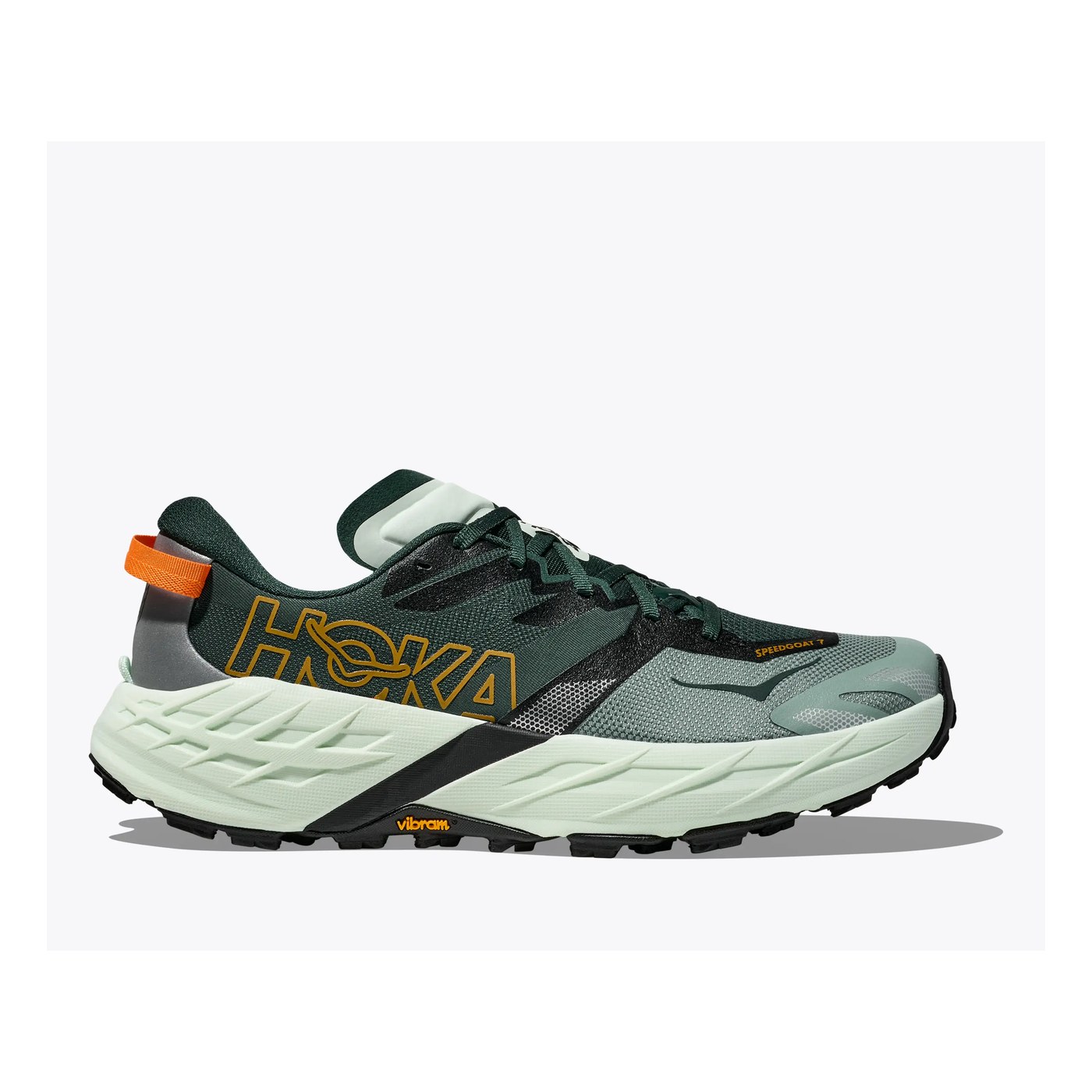
Vibram Megagrip: THE benchmark on the market
Vibram Megagrip is probably the best trail rubber on the market today. It grips almost everywhere: dry trails, rocks, wet roots, damp grass. The only terrain where it hits its limits: deep mud (5 mm lugs aren't enough to dig in) and snow (no spikes or long lugs).
The outsole pattern was slightly reworked on the V7 to shed mud better between the lugs, a small improvement you notice as soon as conditions turn wet.
Redesigned upper: tougher, still breathable
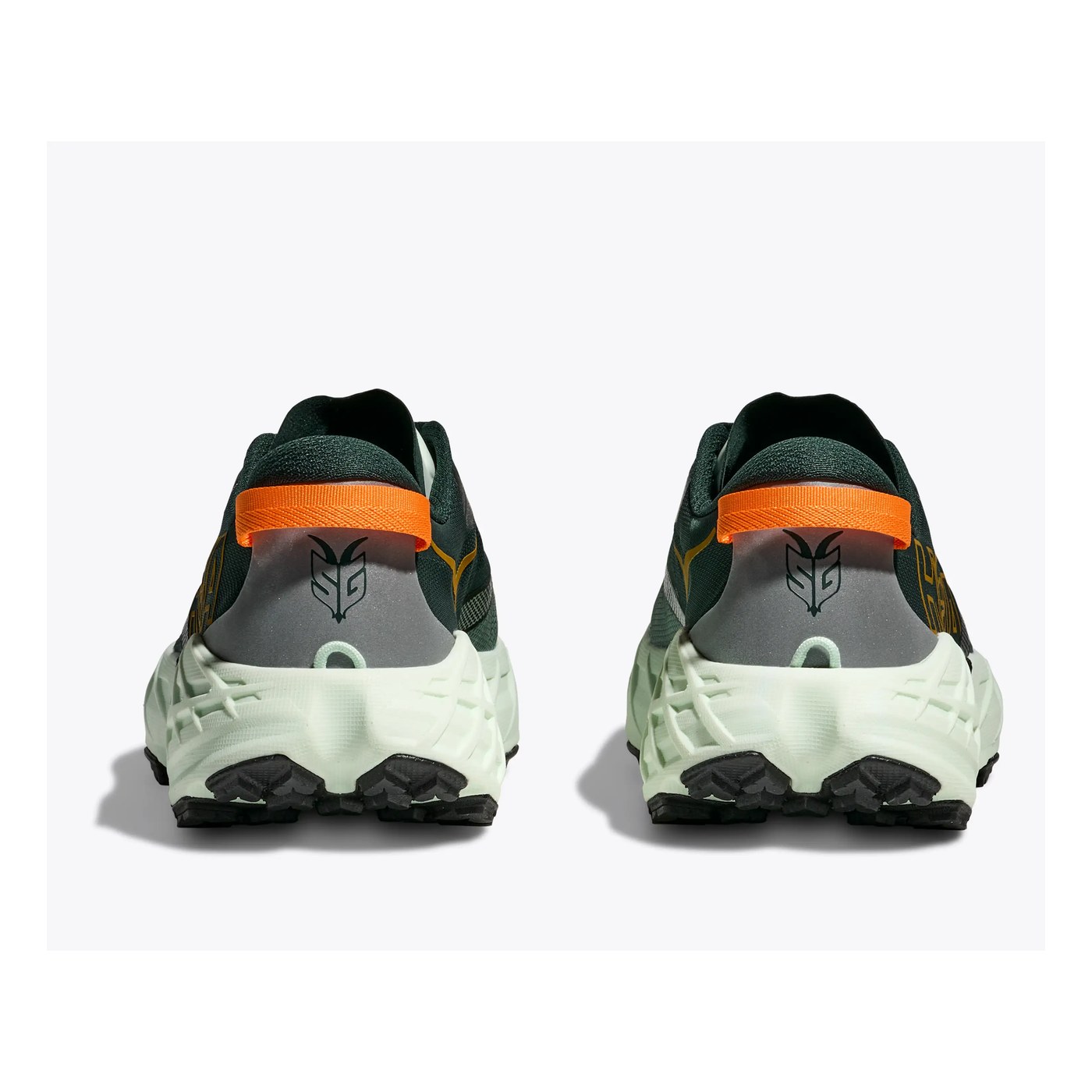
The upper was reworked to gain durability without losing breathability. The mesh is tighter in abrasion zones (outer sides, toe) and more open on top to let heat escape. The heel counter is padded without overdoing it, and the lacing delivers a precise lockdown with no pressure points.
What French reviewers say
u-Trail stresses that the Speedgoat 7 remains the absolute benchmark for versatile trail running, with a comfort/grip/durability balance that's unique on the market. The review especially praises the new, livelier foam and the improved durability.
Pacing Trail highlights the model's exceptional versatility: it handles long runs, short races and daily training without flinching. The verdict is unequivocal: it's the shoe recommended by 80% of French trail coaches.
Lepape-Info confirms the Speedgoat's dominant position in the versatile trail segment, noting that even as the competition (Saucony Peregrine, Salomon Sense Ride) improves, Hoka keeps its lead thanks to the Vibram Megagrip + generous cushioning combination.
Our RunMorph coach's take. The consensus is clear: the Speedgoat 7 is the mature evolution of a formula that has worked for seven versions. Hoka didn't want to break what works, but it refined the details (foam, durability, mud shedding). If you loved the V6, get the V7 without hesitation.
Quick comparison
Speedgoat 7 vs Salomon Sense Ride 5. The Sense Ride is snappier and geared toward fast trail running, with a higher drop (8 mm) that suits heel strikers. The Speedgoat offers more protection and more versatility over distance. Verdict: Sense Ride for short, punchy trail runs, Speedgoat for long-distance versatility.
Speedgoat 7 vs Saucony Peregrine 14. The Peregrine is more affordable (€140 vs €165) and more geared toward short technical trails. The Speedgoat offers more cushioning and more versatility for long distances. Verdict: Peregrine for the short, technical runner, Speedgoat for the high-volume, long-distance runner.
Speedgoat 7 vs Hoka Tecton X 3. Two Hokas with opposite philosophies. The Tecton X 3 is a racing shoe with carbon plates, built for timed goals. The Speedgoat is the versatile daily trainer. Verdict: Tecton X 3 on race day, Speedgoat 7 for 90% of your runs.
Fitting the Speedgoat 7 into your training strategy
The Speedgoat 7 shines as the main shoe of a versatile trail runner. Here's how to use it smartly:
- As your only trail shoe: if you run 50-80 km/week on trails and have no specific time goal, the Speedgoat 7 can do it all: training, long runs, first ultras. That's the most common scenario.
- As your training workhorse: in a 2-pair trail rotation, the Speedgoat 7 takes on the weekly volume and the long runs. Keep a snappier pair like the Salomon S/Lab Genesis or the Hoka Tecton X 3 for races and fast sessions.
- For ultras: the Speedgoat 7 is one of the best shoes for finishing an 80-160 km race. Its generous cushioning protects your legs over the distance, so you can keep a clean stride all the way to the finish line.
RunMorph's advice: many runners start trail running in a shoe that's too technical, thinking it will help them. It's the opposite: when you're starting out, you need a forgiving shoe that lets you focus on your stride instead of fighting a demanding shoe. The Speedgoat 7 is exactly what you need for this phase, and it will stay relevant even after you've progressed.
The RunMorph coach's verdict
As a coach, the Speedgoat 7 is the trail shoe I recommend to the most runners. Why? Because it pulls off the feat of being protective for beginners, versatile for regular runners and reliable for ultra runners looking for comfort. Very few trail shoes tick all these boxes at once.
The move from V6 to V7 is smart: Hoka refined the foam for more responsiveness and durability, reworked mud shedding and kept everything that made up the model's DNA. The result is a more mature shoe, better suited to the long haul. If you loved the V6, you'll love the V7 even more.
The only real downside: weight. At 280 g, it's not the lightest trail shoe on the market. For a runner focused on pure race performance, the Tecton X 3 or the S/Lab Genesis will be more efficient. But for 90% of amateur trail runners, the Speedgoat 7 is probably the best choice right now.
RunMorph score: 9.1 / 10. At €165, it's a very reasonable investment for such a versatile, durable shoe. Buy it if you want a reliable trail shoe for everyday runs and long distances. Look elsewhere if you're chasing pure speed (Tecton X 3, S/Lab Genesis) or if you mostly run in mud (Mudtalon).
Key takeaways for your training
- The benchmark versatile trail shoe: the Speedgoat 7 is designed for 70-90% of your trail runs (short, long, moderately technical).
- Vibram Megagrip + 5 mm lugs: the best traction on the market today for all-round trail running.
- Supercritical CMEVA foam: new on the V7, livelier and more durable than on the V6.
- 40 mm stack height + Meta-Rocker: maximum cushioning and a geometry that guides your stride without forcing it.
- 5 mm drop: encourages a midfoot strike. If you're coming from a high-drop shoe, allow 1-2 weeks to adapt.
- Broad target audience: beginners, regular runners, ultra runners. Everyone gets something out of it.
- Excellent value for money: €165, one of the best deals in the versatile trail segment.
Frequently asked questions
Is the Hoka Speedgoat 7 good for trail running beginners?
Yes, it's actually one of the best shoes to start trail running in. Its stability, comfort, Vibram Megagrip traction and versatility make it an ideal pair to discover trails and progress to your first 15-30 km races.
How many kilometers does the Speedgoat 7 last?
Expect 700 to 800 km before a noticeable loss of performance. The new supercritical CMEVA foam holds up better over the miles than on the V6, and the Vibram Megagrip outsole is one of the most durable in the segment.
Does the Speedgoat 7 run large or small?
It fits true to size, with a roomier fit than Hoka's road shoes. It's one of the most accommodating Hoka trail shoes for wide feet. If in doubt, go with your usual size.
What's the difference between the Speedgoat 7 and the Speedgoat 6?
Three major changes: new supercritical CMEVA foam (livelier and more durable), a reworked upper (more breathable and tougher), and a slightly modified outsole pattern that sheds mud better. Weight, drop, stack height and the Vibram rubber stay nearly identical. It's an incremental update rather than an overhaul.
Is the Speedgoat 7 a good fit for an ultra trail (80 km and up)?
Yes, it's actually one of the best shoes on the market for that distance. Its generous cushioning protects your legs over the distance, its Vibram Megagrip traction gives you confidence even when you're tired, and its durability lets you finish the race without the shoe breaking down. For pure ultra performance, also look at the Hoka Mafate Speed 5 or the La Sportiva Akasha II.
Recommended articles
- La Sportiva Prodigio 2: versatile trail shoe review
- Hoka Mach 7: the full RunMorph review
- Trail training plan: the complete guide
- Nike ACG Zegama Trail: ZoomX + Vibram Megagrip for ultra trail