Samsung is done playing second fiddle to Apple and Garmin in the sports watch world. With the Galaxy Watch Ultra, the world's biggest smartphone maker finally ships a watch built to go after the summits. Titanium, sapphire glass, dual-band GPS, extended battery life and an arsenal of sensors inspired by preventive medicine: does it deliver, or is it all show?
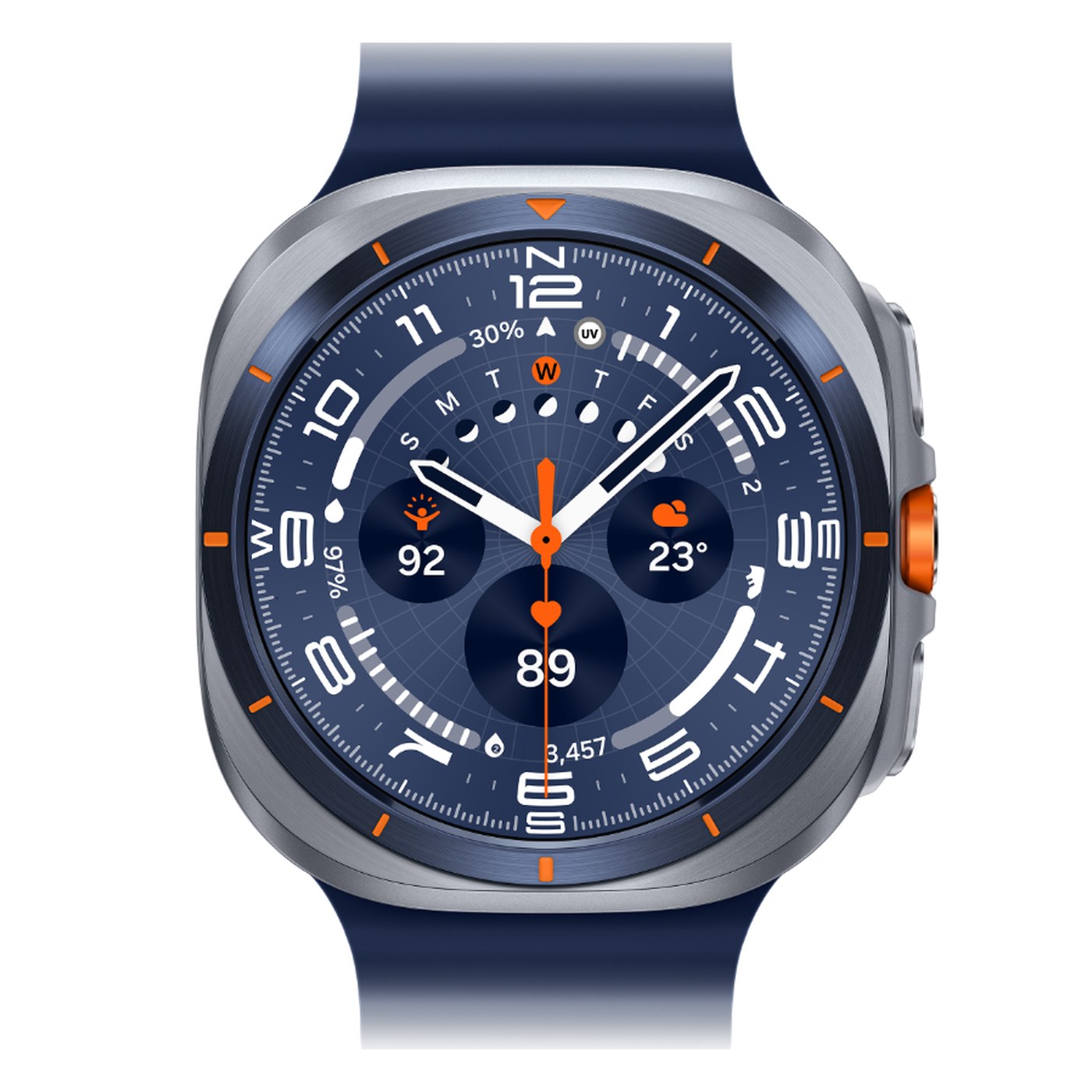
Samsung Galaxy Watch Ultra in Titanium Blue with the Marine band. Samsung, official photo used for editorial purposes.
Samsung Galaxy Watch Ultra: the smartphone leader takes on extreme sports
Until now, the GPS sports watch market was a two-horse race between Garmin and Apple, with Polar and Suunto as outsiders. Samsung may be the world's number 1 smartphone maker, but it struggled to make the Galaxy Watch a serious tool for demanding runners. The Galaxy Watch Ultra changes that.
Unveiled in July 2025, this watch drops the classic round Galaxy Watch design for a 47 mm "squircle" (a square with rounded corners) that deliberately echoes the Apple Watch Ultra. The Grade 4 titanium case, sapphire glass and MIL-STD-810H certification send a clear message: Samsung wants to play in the big leagues.
At RunMorph, we put the watch through a week of testing at paces from 4:30/km to 6:30/km, intervals included, plus trail runs of 15 to 25 km. Here's what we took away.
BioActive technology: what does it change on your wrist?
Samsung's BioActive sensor is the heart of this watch. It packs three functions into a single module: optical heart rate, SpO2 and bioelectrical impedance. That last one enables measurements no other smartwatch on the market offers.
The AGEs index (Advanced Glycation End-products) is the flashiest new feature. This marker, usually measured in a lab by spectroscopy, is estimated here through bioimpedance while you sleep. Samsung makes no medical claims, but tracking this index over time can reflect how your diet and recovery affect your metabolism. For a runner who optimizes every variable of their training, that's valuable long-term data.
Vascular load, for its part, assesses the strain on your cardiovascular system at rest and during exercise. Combined with sleep tracking and the Galaxy AI energy score, it gives you a more complete picture of your recovery than a simple resting heart rate average.
One catch: blood pressure measurement and ECG only work with a Samsung smartphone. That's the first major limitation of the ecosystem.
GPS accuracy and mapping: a match for Garmin?
Dual-frequency GPS (L1 + L5) is where Samsung catches up. Tested on wooded trails and in dense urban areas, the tracks are far cleaner than on older Galaxy Watch models. Deviations on 5 km forest loops stay under 1-2%, which puts the watch at the top end of the market, on par with the Garmin Fenix 8 and the Suunto Vertical 2.
Offline mapping benefits from 64 GB of storage, double the previous generation. You can load detailed topo maps for several regions without worrying about running out of space. Track Back, borrowed from outdoor watches, guides you back to your starting point safely, even with no cell signal.
Night mode, which turns the display red, is a smart touch for trail runs after dark: it preserves your peripheral vision while keeping your data visible. Garmin has offered this for years, but Samsung executes it with style.
Field test: battery life, comfort and readability
We tested the Galaxy Watch Ultra for a week, logging around forty kilometers in total (easy runs, intervals and an 18 km trail run). It holds up well, with a few caveats.
The 3000-nit AMOLED display is stunning. In full summer sun, readability is flawless, clearly better than Suunto's transflective screens. The watch face complications stay readable at a glance, even running at 4:30/km.
Battery life, on the other hand, is its relative weak spot. In daily training use with GPS on 4-5 times a week, expect 2 to 2.5 days between charges. That beats an Apple Watch Ultra 2, but falls far short of the 5-7 days of a Garmin Forerunner 965 or the 10+ days of a COROS Vertix 2S. Fast charging (about 60 minutes) partly makes up for it, but ultrarunners will need a power bank for races over 24 hours.
Comfort on the wrist splits opinion. At 60.5 g and 47 mm across, the watch is imposing. Runners with slim wrists will find it bulky, especially at night. The proprietary bands (Marine, Trail, PeakForm) are well made, but their incompatibility with older Galaxy Watch bands will frustrate owners of previous models.
RunMorph's advice: if you're torn between the Galaxy Watch Ultra and a Garmin, ask yourself one question: do you use a Samsung smartphone? If so, the Galaxy Watch Ultra integrates seamlessly (blood pressure, ECG, Galaxy AI). If not, a Garmin gives you a more open ecosystem and longer battery life.
Samsung Galaxy Watch Ultra vs Garmin Fenix 8: the head-to-head
| Criterion | Samsung Galaxy Watch Ultra | Garmin Fenix 8 |
|---|
| Display | 1.5" AMOLED, 3000 nits | 1.4" AMOLED, 1000 nits |
| GPS battery life | ~48 h | ~96 h |
| GPS | Dual-band L1+L5 | Multi-band L1+L5 |
| Health sensors | BioActive (AGEs, vascular load) | HR, SpO2, HRV, ECG |
| Mapping | Offline, 64 GB | TopoActive, 32 GB |
| Ecosystem | Android, optimized for Samsung | Cross-platform |
| Price | €599-749 | €899-1099 |
Which one you pick depends on how you train. The Galaxy Watch Ultra wins on the display, its innovative health metrics and price (compared with the Fenix 8). The Fenix 8 stays ahead on battery life, training ecosystem and cross-platform compatibility. For a triathlete who races ultras, Garmin remains the safe choice. For a city runner and amateur trail runner who wants a complete smartwatch, Samsung offers solid value for money.
Which runner is the Galaxy Watch Ultra made for?
Three profiles stand out as ideal users of this watch.
The versatile Android runner
You run 3 to 4 times a week, on roads and trails, and you want a watch that looks as good at the office as it performs on the trails. The AMOLED display, smart notifications and premium design cover exactly that.
The health-tracking enthusiast
You already track your sleep and recovery, and you're curious about new metrics like the AGEs index or vascular load. Samsung Galaxy AI turns this data into actionable recommendations, with no paid subscription required.
The weekend trail runner
You head out for 15 to 30 km runs on weekends, sometimes at night. Dual-band GPS, offline mapping and night mode have you covered. For a 50 km ultra or longer, though, battery life will be tight.
How to fit the Galaxy Watch Ultra into your RunMorph training plan
The Galaxy Watch Ultra excels at day-to-day tracking: Training Readiness, energy score and sleep analysis help you dial in your running intensity. Paired with the RunMorph app, it lets you follow your training schedule on the watch while getting Samsung's advanced recovery metrics.
At RunMorph, we recommend using the watch for the three pillars of your training:
- Recovery: sleep tracking and the energy score help you adjust your training load week after week.
- Quality sessions: dual-band GPS and accurate heart rate let you stay in your pace zones during intervals and tempo runs.
- Long runs: offline mapping and Track Back keep your trail explorations safe, even with no cell coverage.
👉 Explore RunMorph training plans tailored to your level and goals.
The RunMorph Coach's verdict
The Samsung Galaxy Watch Ultra is a success. Samsung has finally understood what demanding runners expect from a premium sports watch: a bright display, accurate sensors, a rugged build and a smart ecosystem. The AGEs index and vascular load deliver genuinely new data, not empty marketing.
The main drawback is still battery life. Two to three days is enough for daily use but tight for multi-day adventures. And locking some health features to Samsung smartphones penalizes owners of other Android brands.
At €599 to €749 depending on the version, the Galaxy Watch Ultra positions itself as a credible alternative to the Apple Watch Ultra 2 for Android users, and as a more affordable watch than the Garmin Fenix 8, with trade-offs on battery life and the training ecosystem.
RunMorph score: 8/10. A very good GPS watch that lacks the battery life to reach excellence.