Launched in May 2023, the Garmin Forerunner 965 has come through two years of firmware updates and fierce competition to land in 2026 with an unexpected position: at around €499, it offers offline TopoActive maps, dual-band L1+L5 GPS and 32 GB of streaming music, while its direct rival, the newer Garmin Forerunner 570 (€549), has neither of those last two features. Here's why it deserves your attention in 2026 more than ever.
Garmin Forerunner 965 Review: AMOLED, Maps and 32 GB of Music
8.5/10
The essentials in 3 sentences
The Garmin Forerunner 965 packs a 1.4-inch AMOLED display, dual-band L1+L5 multi-band GPS and offline TopoActive maps into a 53 g case: a trio few rival watches offer under €500. With 32 GB of music storage, Garmin Pay and one of the most complete physiological suites on the market, it targets serious runners who don't want to leave their phone in the locker room. Its one real drawback: 31 h of GPS battery life means you'll need to recharge before long ultra trails.
8.5
/ 10 · RunMorph overall score
Who is it for?Runner-triathletes who want maps, music and multi-band GPS without spending €749
Who should skip it?Ultrarunners who need 40+ h of continuous GPS or a built-in flashlight
Garmin Forerunner 965: AMOLED, maps and music, the sweet spot of the Forerunner lineup
In the 2025-2026 Forerunner lineup, every watch holds a clear position. The Forerunner 70 (€249.99) opens the AMOLED series. The Forerunner 170 (€299.99) adds a barometric altimeter. The Forerunner 265 (€449) steps up in performance, without maps. The Forerunner 570 (€549) adds L1+L5 multi-band GPS and Triathlon Coach, but no maps and no music. Then there's the 965: the first watch in the running lineup to carry TopoActive maps and 32 GB of music storage. The Forerunner 970 (€749) only truly beats it on ECG, the LED flashlight and sensor generation (Elevate Gen 5 vs Gen 4).
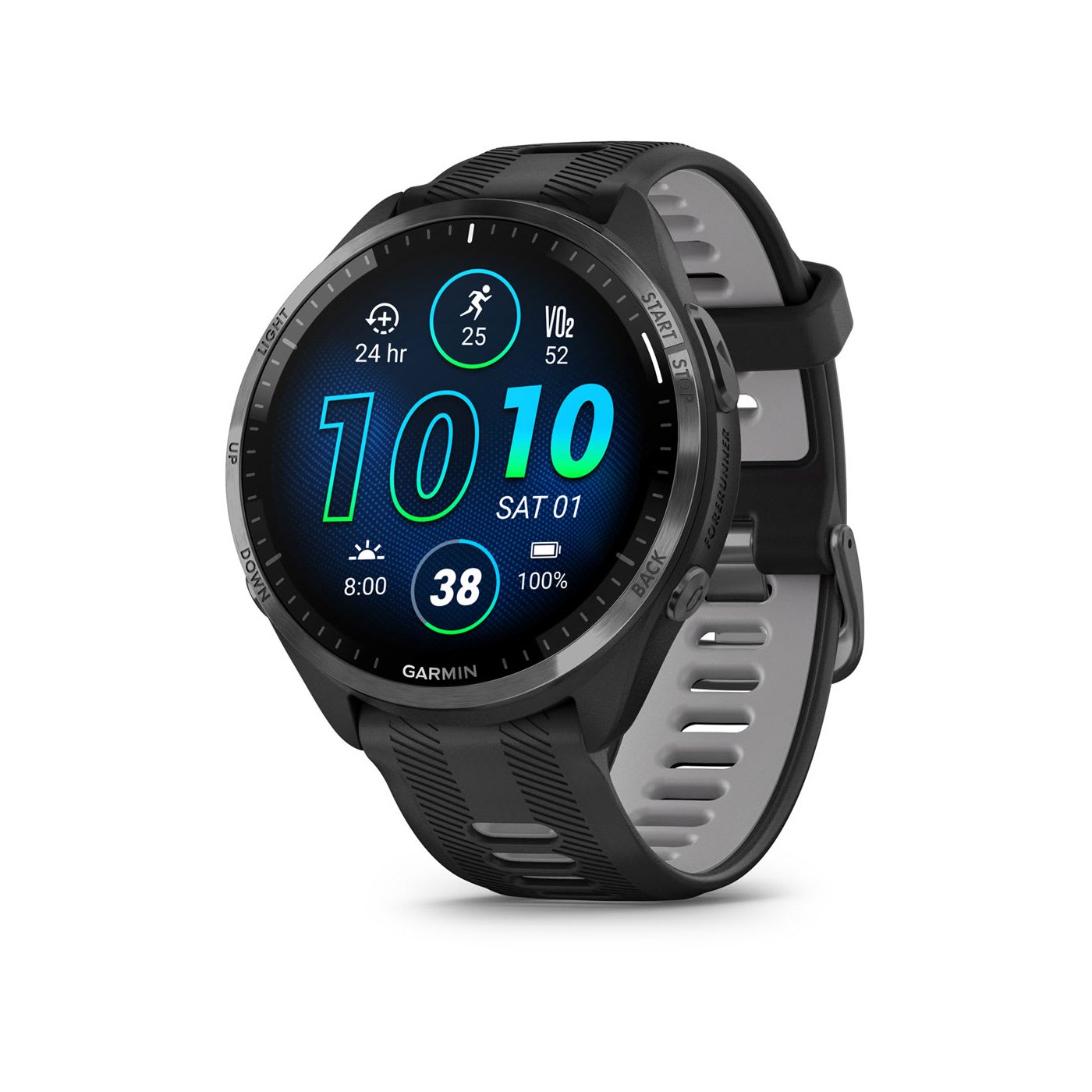
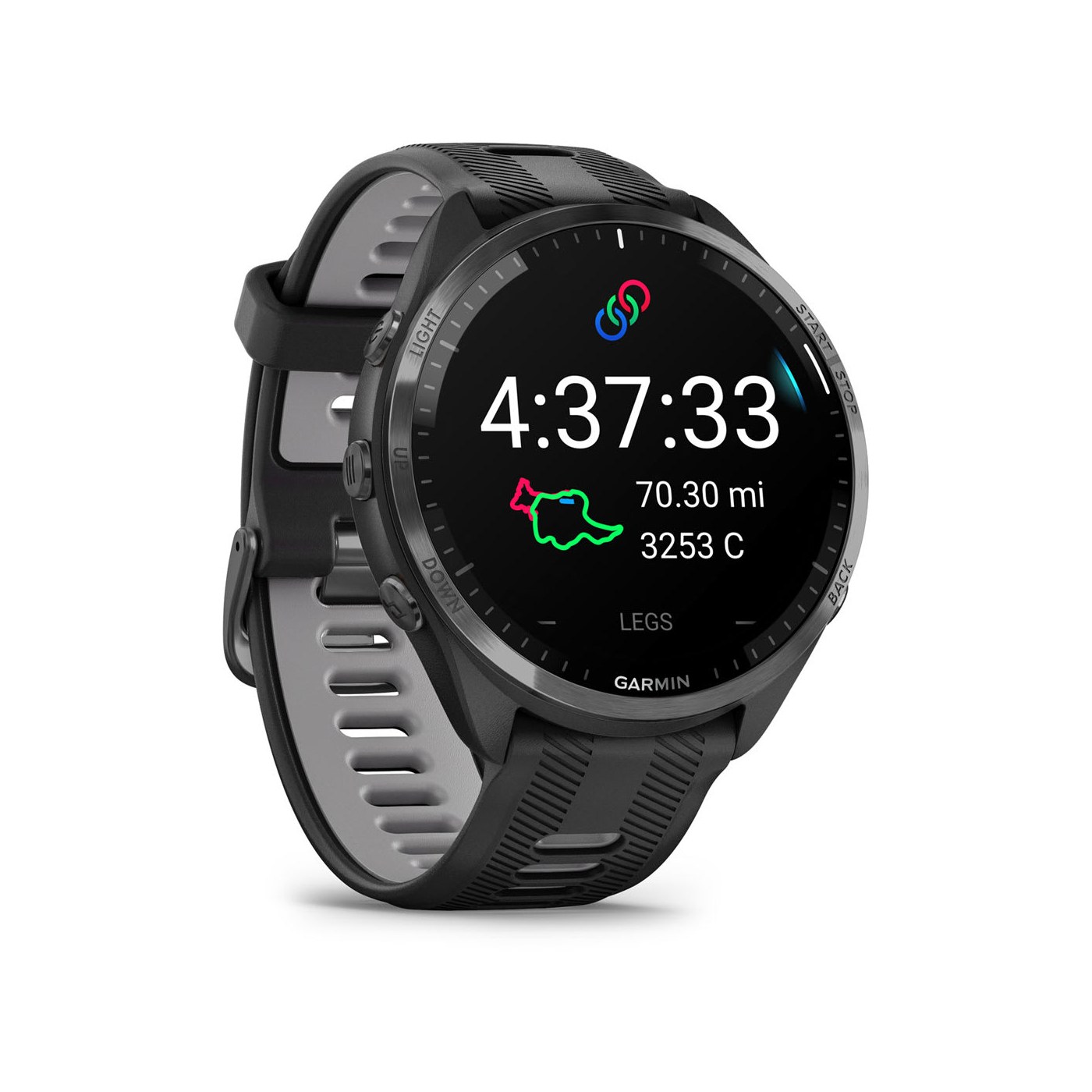
On the wrist, the Forerunner 965 in Carbon Gray DLC Titanium weighs 53 g, two-tone black/powder gray silicone band included. The 47.1 mm case houses a 1.4-inch (35.56 mm) AMOLED touchscreen at 454x454 pixels under Gorilla Glass DX: readable in full sun at 11 a.m., and responsive to touch even with thin gloves. The DLC-coated titanium bezel gives it real impact resistance despite its clean, sporty profile.
RunMorph's advice: if you're torn between the Forerunner 965 and the Forerunner 570, remember that the 570 (newer and €50 more expensive) offers neither maps nor onboard music. For a triathlete who also runs in the mountains or the woods, the 965 is objectively the better watch at its current price. For a wider comparison, also read our review of the COROS Pace Pro (€349, maps + multi-band GPS, no music).
Pros
- Offline TopoActive maps (Europe preloaded, rest of the world via Wi-Fi)
- Dual-band L1+L5 GPS with adaptive SatIQ
- 32 GB of music (Spotify, Deezer, Amazon Music)
- Built-in Garmin Pay
- The most complete physiological suite in Garmin's running lineup
- Triathlon/duathlon/swimrun profiles with automatic T1/T2 transitions
- 1.4-inch AMOLED readable in full sun
- Interchangeable 22 mm quick-release band
Cons
- 31 h of GPS battery life: not enough for 40+ h ultra trails
- No ECG (reserved for the Forerunner 970 and fenix 8)
- No built-in LED flashlight
- Elevate Gen 4 sensor (the 970 gets Gen 5)
- One size only, 47.1 mm: no compact version
- Worldwide maps must be downloaded separately over Wi-Fi
Technical specs
| Spec | Garmin Forerunner 965 |
|---|---|
| Brand | Garmin |
| Model | Forerunner 965 (ref. 010-02809-00, Carbon Gray / Black) |
| Official release | May 2023 |
| Case | 47.1 mm, Carbon Gray DLC titanium bezel + reinforced polymer |
| Weight | 53 g (22 mm two-tone silicone band) |
| Display | 1.4-inch (35.56 mm) AMOLED touchscreen, 454x454 px, Gorilla Glass DX |
| GNSS | Dual-band L1+L5 multi-band (GPS/GLONASS/Galileo/BeiDou/QZSS) + SatIQ |
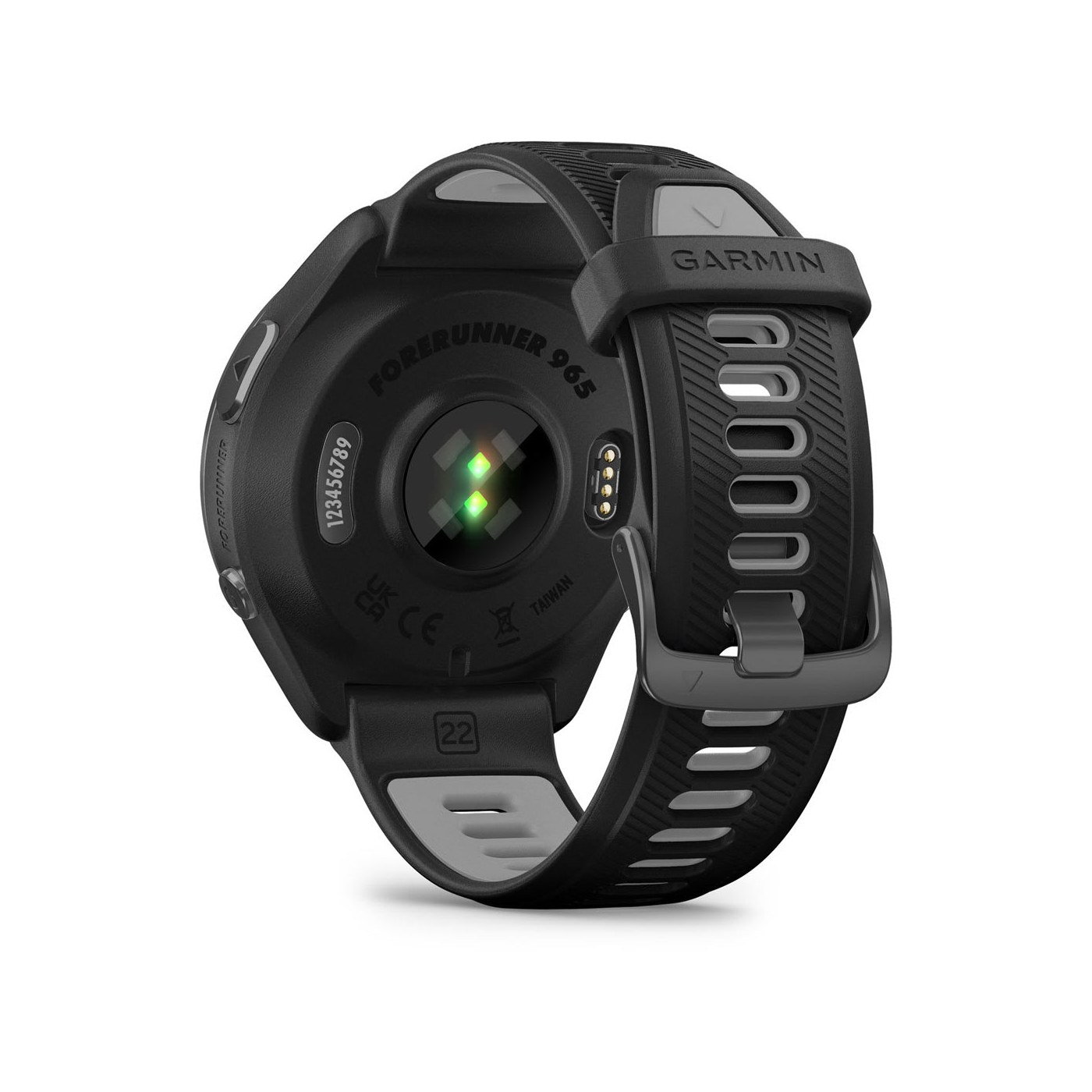
| Heart rate sensor | Elevate Gen 4 (optical OHR + SpO2) |
| Other sensors | Barometric altimeter, compass, gyroscope, thermometer, accelerometer |
| ECG | No |
| Maps | Yes: TopoActive Europe preloaded + extra regions via Wi-Fi |
| Sport profiles | 80+ profiles (triathlon, duathlon, swimrun, automatic transitions) |
| Music storage | 32 GB (Spotify, Deezer, Amazon Music) |
| Contactless payments | Yes (Garmin Pay) |
| Water rating | 5 ATM (50 m) |
| Battery life | 23 days smartwatch / 31 h standard GPS / 21 h All-Systems GPS / 8 h GPS + music |
| Charging | USB-C (via proprietary magnetic adapter) |
| Connectivity | Bluetooth 5.0, ANT+, Wi-Fi 2.4 GHz |
| Price | €649.99 (2023 launch) / from €499 (July 2026) |
Who is the Forerunner 965 for?
The runner-triathlete who wants maps without paying €749
This is the core profile. You race sprint or Olympic triathlons, you regularly head out to run in the woods or the mountains, and you don't want to wrestle with your phone to find your way. The Forerunner 965 gives you TopoActive maps, automatic T1/T2 transitions and Garmin's Triathlon Coach in a 53 g case. At €499, no direct competitor offers the full trio. The COROS APEX 4 (€499.99) comes closest, but without the 32 GB of music.
The serious marathoner running 4:00-5:30 min/km paces
You're training for a half or a full marathon on a structured plan, and you want to analyze your cadence, stride length and wrist-based power without an external sensor. The 965's physiological suite (Training Readiness, HRV Status, Training Load, real-time Stamina) is the most complete in the affordable range, and the adaptive Daily Suggested Workouts easily replace a basic coach. Syncing with RunMorph training plans takes a few seconds through Garmin Connect.
The weekend trail runner covering 15-40 km
You're not an ultra trail runner, but you do a few 20-40 km trail races a year. The 31 h of standard GPS battery life is plenty for those distances. TopoActive maps give you confidence on unmarked terrain, and ClimbPro previews your climbs so you can manage your energy reserves better. If you regularly race for more than 35-40 h, look instead at the COROS APEX 4 (65 h All-Systems GPS, €499.99) or the Polar Grit X2 Pro (43 h dual-band GPS, €749).
GPS accuracy and heart rate sensor
The Forerunner 965's dual-band L1+L5 GPS, paired with adaptive SatIQ mode, puts the watch among the leaders for track accuracy. SatIQ automatically picks the most efficient satellite mode for your surroundings: in urban canyons or under dense tree cover, it switches to full multi-band; in open countryside, it saves battery with single-band acquisition. On 10 to 30 km runs over mixed terrain, recorded distances land within 1.5% of a measured reference: more than enough for runners following a plan at a precise pace.
The Elevate Gen 4 sensor holds up well on easy runs (paces between 5:00 and 6:30 min/km), with heart rate readings generally within plus or minus 3 bpm of a chest strap. Short, high-intensity intervals (200-400 m repeats) can produce larger gaps, as on every optical watch. For those sessions, pairing the 965 with a Garmin HRM 600 or a COROS HR Monitor remains the most reliable option for quality workouts. In the pool, the watch uses its accelerometer to count lengths with Garmin's usual accuracy.
Maps and navigation on the Forerunner 965
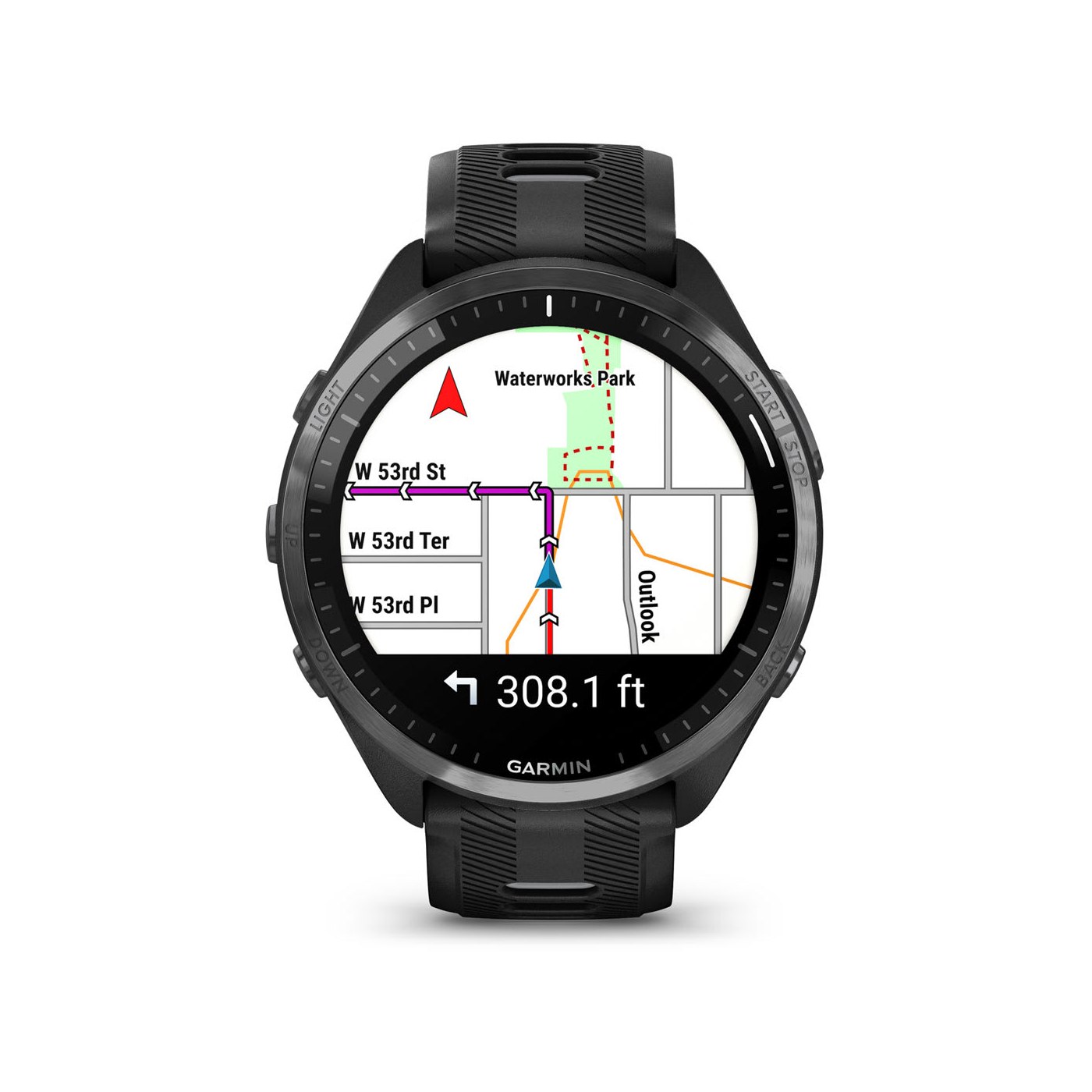
Preloaded TopoActive Europe maps are the 965's number one selling point within its lineup. Available from the Navigation menu, they show paths, marked hiking trails, contour lines and village names in clear color on the 454x454 px AMOLED. Turn-by-turn mode flags each turn with a vibration alert and shows the distance to the next junction, whether you're following an imported GPX track or a preloaded course.
For regions outside Europe, Garmin lets you download TopoActive World maps over Wi-Fi, straight from the watch on your home network or through Garmin Express. ClimbPro works just as well on road as on trail: it shows remaining elevation and real-time gradient as soon as your GPX track contains a climb with more than 75 m of elevation gain. Round Trip Suggestions builds loops from your current location based on the time or distance you choose, a favorite for exploring new ground when traveling or on vacation.
Training and recovery metrics
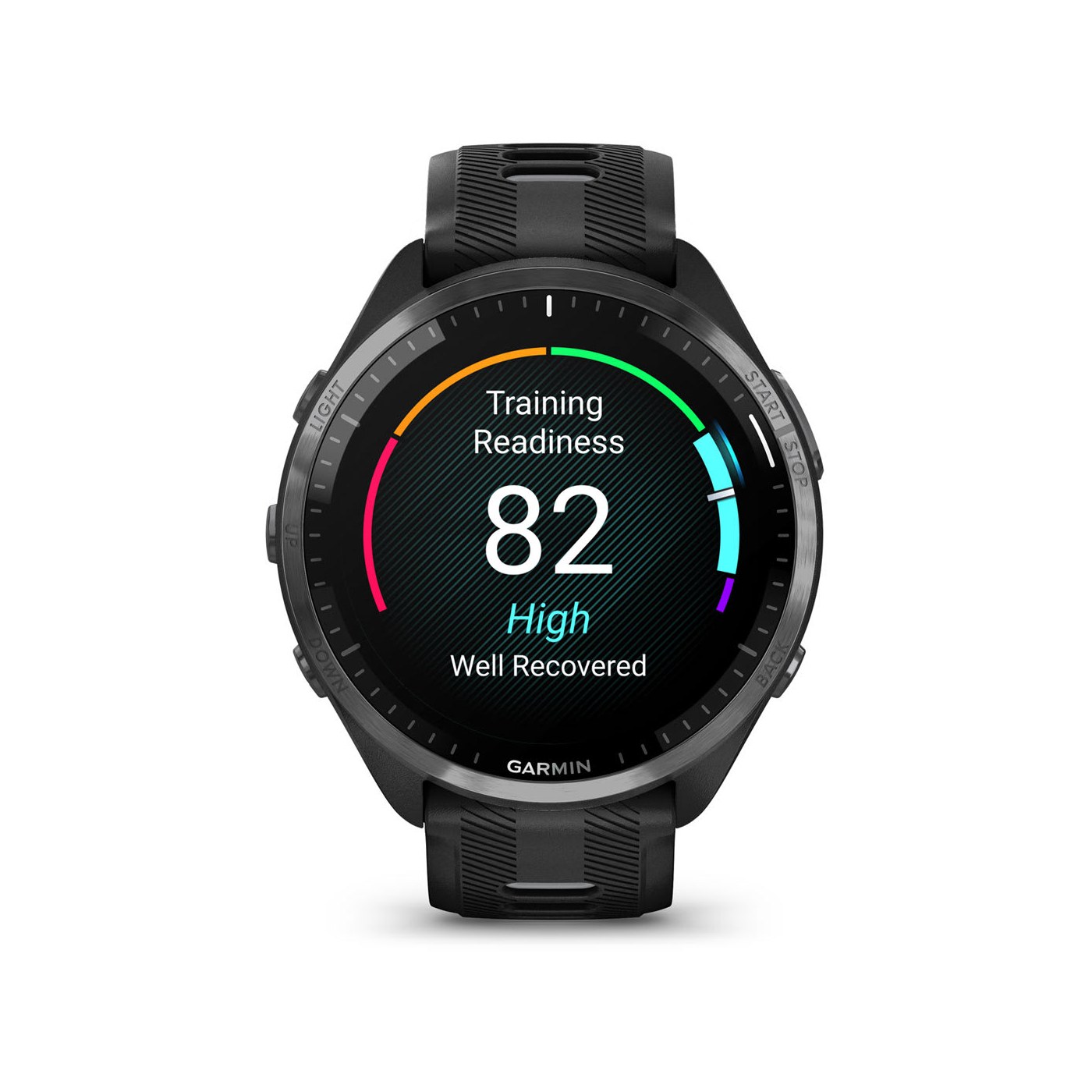
The Forerunner 965 carries the most complete Garmin suite you can get without a third-party subscription. Training Readiness combines HRV status, recovery time, training load, sleep and stress into a score from 0 to 100 every morning: it's the central indicator that should drive your daily call between a hard session and active recovery.
HRV Status tracks your overnight heart rate variability over a rolling 5 nights and alerts you as soon as your curve leaves your personal baseline. Training Load breaks your load into three zones: low aerobic, high aerobic and anaerobic. Stamina shows your muscular reserve in real time during the effort, ideal for pacing the final kilometers of a half marathon or a trail race. Race Predictor estimates your target times for the 5 km, 10 km, half and marathon from your continuously calculated VO2 max.
Wrist-based running dynamics (cadence, stride length, vertical oscillation, ground contact time, ground contact time balance) are available without any extra accessory. PacePro shines on race day: load your course, set your goal time, and the watch builds a km-by-km pacing strategy that accounts for elevation. On a 21 km half marathon with 400 m of elevation gain, it automatically adjusts your target pace on the climbs to save your reserves for the finish.
Real-world battery life of the Forerunner 965
Garmin rates the Forerunner 965 at 23 days in smartwatch mode and 31 h in standard GPS (single-band GNSS). In real-world L1+L5 All-Systems multi-band use, expect closer to 20-21 h. In GPS mode with Bluetooth music streaming, battery life drops to about 8 h.
To give you concrete benchmarks: a marathon build with 3 runs a week (1 long run of 2 h + 2 sessions of 45-60 min) uses about 4-5 h of GPS per week. The 965 easily lasts 4 to 5 days between charges during a marathon block. For a 30-40 km trail race with maps active, plan on 7-8 h of GPS: the watch finishes comfortably. For races over 30 h or UTMB-style routes, look instead at the Garmin Enduro 3 (320 h solar) or the COROS Vertix 2S (140 h UltraMax).
Forerunner 965 vs Forerunner 570 and Suunto Race 2: the comparison
| Spec | Forerunner 965 (€499) | Forerunner 570 (€549) | Suunto Race 2 (€599) |
|---|---|---|---|
| Display | 1.4-inch AMOLED 454 px | 1.4-inch AMOLED 454 px | 1.5-inch LTPO AMOLED 466 px |
| Weight | 53 g | 50 g | 67-76 g (titanium/steel) |
| Multi-band GPS | Yes (L1+L5 SatIQ) | Yes (L1+L5 SatIQ) | Yes (L1+L5) |
| Maps | Yes (TopoActive Europe) | No (breadcrumb trail only) | Yes (worldwide offline) |
| Music | 32 GB (Spotify/Deezer) | No | Yes (32 GB) |
| ECG | No | No | No |
| GPS battery life | 31 h standard / 21 h All-Systems | 16 h multi-band | 55 h multi-band |
| Triathlon | Yes (auto T1/T2 transitions) | Yes (+ Triathlon Coach) | Yes (115+ sports) |
| NFC payments | Garmin Pay | Garmin Pay | No |
The verdict is clear: for €50 less than the Forerunner 570, the 965 adds TopoActive maps and 32 GB of streaming music. The 570 fights back with a built-in microphone (Voice Pins) and a more advanced Triathlon Coach with voice coaching. If maps matter to you, the 965 is the better buy. Against the Suunto Race 2 (€599), Suunto wins on battery life (55 h vs 31 h) and free worldwide offline maps, but Garmin takes back the lead on the depth of its physiological suite, firmware stability and Garmin Pay.
Pair the Forerunner 965 with a RunMorph plan
Dual-band GPS accuracy and Garmin's load metrics let you follow a dynamic training plan, adjusted day by day to how well you've actually recovered. No more running blind through your intensity zones.
See RunMorph training plansHow to fit the Forerunner 965 into your RunMorph training plan
Syncing the Forerunner 965 with Garmin Connect opens the door to detailed use of your data. At RunMorph, we recommend checking the watch's Training Readiness every morning against the intensity planned in your schedule: if your score drops below 40, push back the day's hard session or swap it for an easy run. This simple rule significantly cuts the risk of overreaching during high-load blocks.
On race day, PacePro is your pacing compass: load the course of your marathon or trail race and set your goal time. The watch shows in real time whether you're ahead of or behind your pacing strategy, accounting for every hill. On your next 10 km or half, it's the tool that replaces mental math at halfway. Combine this data with your RunMorph plan to set your zones on your actual physiological capacity, not on generic tables.
RunMorph coach's verdict
The Garmin Forerunner 965 isn't the newest or the longest-lasting watch in the RunMorph catalog, but it has become one of the most coherent at its current price. It's ideal for the runner-triathlete logging 50 to 80 km a week, running in the mountains a few times a season and listening to music on long runs. The combination of TopoActive maps + dual-band GPS + Garmin Premium suite + 32 GB of music for around €499 remains, in July 2026, a hard offer to beat.
It isn't the watch for 50+ hour ultras (not enough battery) or the lightest in its category, but for 95% of serious runners who also do triathlons, 20-40 km trail races and big-city marathons, it ticks every box with no compromise on what matters.
RunMorph overall score: 8.5/10
Key takeaways for your training
- The Forerunner 965 is the first Garmin Forerunner to combine TopoActive maps, dual-band L1+L5 GPS and 32 GB of music, now available for €499.
- Training Readiness and overnight HRV tracking make daily intensity decisions far more objective than feel alone.
- 31 h of GPS battery life is perfect for trail races under 30 km and marathons, but not for overnight ultra trails.
- The multisport profile with automatic T1/T2 transitions makes it a true triathlon watch, with no extra cost or accessory.
- At around €499 in July 2026, it offers a better features-to-price ratio than the Forerunner 570 (€549 with no maps) for every runner who wants to navigate off marked trails.