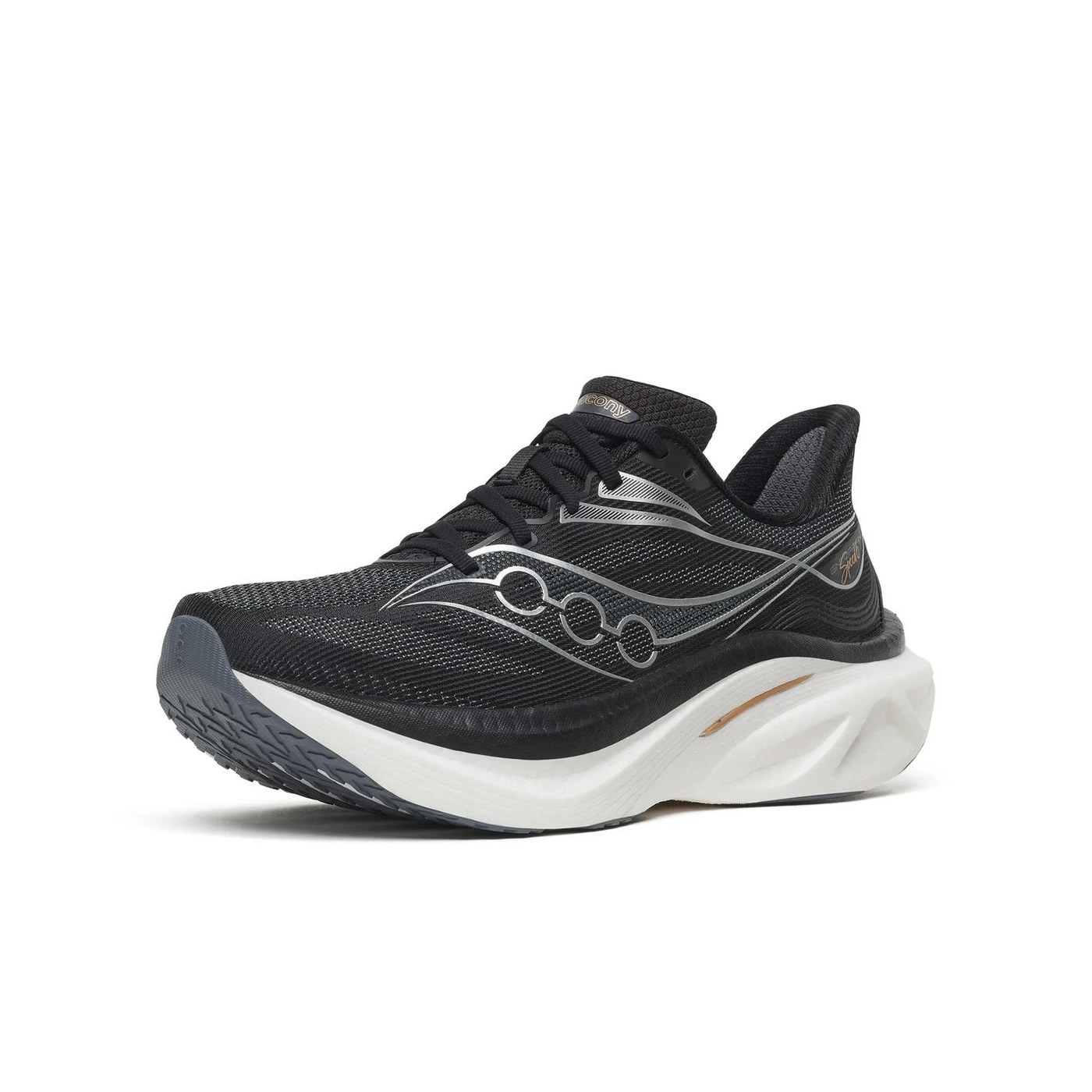
Two days. That is the age of the Saucony Endorphin Speed 6 as this review goes live, released on October 15, 2026 in the United States after a September 14 announcement. Saucony swapped the foam, reworked the nylon plate, trimmed the upper, and raised the price by 10 dollars. The promise stays the same across six generations: one shoe for threshold work, intervals and race day, without the price tag of a full carbon racer. The real question: does the V6 finally fix the softness its own fans flagged on the V5?
Saucony Endorphin Speed 6: +2 mm of Foam, +10 Dollars, the Unfiltered Review
8.2/10
The essentials in 3 sentences
The Endorphin Speed 6 swaps its PWRRUN PB foam for a firmer, snappier PWRRUN PBX, adds 2 mm of stack under the foot, and climbs by 10 dollars in the United States. It targets the runner who wants one shoe for threshold work, intervals and racing from 10K to marathon, not the runner chasing plush cushioning on easy long runs. A snug fit out of the box and heel rubber that needs watching from 56 km temper a genuine jump in responsiveness.
8,2
/ 10 · RunMorph overall score
Who is it for?The runner who wants one pair for threshold work, intervals and racing from 10K to marathon, and who is fine with a firmer ride than before.
Who should skip it?The runner chasing plush cushioning on easy long runs, training for a sub-5K, or unwilling to pay more than the Speed 5 for a gain that still needs proving over time.
Saucony Endorphin Speed 6: the tempo trainer that changes foam without changing its mission
The Endorphin line popularized the idea of a nylon plate in a fast training shoe, without the price or the stiffness of a carbon racer. The Saucony Endorphin Speed 6 is the sixth generation, and it is only two days old as this review is written: announced on September 14, 2026, it has only been on sale in the United States since October 15, through Saucony and a handful of selected retailers. No lab measurement sheet and no French review exist yet on this exact model.
At RunMorph, the starting point comes from several American testers who covered the previous generation: the Speed 5 was seen as a touch soft, almost too comfortable for a shoe meant to make threshold work faster. Saucony answers by replacing the PWRRUN PB foam with a PWRRUN PBX built from molded PEBA beads, and by reworking the nylon plate geometry. The announced result: 2 mm more foam, with no absolute figure published by the brand, and a price that moves from 165 to 175 dollars stateside. The French price, for its part, had not been posted at the time this review was written: for consistency with the Speed 5 tag (200 euros) and the US price hike, a cautious range of 210 to 220 euros looks reasonable, with no official value at this stage.
RunMorph's advice: if you are torn between this V6 and the Saucony Endorphin Speed 5, still in stock at a discount with some retailers, do not rush into the new release. The responsiveness gain looks real from the early reports, but there is no track record yet on its lifespan in everyday training.
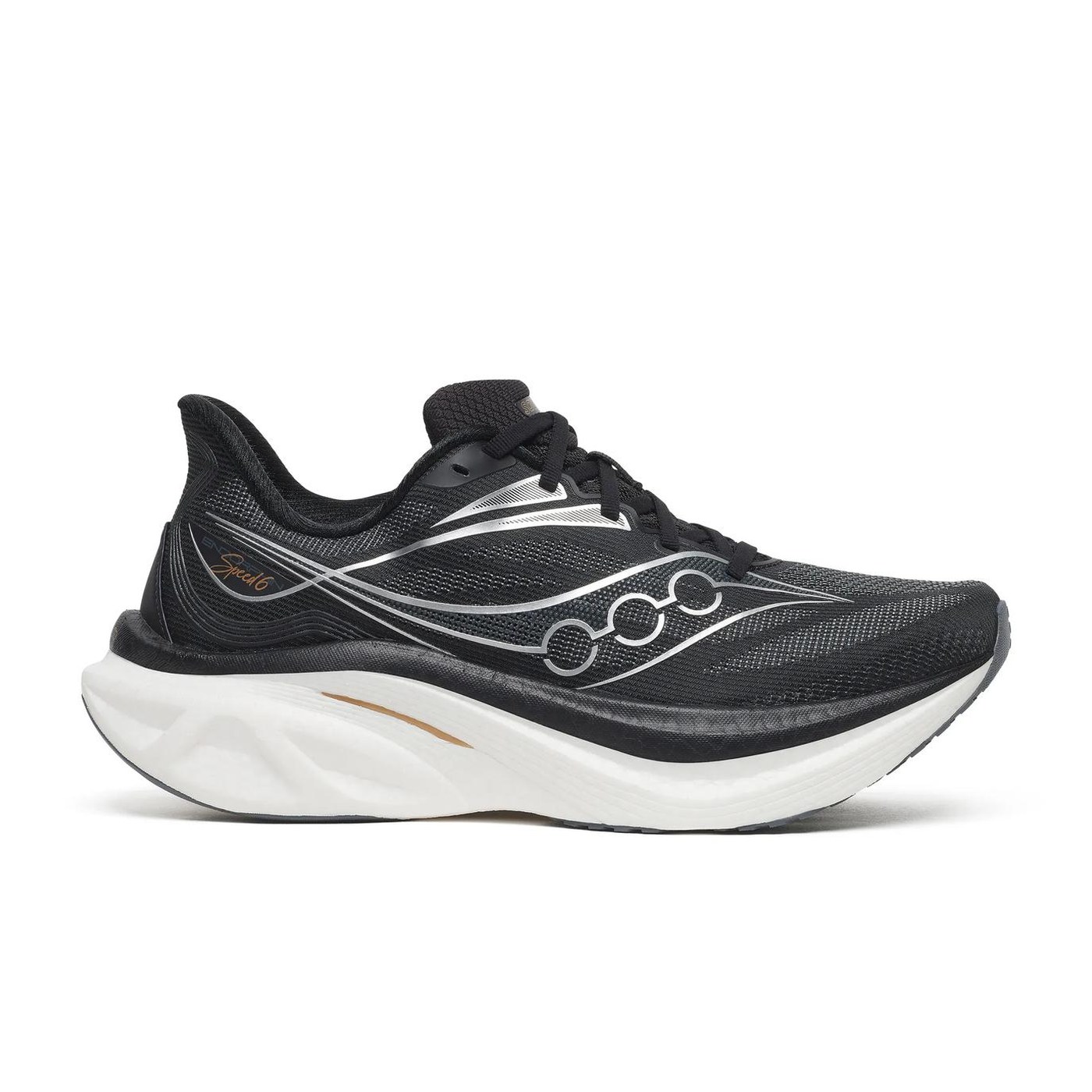
© Saucony, official photo used for editorial purposes
Endorphin Speed 6 spec sheet: a drop that does not move, a foam that was fully reworked
| Brand | Saucony |
| Model | Endorphin Speed 6 |
| Release date | October 15, 2026 (United States). French availability not confirmed yet |
| Type | Nylon-plated super trainer / tempo shoe, road |
| Drop | 8 mm (unchanged since the first Endorphin Speed) |
| Stack height heel / forefoot | 38 mm / 30 mm (derived figure, see next section) |
| Men's weight (US9) | About 232 g, consistent across three cross-checked reports |
| Women's weight (US8) | 196 to 203 g depending on the source, gap unresolved |
| Foam | PWRRUN PBX, molded PEBA beads |
| Carbon plate | No: reworked nylon plate, medial and lateral wings |
| Outsole | XT-900 rubber |
| Upper | Light, breathable mesh, longer tongue |
| Recommended distance | Threshold, intervals, racing from 10K to marathon |
| Official US price | 175 dollars announced (179,95 dollars at one specialty retailer) |
| French price | Not posted at launch. Estimated range 210 to 220 euros, unofficial |
Endorphin Speed 6: what Saucony announces versus what the first cross-checked reports already say
No independent lab has published a measurement sheet yet on this two-day-old model. The figures below cross-check three separate US sources: a specialty retailer's unboxing piece, a multi-tester review, and an American retailer's product sheet. Two gaps deserve a close look before you buy.
| Data point | Announced by Saucony | Cross-checked report (US sources) |
|---|---|---|
| Men's weight | Not precisely communicated on the product page | 232 g (US9), consistent across all three reports, 3 g lighter than the Speed 5 (235 g) |
| Women's weight | Not communicated | 196 g according to one source, 203 g according to another: a 7 g gap that remains unresolved |
| Drop | 8 mm, same as the Speed 5 | 8 mm confirmed by all three reports, no gap |
| Stack height heel / forefoot | "2 mm more foam" versus the V5, with no absolute figure published | 38 mm / 30 mm by deduction, starting from the Speed 5's 36 mm / 28 mm stack. Saucony still publishes no absolute figure for the V6 |
| US price | 175 dollars | 179,95 dollars at one retailer, 10 dollars more than the Speed 5 |
The real grey area is not the drop, confirmed everywhere and unchanged, but the stack height and the women's weight. Saucony talks up a foam gain without ever giving the figure that would let anyone check it. The math built from the Speed 5 holds up, but it stays math, not a measurement.
PWRRUN PBX and the reworked nylon plate: what changes underfoot?
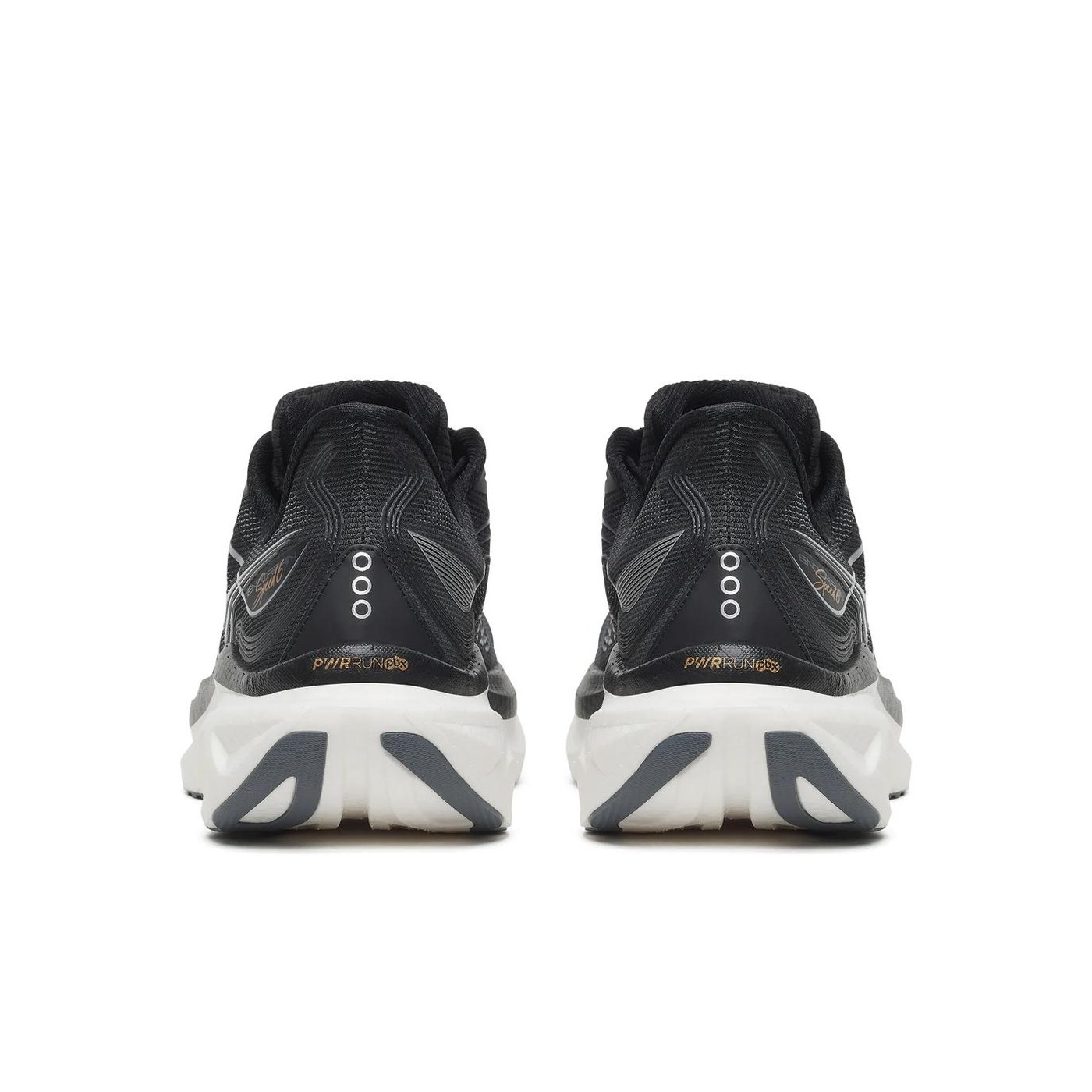
PWRRUN PBX is a PEBA foam molded from compacted beads, a technique aimed at better energy return than the Speed 5's injection-molded PWRRUN PB. Two American testers describe the feel the same way: firmer on contact, but snappier once the pace picks up. The nylon plate itself was redrawn with medial and lateral wings that widen its footprint, plus an updated SpeedRoll geometry that sharpens the forefoot rocker.
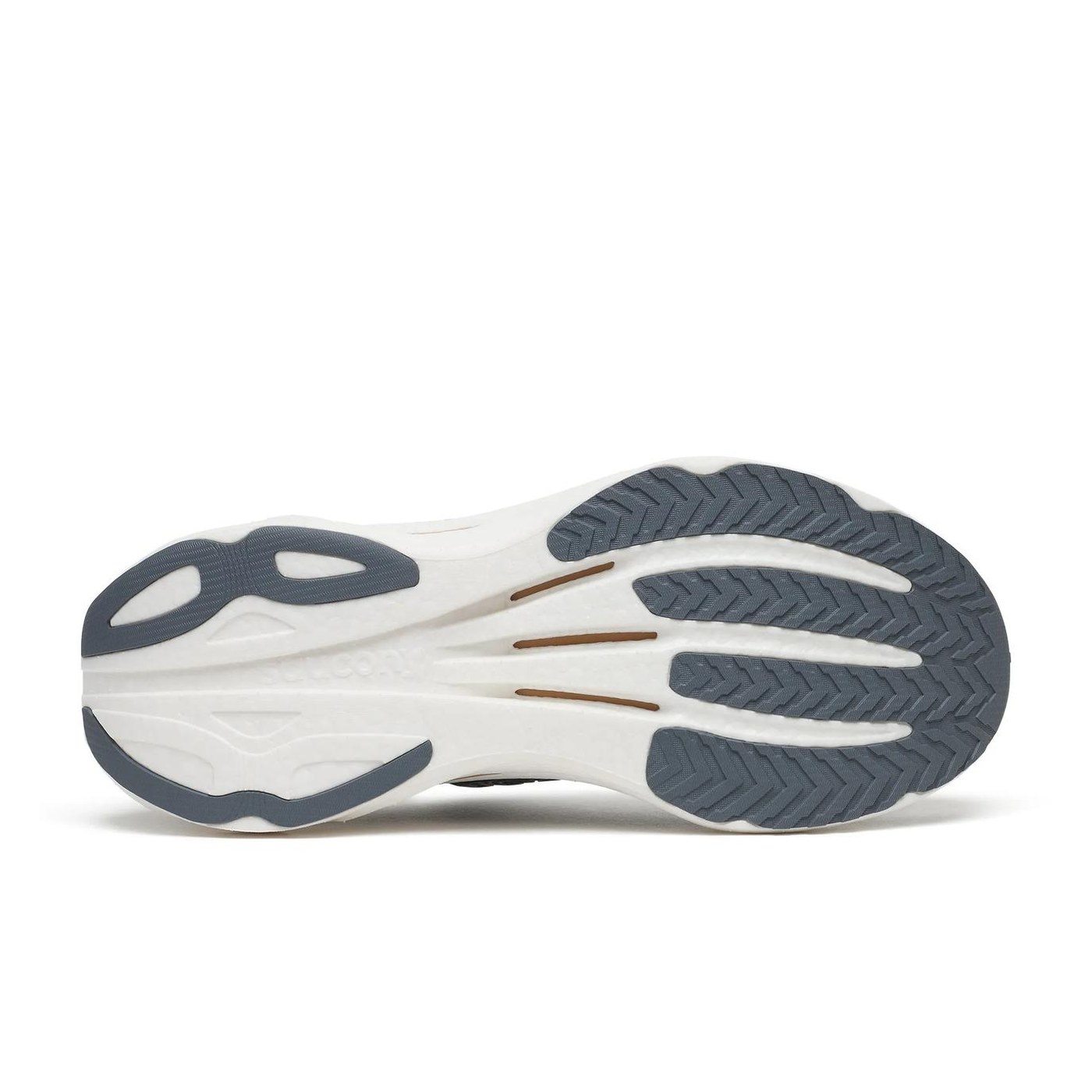
On the outsole, XT-900 rubber now covers a larger share of the sole than before: the Speed 5 left more bare nylon plate exposed, while the V6 covers an extra portion with rubber, with a reworked layout at the heel. The stated goal is simple: more forefoot snap, without giving up grip on dry or wet roads.
Fit on the Endorphin Speed 6: roomier up front, snug out of the box
Saucony has not yet published a precise toe box height measurement for this model, and no cross-checked report has filled that gap so far: there is no millimeter figure to set against the market average, and RunMorph would rather say so than invent a number. Only qualitative feedback exists for now. One American retailer describes a roomier forefoot than on the Speed 5, though still short of a daily trainer's volume. The longer tongue and a reinforced midfoot gusset improve lockdown, but the overall fit is still described as snug on the first lace-up: one tester explicitly recommends going half a size up if you are unsure, or avoiding sockless runs, since the tongue and toe overlay can create pressure points before the mesh breaks in.
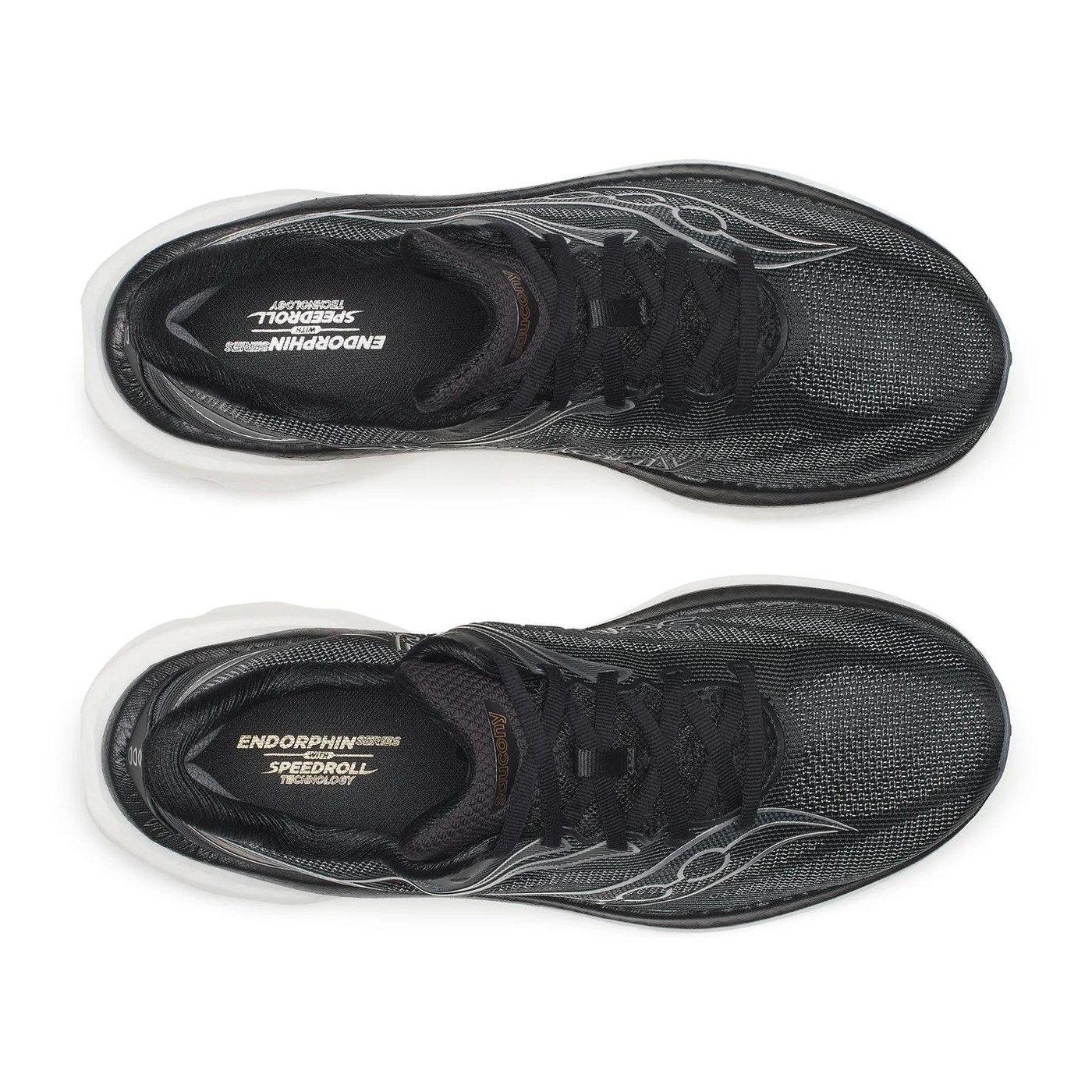
© Saucony, official photo used for editorial purposes
On the road: what the first runners in the V6 are reporting
Three real reviews already exist on this model released two days ago, all American, used here without naming them. The first, run by two testers on the same pair, lands on two readings that diverge sharply. The first tester finds the shoe firm at easy paces but snappy and enjoyable once the pace rises, to the point of calling it his favorite training shoe for threshold sessions. He judges it too stiff for 5K efforts and below, and flags visible heel rubber abrasion after 35 miles, or 56 km covered. The second tester describes it as smooth and easy to roll through, better at easy to moderate paces than at the very fast end, where the forefoot feels harder to bite into. He sees no notable wear after 20 miles, or 32 km. Both compare the Speed 5's feel to something soft against a firmer, snappier V6, but they do not agree on wear speed or on how firm the shoe feels at easy paces.
A second review, built as an unboxing piece with detailed measurements, confirms the spec sheet figures and highlights the upper upgrade: lighter, more breathable, longer tongue, a change it calls necessary compared with the previous version. A third review, framed around a return to the Speed line's roots, confirms a roomier forefoot than on the Speed 5 and advises sizing up if you are between sizes. It praises the versatility across threshold runs, interval sessions and race day, but judges the model less suited to very easy, long runs in plush-cushioning mode, where a daily trainer remains the better pick. That same review places the Speed 6 between a classic versatile trainer and a nylon-plated racer more accessible than a carbon one.
RunMorph's read on these three reports: the responsiveness gain at threshold pace is agreed on, the heel rubber's durability is not, and it will take several hundred community-logged kilometers before that picture clears up.
Which pace it works at, and which pace it struggles at
Easy running and base endurance: not this shoe's natural habitat. The PWRRUN PBX foam, firmer than the previous generation, delivers less passive comfort than a daily trainer on very slow runs, and the nylon plate adds a stiffness that some runners will feel below 5:30/km pace.
Long run: solid on steady-pace stretches, less convincing across a long run spent entirely at easy effort, for the same reason of relative foam firmness.
Marathon pace: one of the reported strengths. The wider forefoot rocker and the nylon plate deliver propulsion without a carbon plate's rigidity, which makes long blocks at goal pace easier without excess muscular fatigue.
Threshold and half marathon pace: the shoe's sweet spot, described by one tester as his favorite training pace in this exact pair.
Short intervals: more debatable. One tester finds the forefoot harder to bite into on very fast efforts, and another calls it outright too stiff below 5K pace.
The real flaw: heel rubber that needs watching from 56 km
Across the two pairs tested overseas, one tester reports visible heel rubber abrasion after 35 miles, or 56 km covered, and openly worries about what comes next. The second tester, on the same model, sees no comparable wear after 20 miles, or 32 km. That gap is not a footnote for a runner weighing this shoe as a main tempo trainer: before putting close to 215 euros into a pair whose lifespan remains unclear, it is worth tracking wear on your own pair from the first runs rather than trusting an average figure that does not exist yet.
The snug fit: size up half a size if you are unsure
A second point worth flagging on its own, already touched on above but important enough to earn its own paragraph since it shapes the purchase decision: the upper, lighter and more breathable than on the Speed 5, is still described as short and snug on the first lace-up. One tester explicitly recommends going half a size up if in doubt, or avoiding sockless runs until the mesh breaks in, since the tongue and toe overlay can create pressure points. For an online purchase without an easy return, that advice beats a 215-euro regret.
Endorphin Speed 6 vs Endorphin Speed 5: is it worth upgrading?
| Data point | Endorphin Speed 5 | Endorphin Speed 6 |
|---|---|---|
| Foam | PWRRUN PB | PWRRUN PBX, molded PEBA beads |
| Stack height heel / forefoot | 36 mm / 28 mm | 38 mm / 30 mm (derived, +2 mm) |
| Drop | 8 mm | 8 mm |
| Men's weight | 235 g | 232 g (3 g lighter) |
| Women's weight | 215 g (EU39) | 196 to 203 g depending on the source |
| Price | 200 euros | Not posted in France, ~210 to 220 euros estimated (US +10 dollars) |
| Plate | Nylon | Reworked nylon, wider wings, sharper forefoot rocker |
The rule of thumb is simple: a runner who found the Speed 5 too soft once the pace picked up has good reason to move to the V6, which gains responsiveness without adding weight. A runner who liked that softer Speed 5 ride on steady long runs, or who does not want to pay more for a gain that is not yet proven over time, can keep their current pair, or grab the previous generation while retailers clear stock at a discount.
Endorphin Speed 6 vs Nike Zoom Fly 6 and Hoka Mach X 3: the comparison
| Data point | Saucony Endorphin Speed 6 | Nike Zoom Fly 6 | Hoka Mach X 3 |
|---|---|---|---|
| Plate | Nylon | Carbon (FlyPlate) | Pebax |
| Announced drop | 8 mm | 8 mm (9,6 mm measured) | 5 mm (9,5 mm measured) |
| Stack height heel / forefoot | 38 mm / 30 mm (derived) | 42 mm / 34 mm announced (39,7 / 30,1 mm measured) | Stack above 40 mm |
| Men's weight | About 232 g | 248 g in lab testing (up to 265 g in a size 44 field report) | 252 g announced (264 g measured) |
| Price | ~210 to 220 euros estimated | 169,99 euros | 190 euros |
| Full review | This article | Nike Zoom Fly 6 | Hoka Mach X 3 |
The decision rule fits in one line. For an accessible carbon plate on a tight budget, the Zoom Fly 6 stays nearly 50 euros cheaper, despite a real drop and stack height higher than what Nike announces. For maximum stack and a tolerance for a drop that behaves close to 10 mm in practice despite the 5 mm label, the Mach X 3 wins out. For staying on a softer nylon plate than a carbon one, gaining responsiveness over the previous Saucony generation, and accepting a price likely near the top of the pack once the French tag is confirmed, the Speed 6 is the logical pick.
Pros and cons of the Saucony Endorphin Speed 6
Pros
- Reworked nylon plate snappier at threshold pace, felt by two testers out of three
- Lighter, more breathable upper with a longer tongue, called a necessary change by one specialty retailer
- Men's weight stable around 232 g despite the added foam
- Wider forefoot rocker that eases the threshold-to-interval transition
- Unchanged 8 mm drop: no relearning your stride if you already run the line
Cons
- US price up by 10 dollars, French price not confirmed at launch
- Snug fit out of the box, possible pressure points without socks
- Heel rubber to watch from 56 km according to one tester
- Too stiff for sub-5K work according to that same tester
- Not ideal for very easy, long runs in plush-cushioning mode
© Saucony, official photo used for editorial purposes
Grip and durability: what is the cost per kilometer on the Endorphin Speed 6?
XT-900 rubber covers a wider share of the outsole than on the Speed 5, with grip judged solid on both dry and wet roads, especially at the forefoot according to the early reports. It is impossible, however, to put a firm lifespan figure on this model: it has only two days of commercial existence, and the only two reports available contradict each other, one flagging heel abrasion from 56 km, the other seeing nothing comparable at 32 km. For consistency with the nylon-plated super trainer category, and with the Speed 5's known behavior, a lifespan in the 500 to 600 km range looks like a reasonable starting point, to be confirmed over the coming months.
On that basis, and with an estimated French price of 215 euros, the cost per kilometer lands around 0,39 euro. For comparison, the Nike Zoom Fly 6, at 169,99 euros for a similar lifespan, costs about 0,31 euro per kilometer, close to 25% less. That gap is worth paying only if the Speed 6's responsiveness gain matters more to you than the extra cost.
© Saucony, official photo used for editorial purposes
Our take: who is it for, and which RunMorph plan fits?
The Endorphin Speed 6 earns its keep with the runner training for something between a 10K and a marathon who wants one shoe for threshold sessions, intervals and race day. Its sweet-spot pace lines up almost exactly with most amateur runners' half marathon pace, which makes it a natural tool for sharpening threshold sessions in a half marathon block, while still pulling duty on marathon-pace segments inside a marathon build's long run. It fits less well the runner looking for one shoe to cover easy Sunday base miles, or anyone chasing a 5K PR.
This shoe fits naturally into a half marathon build, sharpening the threshold sessions that match its sweet-spot pace, and pulling extra duty on marathon-pace segments inside a marathon build's long run.
Our recommendation: pair this shoe with the RunMorph half marathon plan to turn this responsiveness gain into measurable progress on your threshold sessions.
RunMorph's verdict
The Endorphin Speed 6 delivers on a precise, modest promise: make the line snappier without touching the drop or piling on weight. The overall score of 8,2/10 weighs a genuine responsiveness gain, widely confirmed by the early reports, against three concrete reservations: a French price still unclear but likely higher, heel rubber durability that splits the only two testers available, and a snug fit that demands checking your size before ordering. This is not a revolution. It is a serious refinement of an already solid shoe, best reserved for runners willing to pay for the new release without a long-term track record yet.
Key takeaways for your training
- 232 g: men's weight stays nearly flat despite the added foam, 3 g lighter than the Speed 5
- 2 mm: the foam-thickness gain Saucony announces, with no absolute figure published so far
- 8 mm: the drop has not moved since the first generation, no stride relearning needed
- 56 km: the point where one tester flags visible heel rubber abrasion, worth watching on your own pair
- 10 dollars: the announced US price hike, French price still unknown at launch
- 7 g: the women's weight gap between two US sources, check the figure against your own size before buying
FAQ
Is the Saucony Endorphin Speed 6 suitable for beginner runners?
Probably not as a first pair. A runner covering under 30 km a week will get little out of the nylon plate's stiffness and the forefoot rocker, both built for threshold and race paces rather than entry-level easy runs.
What is the price of the Saucony Endorphin Speed 6 in France?
Not confirmed as this review was written: the announced US price is 175 dollars, and the estimated French range sits around 210 to 220 euros, consistent with the Speed 5's 200 euros and the 10-dollar US increase.
Does the Saucony Endorphin Speed 6 run large or small?
Runs small out of the box according to the early reports: plan on half a size up if you are between sizes, since the fit is still described as snug on the first few runs.
What is the difference between the Speed 6 and the Speed 5?
A new PWRRUN PBX foam replaces the PWRRUN PB, 2 mm more stack announced by the brand, men's weight down 3 g to 232 g, and a US price up by 10 dollars, with the drop staying at 8 mm on both.
Is the Saucony Endorphin Speed 6 suited to marathon training?
Yes, on marathon-pace segments within a long run or on race day itself, thanks to its wider forefoot rocker. It is less suited to an entire long run spent at easy effort below 5:30/km pace, where its firmer-than-before foam becomes noticeable.