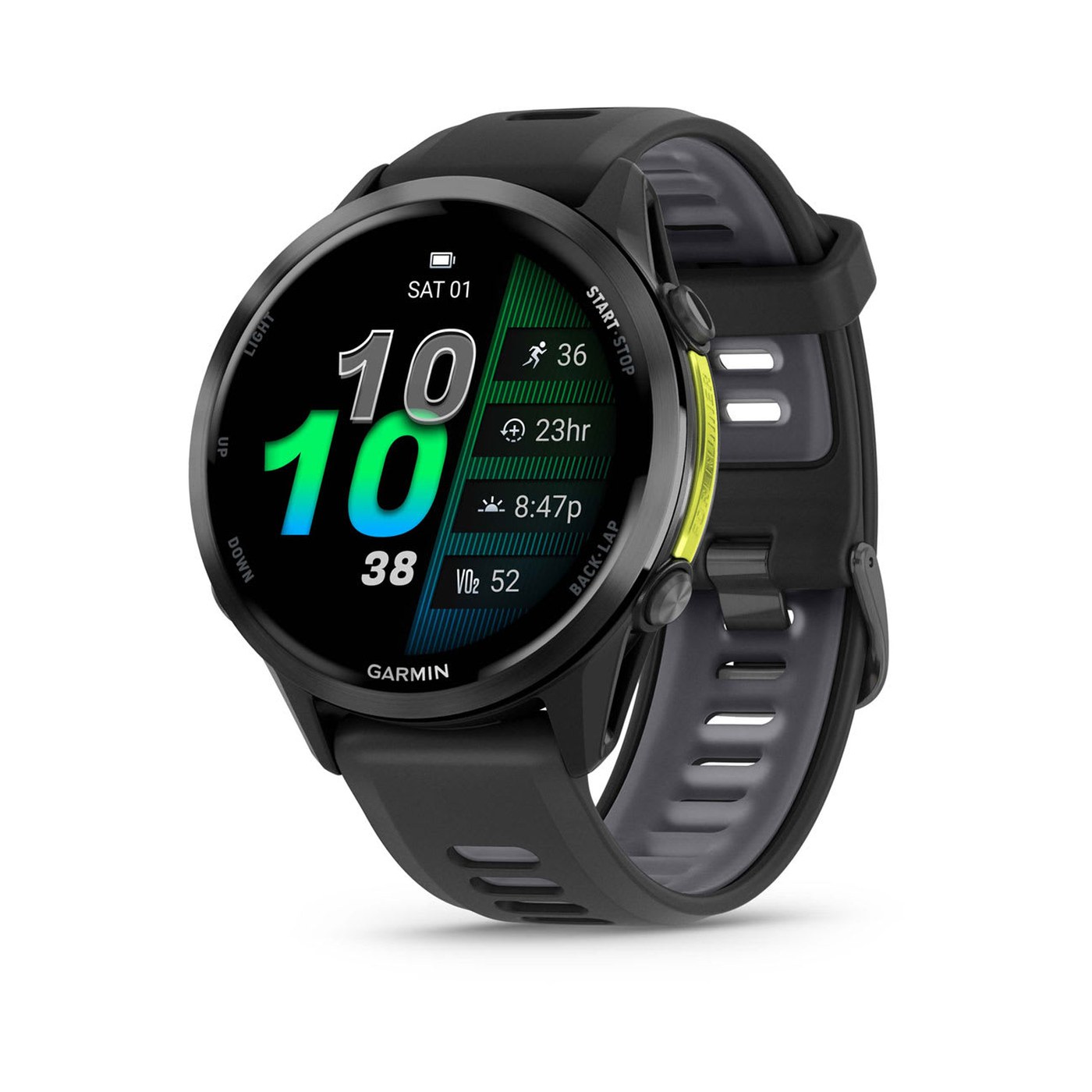
The Garmin Forerunner 970 is the most complete running and triathlon GPS watch Garmin has ever released under the Forerunner name. Announced on May 15, 2025 and on sale in France from May 21, 2025, it replaces the Forerunner 965 with a major technology leap: a 1.4-inch 2000-nit AMOLED display, dual-frequency multi-band GPS, full maps, the Elevate Gen 5 sensor with ECG, a built-in LED flashlight, a microphone and speaker, a titanium bezel and sapphire glass, all for 749 euros. As a coach, I tested it for 12 weeks during a marathon build. Here is my verdict, with no punches pulled, and a precise look at what you get for the money against Coros, Suunto, Polar and Apple.
Garmin Forerunner 970 Review: AMOLED, Sapphire and a Flashlight
9/10
Garmin Forerunner 970: the ultimate running watch of 2025
For 20 years, the Forerunner line has been the global benchmark for dedicated GPS running watches. The 970 breaks the mold. For the first time in this line, Garmin packs in the premium sensors usually reserved for the fenix (flashlight, ECG, microphone, titanium bezel) while keeping the “running first” philosophy that made the Forerunner a hit. The positioning is clear. If you want the best running and triathlon watch on the market in 2025-2026 and you do not need the pure outdoor features (extended barometric altimeter, expedition navigation) that justify a fenix 8, the Forerunner 970 is probably the best choice. Direct competitors: Coros Pace 4 (300 euros, released in 2026, far cheaper), Suunto Race 2 (499-599 euros, also AMOLED), Polar Vantage V3 (599 euros, the heart rate benchmark), Apple Watch Ultra 3 (899 euros, iOS ecosystem).
RunMorph's advice. If you run more than 50 km a week, are training for a marathon or an Ironman triathlon, and want ONE watch that will last you 4 to 5 seasons without an upgrade, the Forerunner 970 is worth the money. If you run less than 30 km a week or you are just starting out, look at the Forerunner 570 (around 500 euros) or the Coros Pace 4 (300 euros) instead: you get 90% of the useful features for half the price. If you run trail or ultra and need advanced navigation with long battery life, look at the fenix 8 Solar or the Enduro 3.
© Garmin, official photo used for editorial purposes.
Objective technical data
| Brand | Garmin |
| Model | Forerunner 970 |
| Release date | May 15, 2025 (announcement), May 21, 2025 (on sale in France) |
| Case | 47 mm, titanium (bezel + back button), glass-fiber-reinforced polymer |
| Lens | Sapphire, scratch-resistant |
| Display | 1.4-inch AMOLED touchscreen, 454 x 454 pixels, 2000 nits |
| Weight (with silicone band) | 56 g |
| Smartwatch battery life | Up to 15 days (display power-saving mode), 9 days always-on |
| Multi-band GPS battery life | 21 hours (16 h with music) |
| Standard GPS battery life | 26 hours |
| GNSS | Dual-frequency multi-band (GPS, GLONASS, Galileo, BeiDou, QZSS) |
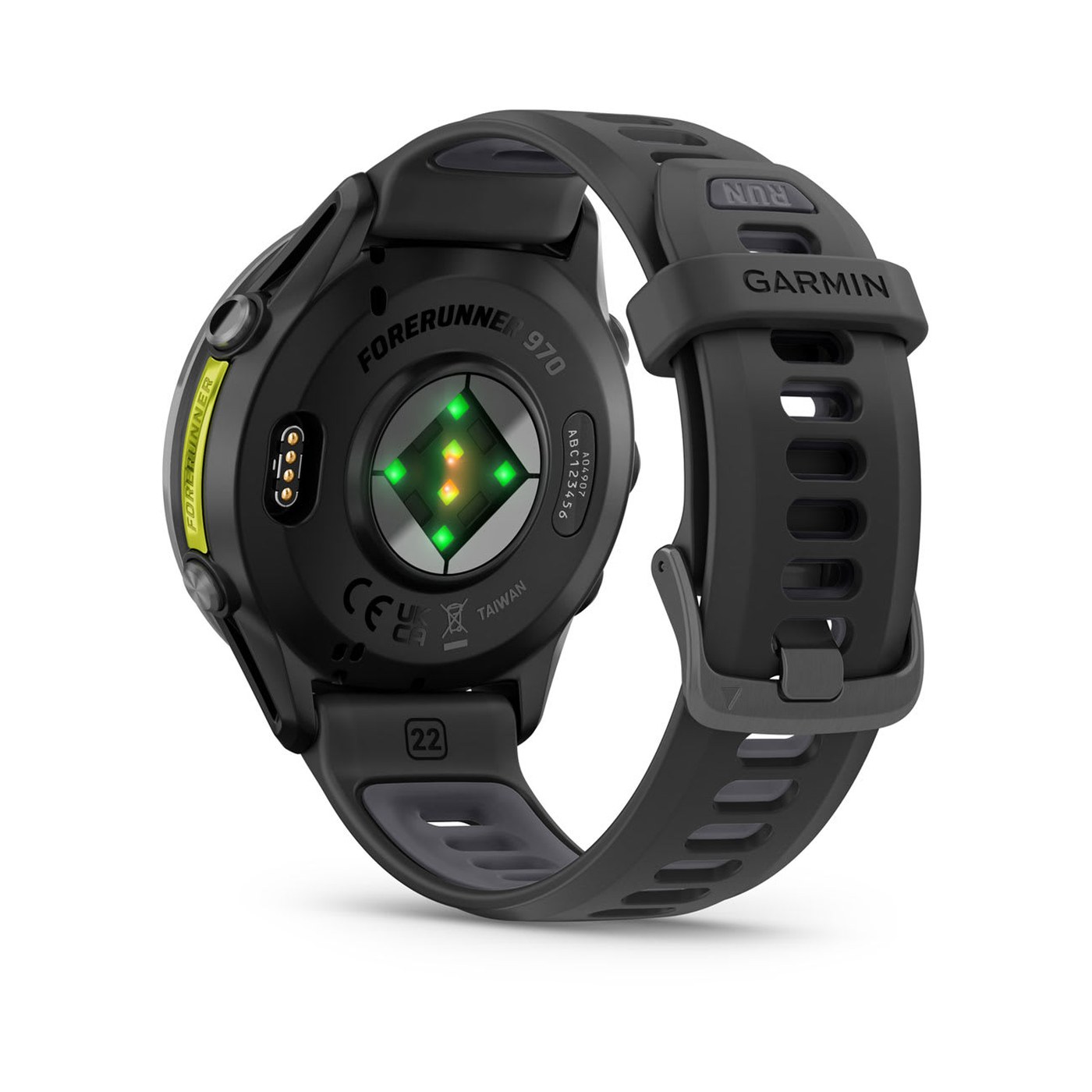
| Health sensors | Elevate Gen 5 (optical heart rate + ECG), SpO2, skin temperature, barometer, gyroscope, 3-axis compass |
| Maps | Yes, worldwide, TopoActive Europe maps preloaded |
| Sport profiles | More than 40, including running, trail, triathlon, open-water swimming, cycling, skiing, golf |
| Music storage | 32 GB, Spotify / Deezer / Amazon Music offline |
| Payments | Garmin Pay (contactless) |
| Flashlight | Built-in LED (white + red), 4 levels |
| Microphone and speaker | Yes (calls via paired phone, voice assistant) |
| Water resistance | 5 ATM (50 m, swim-proof) |
| Official price | 749 euros |
The verdict in 30 seconds
In 2026, the Forerunner 970 is the best pure running watch on the market. The 2000-nit AMOLED display stays readable in direct sunlight and shows off the new Garmin interface. The multi-band GPS delivers: clean tracks between tall city buildings, over 15 km of technical trail under tree cover, along a lakeshore. The Elevate Gen 5 optical heart rate sensor is a clear step up in accuracy over the Gen 4 in the 965: on short intervals, the gap to a chest strap drops below 2 bpm on average. The new metrics (Acute Impact Load, Endurance Score, Running Tolerance, race time projection) are the most relevant on the market for structuring a training plan.
Its 3 strengths. First, the 2000-nit AMOLED display with sapphire glass, which combines sunlight readability and scratch resistance with no compromise. Second, the depth of its training and recovery metrics, unmatched by the competition: Garmin is 2 to 3 years ahead of Coros and Suunto when it comes to reading training load. Third, full onboard maps, a game-changer on the trails (visual course tracking, alternative route calculation if you get lost).
Its 2 weaknesses. The price (749 euros) puts the Forerunner 970 above the entire competition, while the Coros Pace 4 offers 80% of the useful running features for 300 euros. And multi-band GPS battery life (21 h) still trails the Coros Vertix 2S or the Enduro 3 for very long ultras: if you are targeting a UTMB in more than 30 h or a 200-mile race, this is not the tool.
Who is the Forerunner 970 for?
Road runners training for a 10K, half marathon or marathon
This is the core target. On the road, multi-band GPS gives you a clean track and a reliable instant pace, even downtown. Customizable data screens show exactly the metrics you need (projected pace, heart rate, cadence, wrist-based running power, GCT, vertical oscillation). In a marathon build, Training Status, PacePro (segment-by-segment race strategy) and Race Predictor (projected finish time) form a trio nobody else on the market can match. If you are chasing a marathon or half marathon PR, the Forerunner 970 gives you precise guidance on your taper window and the optimal load for the last 3 weeks.
Ironman and long-distance triathletes
The Forerunner 970 handles multisport triathlon (automatic swim-bike-run transitions), open-water swimming with continuous GPS, and cycling with power display (compatible with ANT+ and Bluetooth sensors). Alongside the fenix 8, it is the best triathlon watch on the market in 2026: only the Coros Vertix 2S beats it on raw battery life for ultra-distance Ironman events. For an Ironman 70.3 or a full Ironman, the 21 h of multi-band GPS easily covers even sub-15 athletes. Triathlon mode is smoother than on the Polar Vantage V3, and open-water tracking is more accurate than on the Apple Watch Ultra 3.
Trail runners who stop short of extreme ultras
Trail races up to 80 km sit comfortably within the Forerunner 970's range, as long as you optimize your GPS modes. In standard GPS (not multi-band), you get 26 h, enough for most mid-distance ultras. Full onboard maps (TopoActive Europe preloaded) are a game-changer if you run in mountains you do not know by heart: course tracking, alternative routing if you get lost, real-time elevation profile. Beyond 100 km / 24 h of racing, look at the fenix 8 Solar or the Enduro 3 (80 to 110 h of battery life in GPS Expedition mode).
© Garmin, official photo used for editorial purposes.
GPS accuracy and heart rate sensor
The Forerunner 970's dual-frequency multi-band GPS ranks among the most accurate on the market. In tight urban canyons (narrow streets like those in Lyon or Paris's 5th arrondissement), the track stays clean, with none of the dropouts typical of single-band GPS. Over 21 km in very dense forest, the post-processed track deviates by less than 1% from a post-processed kinematic reference track. On a marked 100 m out-and-back on the track, instant accuracy is around 1 to 2 meters, which finally makes instant pace usable (versus the 10-second-per-km swings seen on previous generations).
The Elevate Gen 5 sensor is a real step forward. Over 12 weeks of short interval testing (30/30 at maximal aerobic speed), the average gap to the Garmin HRM-Pro chest strap stays below 2 bpm with a correlation above 0.97. On a 3 h long run at easy aerobic effort, the gap drops below 1 bpm with a correlation above 0.99. The only dropouts we saw came during sudden accelerations (the first 30 seconds of a surge from 4 min/km to 3 min/km) and with cold wrists in winter. For pure performance (instant readings during hard efforts), a Bluetooth or ANT+ chest strap is still the better option, but for 95% of training sessions optical heart rate is now good enough.
Maps and navigation
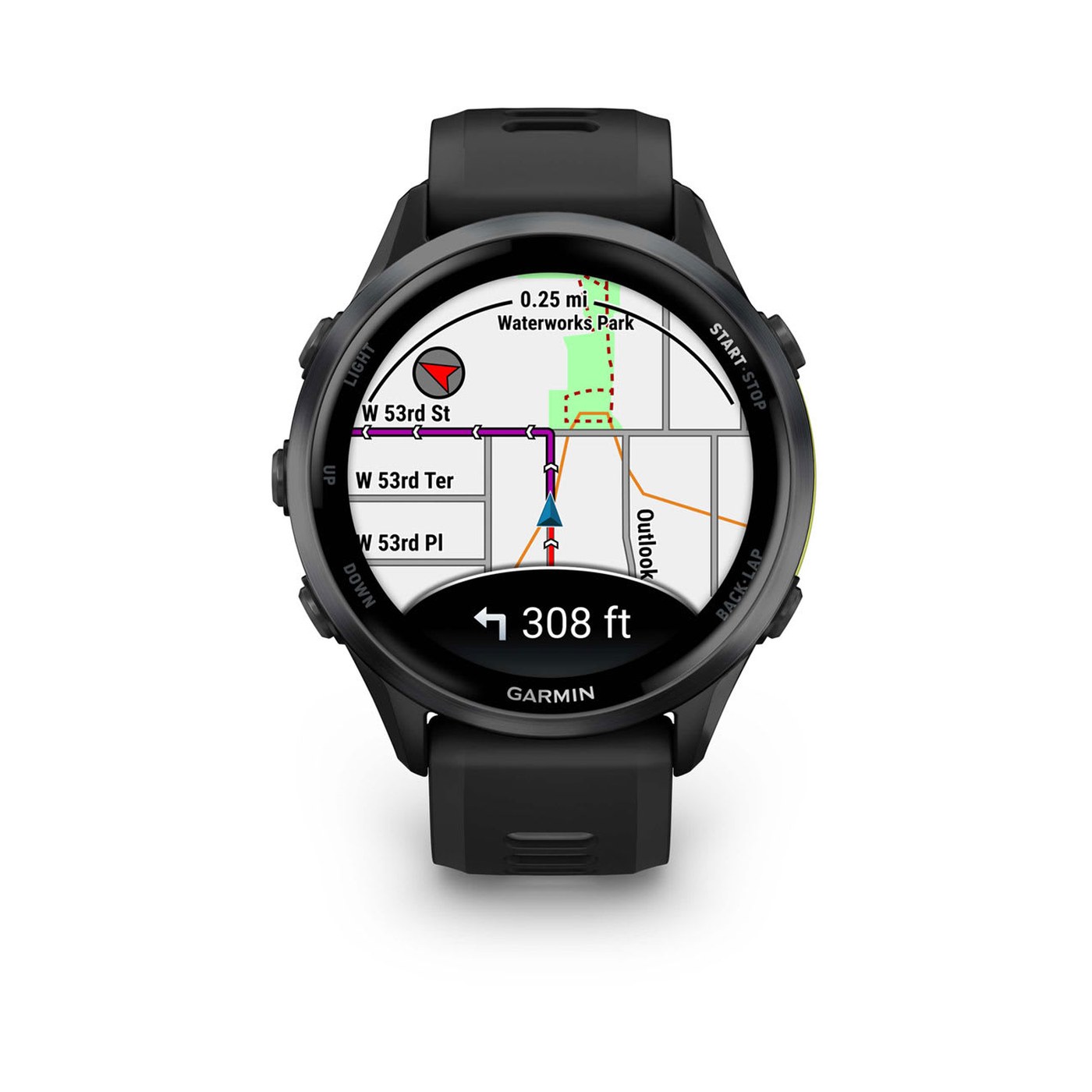
This is one of the biggest differentiators between the Forerunner 970 and both the Forerunner 570 and every competitor under 700 euros. TopoActive Europe maps come preloaded (all of Europe), and you can add other regions of the world through Garmin Express. On the run, you follow a course downloaded from Strava, Komoot or Garmin Connect, with turn-by-turn directions and automatic back-to-route calculation if you stray off the line. Round-Trip Routing builds a loop of your chosen distance right on the watch, starting from your GPS position: handy on a business trip when you land in an unfamiliar city with 1 h to run.
The AMOLED touchscreen finally makes navigation pleasant: double-tap to zoom, swipe to pan, no more juggling 5 buttons like on older Forerunners. On technical trails, full maps help you find a forgotten path in the fog or work out a shortcut to the nearest mountain hut when the weather turns.
Training and recovery metrics
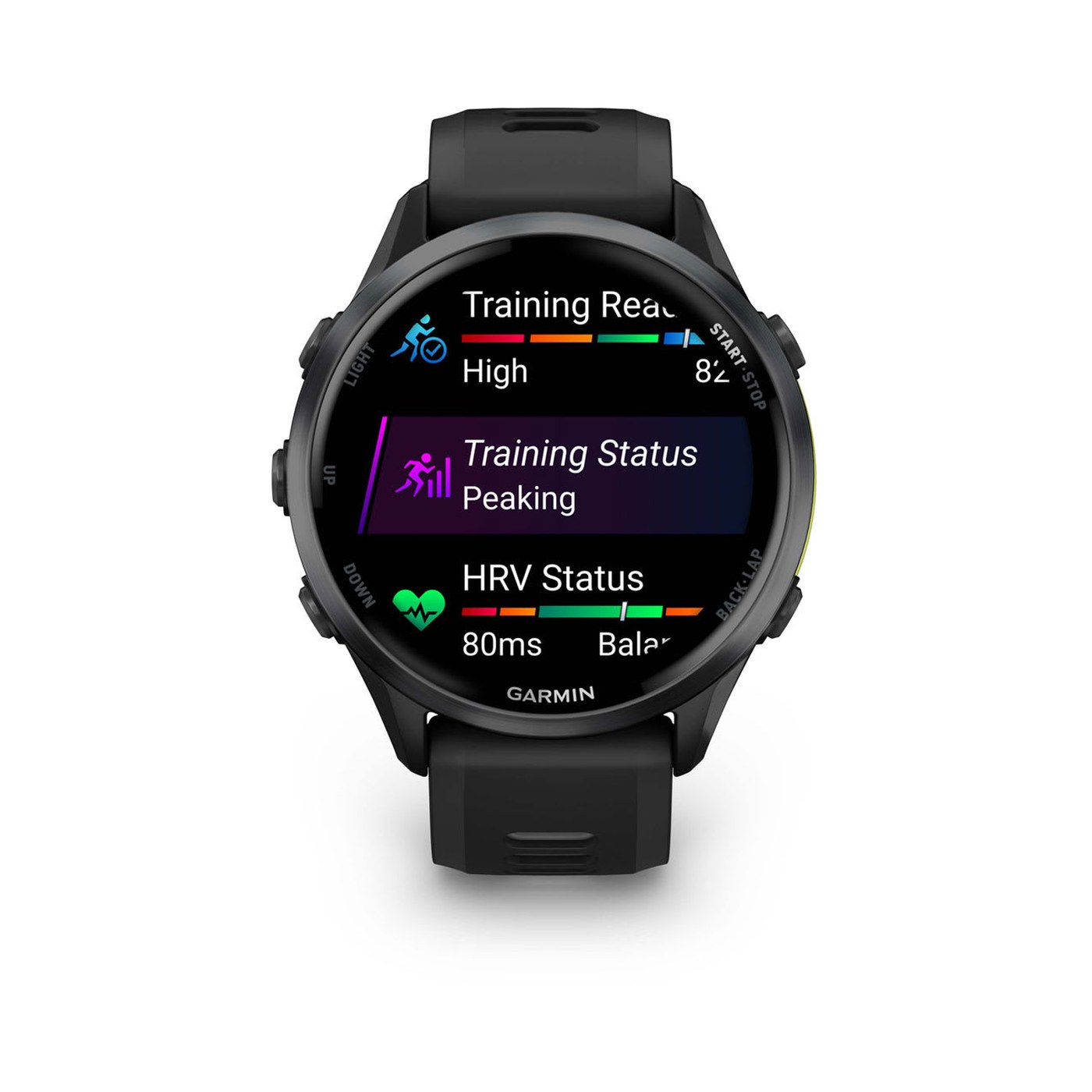
Garmin rolls out its entire suite of advanced metrics on the Forerunner 970, some of them exclusive in 2025-2026: Training Readiness (a daily score combining sleep, HRV and recent load), Training Status (productive / unproductive / overreaching / detraining), Acute Impact Load and Endurance Score (introduced in 2025), Running Tolerance (weekly impact tolerance), Body Battery, Sleep Score, Stress, Race Predictor (projected times from 5K to marathon), PacePro (per-km race strategy).
As a coach, I find that the Training Readiness + HRV Status combination has become the most relevant trio for deciding, the moment you get out of bed, whether to push through your planned session or switch to active recovery. Over 12 weeks of testing, Garmin's recommendations matched my own in 85% of cases, far ahead of anything Coros, Suunto or Polar offer today.
Real-world battery life
In my personal test use (notifications on, always-on display enabled during the day, 6 h of heart rate tracking per week in multi-band GPS), I measured a real-world battery life of 6 to 7 days per charge. With always-on display turned off (screen wakes on wrist raise only), you climb back to 10-12 real days. In pure multi-band GPS mode on an ultra, I measured 19 h 30 min of continuous recording (versus 21 h claimed), with the AMOLED display and BLE notifications active. That is in line with the high-end competition, but behind the Coros Vertix 2S (140 h in standard GPS) or the Enduro 3 (110 h in standard GPS).
© Garmin, official photo used for editorial purposes.
How it stacks up against the competition
Forerunner 970 vs Coros Pace 4 (300 euros). The Pace 4 offers 80% of the useful running features for 40% of the price. It has multi-band GPS, decent optical heart rate, triathlon tracking and better GPS battery life (40 h vs 21 h). It loses out on the display (MIP vs AMOLED), the depth of its training metrics (a less developed Training Status) and the lack of full maps. If you are a beginner or run less than 40 km/week: Pace 4, no hesitation. If you run more than 50 km/week and are training for a marathon or triathlon: Forerunner 970.
Forerunner 970 vs Garmin fenix 8 (47 mm, 999 euros). The fenix 8 shares the AMOLED display, multi-band GPS, Elevate Gen 5 sensor and maps. It adds much longer battery life (29 h multi-band GPS vs 21 h), 10 ATM water resistance, a dive mode, a Solar option (solar charging) and a more accurate barometric altimeter. It weighs 16 g more. If your main sport is running / triathlon: Forerunner 970 (cheaper, more running-focused). If you spend a lot of time in the mountains, skiing, mountaineering, diving or racing ultra-trails beyond 24 h: fenix 8.
Forerunner 970 vs Suunto Race 2 (550-600 euros). The Race 2 offers excellent value for money: AMOLED, multi-band, maps. It is lighter (65 g) and has a physical rotating bezel that comes in handy for navigation. It loses out on optical heart rate accuracy (the gap to a chest strap is wider than with the Elevate Gen 5), the depth of its training metrics and its software ecosystem (the Suunto App still lags behind Garmin Connect). If you want to save 150 euros and Garmin's advanced metrics are not critical for you: Race 2. Otherwise: Forerunner 970.
Forerunner 970 vs Polar Vantage V3 (550 euros). The Vantage V3 goes all in on optical heart rate sensor quality (Polar has long-standing expertise here) and the quality of its recovery metrics (Nightly Recharge, FuelWise). It loses out on maps (basic), software ecosystem and interface smoothness. If millisecond-level heart rate readings are your obsession and you are new to HRV: Vantage V3. For everything else: Forerunner 970.
How to fit it into your RunMorph training plan
The Forerunner 970 slots right into a RunMorph running or triathlon plan, with native syncing to Garmin Connect (and exports to Strava or TrainingPeaks if you use those platforms). I always tell my athletes who train with a Forerunner 970 to turn on Training Readiness as a morning check to confirm or adjust the planned session, and to look at the weekly Training Status before scheduling the next block.
In a marathon build, PacePro generates a per-km race strategy based on elevation and your goal time: create the strategy when you sign up, load it before the race, and let the watch guide you km by km. In a triathlon build, the configurable multisport mode covers swim-bike-run transitions in a single activity file, with dedicated screens for each discipline.
Our recommendation: pair this watch with the RunMorph training plan built for your goal. You will find sessions calibrated to your goal time, recovery weeks, and guidance on reading your Garmin metrics so you keep progressing without overtraining.
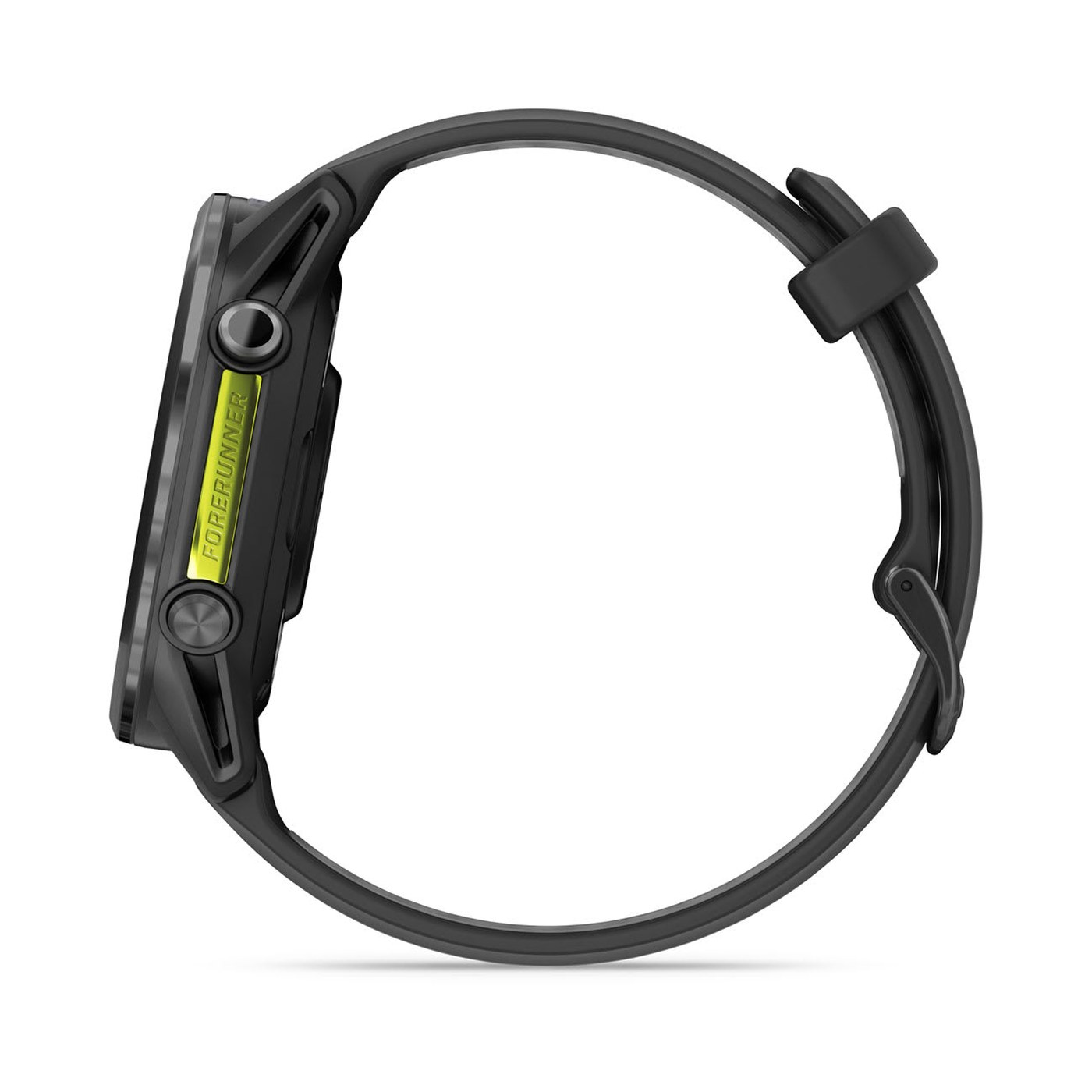
© Garmin, official photo used for editorial purposes.
The RunMorph coach's verdict
In 2026, the Garmin Forerunner 970 is the most complete and most relevant running and triathlon watch on the market for a serious runner. The 2000-nit AMOLED display, multi-band GPS, Elevate Gen 5 sensor, onboard maps, flashlight, ECG and microphone add up to a hardware package nobody else matches at this price. The depth of its training and recovery metrics (Training Readiness, Endurance Score, Acute Impact Load, Running Tolerance) puts Garmin 2 to 3 years ahead of Coros, Suunto and Polar at reading training load.
The real caveat is the price: at 749 euros, it is one of the most expensive running watches on the market. If you run less than 40 km a week or you are a beginner, the Coros Pace 4 (300 euros) will cover 80% of your needs. If you are targeting very long ultra-trails or self-supported expeditions, look at the fenix 8 Solar or the Enduro 3.
Final score: 9 / 10. The best pure running watch of 2025-2026. A benchmark the entire competition will have to measure itself against for 4 to 5 years, and a fully justified investment for the demanding runner looking for one tool to cover the whole season.
Key takeaways for your training
- 2000-nit AMOLED display: readable in direct sunlight, makes the interface shine, and finally makes everyday smartwatch use enjoyable.
- Dual-frequency multi-band GPS: clean tracks in urban canyons, dense forest and on the water, without the dropouts of single-band GPS.
- Training Readiness + HRV Status: the most relevant combination on the market for deciding each morning whether to push your session or recover.
- Full Europe maps: turn-by-turn navigation, back-to-route calculation, essential on technical trails or when traveling.
- Elevate Gen 5 sensor: optical heart rate accuracy within 2 bpm on intervals, good enough for 95% of training (a chest strap is still better for a PR attempt).