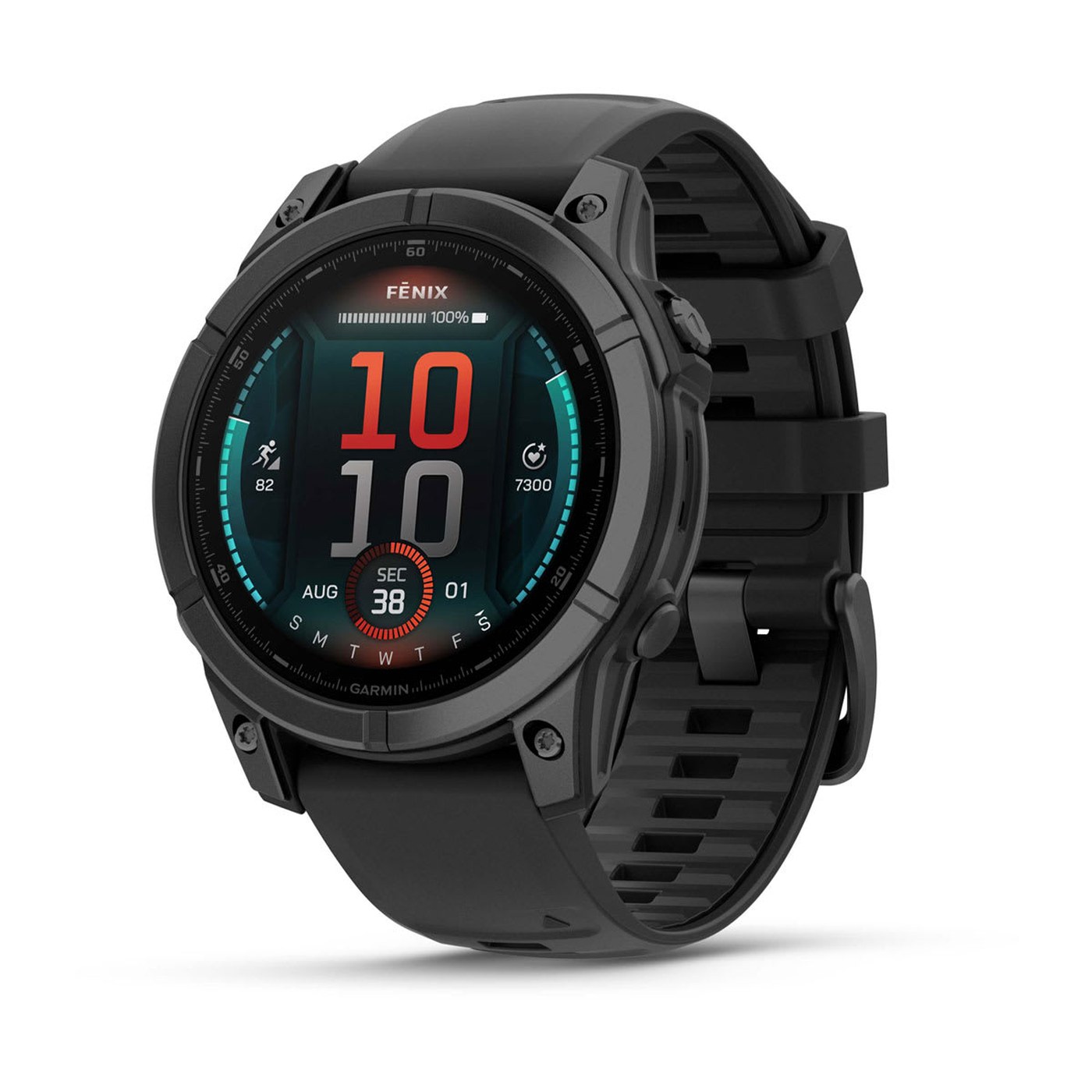
Garmin launched it at €800 in August 2024. Two years later, the fenix E sells for €369 at i-Run. At that price, it becomes the cheapest fenix on the market, with an AMOLED screen, topo maps and Garmin's full training suite. Yet two things are missing that most runners never spot on the spec sheet: dual-frequency GPS and the latest-generation heart rate sensor. RunMorph cross-checked four published reviews to see whether the deal holds up.
© Garmin, official photo used for editorial purposes
Garmin fenix E: the entry-level fenix that became a real bargain at €369
On 27 August 2024, Garmin unveiled the fenix 8 in Chamonix, on the sidelines of UTMB. In the shadow of that launch, a second watch arrived: the fenix E. Announced price, €800. That is €200 less than the 47 mm steel fenix 8 AMOLED.
On paper, the maths did not add up. To save €200, you gave up dual-frequency GPS, the flashlight, the speaker, the microphone, ECG and half the storage. Two English-language reviewers called it "strange" within the line-up, or described it as the middle child nobody knows where to place. In substance, the fenix E reuses the recipe of the 2022 Epix Gen 2 under a new name. It is less equipped than the Epix Pro Gen 2, which already has dual-frequency and the flashlight.
What changes everything is the price drop. As of 13 November 2026, i-Run lists it at €369 (RRP €599), in stock and shipped within 24 hours. In the United States, in the run-up to Black Friday, it drops to $399. So the question is no longer whether the fenix E is worth €800. It never was. The question is whether it is worth €369, against a Forerunner 965 or a Forerunner 570 at the same price level.
RunMorph's advice: if you mostly run on the road and track accuracy matters to you, look at the Forerunner 965 first, which has dual-frequency GPS. Do you mostly run in open mountains and want a fenix case, with buttons that are easy to use in gloves? At €369, the fenix E is the cheapest way into the range.
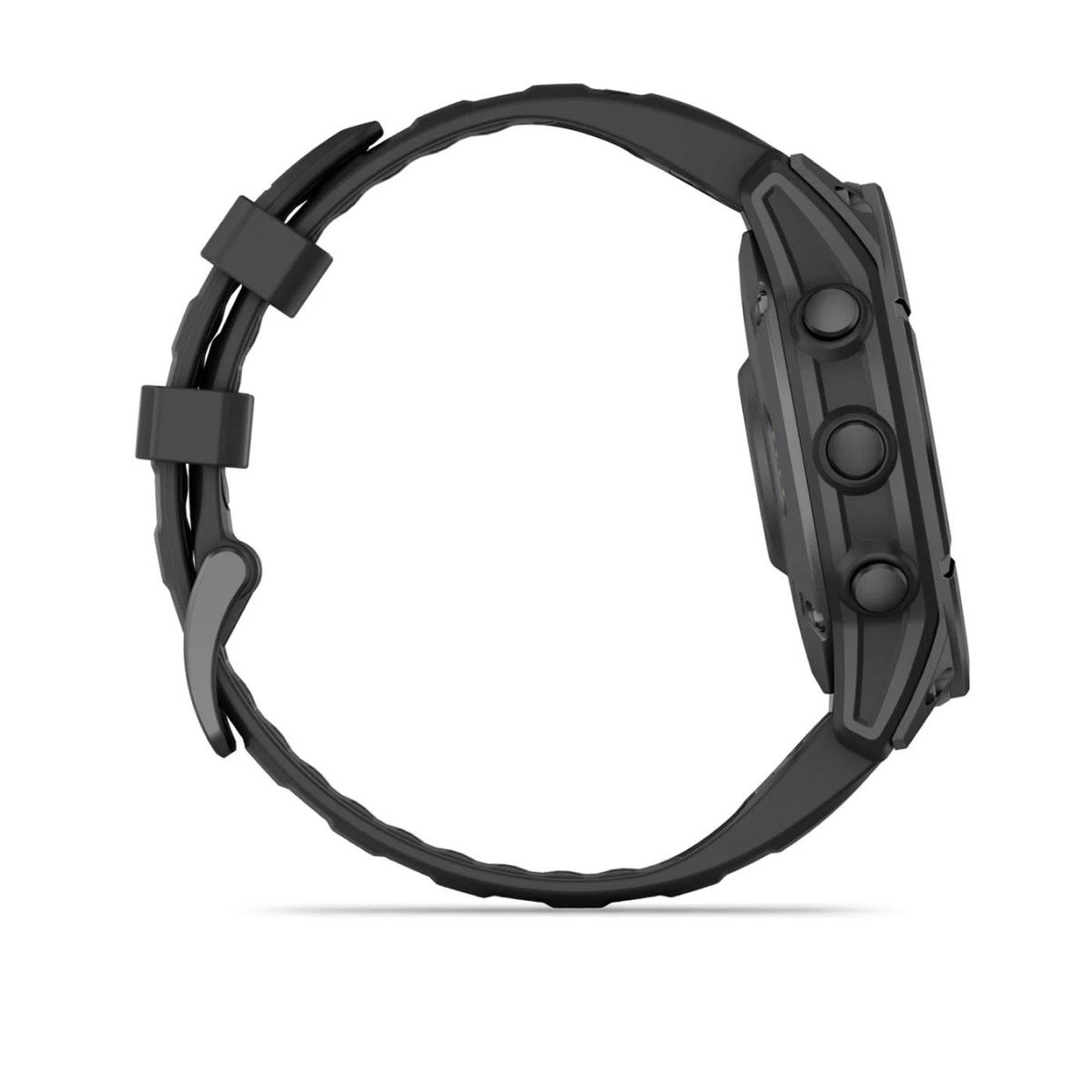
The weight is a surprise. 76 g is 4 g less than the 47 mm steel fenix 8 AMOLED (80 g). In plain terms, the fenix E is not the brick you might expect: the polymer case keeps it light. It is still thick, though, at 14,5 mm, against 13,2 mm for a Forerunner 965. On a slim wrist, you feel it under a jacket sleeve.
© Garmin, official photo used for editorial purposes
What the fenix E lacks: the list that really matters
Garmin stripped seven features from the fenix E compared with the fenix 8. They do not all carry the same weight for a runner.
- Dual-frequency GPS. This is the biggest gap. More on that below.
- The Elevate Gen 5 sensor. The fenix E keeps the Gen 4, the one in the Forerunner 965. No ECG.
- The LED flashlight. A nuisance on a night ultra or when camping, not on a 10K.
- The speaker and microphone. So no calls from the watch and no voice notes.
- Diving. 10 ATM is enough for swimming, not for diving to 40 m.
- Sapphire glass. Gorilla Glass only, more prone to scratches on rocks.
- Half the storage. 16 GB against 32 GB, enough for maps of France and a playlist, not much more.
For a runner, two of these gaps change the buying decision: GPS and heart rate. The rest is about comfort or adventure.
GPS accuracy: a flaw that only shows in forests and cities
The fenix E tracks every constellation (GPS, Galileo, GLONASS, BeiDou), but on a single frequency. In open terrain, it makes almost no difference. Run Évasion, a French site that used it for three months over more than 500 km of road and trail running, reports a satellite lock in under 30 seconds and clean tracks on open paths.
The trouble starts under the trees. In dense forest or between tall buildings, the same French review measured distance overestimated by 3 to 5 %. Over a half marathon, that is 600 m to 1 km too much. In plain terms, your average pace shows faster than reality, and your interval target paces become wrong in those areas.
English-language reviewers point the same way. One of them, who wore it for a month alongside a fenix 8, found the distance "never far off", but regretted the lack of dual-frequency. Another rated the GPS "solid" without matching Garmin's best. None published a figure against a reference course.
So, is it a deal-breaker? Honestly, it depends on your terrain. In the mountains above the treeline, on the track or on country roads, the difference with a dual-frequency watch stays small. In a wooded park or a city centre, it shows.
The barometer, on the other hand, is reassuring. After calibration, Run Évasion found the altimeter within 2 % of map data. For a trail runner tracking elevation gain, that is the number that counts.
Heart rate sensor: fine for endurance, behind on intervals
The Elevate Gen 4 dates from 2021. It is also in the Forerunner 965 and the Epix Gen 2. Reviewers broadly agree on it.
On endurance runs, it keeps up most of the time. Run Évasion reports an average 95 % correlation with a chest strap, without detailing the method. One English-language reviewer found it accurate on steady efforts. Another, who compared it with a chest strap for a month, still saw "wobbly" readings on a steady long run. The gap depends mostly on how tight the strap is and on your skin. To follow a trend, the curve remains usable.
On intervals, it falls behind. Run Évasion notes a lag of a few seconds on short intervals and sudden pace changes. One English-language reviewer goes as far as recommending a chest strap for hard work. Two sources, same verdict, and none says otherwise.
There is a fix. A Garmin HRM-Pro Plus solves the problem and adds running dynamics. Budget about €130 extra if you do threshold work or 30/30s every week.
Maps and navigation: the real edge over entry-level Forerunners
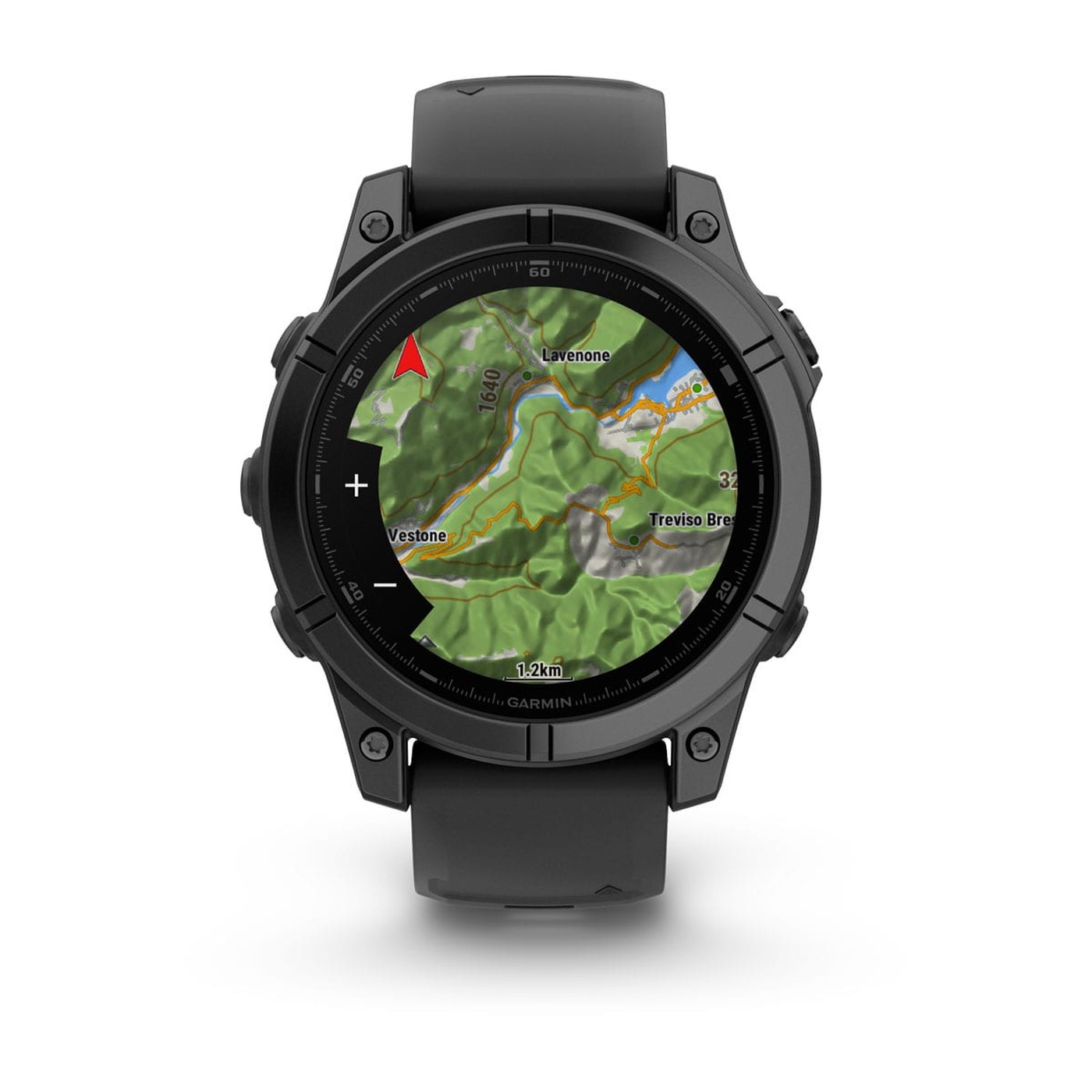
The fenix E shows TopoActive topo maps, with course navigation, back to start and rerouting. Maps install over Wi-Fi from the watch and take up part of the 16 GB. The 1,3-inch 416 x 416 pixel screen stays readable in full sun, even if it is slightly smaller than the 1,4-inch screen of the 47 mm fenix 8.
© Garmin, official photo used for editorial purposes
For a trail runner, this is what justifies the fenix E over a Forerunner 570, which has no maps. On a self-supported trail, the map on your wrist saves you from pulling out your phone at every junction. No flashlight, so your headlamp remains mandatory at night.
Training metrics: the full Garmin suite, no compromise
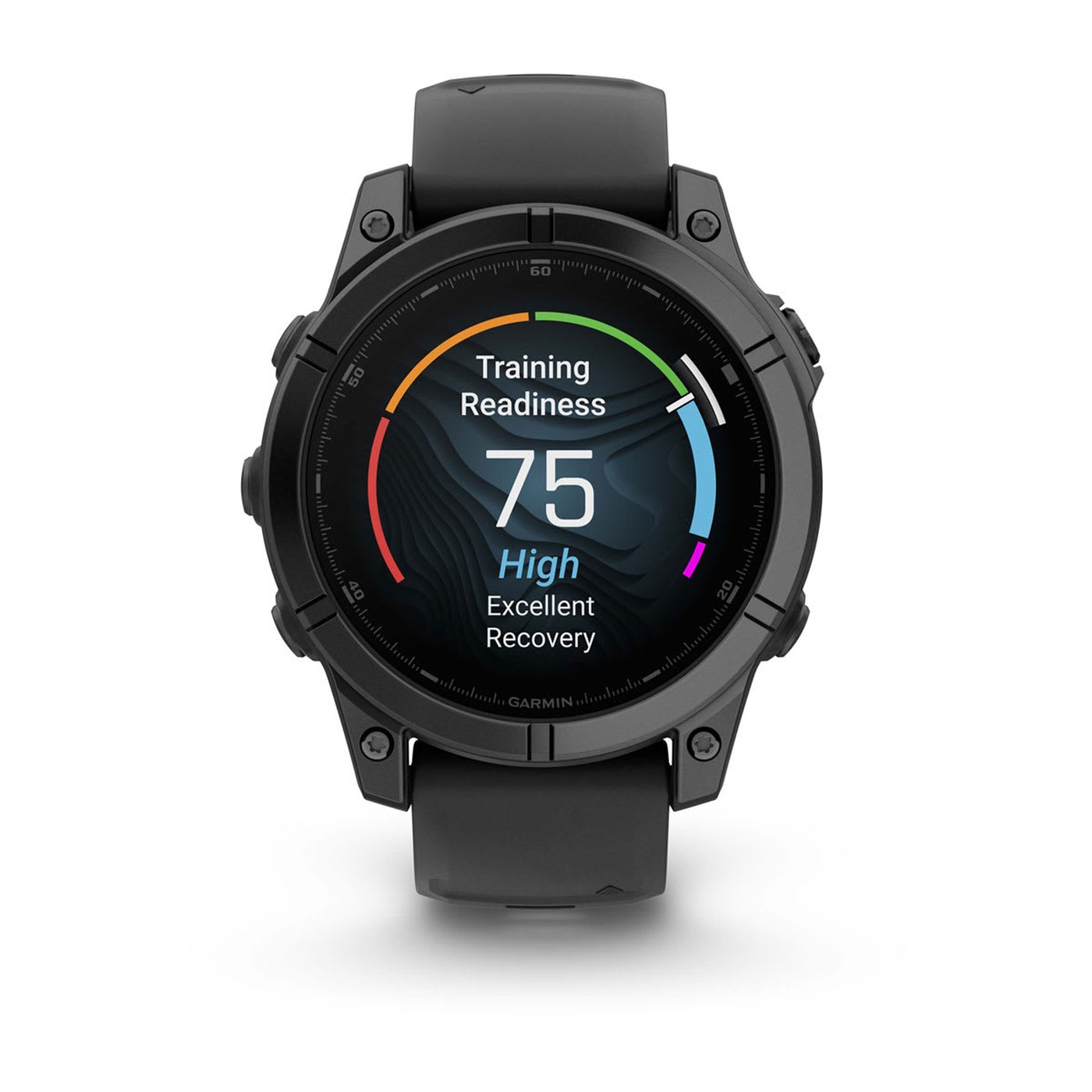
Here, the fenix E loses nothing. You get Training Readiness, Training Status, acute load and overnight HRV status. On top of that come Endurance Score, Hill Score, wrist-based running power, daily suggested workouts and race time predictions. Body Battery and sleep score round it off.
© Garmin, official photo used for editorial purposes
One caveat, noted by a reviewer who compared both watches: the Stamina metric (remaining endurance during a run) did not give the same values as on the fenix 8. That makes sense, since it depends on heart rate and the sensors differ. For following a plan, nothing is missing.
Real-world battery life: a week of runner use
| Mode | Garmin claim | Measured by reviewers |
|---|
| Smartwatch (raise to wake) | 16 days | 10 to 15 % per light day, 20 % per busy day |
| Smartwatch always-on | 6 days | Just under a week |
| All-systems | 32 h | About 3 % per hour, i.e. 33 h extrapolated |
| Mixed use (3 one-hour GPS runs per week) | Not stated | One week between charges |
The most precise reading comes from a reviewer who wore it for a month: 3 % battery per hour in all-systems mode. That matches the 32 h claim. Their daily drain, 10 to 15 % on quiet days and 20 % on busy ones, gives five to ten days depending on your volume. Run Évasion lands in the same range: one week with three one-hour runs and notifications.
For an ultra, 32 h in all-systems mode covers a 100 km mountain race. Beyond that, GPS-only mode (42 h) or max battery (75 h) takes over, with a coarser track. The 47 mm fenix 8 AMOLED reaches 47 h in GPS-only mode. The gap exists, but it changes little for races under 24 h.
fenix E vs fenix 8: is it worth paying double?
| fenix E 47 mm | fenix 8 AMOLED 47 mm |
|---|
| Launch price | €800 | €1000 (steel) |
| Screen | 1,3-inch AMOLED, 416 x 416 | 1,4-inch AMOLED, 454 x 454 |
| Weight | 76 g | 80 g (steel) |
| Dual-frequency GPS | No | Yes, with SatIQ |
| Heart rate sensor | Elevate Gen 4 | Elevate Gen 5 with ECG |
| Flashlight | No | Yes |
| Speaker and microphone | No | Yes |
| Diving | No (10 ATM) | Yes, down to 40 m |
| Storage | 16 GB | 32 GB |
| Smartwatch battery | 16 days | 16 days |
| GPS-only battery | 42 h | 47 h |
At €800 against €1000, the fenix 8 was the better buy, no question. Today, with the fenix E at €369, the gap often exceeds €400 depending on fenix 8 deals. For that money, you mainly pay for dual-frequency GPS, the Gen 5 sensor and the flashlight. If you run in forests or do night ultras, the fenix 8 is justified. Otherwise, keep the money.
fenix E vs Forerunner 965 and Coros Apex 4: the simple reading
| fenix E | Forerunner 965 | Coros Apex 4 |
|---|
| Screen | 1,3-inch AMOLED | 1,4-inch AMOLED | 1,3-inch transflective MIP |
| Weight | 76 g | 53 g | 52 g (titanium case, without band) |
| Dual-frequency GPS | No | Yes | Yes |
| Maps | Yes | Yes | Yes |
| Claimed GPS battery | 32 h (all-systems) | 31 h (GPS only) | 65 h (all-systems) |
| Contactless payment | Yes | Yes | No |
| Launch price | €800 | €650 | €499,99 |
Put simply, if track accuracy and low weight are your priority, take the Forerunner 965: same heart rate sensor, same software, 23 g lighter and dual-frequency GPS. If you want a tougher fenix case for trail and mountaineering, the fenix E. If battery life matters more than the screen, the Apex 4 doubles down: 65 h of GPS, titanium and sapphire for €499,99, but no contactless payment.
Who is the fenix E for?
The road runner
For a marathon in the countryside, it is enough. But the road is not its terrain. In cities, between buildings, the single-frequency track loses accuracy. For the same budget, a Forerunner 965 or a Forerunner 570 will serve you better.
The trail runner
This is its audience. Maps, a reliable barometer, buttons that are easy to use in gloves, 32 h in all-systems mode. Above the treeline, the GPS flaw becomes almost invisible. Add a headlamp for night starts.
The triathlete and multisport athlete
All the profiles are there: pool and open-water swimming, cycling, transitions. On the bike, the Gen 4 sensor is less reliable on surges. A chest strap settles it.
© Garmin, official photo used for editorial purposes
How to fit it into your RunMorph training plan
The fenix E is a watch for volume and elevation. Its suggested workouts and training status track a long build well. For key sessions, a few simple rules.
- On long runs, trust the wrist heart rate: at a steady pace, it keeps up.
- For intervals, use a chest strap or run by pace, on the track or on an open stretch.
- On trails, follow your elevation gain on the barometer, calibrated at the start.
Your next step: the fenix E makes the most sense during a trail build, with its maps and reliable altimeter. To structure your hill sessions and long mountain runs, follow a
RunMorph trail training plan, tailored to your level and your target race.
RunMorph Coach verdict
At €800, the fenix E was a bad deal. Garmin was selling a name and a case while removing what gives a running watch its value in 2024: dual-frequency GPS and the latest heart rate sensor. At €369, the picture changes.
You get an AMOLED fenix with maps, the full Garmin training suite and a week of battery, for the price of a mid-range Forerunner. The two flaws are real: distance overestimated by 3 to 5 % in dense forest, heart rate lagging on intervals. They matter less for a trail runner who runs in open mountains and already owns a chest strap.
The overall score weights metrics and price first, then GPS and heart rate, then battery life. Result: 7,5/10. For a road runner in the city, take the Forerunner 965 instead.