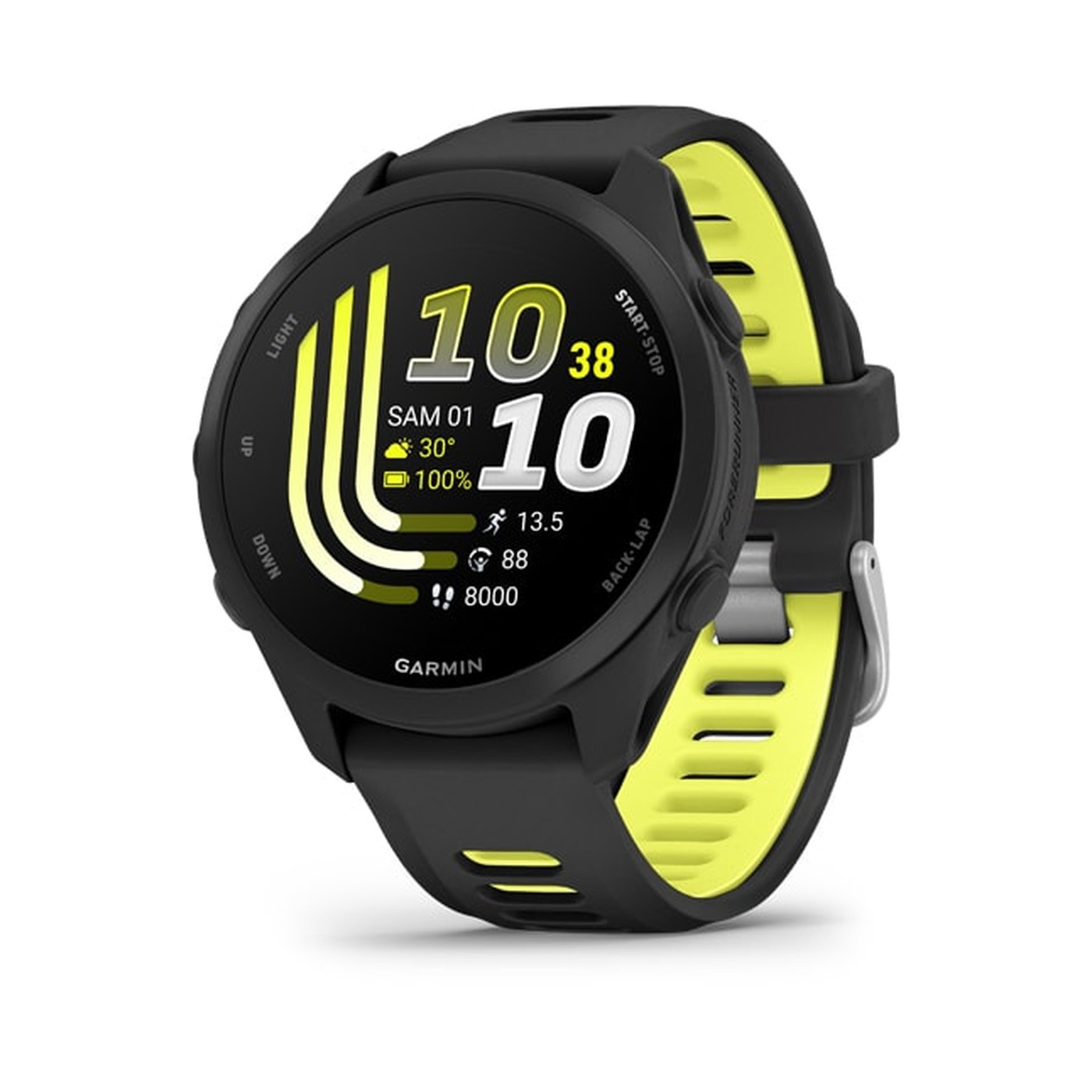
Announced on May 12, 2026 and on sale in France since May 15, the Garmin Forerunner 170 is the new premium entry point from the American giant. At €299.99, it inherits the full physiology suite of the high-end Forerunners (Training Readiness, HRV Status, adaptive Garmin Coach) in a light 41-gram AMOLED case. The promise: bring Garmin tools once reserved for €450-plus models to a much wider audience.
Garmin Forerunner 170 Review: Premium AMOLED Garmin Under €300
8.5/10
Garmin Forerunner 170: the affordable running watch that stops cutting corners
For years, Garmin's entry-level running range meant compromise. A low-res MIP screen on the Forerunner 55, capped metrics on the Forerunner 165, no Training Readiness below €450: beginner and intermediate runners had to choose between a sensible budget and a real analysis tool. The Forerunner 170 closes that chapter. It carries over almost the entire physiology suite of the Forerunner 970 (which we tested at €749), packs it into a 42 mm polymer case weighing 41 grams, and sells it for €299.99. Slotted between the Coros Pace 4 (€269) and the Forerunner 970 (€749), it completes a coherent trio if you want to upgrade your gear step by step.
RunMorph tip. If your budget is around €300 and you want a watch that can carry you through your first marathon build, the Forerunner 170 is the most rational pick on the market in May 2026. You get the metrics that make a Forerunner 970 so compelling (Training Readiness, HRV Status, adaptive Garmin Coach) without paying for full mapping or multi-band GPS. If you need an even tighter budget with an AMOLED display and excellent multi-band GPS accuracy, check out the Coros Pace 4 at €269, which takes a different approach.
© Garmin, official photo used for editorial purposes
Technical specifications
| Brand | Garmin |
| Model | Forerunner 170 |
| Release date | May 12, 2026 (announcement), May 15, 2026 (on sale in France) |
| Case size | 42 mm, reinforced polymer |
| Weight | 41 grams (silicone band included) |
| Display | 1.2-inch AMOLED touchscreen, 390 x 390 px, Corning Gorilla Glass 3 |
| Battery life | 10 days in smartwatch mode, ~4 days with AOD, 20 h in standard GPS, 14-16 h in multi-GNSS |
| GNSS | Multi-GNSS (GPS, GLONASS, Galileo, BeiDou, QZSS), single-frequency (no L1+L5 multi-band) |
| Sensors | Elevate Gen 4 optical heart rate sensor, barometric altimeter, compass, gyroscope, skin temperature sensor, accelerometer |
| Mapping | No maps, breadcrumb trail for route following |
| Sport profiles | More than 80 profiles (50+ added vs the Forerunner 165), including road running, trail, treadmill, cycling with a power meter, swimming, triathlon |
| Music storage | Not on the standard 170, yes on the Music version (Spotify, Deezer, Amazon Music) |
| Contactless payments | Garmin Pay (NFC) |
| Water resistance | 5 ATM (50 meters) |
| Smartphone connectivity | Bluetooth, Wi-Fi (automatic sync with Garmin Connect) |
| Price | €299.99 (Forerunner 170) / €349.99 (Forerunner 170 Music) |
Who is the Forerunner 170 for?
The beginner who wants a serious tool from day one
This is the most obvious target. If you're new to running and want a watch you won't outgrow in six months, the Forerunner 170 ticks every box. The adaptive Garmin Running Coach builds you a personalized plan (5 km, 10 km, half marathon) with daily workouts that adjust as you progress. Training Readiness, inherited from €500-plus models, tells you every morning whether your body is ready to handle a hard session. In practice, it's the tool that keeps you clear of the classic mistakes of the self-coached runner: stacking sessions that are too intense, ignoring recovery, overloading a week after a bad night's sleep.
The intermediate runner training for a half or a full marathon
If you run 30 to 60 kilometers a week and chase a time goal over 10 km, the half marathon or the marathon, the Forerunner 170 gives you a complete toolbox. HRV Status (overnight heart rate variability analysis), Training Load (acute and chronic training load), Body Battery (daily energy gauge), estimated VO2max and race predictor: you get the same depth of physiological insight as with a Forerunner 970. For this profile, the only real difference comes down to GPS accuracy in tough environments and the lack of maps. In dense urban areas or under thick forest cover, the 170's single-frequency GPS shows its limits against the 970's L1+L5 multi-band. For road marathon prep, the gap is minor.
The occasional triathlete or multisport cyclist
The Forerunner 170 handles multisport, triathlon, and pool and open-water swimming. It pairs with cycling power meters (Stages, Favero, 4iiii, Wahoo, Garmin Rally), which is rare at this price, and includes Garmin Cycling Coach for adaptive bike plans. If you're new to triathlon (sprint, Olympic distance), you get a solid compromise here, as long as you can live without maps. For an Ironman or an ultra-trail, the Forerunner 970 remains the go-to tool (long battery life, mapping, multi-band GPS).
© Garmin, official photo used for editorial purposes
GPS accuracy and heart rate sensor
This is the Forerunner 170's sore spot. Garmin made a clear pricing call: no multi-band GPS in this range. The 170 runs single-frequency, with access to the GPS, GLONASS, Galileo, BeiDou and QZSS constellations. Independent readings from international testing labs agree: accuracy on open roads is very good, on par with the Forerunner 265 it replaces. In disrupted environments (dense urban canyons, closed forest canopy, deep valleys), however, the gap with multi-band becomes measurable. On a typical "city run between tall buildings" course, single-frequency GPS usually drifts by 1 to 3% over the total distance, while multi-band stays under 1%. If you only run in the city on the same routes, relative consistency stays excellent. If you often run in forests or mountains, this matters.
On the heart rate side, the 170 uses the 4th-generation Elevate optical sensor (the same as on the Forerunner 265 and Forerunner 965), not the Gen 5 version reserved for the Forerunner 970. Accuracy at a steady effort (easy runs at moderate pace) is very good. During hard efforts with rapid heart rate changes (short intervals, sprints, sudden surges), the optical sensor shows the usual limits of the technology: delayed response and smoothed-out peaks. For quality sessions, the smart move is still to pair the watch with a chest strap (HRM-Dual, HRM-Pro Plus, Polar H10) via Bluetooth or ANT+. For easy runs and long runs, wrist-based heart rate is enough.
Mapping and navigation: what's missing
The Forerunner 170 has no maps at all. That's the clearest line between it and the Forerunner 970 or the Suunto Race 2 (which offers free worldwide offline maps at a similar price). You get a breadcrumb trail to follow a route imported from Garmin Connect or Strava, but with no base map, no street names and no points of interest. For urban or suburban road runners, that's rarely a dealbreaker: you follow your track on a black background, and the "Back to Start" feature takes you back to a known point in a straight line. For trail runners heading onto unmarked paths, it's limiting. If map navigation is one of your priorities, look at the Suunto Race 2 (€599, worldwide maps included) or the Forerunner 970.
Training and recovery metrics
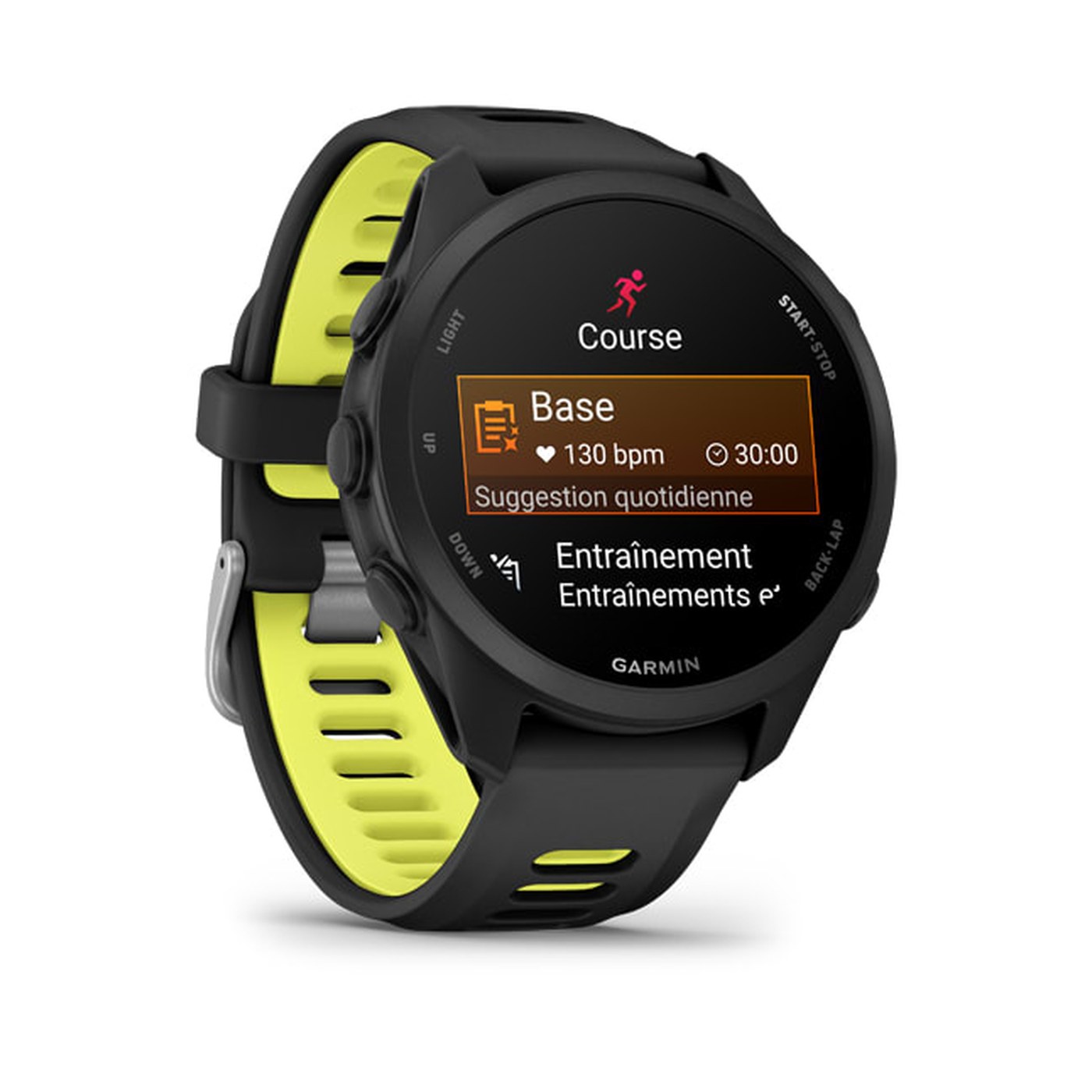
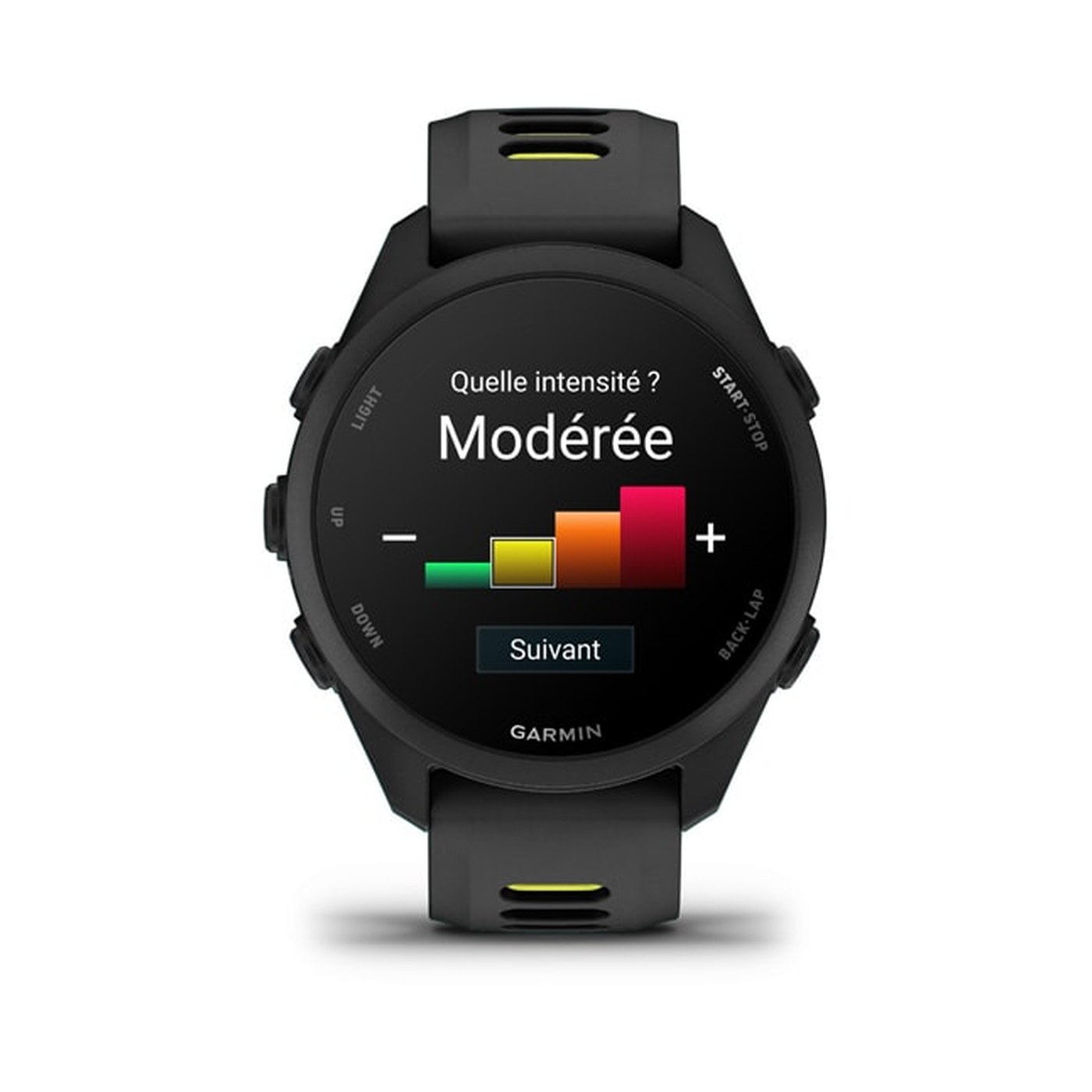
This is where the Forerunner 170 sets itself apart from direct competitors at the same price. Garmin opened its entire physiology suite to this range: Training Readiness (daily 1-100 score combining sleep, HRV, recent load, stress and estimated hydration), HRV Status (overnight heart rate variability status over 4 weeks), Training Load (acute vs chronic load with optimal / productive / unproductive zones), Training Status (overall fitness state), Body Battery (real-time energy gauge), Sleep Score (sleep analysis with stages), Stress Score, Daily Suggested Workouts (the day's suggested session based on your load), Race Predictor (finish time predictions for 5 km, 10 km, half marathon and marathon), Endurance Score, Hill Score, estimated VO2max.
The adaptive Garmin Running Coach deserves its own mention. You enter your goal (race date, distance) and your weekly availability, and the watch builds an evolving plan that adjusts to your progress and physiological state. Bad night's sleep? The next day's hard session is automatically scaled back. Fatigue spike flagged by HRV? A recovery day gets inserted. If you don't yet follow a structured plan with a coach, it's a genuinely useful assistant.
© Garmin, official photo used for editorial purposes
Real-world battery life
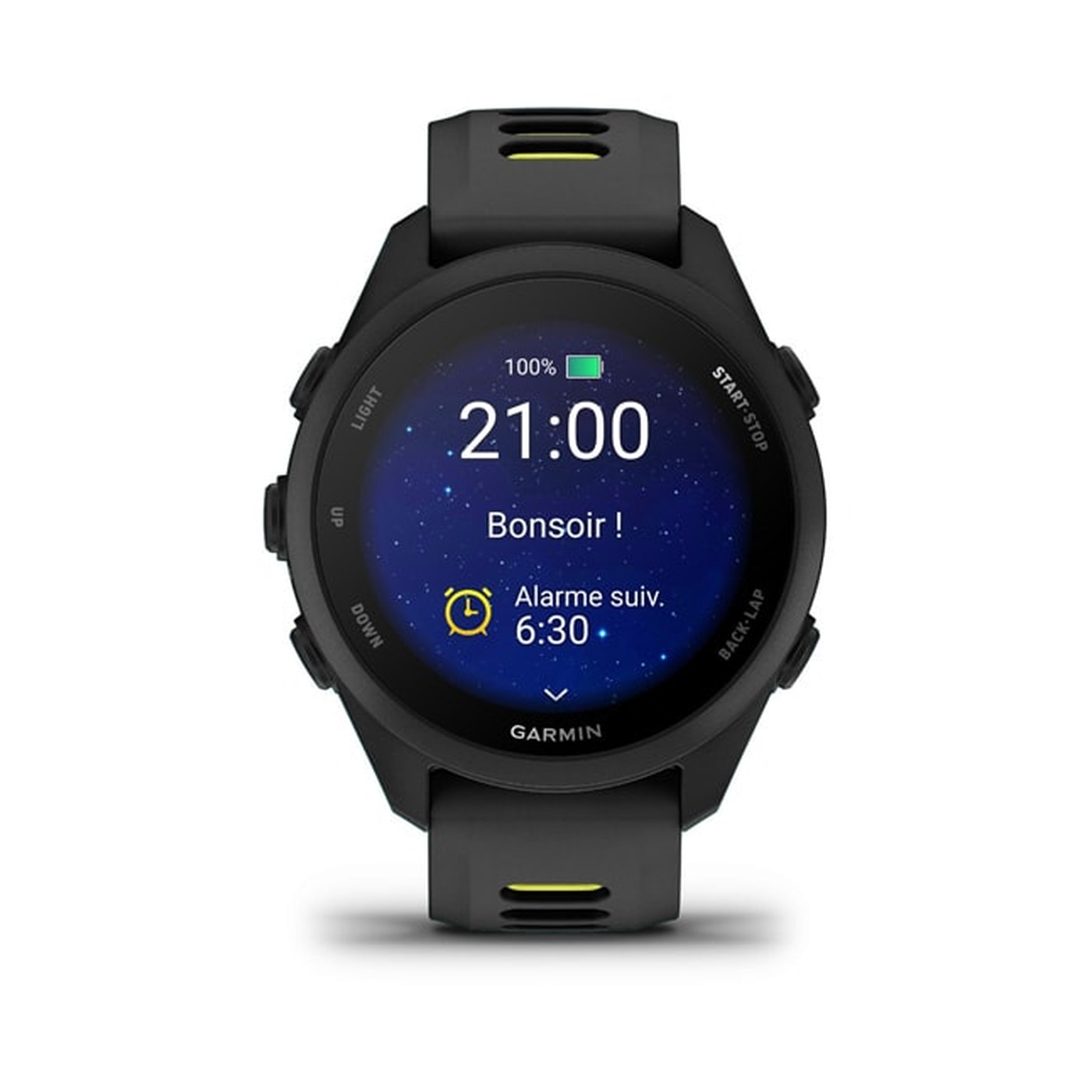
Garmin's official figures: 10 days in smartwatch mode (screen off at rest), around 4 days in AOD mode (always-on display), 20 hours in standard GPS mode (single-frequency multi-GNSS) and 14 to 16 hours in all-constellation multi-GNSS mode. Independent lab measurements confirm these numbers within a 10 to 15% margin depending on real-world use (auto brightness, notifications, sessions with the display on). With a typical 5 hours of running per week plus sleep tracking and smartphone notifications, the battery honestly lasts 8 to 9 days, so one charge a week. That's slightly behind the Coros Pace 4 (rated at 19 days in daily use) but well ahead of an Apple Watch Series 10. A USB-C charge takes about 60 minutes to go from 10 to 100%.
How it stacks up against the competition
Three watches are fighting over the €250-350 segment in May 2026, and each has its own angle.
Against the Coros Pace 4 (€269), the Forerunner 170 loses on three counts: no L1+L5 multi-band GPS (the Pace 4 has it despite its lower price), shorter everyday battery life (10 days vs 19), and a 1.2-inch screen that matches the Pace 4's 1.2 inches but with slightly lower pixel density. It wins, however, on the software ecosystem (Garmin Connect remains the benchmark for analysis), the depth of physiological metrics (full overnight HRV Status, Training Readiness, adaptive Garmin Coach plans), Garmin Pay support and the breadth of the Connect IQ app catalog. If you want the best GPS accuracy for the least money, the Pace 4 is unbeatable. If you value the ecosystem and analysis metrics, the 170 makes the difference.
Against the Suunto Race 2 Titanium Trail (€599), the Forerunner 170 plays in a different price bracket. The Race 2 offers free worldwide offline maps, multi-band GPS, a Grade 5 titanium case, sapphire glass, 55 hours of battery life in multi-band GPS and a 1.5-inch 466 x 466 px display. If you don't run technical trails and will never spend €600 on a watch, the 170 is the rational choice. For a demanding trail runner, the Race 2 sits 1.5 tiers above.
Against the Forerunner 970 (€749, premium range), the 170 bets on a well-managed compromise. You keep 90% of Garmin's physiology suite (Training Readiness, HRV Status, adaptive Garmin Coach, Race Predictor, advanced running metrics). You lose the full TopoActive Europe maps, L1+L5 multi-band GPS, the titanium case with sapphire glass, the LED flashlight, the microphone and speaker, and the Elevate Gen 5 heart rate sensor with ECG. If you're preparing an ultra-trail with map navigation in the mountains, the 970 remains essential. For 90% of road and mixed-terrain runners, the 170 does the same job for €450 less.
How to fit it into your RunMorph training plan
The Forerunner 170 fits perfectly into a structured progression. On the RunMorph Plans page, pick a plan that matches your goal (10 km, half marathon, marathon, return to running). RunMorph sessions specify pace, target heart rate and duration. The 170 lets you turn those instructions into guided workouts: set up the structured session in Garmin Connect, send it to the watch and let it guide you. You can turn off Garmin's Daily Suggested Workout if you're following a specific RunMorph plan (recommended, to avoid clashes between the two approaches).
If you're starting a RunMorph marathon plan, make it a habit to check Training Readiness every morning before a hard session. If the score drops below 30 ("low" zone), you're better off pushing the quality session to the next day and replacing it with active recovery. Many RunMorph athletes also use the weekly HRV Status to confirm the training block remains sustainable: a downward HRV trend over 7 days is a reliable signal to schedule a recovery week.
The RunMorph verdict
The Garmin Forerunner 170 is the new benchmark in the €250-350 running watch segment. Garmin made a bold strategic call: open its entire physiology suite (the same as on the €749 970) to this affordable range, while making smart trade-offs on mapping and multi-band GPS. The result is a watch that single-handedly makes the Forerunner 165, released a year earlier, obsolete, and puts real pressure on the Coros Pace 4 and the Apple Watch SE 2 in the French market.
The only real debate is between the Forerunner 170 and the Coros Pace 4. If multi-band GPS accuracy is your absolute priority (trail, dense cities, forest), the Pace 4 remains the more rational choice at €269. If the Garmin Connect ecosystem, Garmin Pay, adaptive Garmin Coach plans and the depth of analysis metrics weigh more in your decision, the Forerunner 170 is your pick. RunMorph score: 8.5/10.
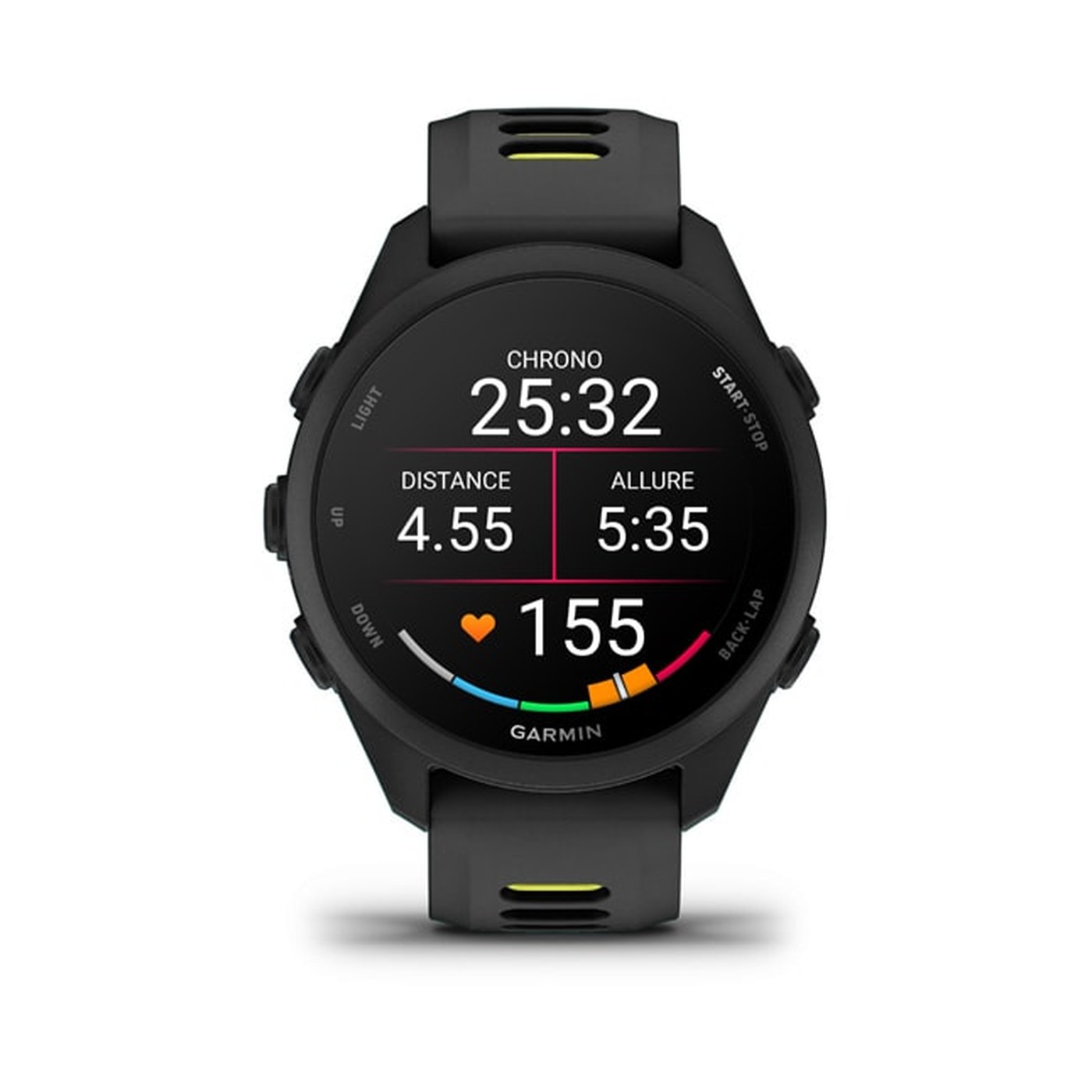
© Garmin, official photo used for editorial purposes
Key takeaways for your training
- Full physiology suite for €299.99: Training Readiness, HRV Status, adaptive Garmin Running Coach, Body Battery, Sleep Score. The same foundation as the €749 Forerunner 970, which finally makes this affordable range a serious option.
- Single-frequency GPS, no multi-band: excellent accuracy on open roads, more average in disrupted environments (urban canyons, dense forest). For running on open city streets and in urban parks, it's enough.
- No maps at all: breadcrumb trail only. If you're aiming for technical mountain trails with navigation on unmarked paths, it falls short. For roads and familiar trails, it works.
- Chest strap recommended for hard sessions: the wrist-based Elevate Gen 4 sensor smooths out short-interval peaks. For easy runs and long runs, the wrist is enough.
- Compatible with cycling power meters and Garmin Cycling Coach: a rarity at this price, which makes it an excellent tool if you also ride a bike or are preparing your first triathlon.