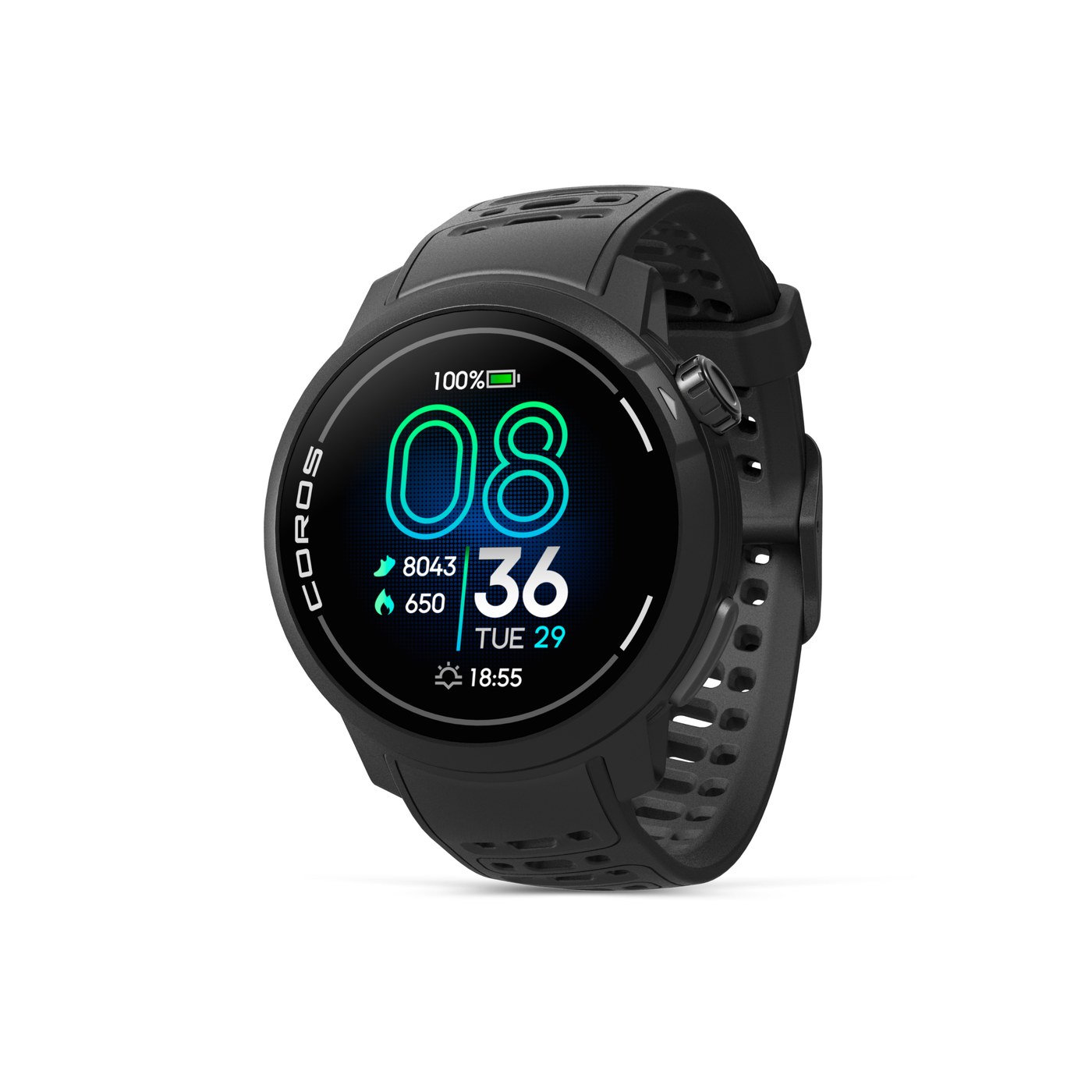
The COROS Pace Pro pulls off a rare combination in 2026: a 1.3-inch AMOLED display at 1500 nits, L1+L5 multi-band GPS, global offline mapping and 38 hours of battery life in all-constellation GPS mode, all in a 49 g polymer case (37 g on the nylon strap) for €349. The mid-range AMOLED segment had never seen this level of features at this price.
COROS Pace Pro Review: 37 g, AMOLED and Offline Maps for €349
9/10
COROS Pace Pro: the first AMOLED COROS, and much more
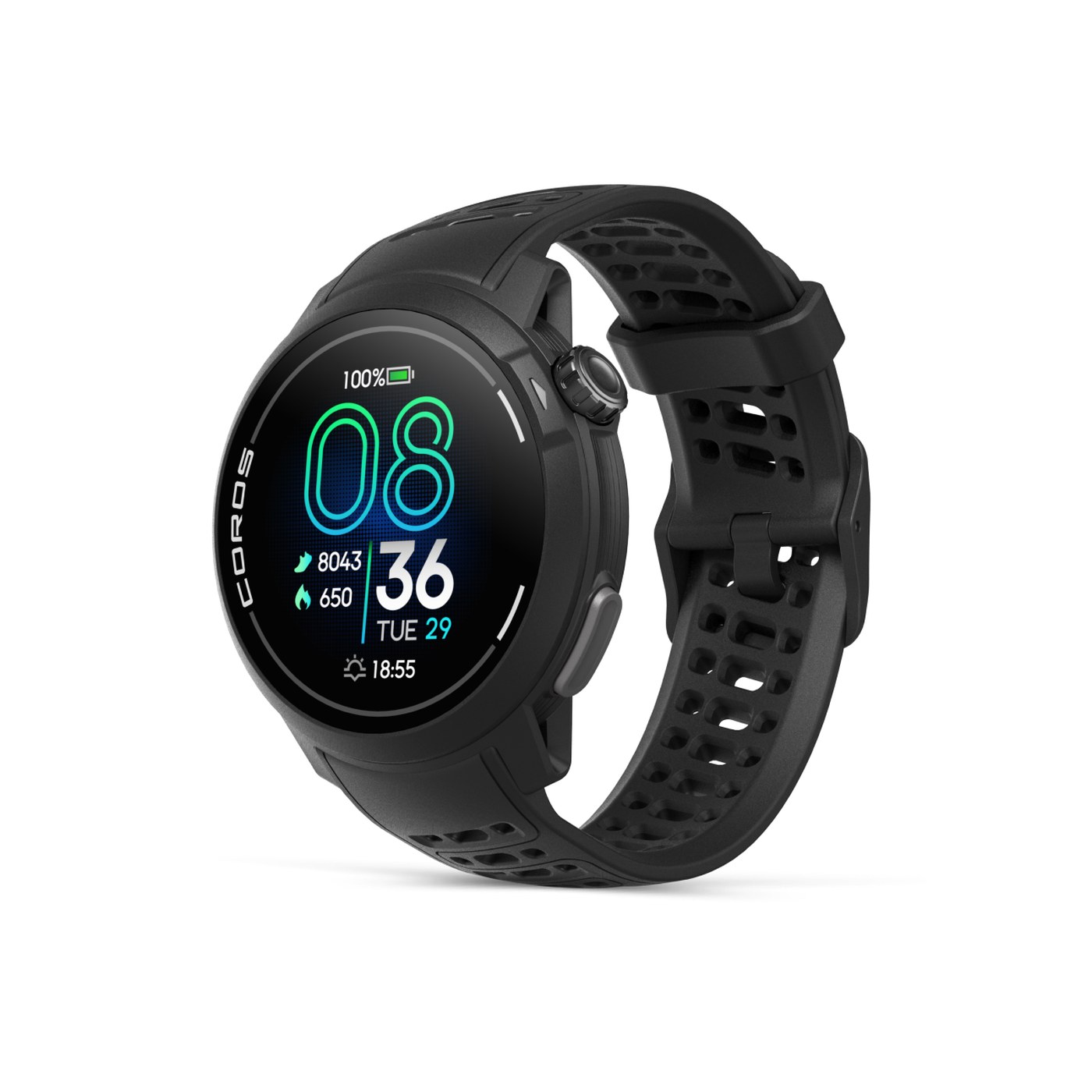
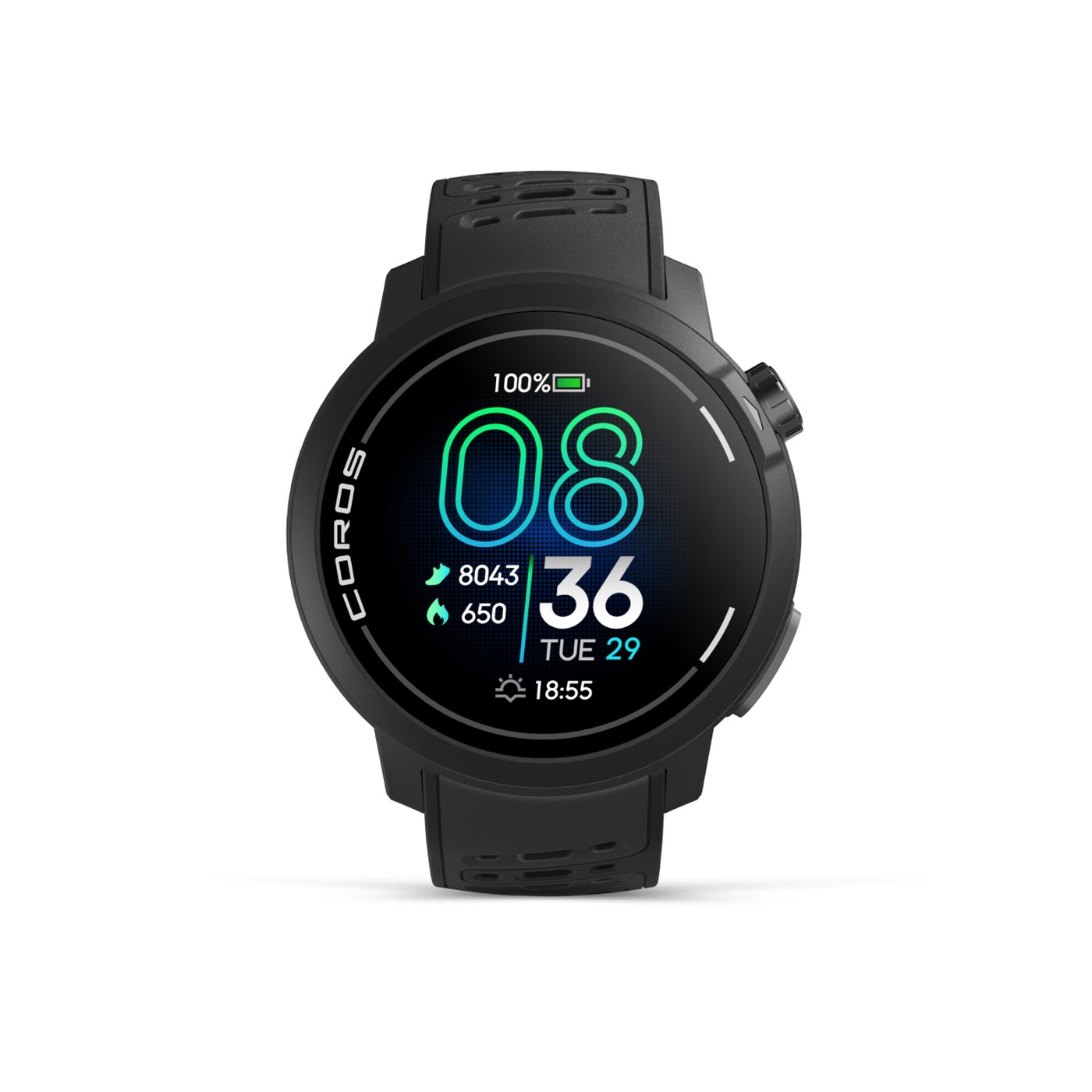
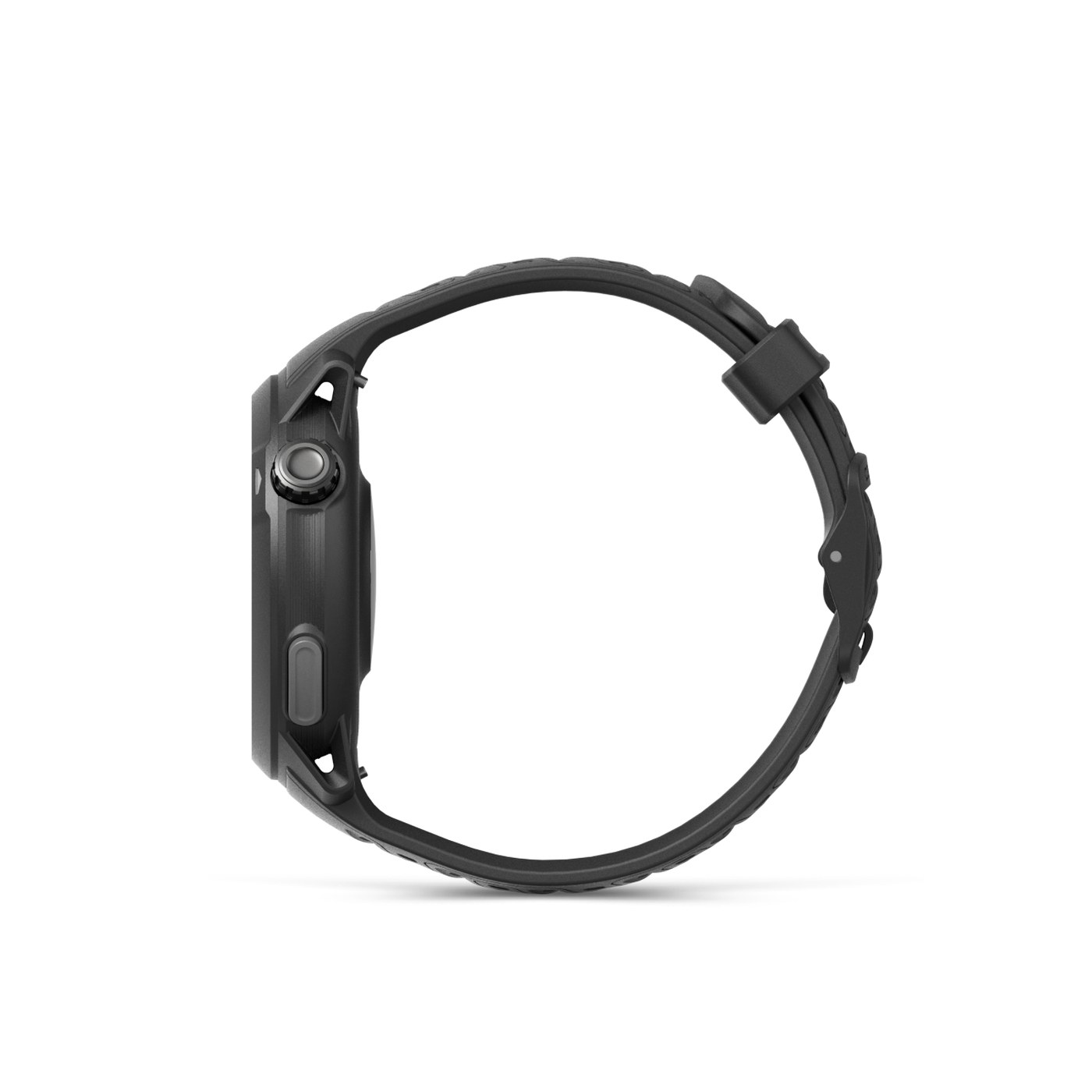
The Pace Pro isn't just a premium version of the Pace 4. It's the first COROS watch with an AMOLED display, and the brand's first to offer global offline mapping. Unveiled on October 31, 2024, it sits above the Pace 4 (€269, also AMOLED but without full mapping) and well below the Apex 4 or the Vertix 2S. The 46 mm case, made of glass-fiber-reinforced polymer, has a digital crown on the side, a nod to the COROS heritage of the Apex Pro and the Vertix. The 1.3" touchscreen runs at 416 x 416 px and 1500 nits, and GPS battery life reaches 38 hours in All Systems mode and 31 hours in L1+L5 dual-frequency mode: numbers closer to a high-end transflective watch than to a mid-range AMOLED. The target: demanding runners who want a modern AMOLED without paying €600 or more, and who value the COROS data ecosystem.
RunMorph's take: the Pace Pro is the COROS AMOLED that makes the Pace 4 a tough sell. If you want global offline mapping and an ultra-bright AMOLED without climbing to €749 like the Garmin Forerunner 970, this is the one to go for. For 30% less money, you get 80% of the features that actually matter to a runner or an all-round trail runner.
© COROS, official photo used for editorial purposes
Technical specifications
| Spec | COROS Pace Pro |
|---|---|
| Brand | COROS |
| Model | Pace Pro (tested color: Black) |
| Official release | October 31, 2024 |
| Case | 46 x 46 mm, 12 mm thick, glass-fiber-reinforced polymer + mineral glass |
| Weight | 49 g (22 mm silicone strap) / 37 g (nylon strap) |
| Display | 1.3" AMOLED touchscreen, 416 x 416 px, 1500 nits |
| Smartwatch battery life | 20 days of daily use without Always-On, 6 days with AOD |
| GPS battery life | 38 h All Systems / 31 h dual-frequency L1+L5 |
| GNSS | Dual-frequency multi-band: GPS, GLONASS, Galileo, BeiDou, QZSS |
| Sensors | Optical heart rate, SpO2, ECG, barometric altimeter, accelerometer, gyroscope, 3D compass, thermometer |
| Mapping | Yes, global offline topographic maps downloadable via Wi-Fi |
| Processor | Ambiq Apollo510, 66% faster than the Pace 3 |
| Sport profiles | Road running, trail, cycling, swimming, triathlon, strength training, winter sports, and more than 25 modes |
| Music storage | 32 GB, local MP3 (no Spotify or Deezer streaming) |
| Contactless payment | No |
| Water resistance | 5 ATM (50 m) |
| Phone connectivity | Bluetooth, Wi-Fi 2.4 GHz |
| Retail price (France) | €349 |
Who is the COROS Pace Pro for?
The demanding road runner who wants a modern AMOLED without breaking the bank
If you're a road runner logging 40 to 80 km a week, training for a half or a full marathon, and you want GPS you can trust down to the meter in a dense city, the Pace Pro ticks every box. L1+L5 dual-frequency GPS keeps your track locked to the street, where a single-band chip drifts between tall buildings. The 1500-nit AMOLED display stays readable in full June sun and on night runs, and the EvoLab suite (Training Load, Recovery Timer, Race Predictor, VO2 max) supports structured progress without forcing a paid subscription the way some rivals do. One detail that makes a real difference on race day: the digital crown lets you scroll through data screens without touching a touchscreen soaked by rain or sweat.
The all-round trail runner who wants mapping without moving up a tier
Global offline mapping, downloaded for free through the COROS map manager and the watch's Wi-Fi, is a game changer at this price. You head out on an unfamiliar trail in the Cévennes or the Vercors and follow the route in color on your wrist, with contour lines and points of interest, exactly as you would on a Forerunner 970 or a Suunto Race 2 costing three to four times as much. Dual-frequency mode lasts 31 hours, more than enough for a 100 km ultra. The barometric altimeter tracks elevation gain accurately, and the back-to-start feature is reassuring when night falls.
The short-course triathlete on a tight budget
If you're a triathlete targeting sprint or Olympic distance and you don't want to drop €700 on a dedicated triathlon watch, the Pace Pro gets the job done. Pool swim, open-water swim, cycling and running profiles with automatic transitions, 5 ATM water resistance, and an optical heart rate sensor that's reliable on easy aerobic runs. The only real compromise: no quick-transition multisport mode as refined as a triathlon-focused Forerunner 970, and the optical sensor is less accurate on short reps than high-end models. Add a textile chest strap and the compromise disappears.
GPS accuracy and heart rate sensor
This is what separates a good running watch from a great one. The Pace Pro's L1+L5 multi-band GPS runs on the Ambiq Apollo510 processor, 2 times more powerful than the Pace 3's chip and 66% faster. In practice, satellite lock takes under 3 seconds after a few runs to settle in, and the track stays glued to the trail even under thick tree cover or between buildings. Independent tests run abroad confirm that the Pace Pro plays in the same league as high-end watches for GPS accuracy, at a €349 price tag. Distances measured on certified loops (5 km, 10 km) stay within a few meters.
The new-generation optical heart rate sensor, paired with SpO2 and ECG, handles easy aerobic running without a hitch. Gaps appear on very short intervals (30 seconds, for example) with aggressive heart rate spikes: that's not a COROS-specific flaw, it's the physical limit of wrist-based optical sensors. If you're after very precise threshold or max aerobic speed work, a textile chest strap is still the way to go, and it pairs seamlessly over Bluetooth.
© COROS, official photo used for editorial purposes
Mapping and navigation
This is the Pace Pro's big upgrade over the Pace 3 and the Pace 4: full offline mapping. You connect the watch to your home 2.4 GHz Wi-Fi, download the region or country through the COROS app, and the free global topographic map stays on the watch. On screen you get street names, named trails, points of interest and contour lines, all easy to navigate with the touchscreen and the digital crown. Zooming and panning are smooth, with no noticeable lag, an area where previous generations dragged down the experience.
The classic navigation features are all there: route following with GPX files imported from Komoot or Strava, back to start, off-course alerts. A few very advanced features are still missing, such as a detailed breakdown of remaining climbs like Garmin ClimbPro (the in-house rival COROS Apex 4 closed that gap in October 2025), but for a trail runner who wants to check their position on the trail without pulling out a phone, the compromise is acceptable.
Training and recovery metrics
COROS ships the EvoLab ecosystem, which organizes the watch's data in the free app and the web-based Training Hub. Key metrics: Training Load (acute load over 7 days and chronic load over 42 days), Recovery Timer (recommended recovery time after each session), Race Predictor (predicted 5 km, 10 km, half marathon and marathon times based on recent runs), Base Fitness (overall fitness level). VO2 max is estimated after your first threshold runs and gets sharper over time.
A feature trail runners love: you can import a custom training plan into the watch as a .fit or .erg file, session by session, with prescribed heart rate or pace zones. Sleep tracking breaks down light, deep and REM sleep, and morning heart rate variability gives a meaningful signal on accumulated fatigue. If you want an adaptive program along the lines of Garmin Daily Suggested Workouts, COROS offers official training plans (5 km to marathon) you can download for free and sync to the watch.
Real-world battery life
COROS's claimed figures hold up in real use: 20 days of daily use without Always-On Display, 6 days with AOD always on. In all-constellation GPS training mode (All Systems), the Pace Pro lasts up to 38 hours, and 31 hours in L1+L5 dual-frequency, the most accurate mode. That covers an ultra up to 100 km in multi-band mode, and well beyond with All Systems plus an external heart rate sensor.
In practice, if you run 5 sessions a week averaging 1 hour, the Pace Pro will last 2 to 3 weeks between charges. Charging through the proprietary USB-C cable takes under 2 hours from 0 to 100%. This kind of power efficiency is rare in the AMOLED segment and goes a long way toward explaining the Pace Pro's premium positioning.
How it stacks up against the competition
At €349, the Pace Pro has few direct rivals that combine AMOLED, L1+L5 multi-band, offline mapping and long battery life. Here's how it compares with today's benchmarks.
| Model | Display | GPS | Offline maps | GPS battery life | Price |
|---|---|---|---|---|---|
| COROS Pace 4 | AMOLED 1.2" | Multi-band L1+L5 | No (breadcrumb) | 41 h All Systems | €269 |
| COROS Pace Pro | AMOLED 1.3" | Multi-band L1+L5 | Yes, global | 38 h All Systems | €349 |
| Suunto Race 2 (Titanium Trail) | AMOLED 1.5" | Multi-band L1+L5 | Yes, global | 55 h multi-band | €599 |
| Garmin Forerunner 970 | AMOLED 1.4" | Multi-band L1+L5 | Yes, TopoActive Europe | 21 h multi-band | €749 |
The Pace 4 remains the most affordable option (€269), but it drops full mapping in favor of breadcrumb navigation. The Suunto Race 2 crushes everyone on multi-band battery life (55 h) and its titanium finish, but it costs €250 more. The Forerunner 970 opens up the Garmin ecosystem with ECG, an LED flashlight and 32 GB of music, at twice the Pace Pro's price. Bottom line: for value for money in a multi-band AMOLED watch with mapping, the Pace Pro is the market benchmark under €400 right now.
How to fit it into your RunMorph training plan
The Pace Pro is a pure data tool: to drive your progress, it needs to sit inside a structured framework. With RunMorph training plans, two main uses stand out. First, tracking load across a marathon block: you schedule your runs in the COROS app or import RunMorph .fit files, the watch guides you through the session (HR zones, target pace, alerts), and you see your cumulative load in Training Hub to adjust your weekly volume. Second, tracking recovery during your taper: morning HRV and the Recovery Timer help you decide whether you can stack another quality session or whether an easy day makes more sense.
For a trail runner following a RunMorph ultra plan, the Pace Pro becomes the cockpit on long runs: offline maps for safety, HR zone alerts to stay in zone 2 for the first 4 hours, and enough battery to cover a 6 to 7 hour run in multi-band mode with ease. All for the price of a pair of high-end running shoes and a trail pack.
© COROS, official photo used for editorial purposes
The RunMorph verdict
The COROS Pace Pro is the most complete mid-range AMOLED watch on the market under €400. At €349, it delivers what didn't exist in this segment 18 months ago: a perfectly readable 1500-nit AMOLED display, L1+L5 multi-band GPS with rare accuracy, responsive global offline mapping thanks to the new Apollo510 processor, and 38 hours of GPS battery life that gets you through an ultra without any anxiety. The trade-offs are limited: no sapphire (the mineral glass is more prone to fine scratches), an optical heart rate sensor that struggles on very fast short reps, no contactless payment, no music streaming (local MP3 only). For runners who prioritize the features that matter for training and racing, these compromises are reasonable given the €250 to €400 you save compared with premium benchmarks.
RunMorph score: 9/10
Key takeaways for your training
- 1500-nit AMOLED: perfect readability in full sun or on night runs, with no more compromise versus an MIP transflective display on this front.
- L1+L5 multi-band GPS: street-by-street accuracy in dense cities and a reliable track under tree cover, on par with watches costing €700 and up.
- Global offline mapping: topographic maps you can download for free over Wi-Fi, an extra layer of safety on unfamiliar trail runs.
- 38 hours of GPS in All Systems: comfortably covers an ultra up to 100 km, with USB-C charging in under 2 hours.
- Free EvoLab ecosystem: Training Load, Recovery Timer, Race Predictor, VO2 max and official training plans, with no paid subscription.
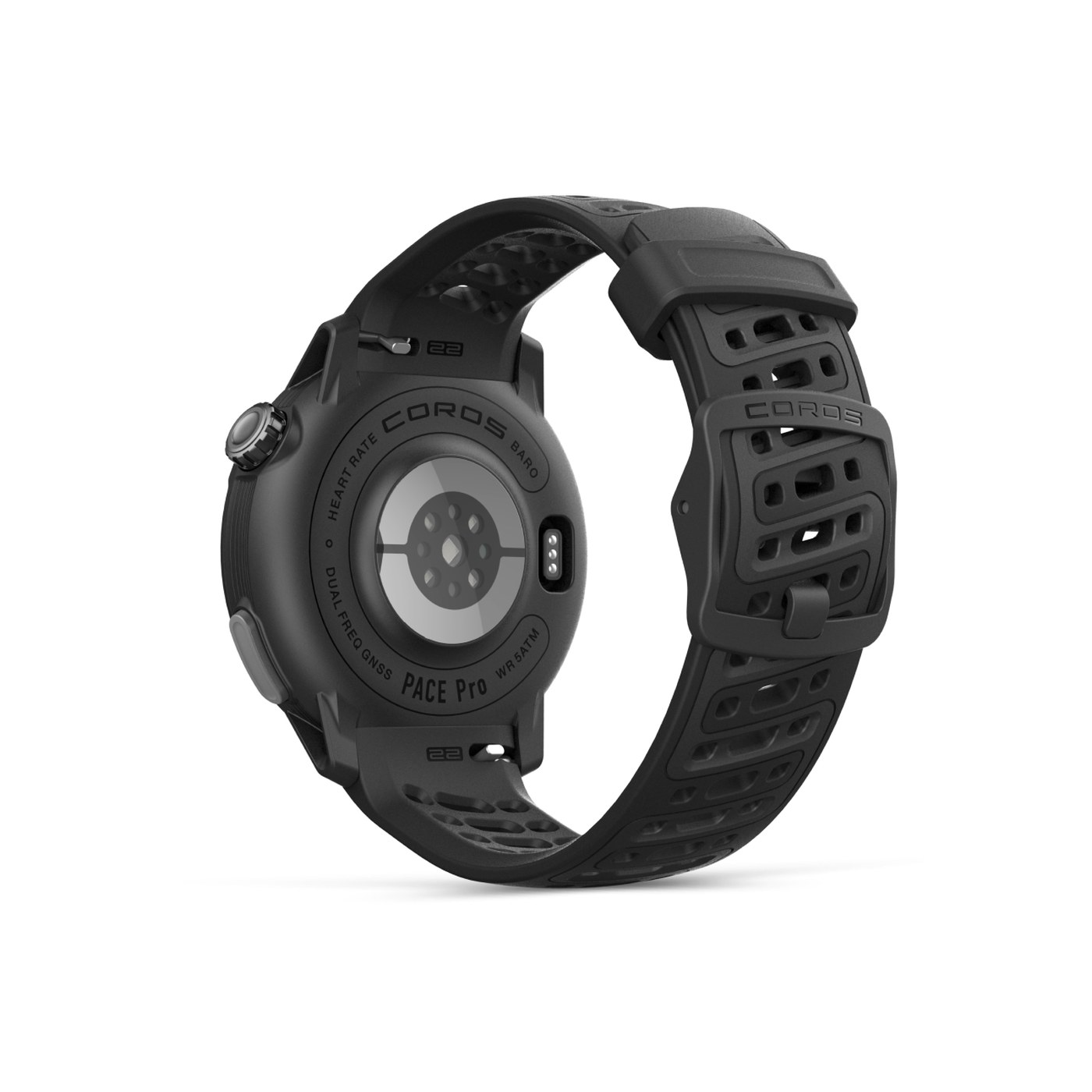
© COROS, official photo used for editorial purposes