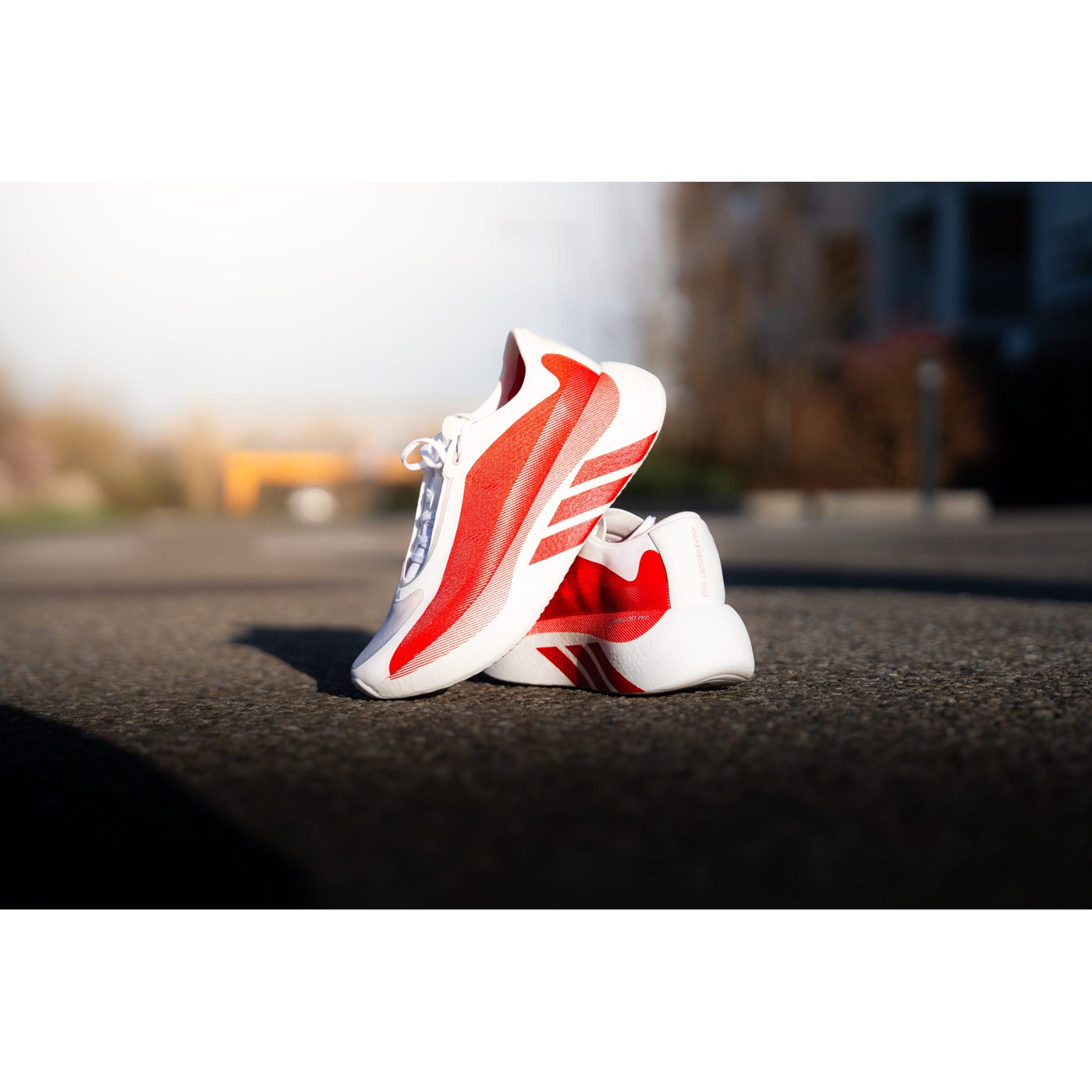
Released on March 17, 2026, the Adidas Hyperboost Edge made plenty of noise with its outsized 45 mm stack height and its new Hyperboost Pro foam. Billed as the first true Adidas training super-shoe, it has one simple goal: replace both your easy-run pair AND your tempo pair with a single model. We put it through its paces to see if it delivers, and above all, who it's built for.
Adidas Hyperboost Edge Review: Adidas' Accessible Daily Trainer
9/10
Adidas Hyperboost Edge: the first Adidas training super-shoe?
For years, Adidas has owned the racing segment with the Adizero line and the comfort segment with the Supernova Rise 3 and the Ultraboost. What it lacked was a proper super-trainer, one that could handle the full range of sessions in a marathon block. That's exactly where the Hyperboost Edge fits. It launched in a red edition on March 17, 2026 in a handful of Adidas stores, then rolled out in several colorways from May 1.
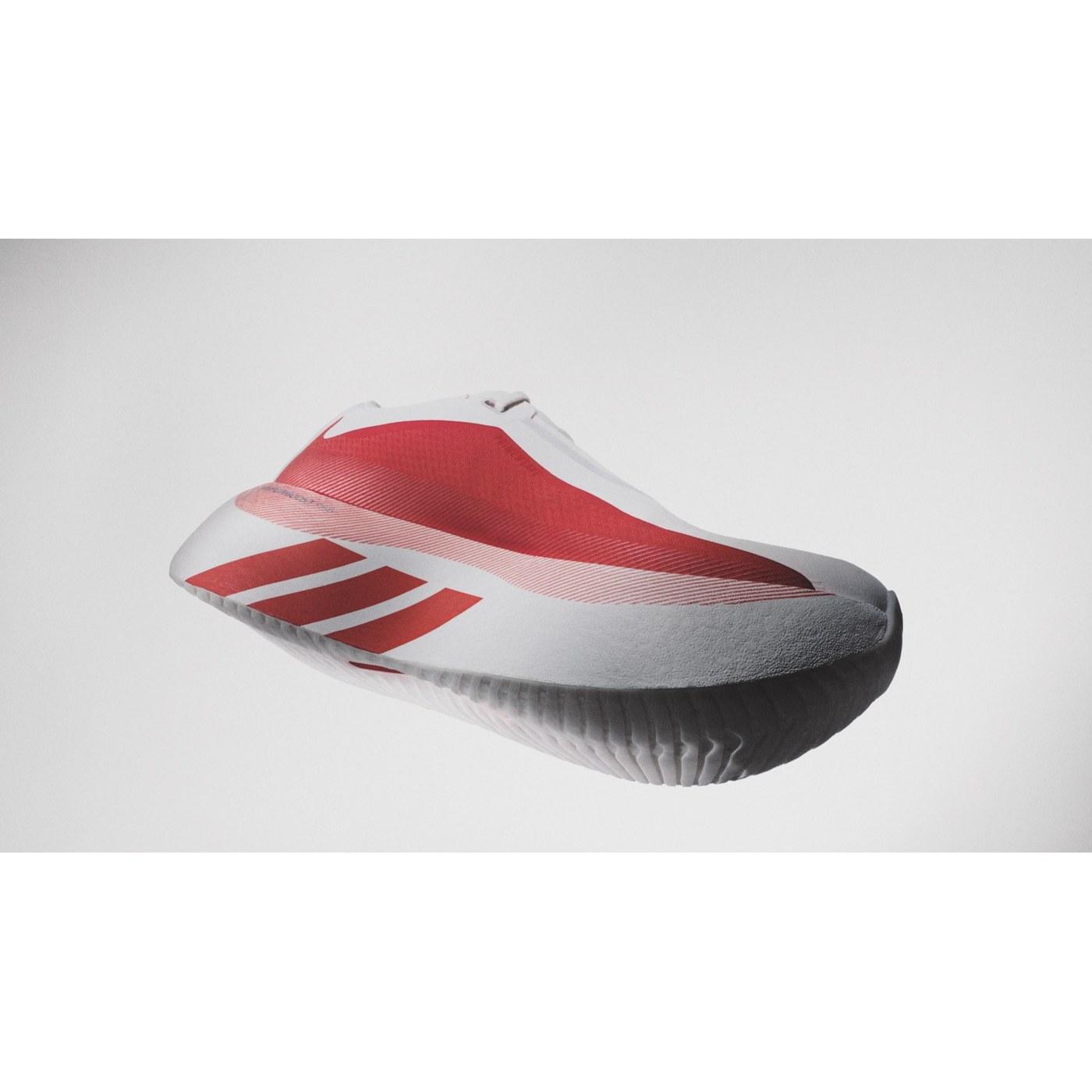
With a 45 mm heel stack, a 6 mm drop and a reasonable 255 g, this shoe looks like nothing else in the Adidas lineup. It's also a clear shot across the bow of the Asics Superblast 3 and the Hoka Skyward X 2: Adidas wants its slice of the super-trainer pie.
RunMorph's advice: a super-trainer like the Hyperboost Edge is not a racing shoe. If you're chasing a marathon time, your race-day shoe is still an Adios Pro Evo 3 or similar. The Hyperboost Edge is built to eat up training miles between races, not to replace your racer.
© Adidas, official photo used for editorial purposes
Objective technical specs
| Brand | Adidas |
| Model | Hyperboost Edge |
| Official release | March 17, 2026 (red edition), new colorways from May 1, 2026 |
| Type | Road super-trainer, max-cushion, no plate |
| Drop | 6 mm |
| Stack height heel / forefoot | 45 mm / 39 mm |
| Weight (EU 42) | 255 g |
| Foam | Hyperboost Pro (supercritical) |
| Carbon plate | No (dynamic rocker) |
| Upper | Engineered mesh + signature 3-Stripes |
| World Athletics compliant | No (45 mm > 40 mm limit) |
| Recommended distance | Easy runs to marathon long runs |
| Retail price | €200 |
Three things to keep in mind before going further. First, the 45 mm heel stack exceeds the 40 mm limit set by World Athletics. You can train in it, but you can't wear it on race day at a sanctioned event (world record, qualifier, etc.). In practice, for 99% of amateur runners, this changes nothing: your Sunday 10K or marathon isn't affected by the rule.
Second, 255 g for 45 mm of foam is remarkable. For comparison, the Hoka Skyward X 2, with its 48 mm stack, weighs 312 g, nearly 60 g more. Adidas did serious work on density.
Third, and maybe most important, there's no carbon plate. The pronounced rocker and the Hyperboost Pro foam are enough to provide responsiveness. It's a deliberate choice to preserve the flexibility and stability of the whole shoe.
Who is the Hyperboost Edge for?
The marathoner in training who wants a single training pair
You're logging 50 to 80 km a week over 12 or 16 weeks of marathon prep. You need a shoe that soaks up the long sessions, lets you show up fresh on Monday for marathon-pace work, and doesn't feel sluggish on short runs. The Hyperboost Edge does exactly that: protection over 30 km, responsiveness on marathon-pace blocks, and a bit of pop on tempo runs.
The runner over 75 kg
For heavier runners, the foam in most carbon super-shoes packs out too fast and loses its qualities after 200 or 300 km. The Hyperboost Edge, with 45 mm of Hyperboost Pro, keeps its plushness much longer, and the wide forefoot base improves stability. It's an excellent option if you weigh 80 kg or more.
The runner simplifying their rotation
You don't want four pairs on your shelf. You want two: one for racing, one for training. The Hyperboost Edge covers 90% of the training spectrum, from easy runs at 5:30 / km to tempo at 4:00 / km. Keep a true carbon super-shoe (Adios Pro Evo 3, Vaporfly 4 or another) for race days, and that's it.
Comfort and step-in feel
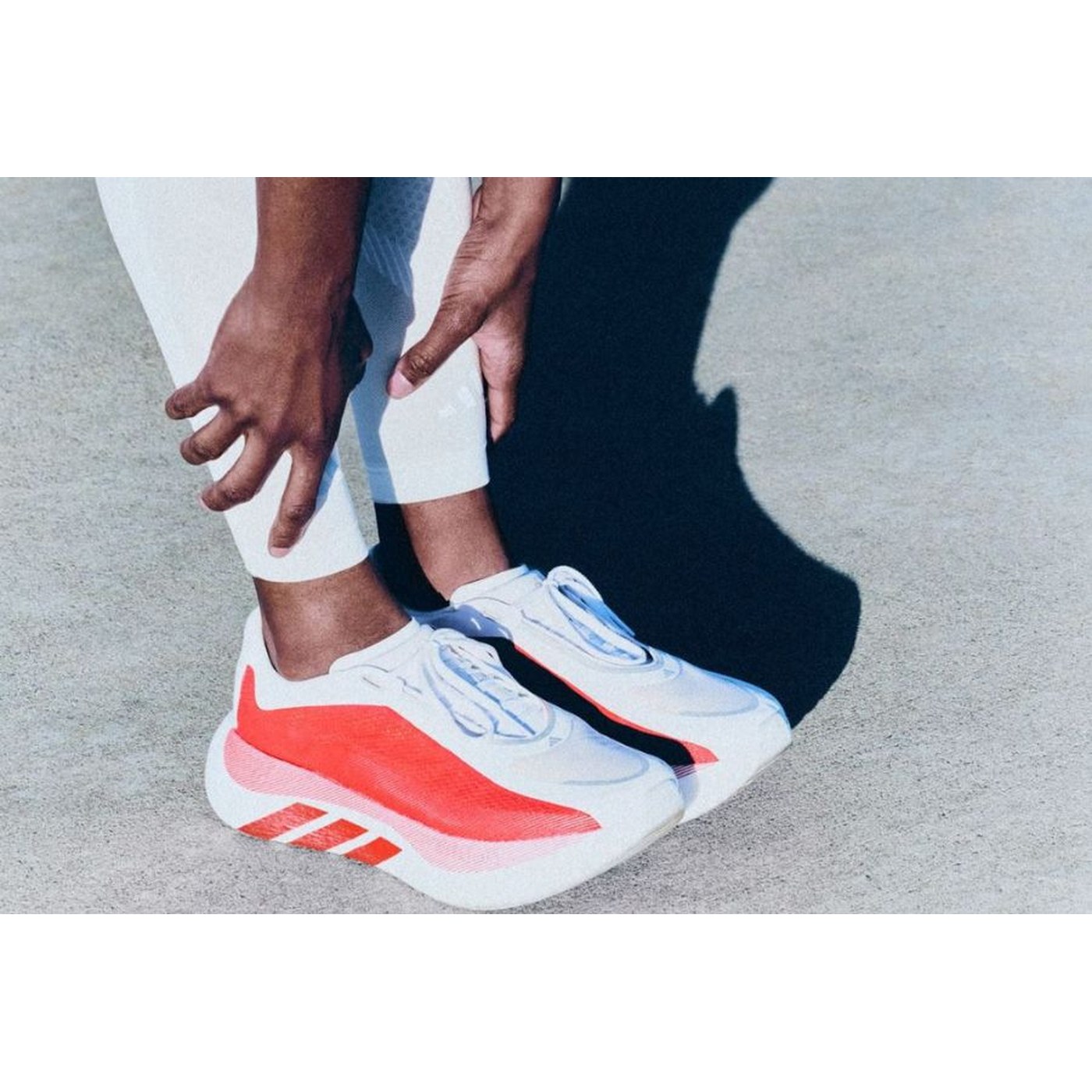
The engineered mesh upper wraps the midfoot snugly, with support reinforced by the three Adidas stripes, which play a structural role here. The fit is on the narrow side in the standard version: if you have wide feet, go up half a size or wait for a possible Wide version.
The tongue is gusseted (attached to the upper) on both sides, so it doesn't shift or slide down. The heel counter is well padded. Step-in feel is instantly premium: you can tell the foam is dense, almost firm at first, without being hard. After a few kilometers, it warms up and gets softer.
How it runs
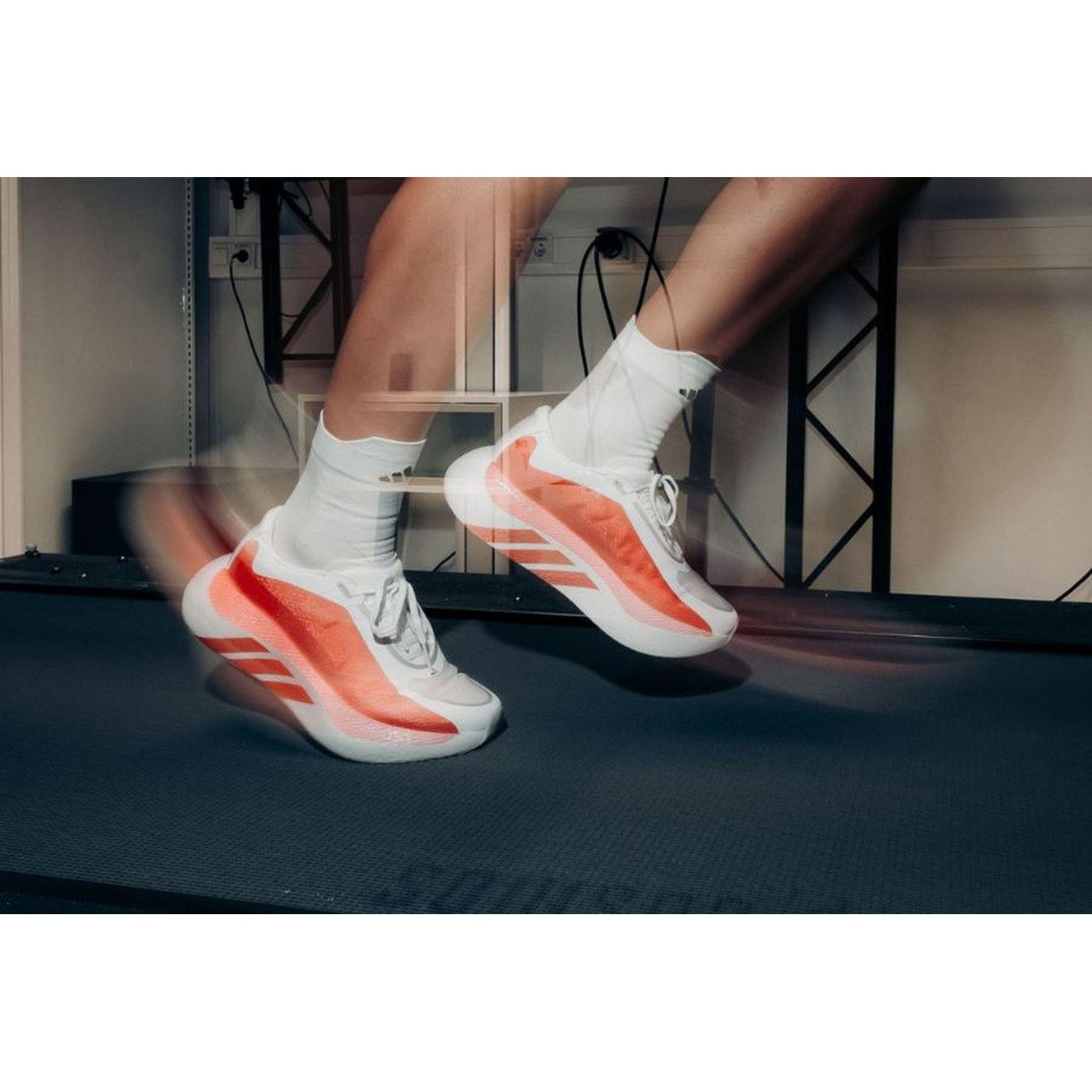
On the road, the Hyperboost Edge shows its true colors. At easy-run pace (5:00 to 6:00 / km), it disappears: it feels like running on a slightly taut cushion. The rocker geometry rolls your stride forward on its own, with no extra muscular effort.
When you pick it up toward threshold (4:00 to 4:30 / km), the Hyperboost Pro foam responds with noticeable energy return. It doesn't catapult you like an Asics Superblast 3, but it carries you. On 5 or 10 km blocks at marathon pace, this shoe genuinely saves your calves and quads.
At faster paces (3:30 / km and below), the shoe gets heavy and unstable. The 45 mm stack shifts a little coming out of turns, and you can tell this isn't its territory. For short intervals like 400 m or 1,000 m repeats, grab your racing shoe or a lighter model such as the Asics Magic Speed 5.
Outsole and grip
The Hyperboost Edge uses dense rubber in high-wear zones (lateral heel, medial forefoot) and exposed foam on the rest of the outsole. This cuts weight but can wear the foam down faster if you run on very abrasive roads. Expect 600 to 800 km of life on standard asphalt, maybe less on gravel paths.
Grip in the dry is flawless. In the wet, it's acceptable, nothing more: the exposed foam zone is less effective than full rubber. Avoid slick cobblestones and painted crosswalks in the rain.
© Adidas, official photo used for editorial purposes
How it stacks up against the competition
The super-trainer segment got crowded in 2026. Here's how the Hyperboost Edge compares with the benchmarks:
Asics Superblast 3 (€200, 250 g, 8 mm drop, 45.5/37.5 stack): the most direct rival. Same price, same philosophy, no plate. The Superblast 3 is slightly bouncier thanks to its FF Leap foam; the Hyperboost Edge is more stable and more protective. Pick based on your stride: the Superblast if you want more snap, the Hyperboost if you want more plushness.
Hoka Skyward X 2 (€225, 312 g, 5 mm drop, 48/43 stack): the ultimate max-cushion shoe, with a carbon plate. The Skyward X 2 is taller, heavier and pricier, but it pushes the sense of propulsion even further. The Hyperboost Edge wins on agility and versatility across varied paces.
Adidas Adizero EVO SL (€150, 220 g, 6 mm drop, 39/33 stack): Adidas' lighter, more affordable cousin. The EVO SL is for runners who want tempo and interval work in a training shoe. The Hyperboost Edge is more protective, more expensive, and geared more toward base endurance and long runs.
Hoka Mach 7 (€160, 248 g, 5 mm drop, 35/30 stack): a faster, lower super-trainer. The Mach 7 is more versatile at threshold and tempo; the Hyperboost Edge wins on marathon long runs.
Comparison verdict: the Hyperboost Edge sits in the "high-cushion super-trainer for big marathon mileage" category, between the Superblast 3 (more responsive) and the Skyward X 2 (more extreme). It's probably the best comfort + responsiveness compromise in the segment, but at €200.
How to fit the Hyperboost Edge into your RunMorph training plan
Here's how to slot the Hyperboost Edge into the rotation of a runner preparing for a marathon or half marathon:
Base endurance easy runs: yes, without reservation. The protection is ideal for zone 1-2 sessions, and the rocker spares your calves on recovery runs.
Long run (90 minutes to 3 hours): this is the Hyperboost Edge's home turf. The foam stays plush, the rocker pushes you forward, and you finish without joint pain.
Marathon-pace blocks: excellent. The energy return of the Hyperboost Pro foam gives just enough pop to hold pace without wrecking you. It's the exact session it was designed for.
Tempo and threshold (4:00 to 4:30 / km): yes, but alternate with a snappier shoe. The Hyperboost Edge gets the job done, but a Superblast 3 or a Mach 7 will be more precise for this kind of effort.
Short intervals (400 m, 1,000 m, max aerobic speed work): no. Too tall, too heavy for those paces. Switch to a light shoe like the Magic Speed 5.
Racing: no, beyond the half marathon (and it isn't World Athletics approved). Keep a true carbon super-shoe for race day: Adios Pro Evo 3, Brooks Hyperion Elite 5 or Nike Vaporfly 4.
To build your rotation around this shoe, take a look at the RunMorph training plans: they're designed to adapt to your mileage, your goal and your gear.
© Adidas, official photo used for editorial purposes
RunMorph verdict
At its 2026 launch, the Adidas Hyperboost Edge is one of the most polished super-trainers on the market. It offers a rare compromise: 45 mm of supercritical foam for just 255 g, no carbon plate, and a geometry that favors a natural stride. It's a shoe built to carry you through the 80% of sessions that make the difference in marathon prep, without letting you down the day you decide to push the pace.
The €200 price tag is in line with its direct rivals (Superblast 3 at the same price, Skyward X 2 more expensive). For a serious runner training 4 to 5 times a week, the cost per use is excellent: count on 600 to 800 km, or 25 to 33 cents per kilometer, which makes it one of the best long-term investments in the segment.
RunMorph score: 9/10. It loses a point for not being World Athletics compliant (irrelevant for most runners, but a drawback for those chasing a qualifier) and for a fit that's a bit narrow for wide feet.
Key takeaways for your training
- Marathon super-trainer: the Hyperboost Edge is built to eat up the long runs and marathon-pace blocks of a marathon cycle.
- 45 mm of foam for 255 g: exceptional density, one of the best cushioning-to-weight ratios on the market.
- No carbon plate: a deliberate Adidas choice to preserve flexibility and stability, with the rocker handling responsiveness.
- Not World Athletics approved: you can't use it in a sanctioned race for a record. 99% of the time, that doesn't concern you.
- Pair it with a true racing shoe: the Hyperboost Edge doesn't replace a carbon super-shoe on race day, but it saves your performance pair for the moment that counts.