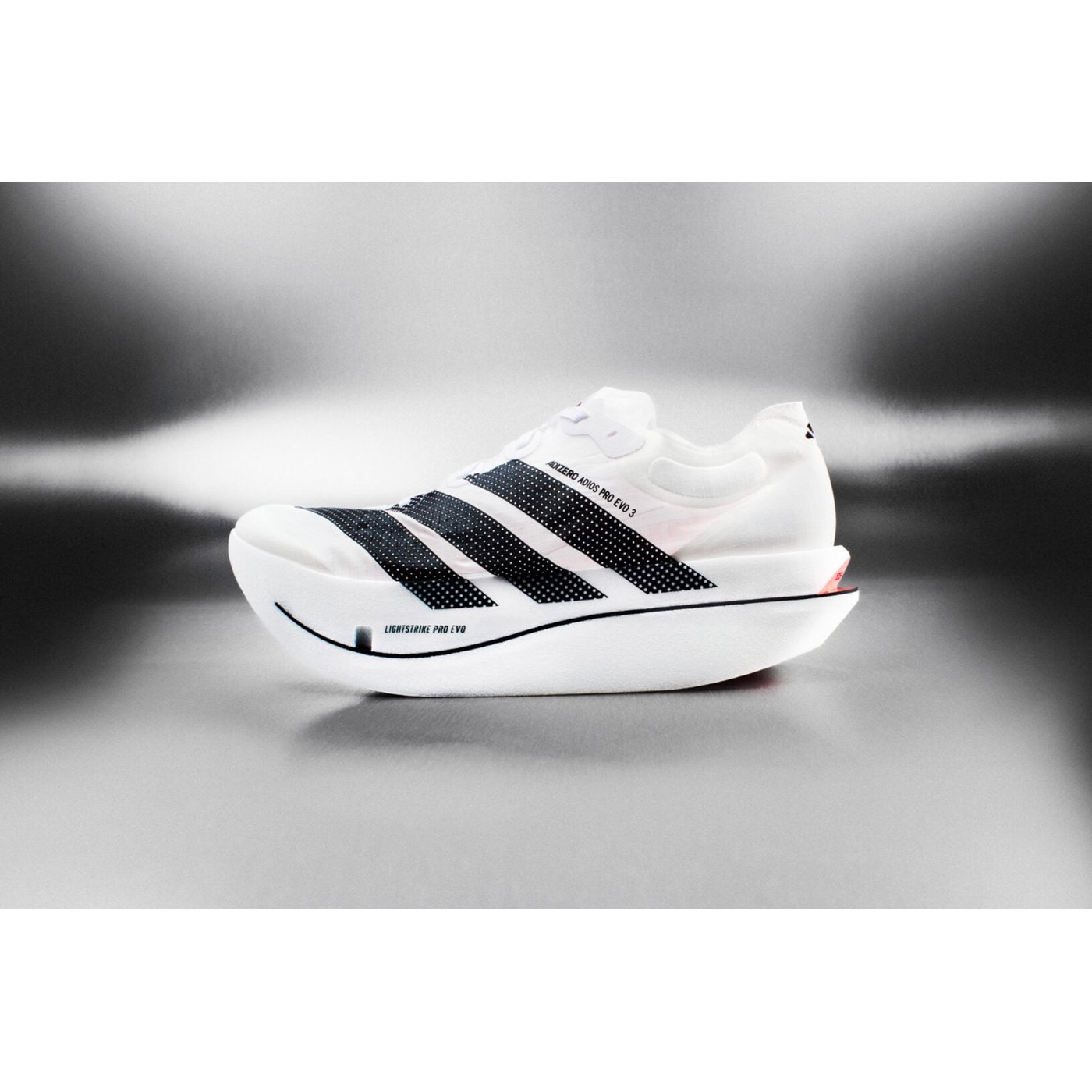
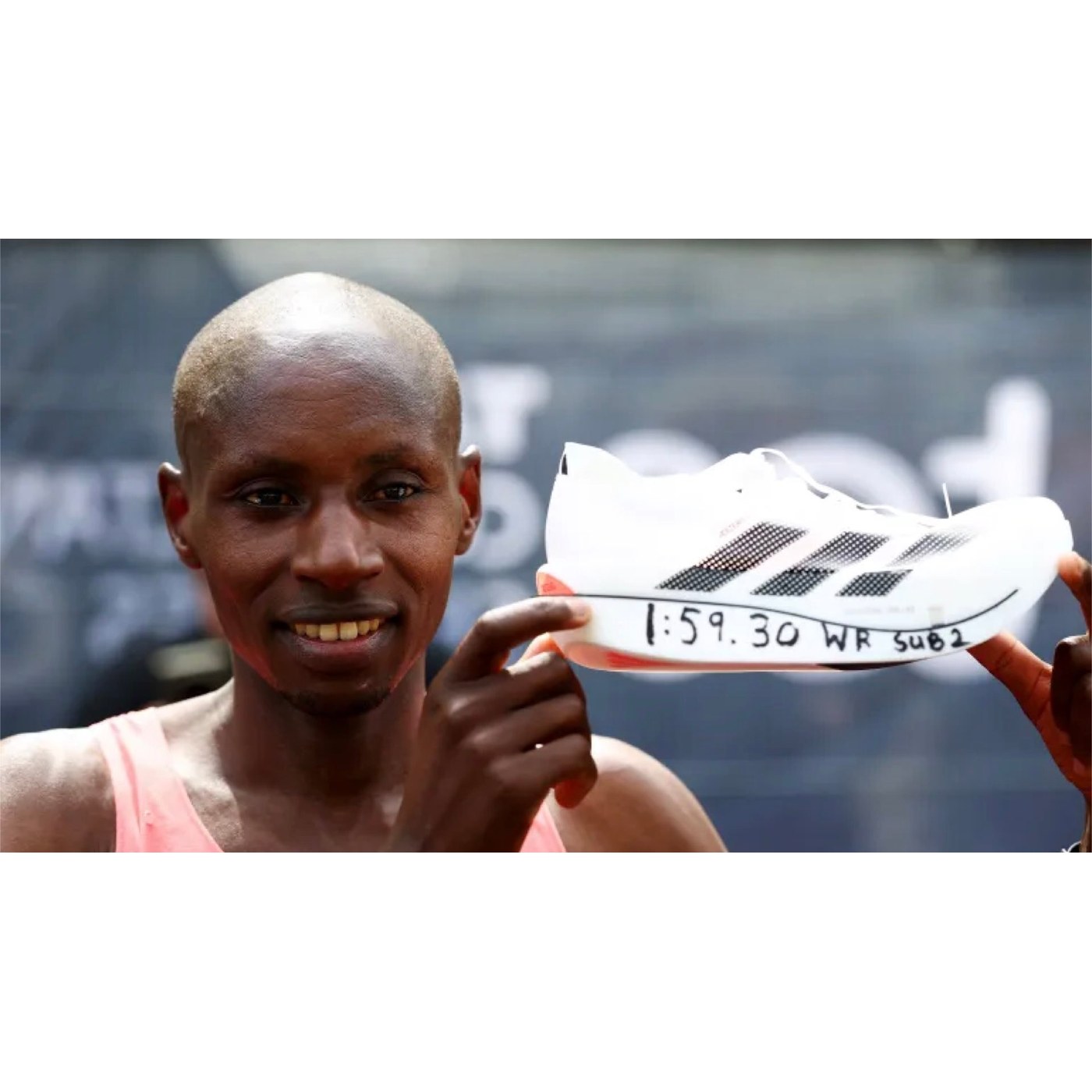
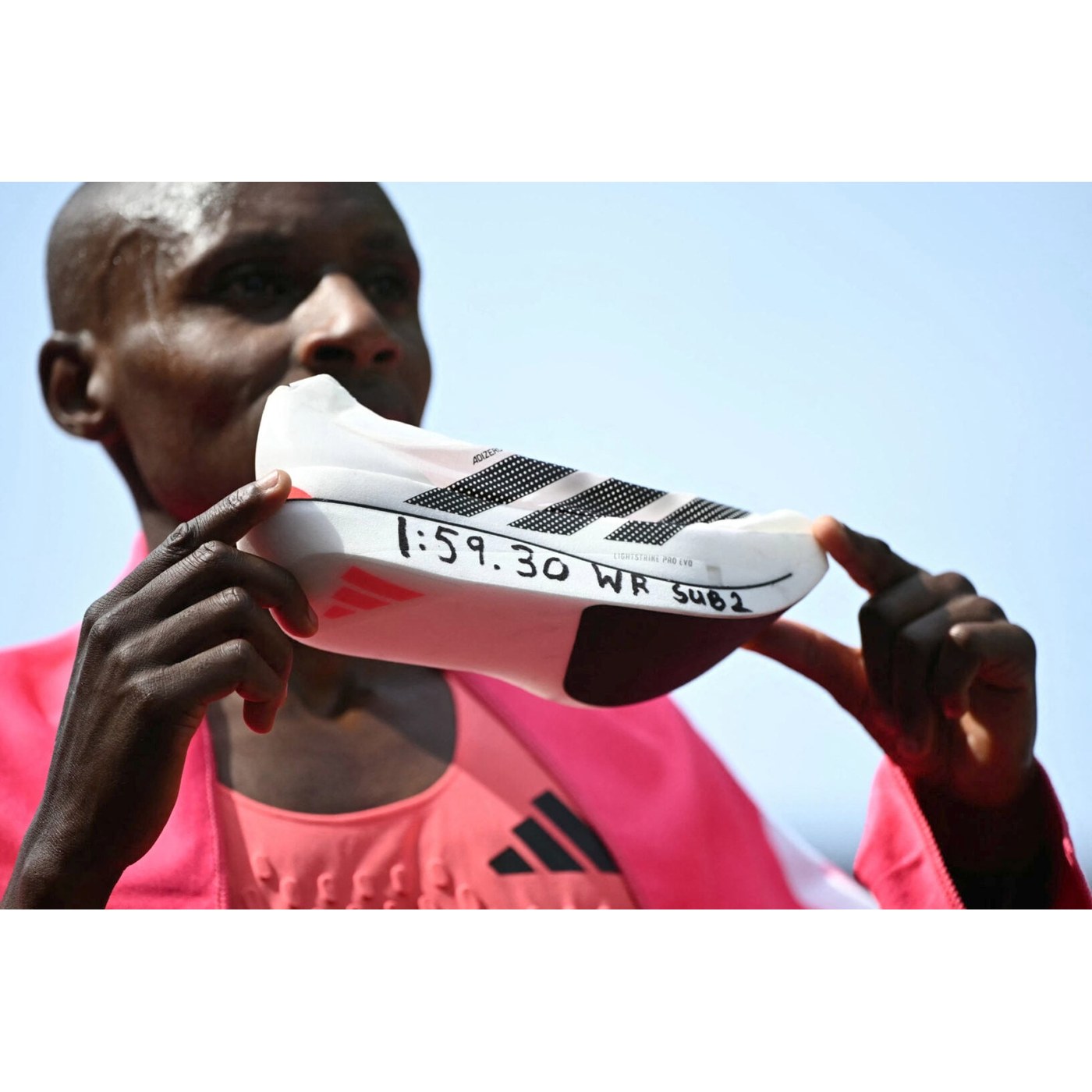
Unveiled on April 25, 2026 as a limited edition for the London Marathon, the Adidas Adizero Adios Pro Evo 3 is the first officially approved racing shoe to dip under 100 grams. Sabastian Sawe wore this pair to break the marathon world record, running 1:59:30. At €500, ultra-rare and built for 2 hours of effort at most, it raises the same question as its predecessor: who is it really made for?
Adidas Adios Pro Evo 3 Review: Record Breaker, but Who Is It For?
9/10
Adidas Adizero Adios Pro Evo 3: the shoe that weighs less than an apple
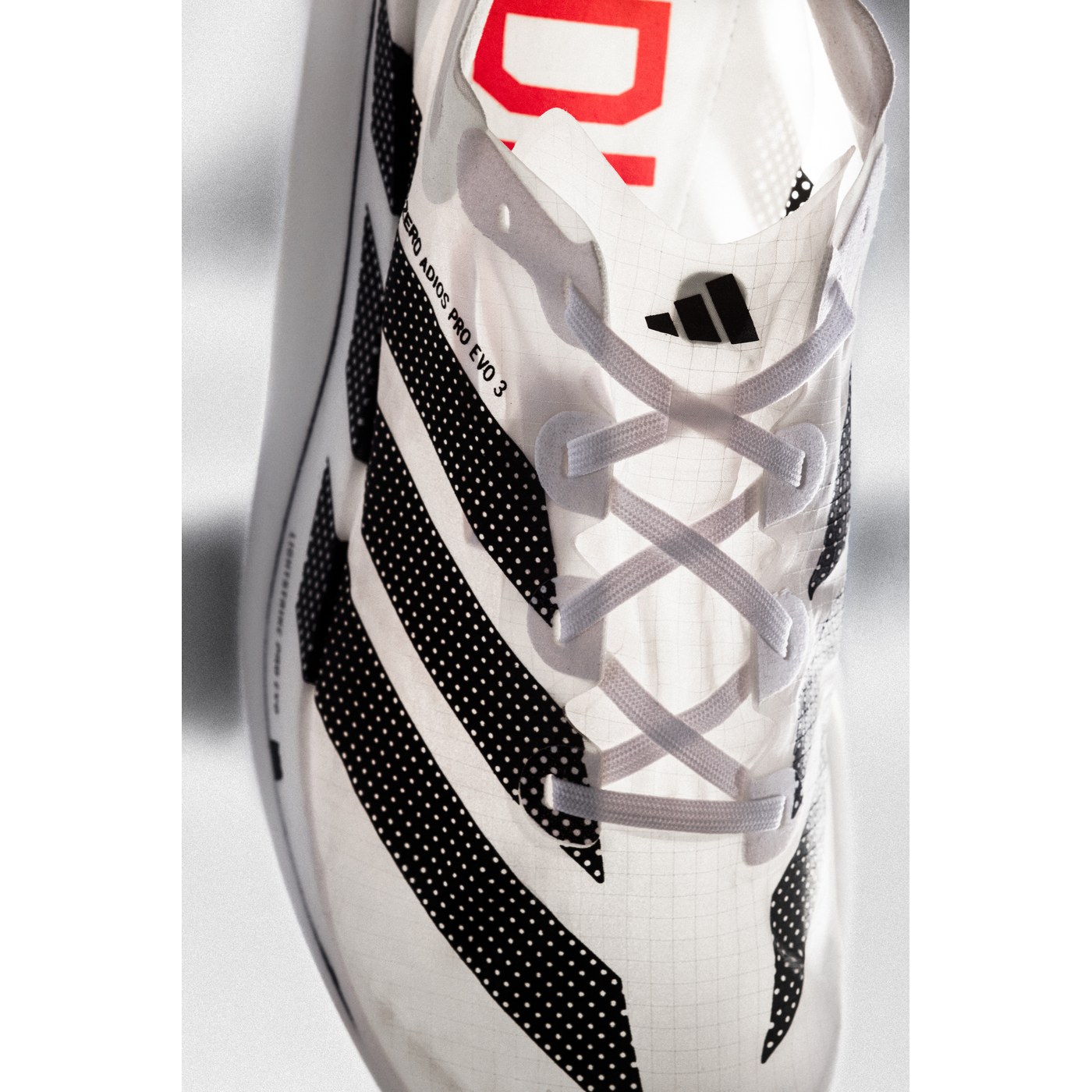
97 grams in a UK 8.5 (EU 42.5). That's three times lighter than a daily trainer like the Brooks Ghost 18, and half the weight of a Nike Vaporfly 4. To hit that number, Adidas stripped out everything it could: the upper is reduced to an ultralight monofilament fabric, the eyelets are replaced by simple slots, and above all, the carbon EnergyRods system of the Pro 1 and previous Pro Evo models gives way to a new architecture: the ENERGYRIM.
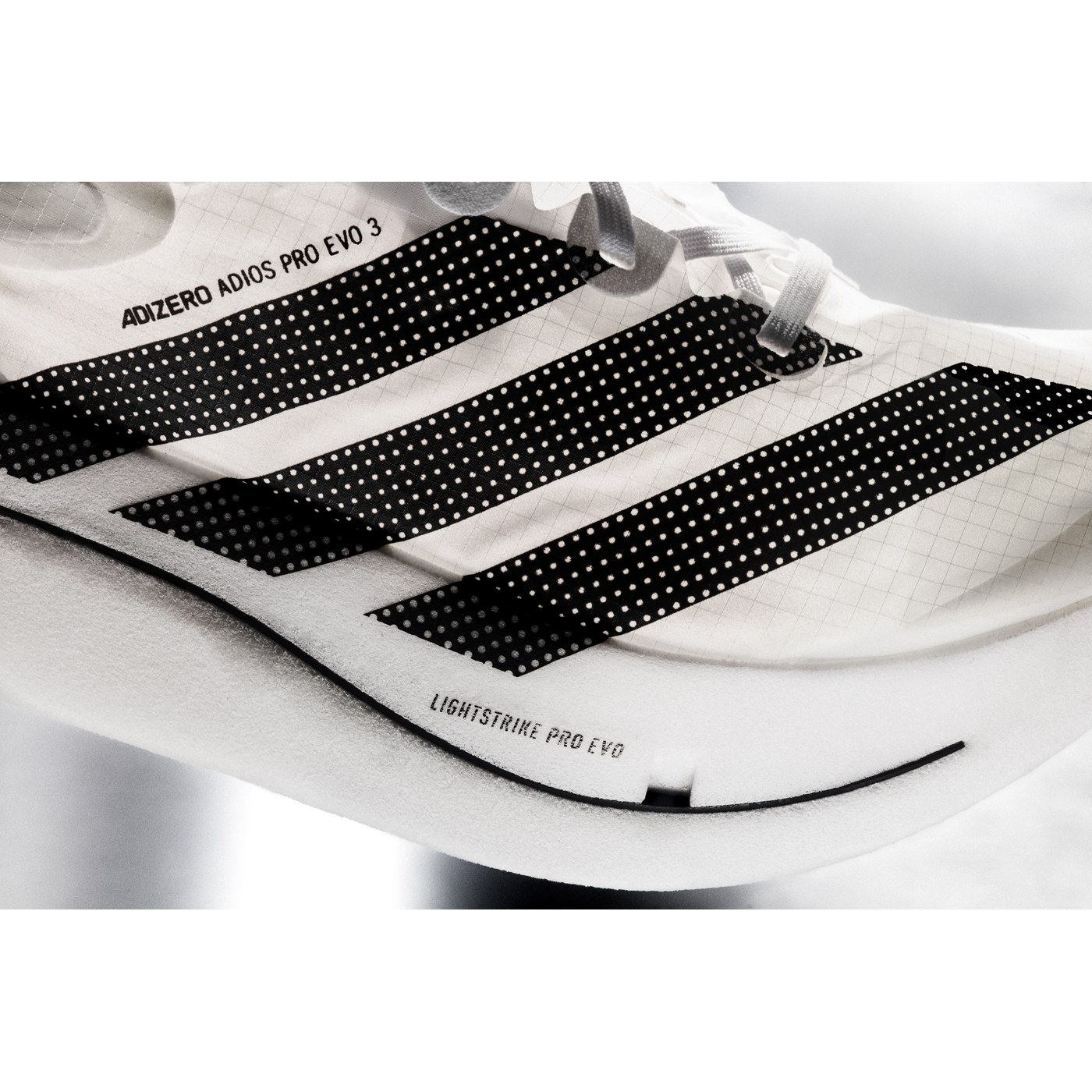
The ENERGYRIM is a carbon frame that runs around the outer edge of the foam, rather than a system of internal rods. The result: fewer parts, less weight, but directional stiffness preserved. Paired with Lightstrike Pro Evo foam (the lightest version in the range), the package delivers brutal propulsion, tailored for elite marathon pace (sub-2:30) and nothing else.
RunMorph tip: at €500 and with an estimated lifespan of 2 or 3 marathons, the Adios Pro Evo 3 is not a training shoe. It's a race-day projectile, and only for runners fast enough to get their money's worth. If you run a marathon in over 3 h 30, you'll get just as much help from a Brooks Hyperion Elite 5 at half the price.
© Adidas, official photo used for editorial purposes
Objective technical specs
| Brand | Adidas |
| Model | Adizero Adios Pro Evo 3 |
| Official release | April 25, 2026 (London limited edition), wide launch fall 2026 |
| Type | Elite marathon racing shoe, ultralight |
| Drop | 3 mm |
| Stack height (heel / forefoot) | 39 mm / 36 mm |
| Weight (UK 8.5 / EU 42.5) | 97 g |
| Foam | Lightstrike Pro Evo (optimized PEBA) |
| Stiffening system | ENERGYRIM (perimeter carbon frame) |
| Upper | Ultralight monofilament, no traditional eyelets |
| World Athletics compliant | Yes (39 mm stack, under the 40 mm limit) |
| Recommended distance | Half marathon, marathon |
| Estimated lifespan | 2 to 3 marathons (200 to 300 km) |
| MSRP | €500 |
A few points deserve attention. First, unlike the Hyperboost Edge, which exceeds the 40 mm limit, the Adios Pro Evo 3 stays under the World Athletics limit with its 39 mm heel stack. That makes it approved for records and official races.
Second, 97 g for 39 mm of PEBA foam is a feat of engineering. For comparison, the Hoka Cielo X1 3.0 weighs 213 g and the Brooks Hyperion Elite 5 196 g. Adidas cut every last bit of excess.
Third, and this is the flip side, durability is sacrificed. Count on 2 to 3 marathons at most before the foam breaks down and the upper tears. At €500, the cost per kilometer tops €1.50.
Who is the Adios Pro Evo 3 for?
The elite or semi-elite runner (sub-2:45 marathon)
If you're targeting a time under 2 h 45 in the marathon, your stride is efficient, your ground contact is quick, and you know how to turn the stiffness of a carbon plate into propulsion. The Pro Evo 3 is for you: it will gain you a few percent in running economy, which translates into seconds, even minutes, by the finish. Sawe used it to run 1:59:30. For you, it could be the difference between 2:38 and 2:35.
The experienced runner preparing a major goal
You're preparing for a marquee marathon (Paris, New York, Berlin, Boston) and want a single pair dedicated to race day. You can afford to invest €500 for that one moment. You do 2 or 3 marathon-pace sessions in it, then wear it on race day. It remains a pure racing shoe, not a trainer.
The collector or the running enthusiast
You love the object, the innovation, pure performance, and you accept that this pair is first and foremost a statement. Fair enough: the Pro Evo 3 is a remarkable piece of engineering. But be clear-eyed about how you'll actually use it.
© Adidas, official photo used for editorial purposes
Comfort and fit
The upper is a single piece of transparent monofilament mesh, almost unreal to look at. No lining, no padding, just a veil structured by the Adidas three stripes, which play a 100% static role here. Lace slots replace traditional eyelets, which saves a few grams but calls for careful lacing to spread the tension properly.
The heel counter is minimalist, just enough to hold your foot in place. Stepping in feels strange: it's as if the shoe isn't there. For a runner used to super shoes (Vaporfly, Hyperion Elite), it's one more step in the same direction. For a newcomer, it can be disconcerting.
On the run
At elite marathon pace (3:00/km and faster), the Pro Evo 3 makes total sense. The Lightstrike Pro Evo foam behaves like a trampoline that resets instantly, and the ENERGYRIM drives your foot forward with every stride. You feel each footstrike launched effortlessly, as if you were running on a gentle downhill.
At half marathon or tempo pace (3:30 to 4:00/km), the shoe stays very responsive, but you start to feel it isn't built for these fast-but-not-extreme paces: a little too unstable on longer ground contacts, a little harsh at the heel.
At amateur marathon pace (4:30 and slower), the magic disappears. The ENERGYRIM plate no longer loads properly, and the foam doesn't compress enough to return energy. What you mostly feel are the drawbacks: little protection, little stability, and a forefoot rubbing against exposed foam.
Outsole and grip
To save weight, Adidas all but removed the outsole rubber. Only two small wear zones are protected (a minimalist outer heel and the medial forefoot). The rest is exposed Lightstrike Pro Evo foam. The upshot: excellent grip in the dry, mediocre in the wet, and catastrophic durability.
In practice, after a marathon run in the rain on wet cobblestones, don't be surprised to see the foam in the forefoot area chewed up. That's deliberate: Adidas chose pure performance over longevity.
© Adidas, official photo used for editorial purposes
How it stacks up against the competition
The Adios Pro Evo 3 plays in the same league as the ultra-elite super shoes. Here's where it stands:
Nike Vaporfly 4 (€280, 196 g, 8 mm drop, 40/32 stack): the direct rival, half the price and far more durable. The Vaporfly 4 remains the benchmark in the segment for 95% of runners chasing a time. The Pro Evo 3 is marginally faster for sub-2:30 runners, marginally less protective and much more expensive.
Brooks Hyperion Elite 5 (€275, 196 g, 3 mm drop, 39/36 stack): a carbon super shoe with DNA Gold PEBA. More versatile, more durable, more affordable (€250), it targets the same performance-minded runner, but with genuine potential for training use.
Asics Metaspeed Sky Tokyo (€250, 200 g, 5 mm drop, 39.5/34.5 stack): for stride-style runners (long stride). More stable, less extreme, more durable. If you're torn between the two, the Metaspeed Sky is probably the better choice unless you already run under 2:30.
Hoka Cielo X1 3.0 (€275, 213 g, 7 mm drop, 40/33 stack): Hoka's super shoe with dual-layer PEBA and a winged, arched carbon plate. More protective, more versatile and more affordable than the Pro Evo 3.
Comparison verdict: the Pro Evo 3 is the lightest shoe on the market, but it only becomes relevant at elite level. For amateur runners targeting between 3 h and 4 h in the marathon, the Vaporfly 4, the Hyperion Elite 5 or the Metaspeed Sky Tokyo offer far better value in terms of performance, price and durability.
How to fit the Pro Evo 3 into your RunMorph training plan
As a coach, here's where I'd place this shoe in the rotation of a sub-2:45 marathoner:
Easy runs and base endurance: no. You'll wear the shoe out for nothing and get zero benefit. Keep an Asics Gel-Nimbus 28 or a Brooks Ghost 18 for those sessions.
Long run (90 minutes or more): no, except for 1 test session 2 or 3 weeks before the race to check the fit and your goal pace.
Marathon-specific pace blocks: yes, 2 to 3 sessions at most in the build, to get used to the feel and dial in your goal pace.
Tempo and threshold: no. Too fragile, and you'll get a better return from an Asics Superblast 3 or a Hoka Mach 7.
Racing: yes, that's exactly what it exists for. Marathon goal sub-2:45, half marathon goal sub-1:15. One pair reserved for race day.
To structure your build around an ambitious time goal, check out the RunMorph training plans: they include periodization and a shoe rotation suited to your level.
© Adidas, official photo used for editorial purposes
The RunMorph Coach's verdict
The Adidas Adizero Adios Pro Evo 3 is an exceptional shoe for an exceptional population. With its 97 g, Lightstrike Pro Evo foam and ENERGYRIM, it's probably the most technically advanced racing shoe available in 2026. It carried Sabastian Sawe to the marathon world record in 1:59:30, which says a lot about its potential.
But at €500, with a lifespan of 2 to 3 marathons and a ride that only makes sense at elite pace, it speaks to a tiny fraction of runners. For 99% of amateur marathoners, the Vaporfly 4 or the Hyperion Elite 5 are far more rational choices.
RunMorph score: 9/10 for sub-2:45 runners, 5/10 for everyone else. It's the first time we've scored a shoe differently depending on the target profile, but the specialization here is so extreme that honesty demands it.
Key takeaways for your training
- Just 97 grams: the first sub-100 g super shoe in history, an all-time lightness record for 39 mm of stack.
- ENERGYRIM replaces the EnergyRods: a perimeter carbon frame instead of internal rods, lighter and just as stiff.
- Reserved for elites: its energy return only fully kicks in at paces under 3:00/km.
- Limited lifespan: 2 to 3 marathons at most, or 200 to 300 km, because of the exposed foam and minimalist upper.
- €500 a pair: an investment to save for a major time goal, not for regular training.