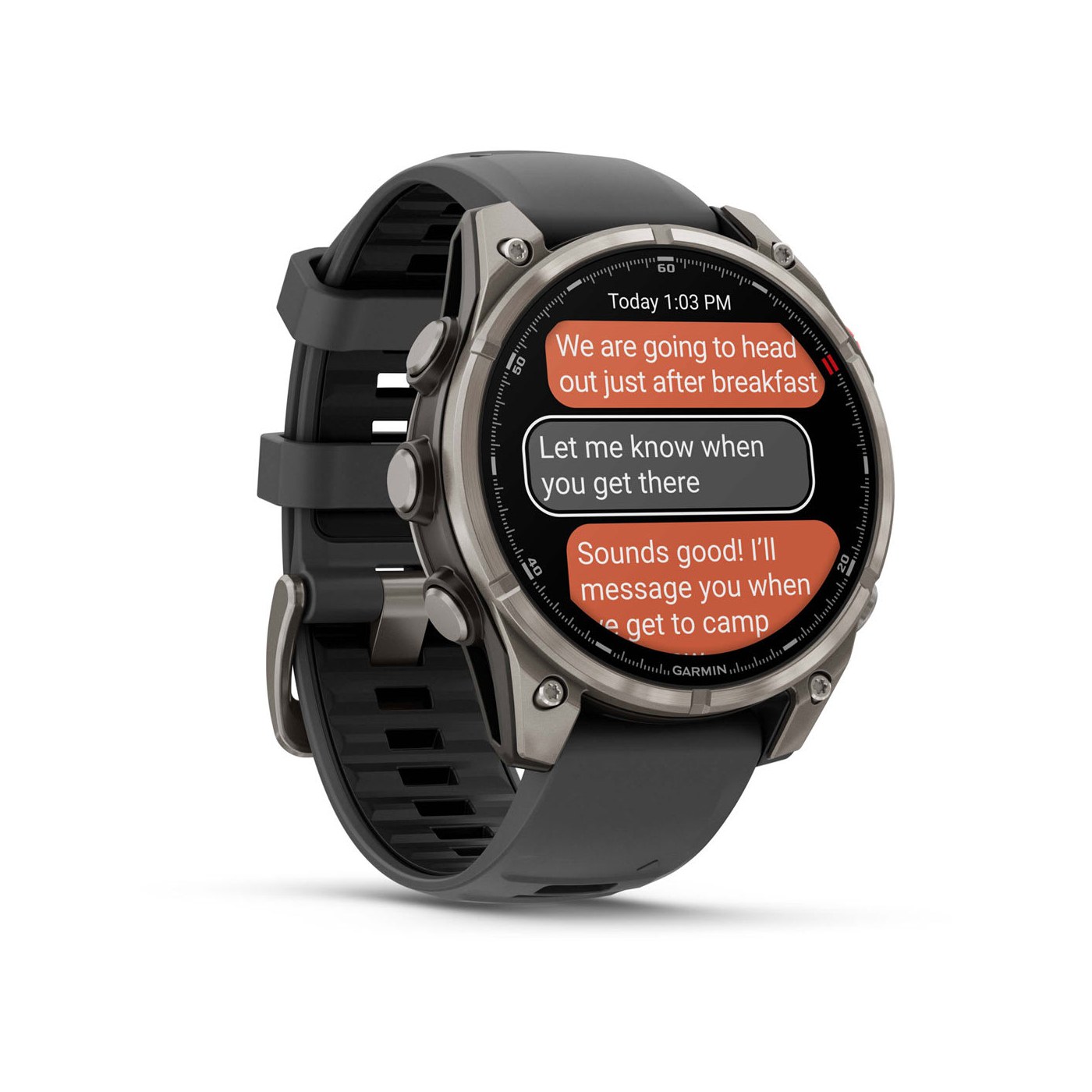
Garmin fenix 8 Pro Review: Satellite Messaging and LTE Built In
9/10
For fifteen years, you had to choose: a fully loaded sports watch on one side, a safety beacon like an inReach on the other. The Garmin fenix 8 Pro tears down that wall. It packs a satellite antenna and an LTE chip right into the case, so you can send a message, trigger an SOS or share your location deep in the mountains with no coverage and no smartphone. That leaves one question this review answers head-on: does this feat justify a 1,199-euro entry price and a mandatory subscription?
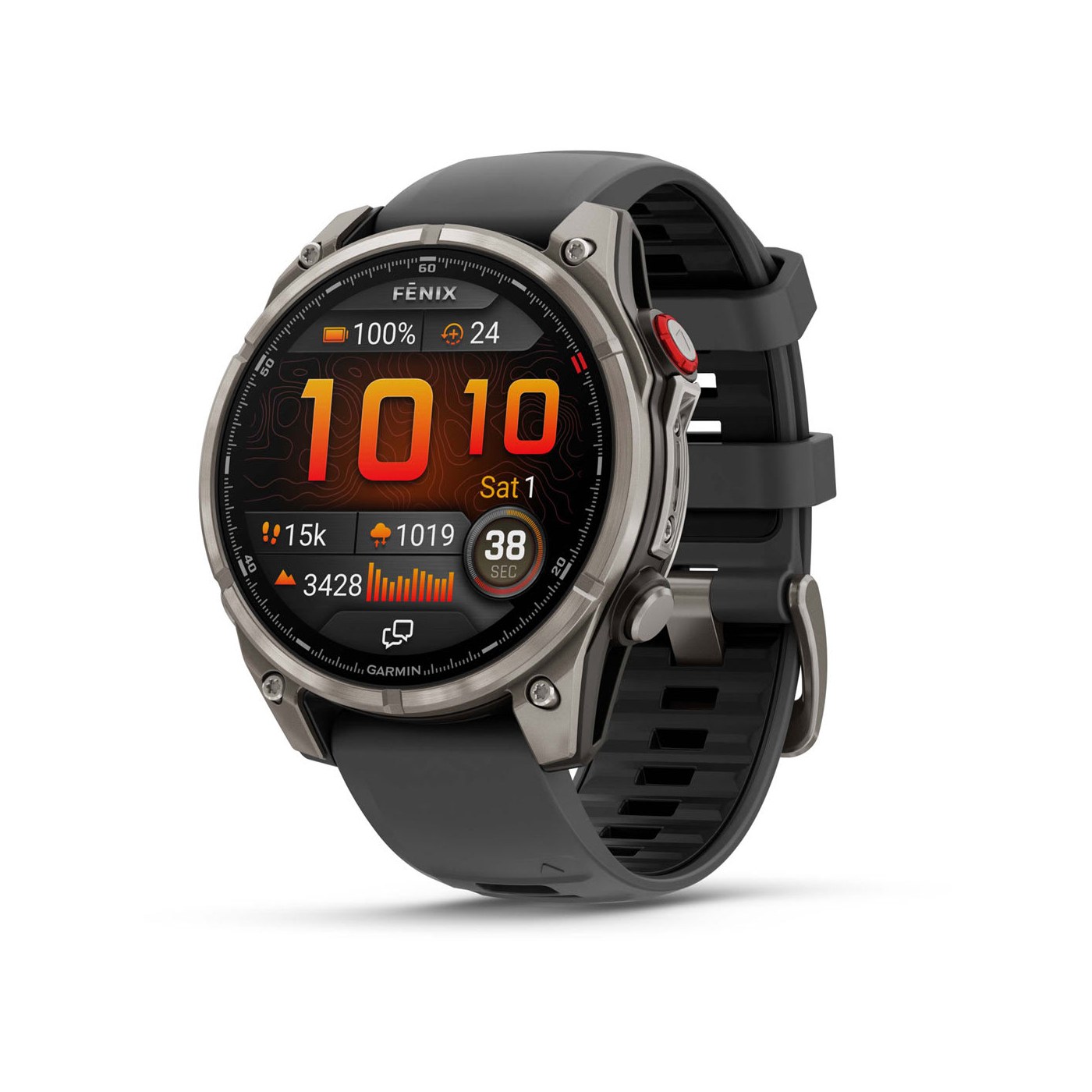
The fenix 8 Pro AMOLED is the fenix 8 pushed to the max, with inReach satellite messaging and LTE built in, designed for adventurers and multisport athletes who head off the beaten track. It keeps the 1.4-inch AMOLED display, the flashlight, the ECG and full-color topo maps, while adding a layer of connected safety never seen before on a watch. The price and mandatory subscription make it a watch for demanding users, but no other watch offers this combination today.
9 / 10 · RunMorph overall score
GPS accuracy9/10
Battery life8/10
Mapping9/10
Metrics9.5/10
Value for money5/10
Who it is forTrail runners, ultrarunners and adventurers who go off the grid and want satellite safety without carrying an extra beacon.
Who it is not forRoad runners who stay in town or in covered areas: they would pay a fortune for features they will never use.
fenix 8 Pro: when the watch swallows the satellite beacon
At RunMorph, we see a clear strategic shift in this lineup. Garmin already had two separate worlds: fenix watches, the multisport and outdoor benchmark, and inReach communicators, those small satellite beacons that mountaineers and ultra trail runners carry to stay reachable far from everything. The fenix 8 Pro merges the two. For the first time, two-way satellite messaging and LTE cellular connectivity live inside the watch case, with no reliance on your phone.
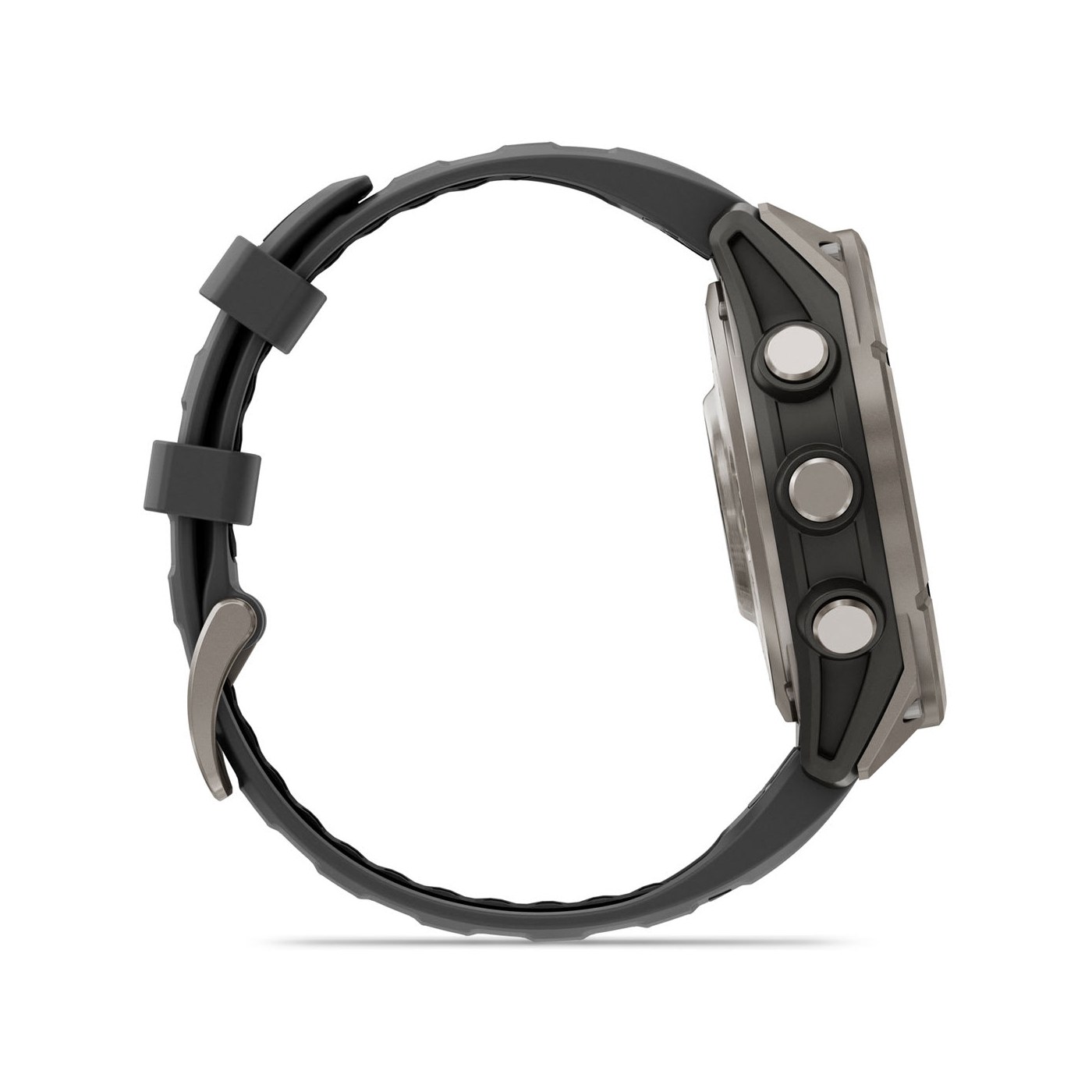
That choice has a physical consequence: the 43 mm model disappears from the Pro lineup. Housing an LTE antenna and a satellite antenna takes space, so only the 47 and 51 mm sizes remain. The fenix 8 Pro AMOLED, the version this review focuses on, comes in both sizes, with a thicker case than the standard fenix 8 (16 mm versus 13.8 mm). That is no small detail: this watch owns its role as an expedition tool before that of a discreet piece of jewelry.
The marketing promise is strong, and the Pro name sells. The smart move is to temper it: on the sports side, the fenix 8 Pro brings almost nothing new compared with the fenix 8. The sensor, the maps, the display and the metrics suite are identical. What you pay for is backup connectivity. The whole value of this watch therefore comes down to a single question: do you really need to be reachable where there is no coverage left?
fenix 8 Pro specs: connectivity packed into one case
Brand
Garmin
Model
fenix 8 Pro AMOLED (47 mm tested)
Official release
October 2025
Case sizes
47 x 47 x 16 mm and 51 x 51 x 16.5 mm
Weight (47 mm)
about 56 g
Display
1.4-inch AMOLED touchscreen, sapphire glass
Materials
Fiber-reinforced polymer, titanium bezel
Battery life (47 mm)
Up to 15 days in smartwatch mode, about 30 h in SatIQ multi-band GPS
GNSS
Dual-frequency multi-band + SatIQ algorithm
Sensors
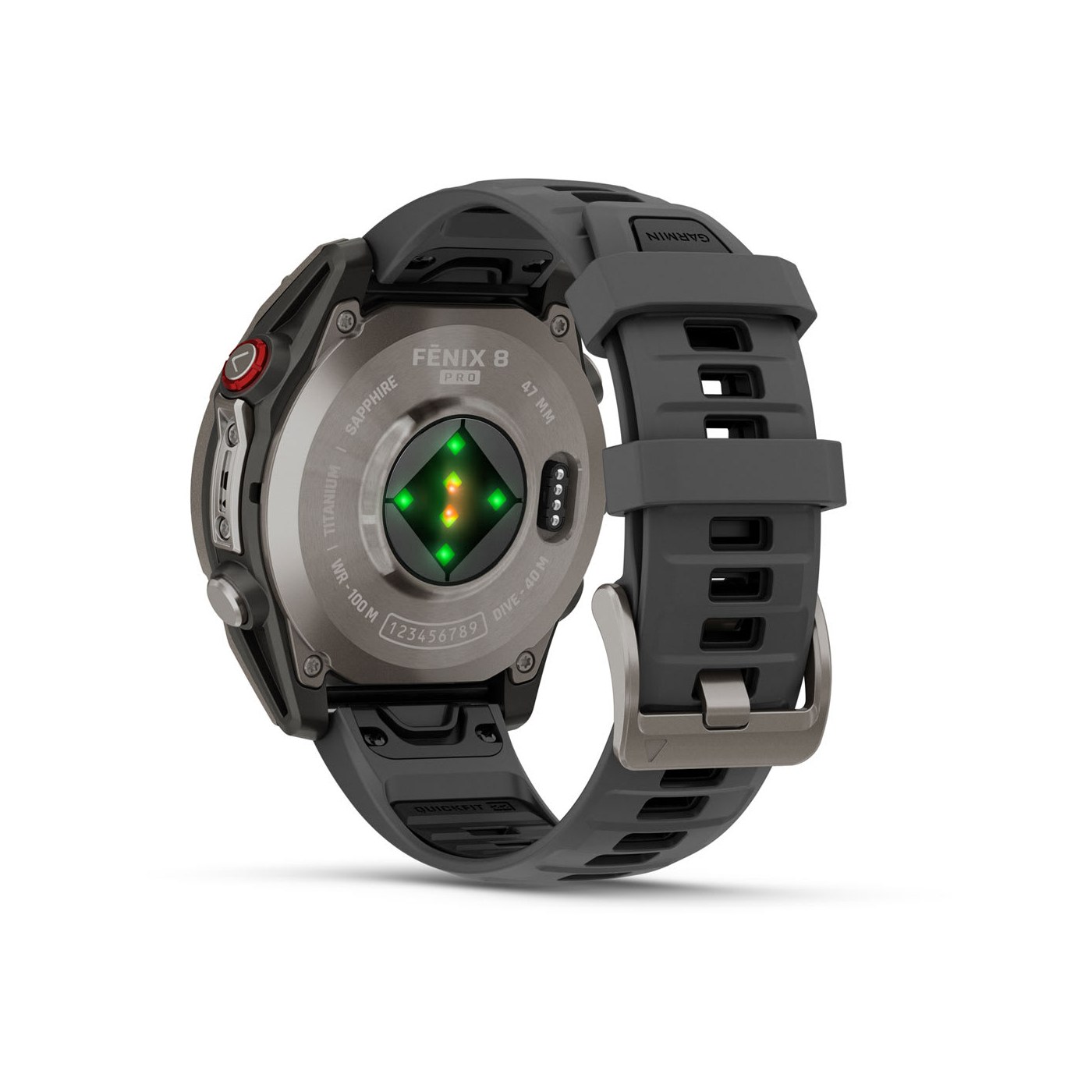
Elevate Gen 5 (heart rate), ECG, SpO2, temperature, barometer, compass
Satellite messaging and LTE: what does it really change?
This is the heart of the matter. On a long run in the mountains, in a canyon or during a remote ultra, your smartphone lost signal long ago. The fenix 8 Pro keeps talking to the sky. Thanks to its satellite transceiver, you send and receive text messages, share your location with friends and family, and above all you can trigger an interactive SOS relayed to rescue services, with a genuine two-way exchange to describe your situation. Where a classic beacon only transmits, the fenix 8 Pro holds a conversation.
When an LTE tower is in range, the watch switches to cellular mode: calls, voice messages, real-time LiveTrack and weather forecasts, all without a phone in your pocket. For the trail runner who leaves the phone in the car, or the parent who wants to reassure the family during a multi-day adventure race, that is a concrete gain in peace of mind.
In all honesty: none of this works without a subscription. Garmin charges 9.99 to 59.99 euros a month for the service, depending on message volume, tracking frequency and included features. That is a recurring cost you need to build into your budget. Without a subscription, the fenix 8 Pro remains an excellent fenix 8, but you paid extra for nothing.
Who is the fenix 8 Pro for?
Trail runners and ultrarunners who go off the grid
This is the obvious target. If you string together long runs in the mid and high mountains, aim for a semi-self-supported ultra or sometimes head out alone on remote trails, satellite safety is a game changer. You also get full-color topo maps, solid GPS battery life and the flashlight for night sections. For this profile, the fenix 8 Pro has no direct equivalent.
Multisport athletes and long-haul adventurers
Triathlon, ski touring, mountaineering, multi-day expeditions: the fenix 8 Pro ticks every box with its complete sport profiles, diving mode, compass and barometer. Location sharing and LiveTrack reassure the people around you during big objectives. It is the right pick for anyone who wants a single watch that can track everything, from a Sunday 10 km to an international adventure race.
Road runners who stay in covered areas
Here, the answer is more clear-cut. If you run in the city, on the track or on loops with mobile coverage, you will never use the satellite or LTE features. You would pay a lot, subscription included, for dormant features. Many athletes with this profile will be better served by a Garmin Forerunner 970, which delivers the same training intelligence without the satellite bill.
GPS accuracy and heart rate sensor: how good are the tracks?
The fenix 8 Pro relies on dual-frequency multi-band GNSS paired with the SatIQ algorithm, which adjusts satellite constellations and reception mode in real time based on your surroundings. In practice, in dense forest or between buildings, the track stays clean and follows the actual route, where many watches lose the plot. Independent measurements confirm this level of accuracy, at the very top of today's market.
On the heart rate side, the Elevate Gen 5 optical sensor improves again on responsiveness during intervals, historically the weak point of wrist-based readings. At RunMorph, we still stand by a simple rule: for your max aerobic speed sessions or short intervals, a chest strap like the Garmin HRM 600 or the Coros HR Monitor armband remains more reliable than any wrist sensor. For endurance work, the Elevate Gen 5 does the job flawlessly.
Mapping and navigation: the terrain on your wrist
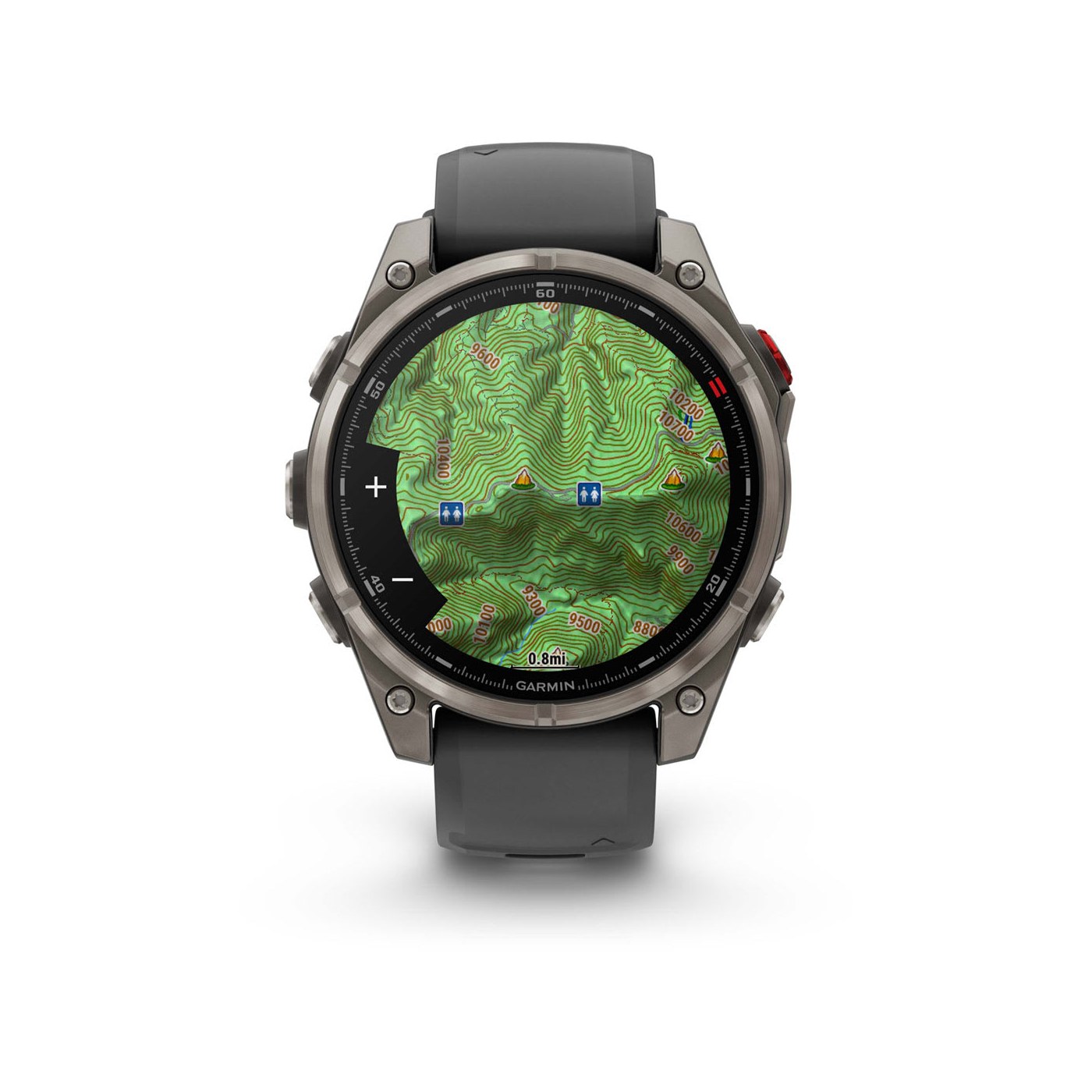
The fenix 8 Pro comes with full-color TopoActive maps, with terrain relief, trails, points of interest and turn-by-turn navigation. Ski resort maps and golf courses are preloaded. On the very bright 1.4-inch AMOLED display, reading the map mid-run is a real comfort, even in full sun. Back to Start and route recalculation round out a package built for exploration.
Paired with satellite messaging, these maps take on their full meaning: you navigate off-trail knowing you can alert a loved one or rescue services at any moment. Few watches combine navigation and emergency communication this well.
This is where Garmin remains the benchmark. The fenix 8 Pro rolls out the full suite: VO2max, morning Training Readiness, HRV Status, Body Battery, sleep score, acute and chronic training load, daily suggested workouts and Garmin Coach with adaptive 5K, 10K, half marathon and marathon plans. You get a detailed read on your fatigue and progress, session after session.
For runners who structure their training, this depth of data is one of the watch's real selling points, regardless of the satellite features. It also makes the watch a natural fit for a planned training approach rather than gadget use.
Real-world battery life
In smartwatch mode, the 47 mm model lasts up to 15 days, while the 51 mm climbs to 27 days thanks to its larger battery. In multi-band GPS with SatIQ, expect about 30 hours, enough to cover an ultra or a long adventure race on a single charge. The always-on AMOLED display and heavy use of LTE or satellite naturally cut those figures, but the whole package stays on par with the best adventure watches. Against battery specialists like the COROS Vertix 2S, the fenix 8 Pro gives ground on raw endurance alone, but makes up for it with its unique connectivity.
fenix 8 Pro AMOLED vs MicroLED vs fenix 8: the comparison to help you choose
Three models look alike on paper, yet the price gap is huge. Here is how to decide.
Criterion
fenix 8 (AMOLED)
fenix 8 Pro AMOLED
fenix 8 Pro MicroLED
Sizes
43 / 47 / 51 mm
47 / 51 mm
51 mm only
Display
1.4-inch AMOLED
1.4-inch AMOLED
MicroLED, up to 4,500 nits
Satellite and LTE
No
Yes
Yes
Smartwatch battery life (51 mm)
up to 29 days
up to 27 days
up to 10 days
Price
from about 900 euros
1,199.99 euros
1,999.99 euros
Best pick for
Multisport athletes in covered areas
Adventurers who go off the grid
Anyone who wants the brightest display on the market
RunMorph's take is simple: if you never leave coverage, the standard fenix 8 is enough and costs less. If satellite safety matters to you, the Pro AMOLED is the sweet spot. The MicroLED, for its part, targets those who want the ultimate display and accept battery life cut by more than half, for a price that nearly doubles.
Built-in satellite messaging and interactive SOS, no separate beacon
LTE for calls, messages and LiveTrack without a smartphone
SatIQ multi-band GPS accuracy at the very top of the market
Bright 1.4-inch AMOLED display and complete full-color maps
Metrics suite and Garmin Coach among the most polished
What we liked less
Very high price, starting at 1,199.99 euros
Mandatory subscription for satellite and LTE
Thicker and heavier case than the fenix 8
No sports gain over the standard fenix 8
No more 43 mm version in the Pro lineup
RunMorph's tip: before you give in, take an honest inventory of your runs. If you really spend time off the grid, satellite safety is worth its price and its subscription. If not, a Forerunner 970 or a Suunto Vertical 2 will give you 90% of the experience for a fraction of the budget.
How to fit it into your RunMorph training plan
The fenix 8 Pro is more than a safety tool: its metrics suite is a full-fledged training engine. To turn your ultra long runs or trail prep into measurable progress, pair it with a structured plan that uses your training load and Training Readiness.
Whether you are targeting your first long trail race, a semi-self-supported ultra or a gradual comeback after injury, RunMorph training plans turn your watch data into concrete sessions, adjusted to how you feel on the day.
RunMorph Coach verdict
The Garmin fenix 8 Pro AMOLED is a rare technical achievement: it erases the line between sports watch and emergency beacon, and does it without compromising on sport, mapping or metrics. For adventurers, ultra trail runners and multisport athletes who venture beyond coverage, it is the most complete device on the market today, and above all the only one that brings all of this together.
The reservation comes down to positioning. Starting at 1,199.99 euros, plus a monthly subscription, this watch only makes sense if you actually use its emergency connectivity. For road or urban running, you would be paying for insurance you would never use. It is a gorgeous, overgifted watch, but built for a specific audience. RunMorph score: 9/10.
Key takeaways for your training
Built-in satellite safety: interactive SOS and off-grid messaging, with no extra beacon to carry.
Budget for the subscription: LTE and satellite require 9.99 to 59.99 euros a month, to factor in from day one.
Elite GPS and mapping: very clean multi-band tracks and full-color topo maps for exploration.
Complete metrics: Training Readiness, training load and Garmin Coach feed genuine planning.
Specific target: essential off the grid, overkill for runners who stay in covered areas.