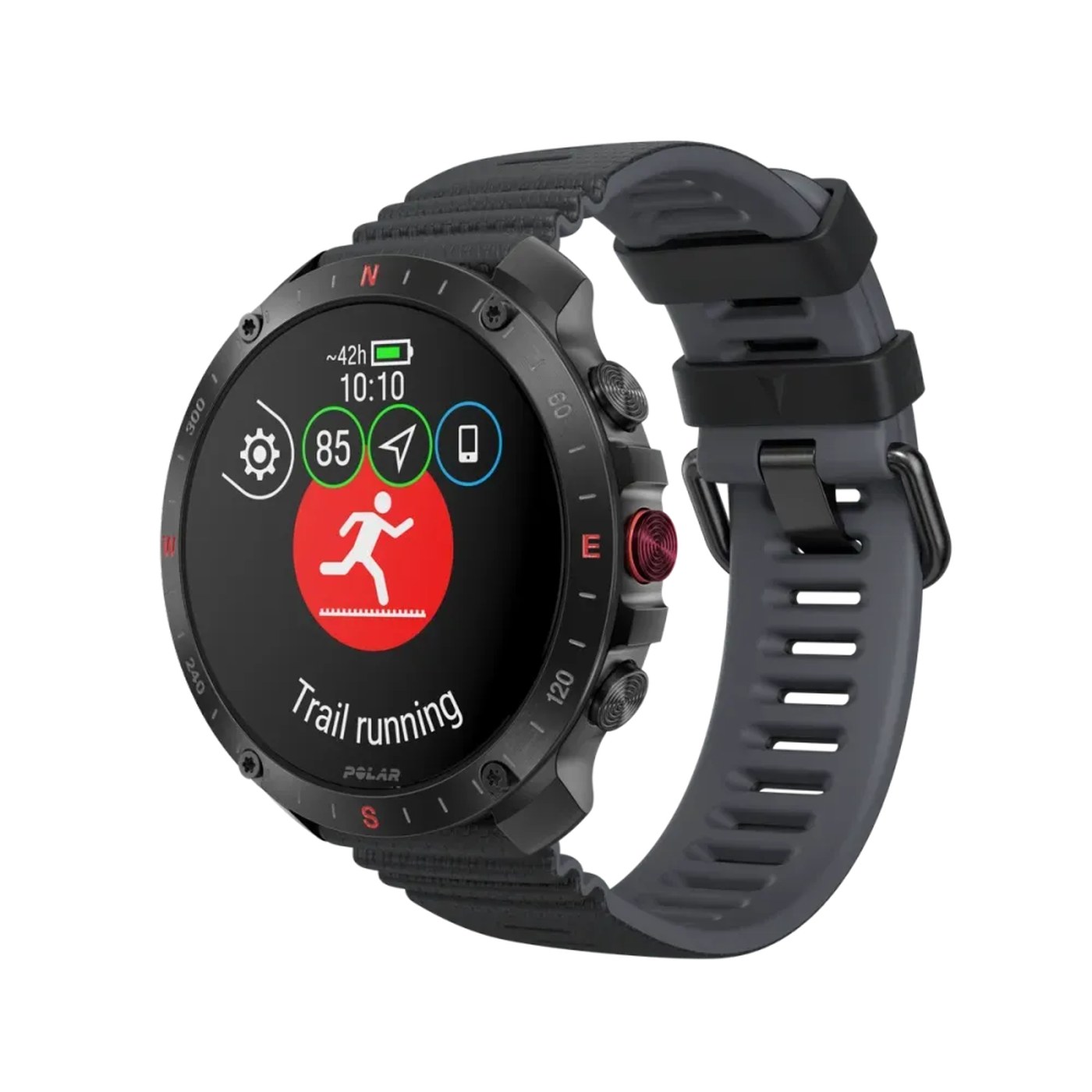
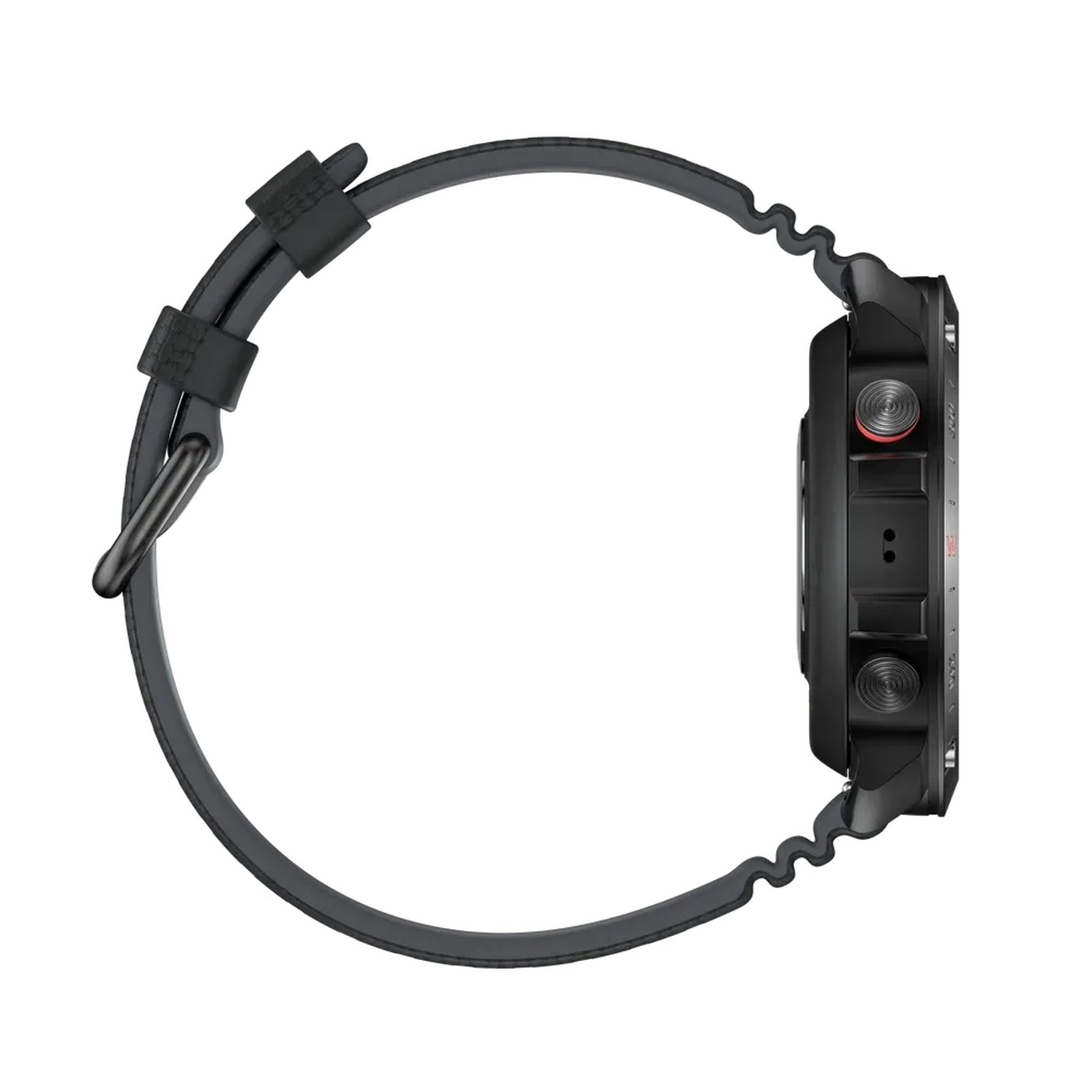
The Polar Grit X2 Pro goes where Polar had never gone before: the premium AMOLED trail watch. Steel case, sapphire glass, dual-frequency L1+L5 GPS under a booster antenna, ECG on the wrist, free worldwide offline topo maps with Komoot turn-by-turn navigation. And a €749.90 list price that regularly drops below €600 at Decathlon and i-Run. Our verdict after cross-checking the reviews from Sport-Passion, Lepape-Info, Montre Cardio GPS, Journal du Geek, Run Évasion and Sprint Running: 8.5/10. Here is who it is built for, what it changes compared with the Vantage V3 and where it still falls short.
Polar Grit X2 Pro Review: Sapphire AMOLED, ECG and Free Maps
8.5/10
Polar Grit X2 Pro: Polar's premium AMOLED trail watch, at last
For two generations, Polar left the expedition trail segment to Garmin and Suunto. The Grit X2 Pro answers every request runners have piled up since: sapphire AMOLED, dual-frequency GPS, free worldwide offline maps, no flashlight but a magnetic compass, MIL-STD-810H and 100 m water resistance. On paper, it takes on the Suunto Vertical 2, COROS APEX 4 and Amazfit Cheetah 2 Ultra, with one argument nobody else has: Polar's physiology suite (Training Load Pro, Recovery Pro, Nightly Recharge, FuelWise).
RunMorph's advice. If you are torn between the Grit X2 Pro and the Vantage V3, ask yourself a simple question. Do you run more than 50% of your mileage on trails? Do you head out self-supported for more than 6 hours? Do you need offline topo maps? Then get the Grit X2 Pro. Otherwise the Vantage V3 (€599.90) covers the same use in a lighter, thinner, more discreet case. The difference is not in the sensors (Elixir and OHR Gen 4 on both) but in ruggedness, dual-band GPS battery life (43 h on both, identical) and full offline mapping (on the Grit, missing on the Vantage).
© Polar, official photo used for editorial purposes
Objective specs
| Brand | Polar |
| Model | Grit X2 Pro (Black Steel version tested) |
| Official release | April 3, 2024 (French retail launch, preorders opened March 2, 2024) |
| Case size | 48.6 mm x 48.6 mm x 14.2 mm |
| Weight | 79 g with silicone strap (stainless steel) / 64 g (Titan) |
| Display | 1.39-inch AMOLED, 454 x 454 px (326 ppi), Always-On sapphire glass |
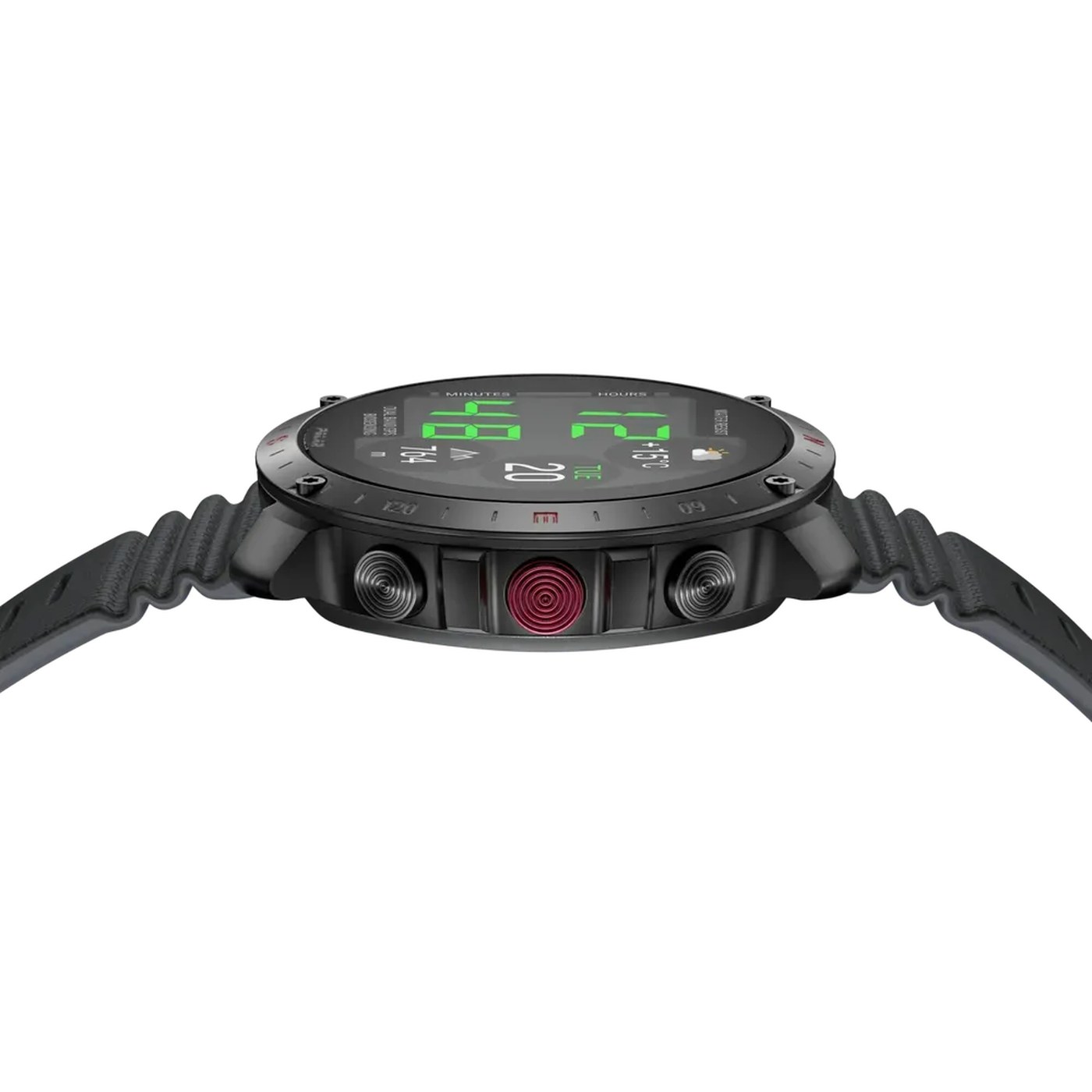
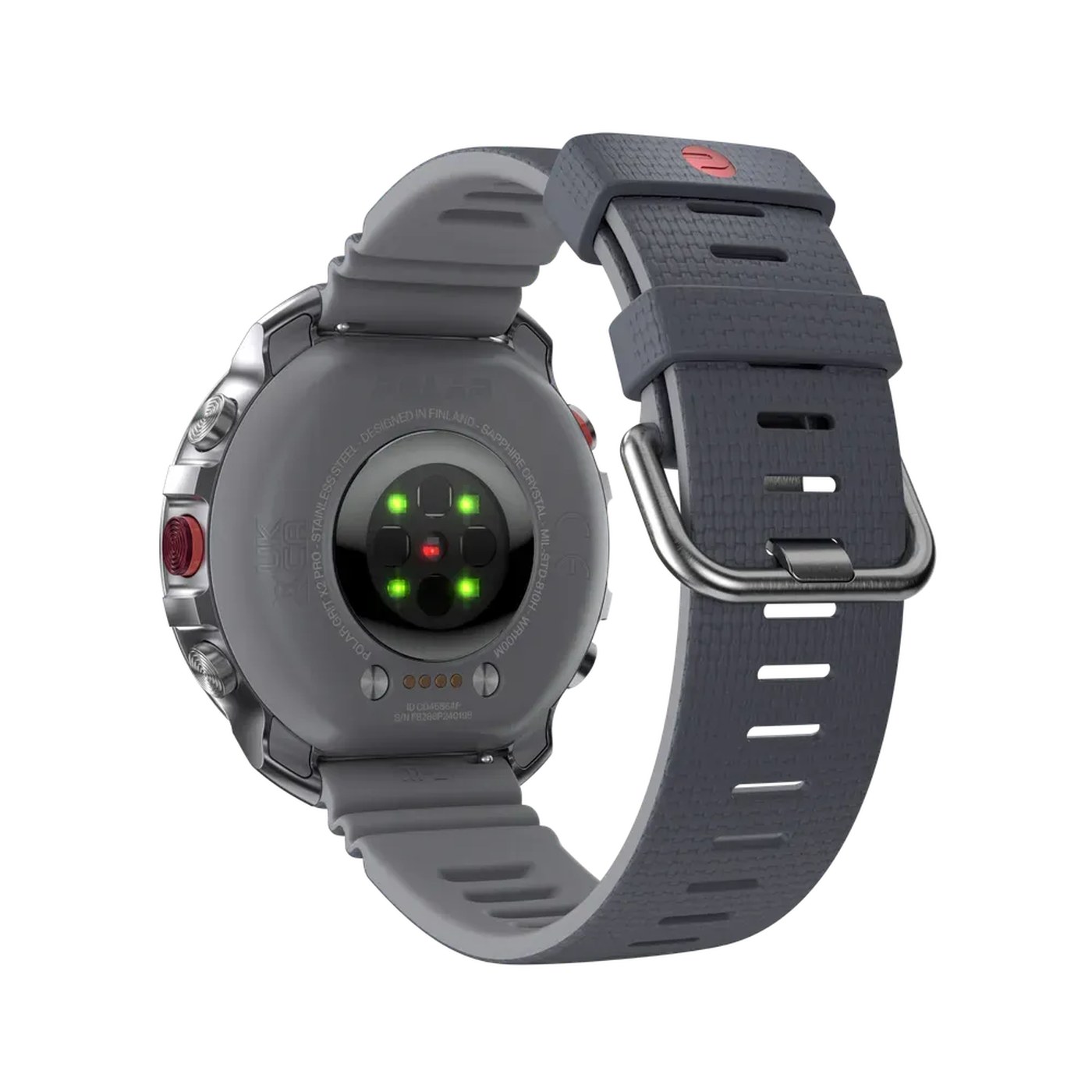
| Materials | Stainless steel case + sapphire + PA11 with 30% glass fiber, OHR sensor under a sapphire lens, MIL-STD-810H |
| GNSS | Dual-frequency L1+L5 (GPS, GLONASS, Galileo, BeiDou, QZSS), new signal-booster antenna under the bezel |
| Sensors | Polar Elixir Gen 1 (OHR Gen 4, ECG, SpO2, Skin Temp), barometer, magnetic compass, accelerometer, ambient light sensor |
| Mapping | Free worldwide offline topo maps (32 GB), North America and Europe preloaded, Komoot turn-by-turn, Hill Splitter, Back to Start, Track Back |
| Sport profiles | 150+ (trail, road, ski touring, mountain biking, gravel, open water swimming, hiking, mountaineering, triathlon) |
| Music storage | None (smartphone control only) |
| Contactless payment | No |
| Water resistance | WR100 (100 m, ISO 22810) + MIL-STD-810H |
| Battery life | 10 days smartwatch / 43 h Performance dual-band GPS / 140 h Eco single-band GPS |
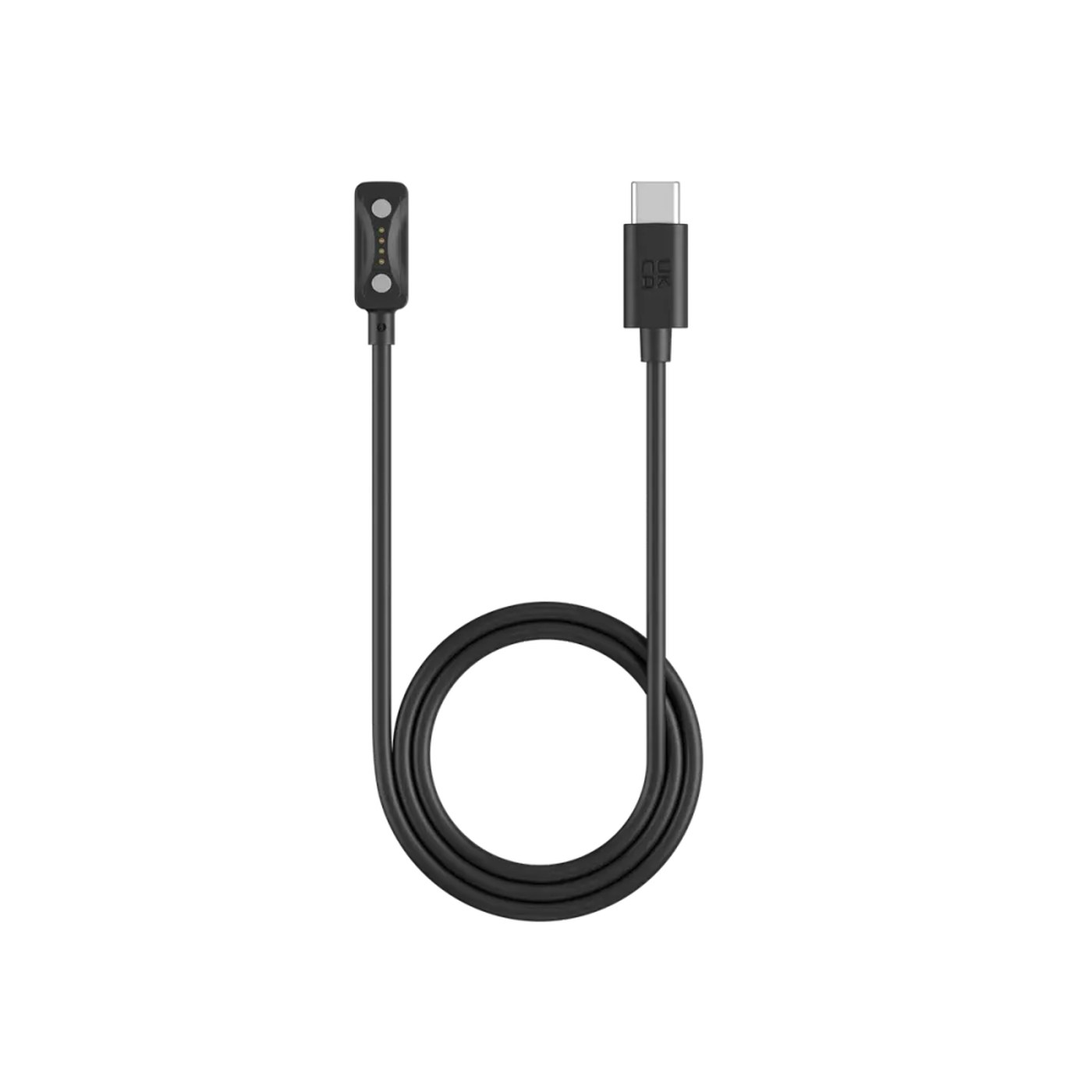
| Battery | 488 mAh Li-pol, proprietary magnetic USB charger (full charge in < 2 h) |
| Connectivity | Bluetooth 5.0, Wi-Fi 2.4 GHz, compatible with iOS 14.5+ and Android 8.0+ |
| List price | €749.90 (Black or Stone Gray steel) / €869.90 (Titan with leather strap + natural leather) |
| Street price, June 2026 | €584.59 at Decathlon, €599 at i-Run for the steel version |
Who is the Grit X2 Pro for?
The trail runner who wants free offline maps without paying for a fenix 8
This is where the Grit X2 Pro hits hardest. The worldwide topo maps are free, download over Wi-Fi through Polar Flow Web and fit in 32 GB of onboard storage. Komoot turn-by-turn directions show up on your wrist with no extra subscription (Komoot Premium stays optional, but basic sync comes free with the watch). Against the Garmin Forerunner 970 at €749, with its TopoActive Europe maps preloaded but limited to one region, the Grit X2 Pro makes a more generous "every region in the world, free" case. Heading to the GR20 this summer? Download Europe + Mediterranean the night before, done.
The loyal Polar runner who wants a truly rugged case
You know the Polar suite (Training Load Pro, Recovery Pro, Nightly Recharge, FitSpark, Running Index, FuelWise, Polar Coach) and you have no desire to relearn everything in Garmin Connect or the Suunto App. The Grit X2 Pro is your only way into a rugged Polar case: 48.6 mm, MIL-STD-810H, operating temperatures from -20 to +50 °C, 100 m water resistance. The Vantage V3 stays thinner and lighter (39 g without strap, versus 79 g with strap on the Grit), but it carries no military certification and lacks full offline mapping.
The ultrarunner who wants 140 h of GPS battery life without dropping to MIP
43 h in Performance dual-band mode sits in the segment average (the Amazfit Cheetah 2 Ultra claims 60 h dual-band at €599, the Suunto Vertical 2 65 h multi-band). But Eco mode climbs to 140 h in single-frequency, enough for a Tor des Géants or a PTL UTMB while keeping an AMOLED display. The COROS APEX 4 lasts 65 h All Systems on a transflective MIP display and the COROS Nomad 50 h, also on MIP: if an AMOLED touchscreen is non-negotiable for you, the Grit X2 Pro stays competitive. If not, the APEX 4 keeps the outright lead in active GPS battery life.
© Polar, official photo used for editorial purposes
GPS accuracy and heart rate sensor
Polar bets big on accuracy with the new signal-booster antenna under the steel bezel. Independent measurements show an average accuracy of 5 m in dual-frequency mode (L1+L5) in open terrain, the category standard. Under dense tree cover or in urban canyons, dual-frequency corrects multipath errors on par with the Forerunner 970 or the Suunto Race 2. Several French reviewers report a slight drift at the start of a session (60-90 seconds before the track locks in), but it settles quickly.
On heart rate, Polar remains the most credible brand on the market. The Elixir sensor combines OHR Gen 4 (five LEDs + photodiodes) with wrist ECG (a 30 seconds reading with two fingers on the bezel). At a steady running pace, the OHR stays within ±2 bpm of an H10 chest strap or a Garmin HRM 600. During short intervals with fast pace changes, as with every optical watch, a 4-6 second lag appears: at those intensities, pair the Grit X2 Pro with a Coros HR Monitor or an H10 strap to get the accuracy back.
Mapping and navigation
This is the major differentiator against the Vantage V3. The Grit X2 Pro loads free worldwide offline topo maps through Polar Flow Web over Wi-Fi, onto 32 GB of onboard storage (North America and Europe preloaded). The color maps on the 454 x 454 AMOLED stay readable in full sun, the touchscreen glides smoothly under your finger (even wet), and the rotating crown handles zoom. Komoot turn-by-turn works with no mandatory subscription: build your route in the Polar Flow app or import it from Strava / Komoot, and the watch guides you turn by turn with vibration alerts.
Hill Splitter automatically detects climbs and descents during the run, adds up elevation gain and loss, duration and pace, and gives you the breakdown at the finish. Back to Start brings you back in a straight line (handy if you get lost), Track Back retraces your route in reverse. All of these features run without mobile data: no smartphone dependency once the route is downloaded.
Training and recovery metrics
Polar's physiology suite is still the most advanced on the market in 2026. Training Load Pro quantifies the cardio + muscle + perceived load of each session and gives you a continuous Tolerance / Productivity / Strain readout. Recovery Pro tracks recovery night after night with the optional orthostatic test (morning HRV measurement) and tells you when you can go hard. Nightly Recharge combines sleep + overnight HRV into a daily score. FitSpark suggests three workouts tailored to you each day (based on your form and load). FuelWise tracks carbohydrate use during a run and triggers fueling alerts.
Running Index gives you your running VO2max + predicted times for 5K, 10K, half marathon and marathon. Hill Splitter (covered above) breaks down elevation gain and loss. Wrist-based Running Power calculates power with no extra sensor (proprietary Polar algorithm, calibration recommended if you want to compare with Stryd). Polar Coach, launched in 2025, builds an adaptive 5K/10K/half/marathon plan: you enter your goal race, current fitness and weekly volume, Polar Coach assembles the plan and adjusts it every week based on the sessions you actually ran. It is the functional equivalent of Garmin's adaptive Garmin Coach. Bonuses included with purchase: 60 days of Strava Premium, 60 days of Komoot Premium, 30 days of TrainingPeaks Premium.
Real-world battery life
Polar claims 10 days in smartwatch mode (continuous heart rate on + notifications). In practice, with AOD off and 4 sessions of 1 h per week in dual-band GPS, the battery lasts 8 to 9 days, in line with the cross-checked reports from Sport-Passion, Lepape-Info and Journal du Geek. With AOD on, that drops to about 6 days.
For long efforts, Performance dual-band mode lasts 43 h. Eco single-frequency mode goes up to 140 h (almost 6 days), enough for a PTL or a Tor des Géants. The proprietary magnetic USB charger takes the battery from 0 to 100% in about 1 h 50 min. The supplied cable is short enough (15 cm) to fit in an ultra pack.
Dual-band GPS battery life of the competition:
- Polar Grit X2 Pro: 43 h
- Garmin Forerunner 970: 21 h
- Suunto Vertical 2: 65 h
- COROS APEX 4: 41 h dual-frequency / 65 h GPS All Systems (transflective MIP)
- Amazfit Cheetah 2 Ultra: 60 h
The Grit X2 Pro lands in the upper half of the field: 43 h dual-band is solid without blowing anyone away like the Vertical 2 or the Cheetah 2 Ultra. Its real edge lies elsewhere: the 140 h Eco mode stays usable during a race (single-frequency is enough on open trails), while other brands give up accuracy entirely in their power-saving modes.
© Polar, official photo used for editorial purposes
How it stacks up against the competition
At its €749.90 list price, the Grit X2 Pro faces three direct rivals in the multi-band AMOLED trail segment. At the actual street price of €584-599, it is a different story.
Polar Grit X2 Pro vs Garmin Forerunner 970 (€749): Garmin keeps the ecosystem advantage (Garmin Pay NFC, onboard Spotify/Deezer/Amazon music, the Connect+ suite with adaptive Garmin Coach). Polar strikes back with free worldwide offline topo maps versus TopoActive Europe sold as a paid add-on by Garmin, and wrist ECG, which Garmin lacks. At list price, it is a technical tie. At street price, the Grit X2 Pro is unbeatable.
Polar Grit X2 Pro vs Suunto Vertical 2 (€599 steel / €699 titanium): Suunto hits harder on battery life (65 h multi-band GPS, three-color LED flashlight, 100 m water resistance), Polar wins on heart rate (ECG + Elixir, far more credible than Suunto's long-standing sensor). For a 70% trail / 30% other activities mix where physiology matters, go Polar. For 90% expedition trail, go Suunto.
Polar Grit X2 Pro vs COROS APEX 4 (€499.99 in 46 mm): the COROS is cheaper, lighter (52 g) and lasts longer in GPS All Systems (65 h in All Systems mode versus 43 h dual-band on the Polar). But the APEX 4 uses transflective MIP (readable in sunlight but dull in shade), not AMOLED. If you want an AMOLED display that pops on your wrist every day, go Polar. If you want maximum active GPS battery life on a tighter budget, go COROS.
How to use it with your RunMorph training plan
The Grit X2 Pro ticks every box for a serious RunMorph training plan companion: running VO2max on the wrist, predicted times for target distances, daily FitSpark suggestions, adaptive Polar Coach 5K/10K/half/marathon plans, Hill Splitter for hilly trail sessions, FuelWise for fueling in long races, ECG for fine-grained heart checks during recovery. So you can follow your RunMorph plan (our method remains the benchmark for week-by-week structure) and use Polar's metrics to fine-tune your load.
In practice: set your goal race in RunMorph Plans (10K, half marathon, marathon, short trail or long trail). Follow the plan day by day. Sync your Polar Flow sessions to Strava (Polar Flow does it automatically). Every Sunday evening, check your Training Load Pro and Nightly Recharge. If Strain and Recovery are red for 3 days, ease off the intensity early in the week. If everything is green, stick to the plan. The pairing works very well because RunMorph handles the big picture and Polar fine-tunes the details.
© Polar, official photo used for editorial purposes
RunMorph verdict
The Polar Grit X2 Pro ticks almost every box of a premium multi-band AMOLED trail watch in 2026: 1.39-inch 326 ppi sapphire display, dual-frequency GPS with a booster antenna, free worldwide offline topo maps, an unrivaled physiology suite, wrist ECG, MIL-STD-810H and 100 m water resistance. It falls short on three points: no onboard music (the proprietary USB only transfers maps, not MP3s), no contactless payment (Polar has never been willing to invest in NFC) and a 48.6 mm case weighing 79 g in steel, so it stands out on a slim wrist. At its €749.90 list price, it goes head to head with the Forerunner 970. At the €584-599 street price at Decathlon or i-Run, it becomes one of the best deals in the 2026 premium trail segment.
RunMorph score: 8.5/10. The best Polar for trail running to date, but it makes more sense on sale than at full price.
Key takeaways for your training
- Free worldwide offline maps: Polar includes North America + Europe topo maps preloaded, with every other region downloadable for free over Wi-Fi. A major advantage over Garmin's TopoActive Europe, sold as a paid add-on.
- Wrist ECG in 30 seconds: place two fingers on the bezel to read your heart rhythm + detect irregularities. Outside of Apple, no other premium trail brand offers this.
- Adaptive Polar Coach physiology suite: Training Load Pro + Recovery Pro + Nightly Recharge + FitSpark + FuelWise. All of it with no paid subscription.
- 140 h Eco battery life in single-frequency GPS: enough for the PTL, Tor des Géants or Hardrock 100. The 43 h Performance dual-band mode covers almost every French ultra.
- Street price under €600 in June 2026: Decathlon €584.59, i-Run €599. At that price, the Grit X2 Pro offers excellent value for money in the high-end AMOLED trail segment. At the €749.90 list price, the choice is less obvious against the Forerunner 970.