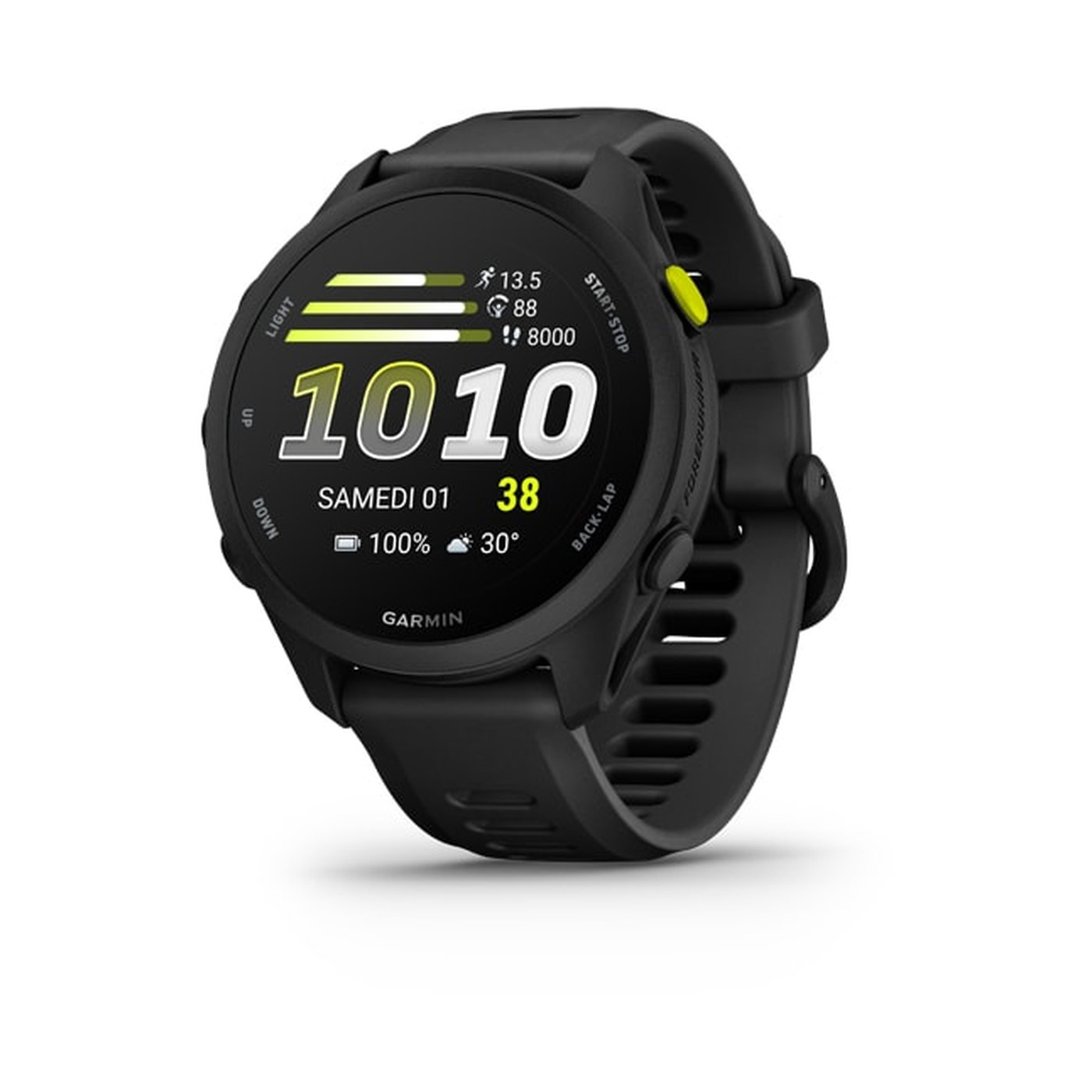
For years, getting an AMOLED Garmin Forerunner on your wrist meant spending more than €350. The new Forerunner 70, launched at €249.99 on May 15, 2026, breaks that barrier and finally brings a color touchscreen, the premium physiological suite and 80+ sport profiles for the price of a Pace 4. The RunMorph Coach went through it in detail to sort out what it gains over the 165, and what it costs you compared with the Forerunner 170.
Garmin Forerunner 70 Review: Garmin's First AMOLED for €249.99
8/10
Garmin Forerunner 70: Garmin's first AMOLED under €250
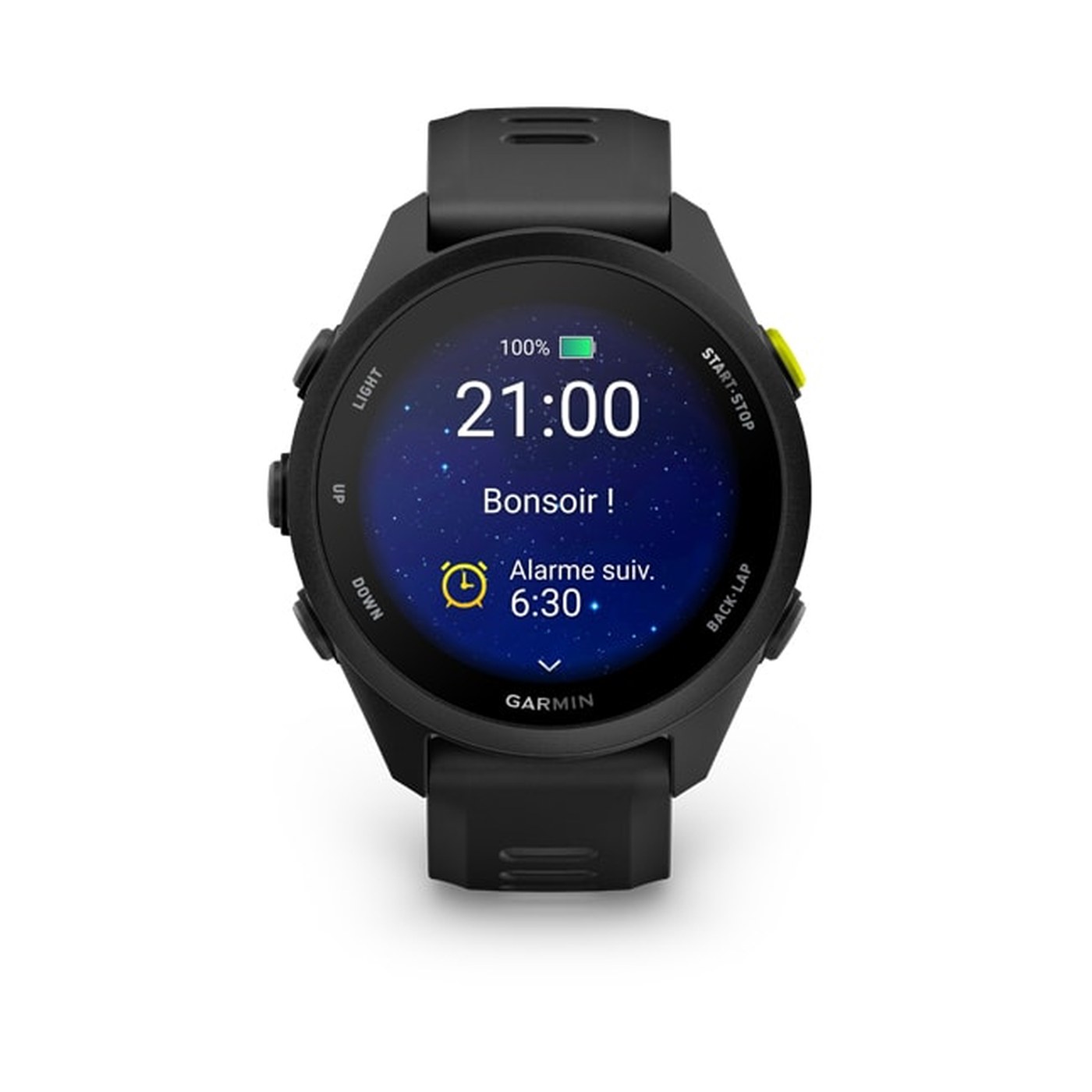
The Forerunner 70 is Garmin's refreshed entry-level model, unveiled on May 12, 2026 and on sale from May 15 at garmin.com and partner retailers. It replaces the Forerunner 165, keeps a 43 mm glass-fiber-reinforced polymer case and moves to a 1.2-inch AMOLED touchscreen, 390 x 390 pixels, readable in direct sunlight. Five physical buttons surround the display, including a neon-yellow Start/Stop button that defines the look of the 2026 model.
The positioning is crystal clear: it's the cheapest Garmin with an AMOLED color display, and the brand's first watch to bring adaptive Coach, Training Readiness and HRV Status below €250. Inside, you get the same architecture as the Forerunner 165 (Elevate Gen 4 sensor, single-frequency multi-GNSS), plus a new watch face and reworked software ergonomics designed for beginner and intermediate runners.
RunMorph's advice. If you're torn between the Forerunner 70 and the COROS Pace 4 at the same price, ask yourself one simple question: do you want the software ecosystem (Garmin Connect, Coach, badges, live Strava segments) or pure technical performance (dual-band L1+L5 GPS, 41 h of battery life in GPS All Systems mode)? The Pace 4 wins on accuracy and battery life, the Forerunner 70 wins on guidance and integration. If you're starting a structured plan or adding swimming and strength training to your running, the Garmin ecosystem remains a clear advantage.
© Garmin, official photo used for editorial purposes.
Objective specifications
| Specification | Garmin Forerunner 70 (Black) |
|---|---|
| Brand | Garmin |
| Model | Forerunner 70 |
| Official release | May 15, 2026 (announced May 12, 2026) |
| Tested reference | 010-04307-00 (Black) |
| Case size | 43 mm glass-fiber-reinforced polymer |
| Lens | Corning Gorilla Glass 3 |
| Weight | 40 g (strap included) |
| Display | 1.2" AMOLED touchscreen, 390 x 390 px, polymer bezel |
| Smartwatch battery life | 13 days without AOD, 5 days with always-on display |
| GPS battery life | 23 h GPS Only, 16 h All Systems multi-GNSS |
| GNSS | Single-frequency multi-GNSS (GPS, GLONASS, Galileo, BeiDou, QZSS), no dual-band L1+L5 |
| Sensors | Elevate Gen 4 optical heart rate sensor, accelerometer, gyroscope, thermometer |
| SpO2 / Pulse Ox | Yes (on-demand and overnight readings) |
| Barometer / altimeter | No |
| Mapping | No (breadcrumb trail only) |
| Sport profiles | 80+ (running, trail, cycling, pool swimming, strength, HIIT, yoga, tennis, skiing, etc.) |
| Music storage | No (smartphone control only) |
| Contactless payments | No (no Garmin Pay) |
| Water resistance | 5 ATM (50 m) |
| Connectivity | Bluetooth, ANT+, no Wi-Fi |
| Charging | USB-C |
| Straps | Interchangeable 18 mm silicone |
| Colors | Black, Whitestone, Citron, Lavender Soft, Tidal Blue, Soft Pink |
| Official price | €249.99 (garmin.com/fr-FR) |
Who is the Forerunner 70 for?
The beginner who wants a structured plan from week one
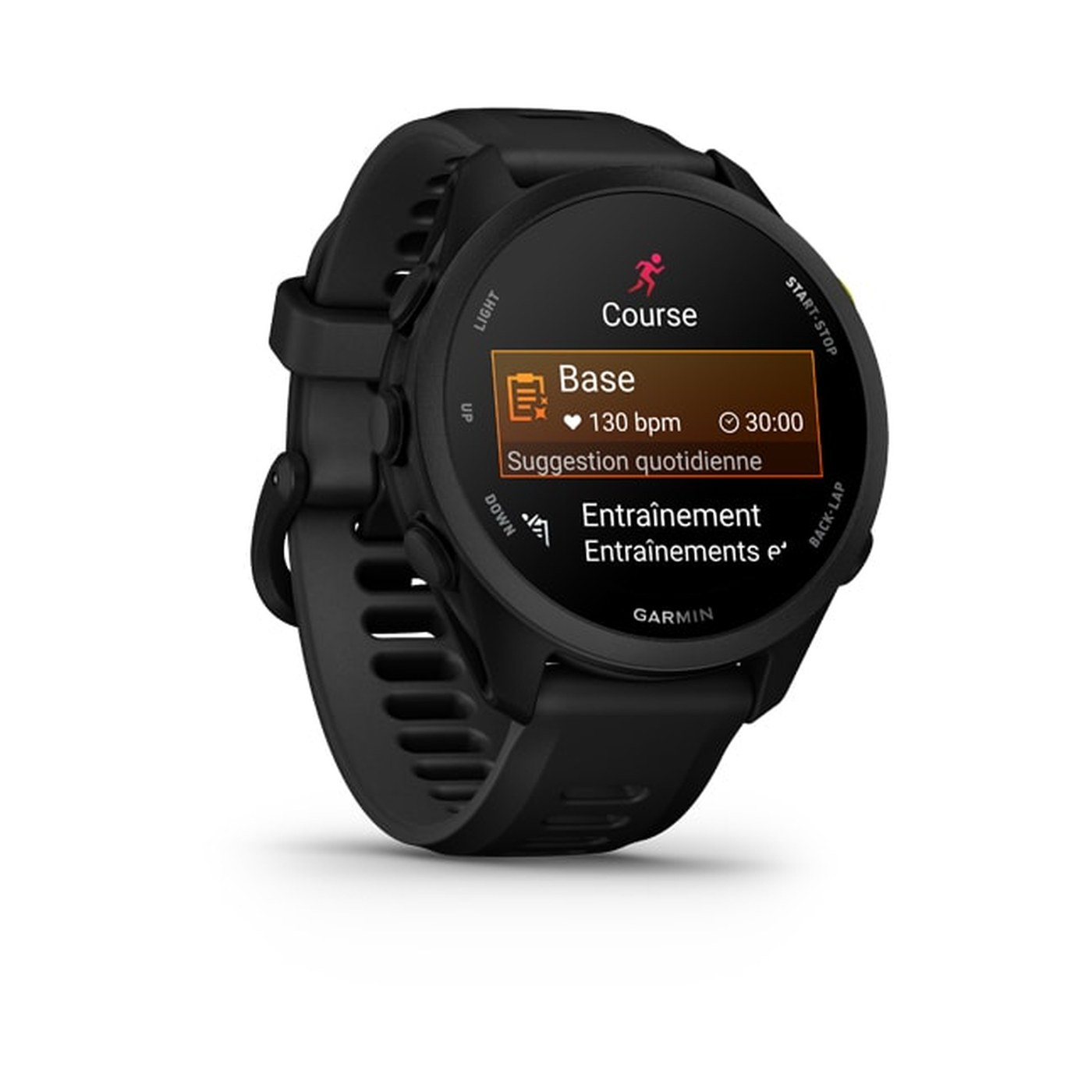
You're new to running or getting ready for your first 10 km. The Forerunner 70 builds you a personalized plan through Garmin Coach (5 km, 10 km, half marathon, marathon) that adapts every week to the sessions you've completed, your heart rate and your sleep. The Daily Suggestion shows up as soon as you power on, saves you from wondering which workout to do, and keeps you on track. For a runner discovering structured training, that's the number one argument over a Garmin Forerunner 55 or a general-purpose watch.
The intermediate runner who wants AMOLED and Garmin Connect at a COROS price
You already run 3 to 4 times a week, you check Garmin Connect every day, and you care about seeing your splits, training load and HRV status on a bright screen. The Forerunner 70 gives you all of that for €249.99, the lowest entry price Garmin has ever set for an AMOLED watch. If you don't need mapping or contactless payments, this is the right ticket into Garmin's premium physiological suite.
The multisport beginner who mixes running, easy cycling and strength work
The 80+ sport profiles cover cycling, pool swimming, strength, HIIT, yoga, skiing, hiking, racket sports and team sports. There's no multisport triathlon mode, but more than enough to track the cross-training sessions in your running plan. The Elevate Gen 4 sensor is the same as on the Forerunner 170 and the 265: decent wrist accuracy at endurance pace, with the usual drop-off on sharp pace changes.
© Garmin, official photo used for editorial purposes.
GPS accuracy and heart rate sensor
The Forerunner 70 uses a single-frequency multi-GNSS chipset shared with the Forerunner 165 and the Forerunner 170. In practice, you pick up GPS, GLONASS, Galileo, BeiDou and QZSS signals in parallel, but without the dual-frequency L1+L5 found on the Forerunner 970, the COROS Pace 4, the COROS Pace Pro or the Suunto Race 2. In dense city centers, under forest canopy or in the mountains, you'll see the track drift into buildings a little more, and instant pace suffers more on quick pace changes. On regular road runs and on the track, accuracy stays very acceptable and the gap with a dual-band watch shrinks to a few meters per kilometer.
As for the heart rate sensor, the Elevate Gen 4 is a proven Garmin staple already used on the 165, the 265 and the 170. It delivers stable readings at endurance pace, clean data on long runs, and stays within plus or minus 3 bpm of an HRM-Dual chest strap. On short intervals, it takes two to three seconds to catch up with each acceleration, which is typical for a wrist sensor. If you do a lot of precise zone work (repeated zone 4 and 5 efforts), a Bluetooth or ANT+ chest strap is still the smart move to get back the accuracy of a dual-band watch.
Mapping and navigation
No mapping on the Forerunner 70. You get a breadcrumb trail that lets you return to your starting point and follow a course imported via Garmin Connect, but no onboard topo maps, no turn-by-turn directions, no street names. It's a deliberate trade-off to hold the price and the battery life. For road running or marked trails, breadcrumb navigation easily covers your needs. For technical, self-supported trail running, you need to step up to a Suunto Race 2, a COROS Pace Pro or the Forerunner 970.
Important: the Forerunner 70 has neither a barometer nor an altimeter. Elevation is calculated by GPS alone, which hurts accuracy in the mountains or under heavy cloud cover. For vertical trail running, go for a Forerunner 170 (which does have a barometer) or higher.
© Garmin, official photo used for editorial purposes.
Training and recovery metrics
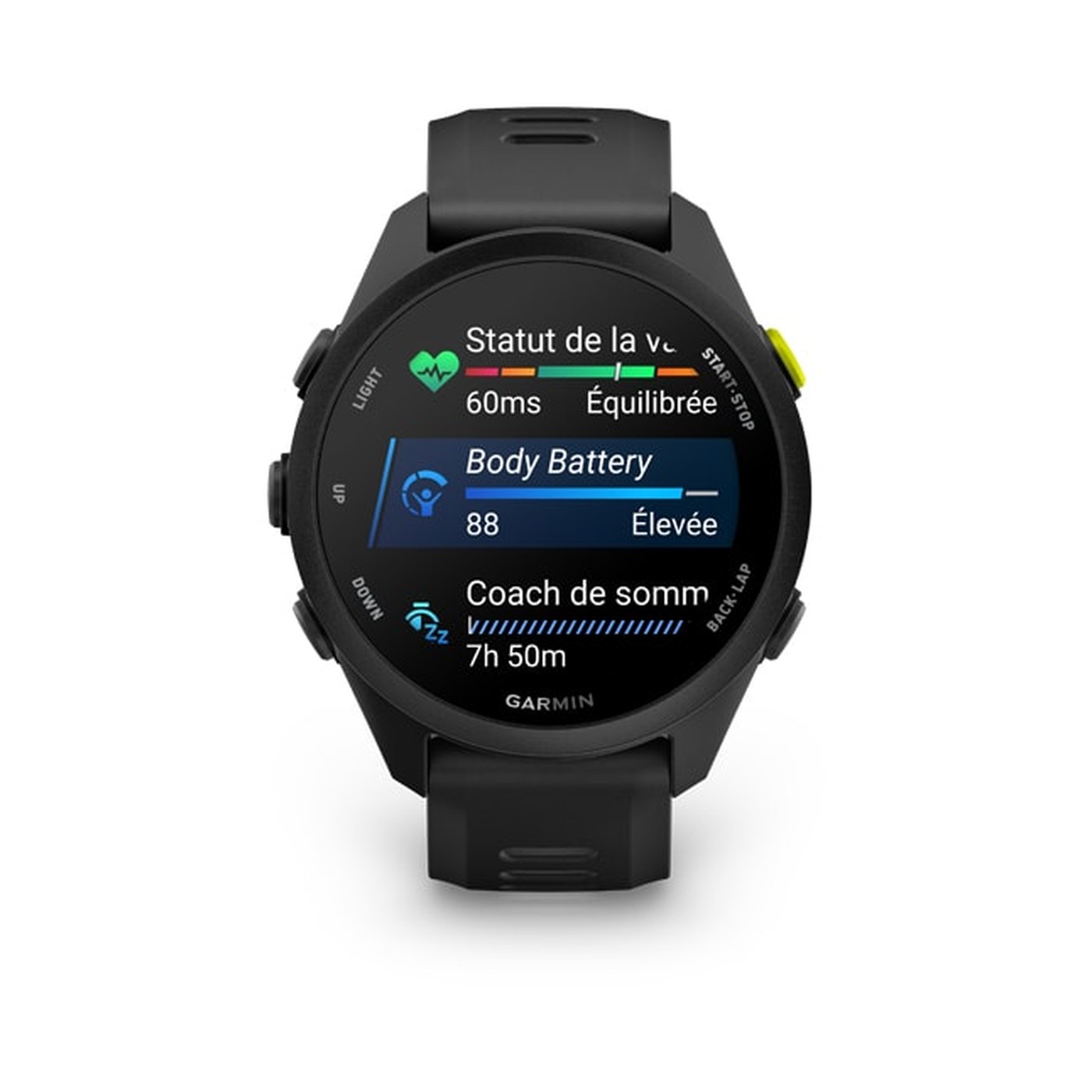
This is the real surprise of the Forerunner 70: the premium physiological suite drops to €249.99. You get Training Readiness (a score from 1 to 100 every morning that combines sleep, recent load, HRV and logged hydration), HRV Status (heart rate variability status over 7 days), Body Battery (a 0-100 energy gauge), Sleep Score with sleep stages and coaching, adaptive Daily Suggested Workouts, and Garmin Running Coach with plans from 5K to marathon. You also get running dynamics (cadence, stride length, vertical oscillation, ground contact time) and wrist-based running power, with no external accessory.
What's missing compared with the Forerunner 970: aerobic/anaerobic workout evaluation, Race Predictor adjusted to your terrain, Endurance Score, PacePro, Hill Score and stride efficiency analysis. If you're just starting structured training or preparing for anything from a 10 km to a marathon with a 4 h target, you honestly don't need these advanced metrics. The 70 is more than enough.
Real-world battery life
13 days in smartwatch mode without the always-on display, 5 days with AOD enabled, 23 hours in GPS Only and 16 hours in multi-GNSS All Systems. If you log 3 to 4 one-hour runs a week, you'll charge the watch once every 8 to 10 days in real-world use (notifications, sleep and daily tracking on). A full charge over USB-C takes about an hour.
What that means in practice: a 4 h marathon uses about 18% of the battery in GPS Only, and a 6 h trail run in multi-GNSS uses 38%. For ultra-trail races beyond 16 hours, you need to switch to the COROS APEX 4, the Suunto Vertical 2 or the Forerunner 970.
How it stacks up against the competition
At €249.99, the Forerunner 70 faces a demanding quartet.
Against the COROS Pace 4 (€269, 1.2-inch AMOLED, dual-band L1+L5, 41 h GPS All Systems), you lose dual-band GPS and twice the GPS battery life, but you gain Garmin Connect, Garmin Coach, Daily Suggestions, 80+ sport profiles, Strava Live Segments integration and benchmark sleep scoring. For a runner getting into structured training or who values the software ecosystem, the Forerunner 70 comes out on top. For a technically demanding, self-sufficient runner, the Pace 4 remains unbeatable.
Against the Forerunner 170 (€299.99), you save €50, but you also lose the barometer/altimeter, Garmin Pay contactless payments and the music mode of the 170 Music version. You keep the 1.2-inch AMOLED display, the Elevate Gen 4 sensor, the full physiological suite and multi-GNSS. The 170 remains the right pick if you mix in vertical trail running (you need a barometric altimeter) or want to pay at the store without pulling out your phone.
Against the COROS Pace Pro (€349, 1.3-inch AMOLED, dual-band, full offline world maps, 32 GB of music), the Forerunner 70 is €100 cheaper and keeps the Garmin ecosystem, but loses full mapping, onboard music and dual-band GPS. The Pace Pro is the pick if you want a complete, self-sufficient road and trail watch at a reasonable price.
How to fit it into your RunMorph training plan
The Forerunner 70 is the ideal gateway into a structured RunMorph plan. Garmin Connect syncs natively with Strava and most third-party platforms, so your RunMorph plan can pull in every run, analyze your load and adjust the next sessions. Garmin's Daily Suggested Workouts can either complement a guided RunMorph plan (suggested rest days, very slow easy runs) or be switched off if you follow your RunMorph plan to the letter.
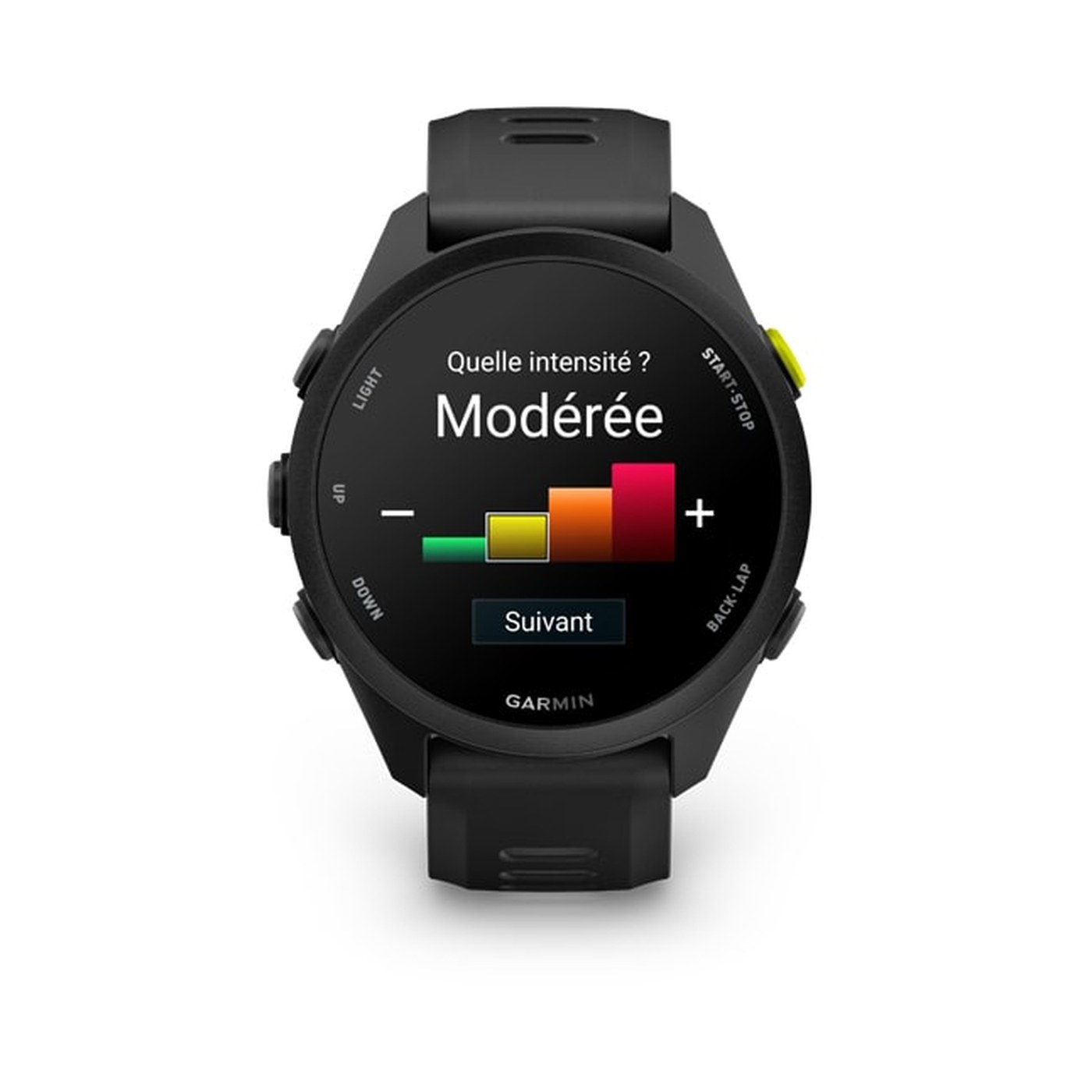
If you're starting a RunMorph 5 km or 10 km plan, the Forerunner 70 gives you everything you need: structured workouts (intervals with vibration alerts), daily HRV to adjust intensity, and sleep scores to manage fatigue. If you're preparing for a half marathon or marathon with RunMorph, add a Bluetooth heart rate chest strap for threshold sessions, and the 70 will do the job all the way to race day.
© Garmin, official photo used for editorial purposes.
The RunMorph Coach's verdict
The Forerunner 70 pulls off what many had been waiting three years for: bringing Garmin AMOLED and the premium physiological suite below €250. The trade-offs are easy to spot (no barometer, no Garmin Pay, no music, no dual-band) and they make sense for a runner who's starting out or who values the software ecosystem over cutting-edge GPS. At this price, its only real rival is the COROS Pace 4: you choose between Garmin Connect, which does more to guide you, and COROS, which is sharper on accuracy and battery life. For 80% of regular runners, the Forerunner 70 is the right answer.
Score: 8.5/10.
Key takeaways for your training
- Garmin's first AMOLED under €250: the 70 brings the color touchscreen and the premium physiological suite down to the Forerunner's historic entry price.
- Full physiological suite: Training Readiness, HRV Status, Body Battery, Sleep Score, adaptive Daily Suggestions and Garmin Running Coach finally drop below €250.
- Single-frequency GPS you have to live with: multi-GNSS performs well on road runs and on the track, but falls clearly behind the dual-band of the Pace 4 or the Forerunner 970 in dense cities, under canopy and in the mountains.
- No barometer, no mapping: go for the Forerunner 170 if you run vertical trails, or the Pace Pro / Race 2 if you want onboard maps.
- Natively compatible with RunMorph plans: Garmin Connect talks to Strava and most platforms; the 70 is all you need to train for anything from 5 km to the marathon, aiming for consistency rather than an all-out record.