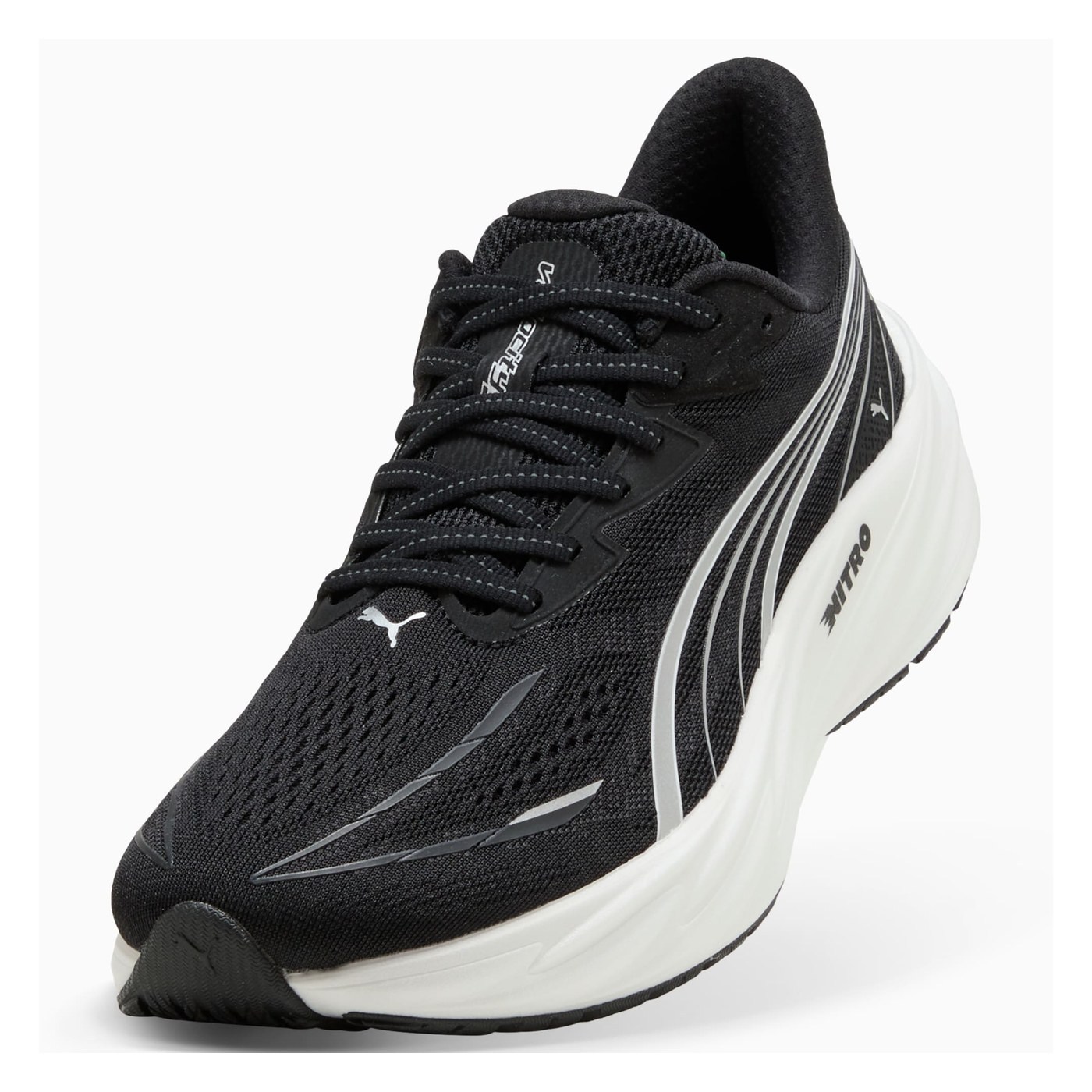
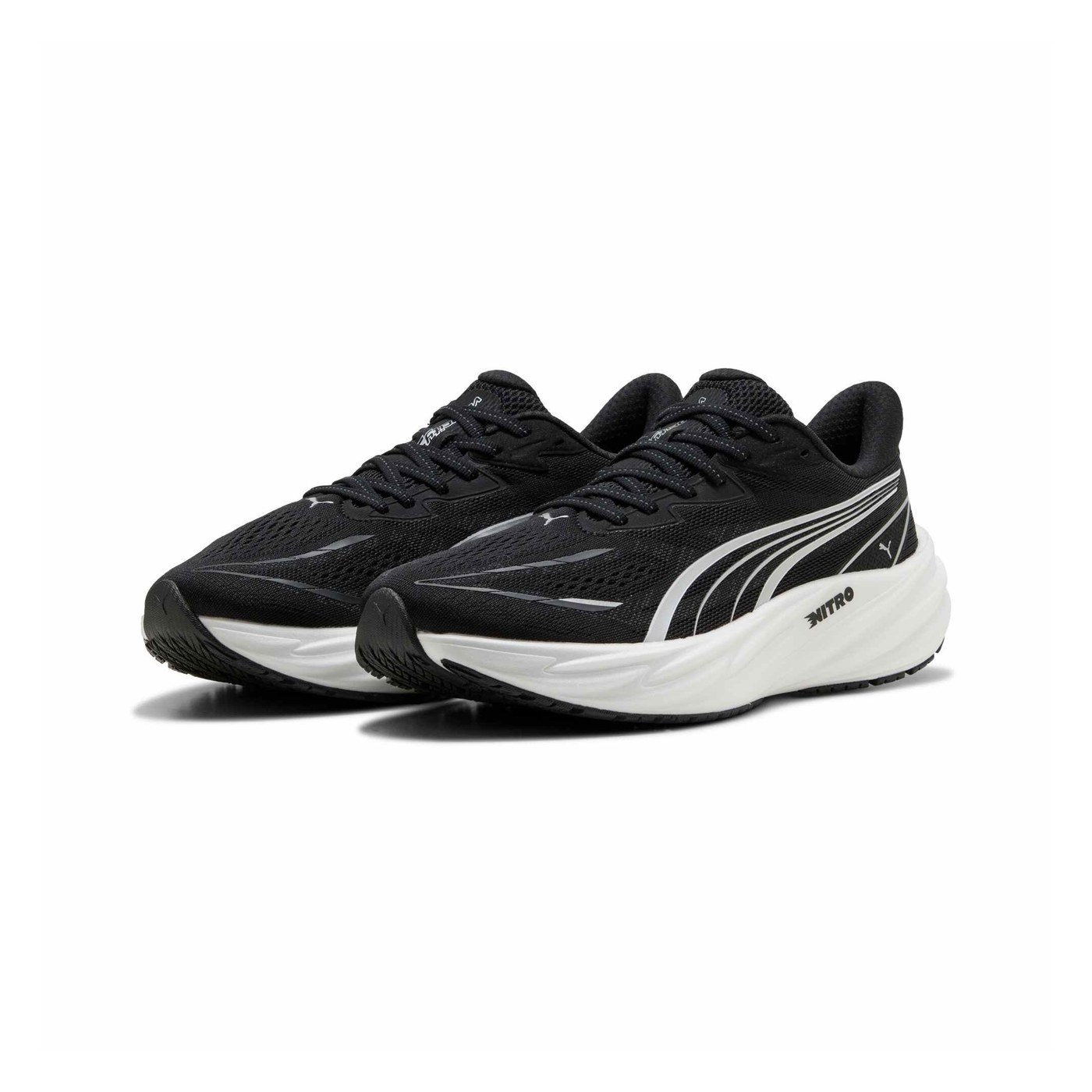
Puma has been selling its race-day super shoes for years, the Fast-R Nitro Elite and the Deviate Nitro, but had never offered a true versatile daily trainer in the RunMorph catalog. The Velocity NITRO 5 fills this gap, with a number that stands out right from the first independent lab measurements: a stated drop of 8 mm, measured at 5.2 mm by one lab and 9.8 mm by another.
© Puma, official photo used for editorial purposes
Puma takes on the daily trainer segment: a blank spot, finally filled
At Puma, the running strategy long focused on pure performance: the Fast-R Nitro Elite for racing, the Deviate Nitro for tempo workouts. The most crowded market segment, the sub-€150 daily trainer battleground contested by the Nike Pegasus 42, Brooks Ghost 18, and Saucony Ride 19, remained without a direct answer from the leaping cat brand. The Velocity NITRO 5 changes that: the fifth iteration of a line launched in 2020, it takes direct aim at this high-volume market, designed for the runner clocking three to five runs a week without chasing performance at all costs.
The bet is clear: offer a shoe that is lightweight for the category (238 g (8.4 oz) measured in an independent lab, compared to 286 g (10.1 oz) for the Pegasus 42 and 289 g (10.2 oz) for the Ghost 18) without sacrificing price, set at €130. Puma claims smart design rather than a tech revolution: the brand states it fixed friction points identified on the V4 rather than reinventing the NITROFOAM that has been around for several generations.
Velocity NITRO 5: what Puma claims vs. what was measured
This is where the review takes an unusual turn. Two independent testing protocols, one recalculating drop from stack measurements, the other measuring it directly with calipers, produced wildly different numbers for the exact same shoe. Neither matches the figure announced by Puma.
| Spec | Stated (Puma) | Measured (independent) |
|---|
| Weight (US9) | 244 to 246 g (8.6 to 8.7 oz) | 238 g (8.4 oz) to 242.4 g (8.6 oz) depending on the source |
| Drop | 8 mm | 5.2 mm to 9.8 mm depending on the source, a 4.6 mm gap between the two measurements |
| Heel stack | 34 mm | 31.3 mm to 35.0 mm depending on the source |
| Forefoot stack | 26 mm | 25.2 mm to 26.1 mm depending on the source |
| Toebox width | Not disclosed | 72.1 mm, compared to a segment average of 73.2 mm |
A drop discrepancy of this size between two rigorous protocols, on the exact same shoe and colorway, is no minor detail: it illustrates how much brand-stated drop remains a theoretical number calculated on a design blueprint, while the actual molded stack height varies from unit to unit and protocol to protocol. At RunMorph, our take is cautious: the stated 8 mm figure is likely closest to the true average, but drop-sensitive runners should definitely not rely on the marketing spec sheet alone with this model.
NITROFOAM and PUMAGRIP technology: what does it change underfoot?
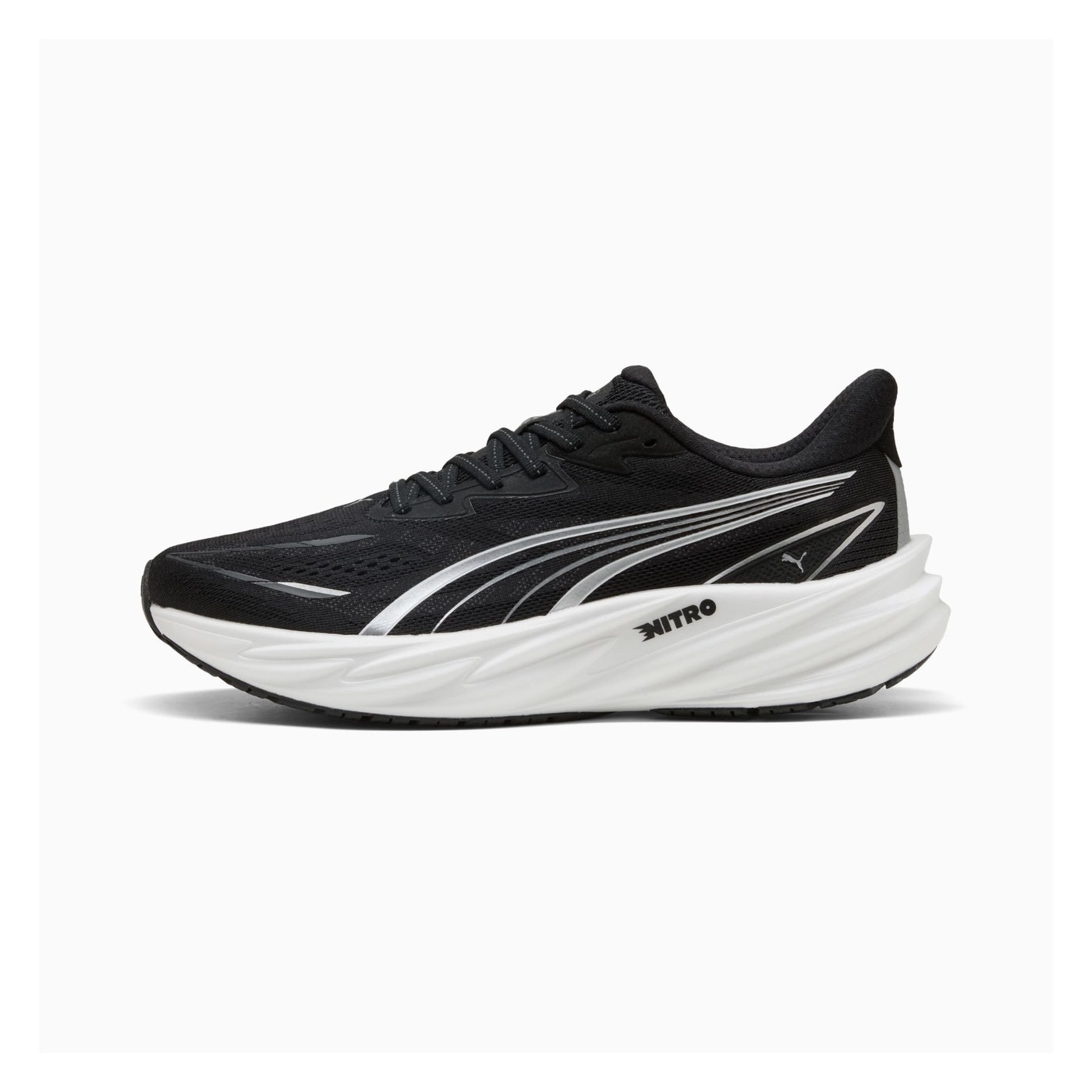
NITROFOAM is a nitrogen-infused ATPU (thermoplastic elastomer) foam, a compound Puma also uses on the Deviate and Fast-R. On the Velocity NITRO 5, it is molded into a very flexible geometry: longitudinal flex stiffness measured in an independent lab came in at 9.3 newtons, compared to a 15.5 newton average in the daily trainer segment, while torsional stiffness dropped to 7.4 Nm versus a 14.4 Nm average. In practical terms, the sole bends and twists nearly twice as easily as the average daily trainer tested under the same protocol. This flexibility explains the ride often described as natural in independent reviews, but it also deprives the shoe of any marked propulsive pop at higher paces, lacking a plate or pronounced rocker geometry to compensate.
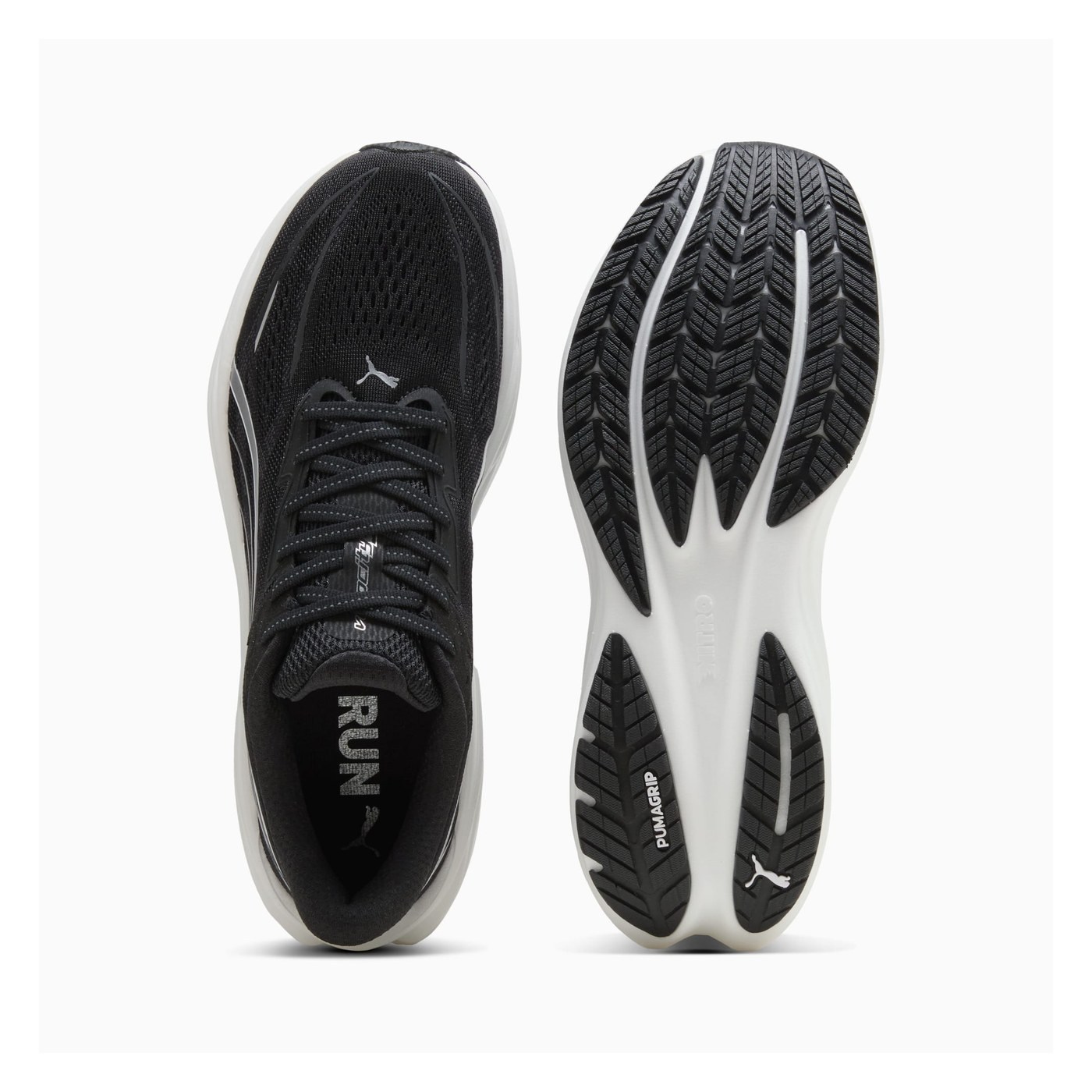
In terms of traction, the PUMAGRIP outsole recorded a friction coefficient of 0.78 on wet concrete, compared to a 0.53 segment average, representing a clear, measurable upgrade over the previous generation. This is one area where independent tests completely agree: the V5 bites into wet asphalt far better than the overwhelming majority of daily trainers tested under the same protocol.
© Puma, official photo used for editorial purposes
The fit: staying true to Puma's narrow heritage
The toebox measures 72.1 mm wide by 26.3 mm high (vertical volume), compared to segment averages of 73.2 mm and 27.0 mm, respectively. Overall midfoot width came in at 92.6 mm, versus 95.2 mm on average. These differences are only a few millimeters each, but they add up: one lab protocol and two independent wear tests consistently found a narrower-than-average fit, especially through the midfoot and forefoot. One long-term tester explicitly wished for more volume in that exact area, while another found it simply true to size without specific fit complaints. At RunMorph, our advice is clear: if you have wide feet or toenails sensitive to pressure, try the shoe on before buying, or go up half a size.
RunMorph Coach tip: if you are torn between the Velocity NITRO 5 and a Hoka Clifton 11 for your weekly mileage, the deciding factor comes down to fit rather than weight: the Clifton 11 offers an optional Wide width, while the Puma does not.
Road testing: what the data and independent reviews say
No long-term French road test was available at the time of writing for this newly released model: our analysis therefore draws primarily on a comprehensive lab protocol and two independent English-language wear tests, complemented by a French first-look review published in early September. All three sources agree on one point: the Velocity NITRO 5 is an enjoyable, lightweight shoe for easy runs, boasting traction that easily beats the segment average.
Opinions diverge sharply, however, once the pace picks up. One wear test described the shoe as lacking propulsion and gave it a responsiveness score of 6.3 out of 10, noting cushioning that felt firm as the run went on. Another review, written by a tester familiar with several generations of the line, praised its excellent balance of cushioning, weight, and durability, awarding the shoe a very high overall score with its only drawback being a lack of midfoot width. Lab measurements, on the other hand, recorded energy return above the segment average at both the heel (64.0% vs. 58.8% average) and forefoot (69.3% vs. 61.5% average), which partly contradicts the perceived lack of pop on the road. At RunMorph, our interpretation is that while the shoe does return energy measurably, its very flexible geometry (see the tech section above) prevents that energy from translating into forward propulsion at speed, a classic gap between static lab metrics and dynamic on-road feel.
Where it works, where it falls short
Easy runs and easy aerobic running: this is the shoe's sweet spot. Soft cushioning and traction measured at 0.78 (vs. a 0.53 average) make it a reliable workhorse for easy miles, even on wet pavement.
Long runs: energy return measured above the market average (64 to 69.3% depending on foot strike zone) holds up over distance, but one tester reported cushioning firming up over the miles, something to watch beyond 90 minutes.
Marathon pace: flex stiffness at half the segment average (9.3 N vs. 15.5 N) fails to deliver the propulsive rocker effect runners look for when chasing a marathon time. The shoe works, but it is not the top pick in the RunMorph catalog for this specific goal.
Threshold pace and half marathons: this is where the absence of a plate and low torsional stiffness (7.4 Nm vs. 14.4 Nm average) show up most: one wear test explicitly flagged it as lacking propulsion at these paces.
Short intervals: not recommended. A responsiveness score measured at 6.3 out of 10 and no propulsion plate leave the Velocity NITRO 5 far behind RunMorph reference models in this space, such as the Nike Streakfly 2 or Asics Hyper Speed 6.
Major drawback: a fit that leaves wide feet out
This is not an isolated detail, but a consistent data point: a 72.1 mm toebox (segment average: 73.2 mm), 92.6 mm overall width (average: 95.2 mm), and 26.3 mm vertical volume (average: 27.0 mm). Across all three measured dimensions, the Velocity NITRO 5 ranks consistently below market average, never above. One English-language reviewer concluded it was simply unsuitable for wide feet. For a runner looking into their first pair of Pumas, this is the first thing to check, well before price or weight.
Major drawback: propulsion drops off beyond easy runs
The second structural flaw lies in the sole geometry. With a flex stiffness of 9.3 N (segment average: 15.5 N) and torsional rigidity of 7.4 Nm (average: 14.4 Nm), the Velocity NITRO 5 is mechanically one of the most flexible daily trainers in its class, lacking a plate or pronounced rocker to offset that flex with forward drive. The direct result, reflected in a responsiveness rating of 6.3 out of 10 in an independent wear test, is a distinct lack of pop whenever you push past easy run paces. That is not a dealbreaker for the shoe's core mission, but it should guide your choice if you want a single do-it-all pair that can handle threshold workouts too.
© Puma, official photo used for editorial purposes
Velocity NITRO 5 vs. Velocity NITRO 4: should you upgrade?
| Spec | Velocity NITRO 4 | Velocity NITRO 5 |
|---|
| Estimated weight (US9) | Around 224 g (7.9 oz) (calculated from measured increase) | 238 g (8.4 oz) to 242.4 g (8.6 oz) measured |
| Traction | Previous outsole, friction undocumented under same protocol | 0.78 measured, well above the segment average (0.53) |
| Upper | Friction points noted in user feedback | Reworked mesh, friction resolved according to French first look |
| Price | Around €120 at end of life | €130 |
Independent data points to a weight gain of about 6% compared to the V4, turning it from one of the lightest daily trainers on the market into a shoe that is simply light for its class. In return, traction improves significantly and upper friction points noted on the previous version have been addressed. If you already own a V4 in good shape, there is no rush to upgrade just for grip. If you are buying new, however, there is no reason to pick the V4, which is now at the end of its retail cycle.
Velocity NITRO 5 vs. Nike Pegasus 42 and Brooks Ghost 18: comparison
| Spec | Puma Velocity NITRO 5 | Nike Pegasus 42 | Brooks Ghost 18 |
|---|
| Measured weight | 238 g (8.4 oz) | 286 g (10.1 oz) | 289 g (10.2 oz) |
| Measured drop | 5.2 to 9.8 mm depending on the source | 14.0 mm | 12.2 mm (10 mm stated) |
| Measured heel stack | 31.3 to 35.0 mm | 36.0 mm | 37.3 mm |
| Official price | €130 | €140 | €150 |
The straightforward takeaway: the Velocity NITRO 5 is clearly the lightest of the three, sitting 48 to 51 g (1.7 to 1.8 oz) under its two direct rivals under the same protocol, and the most affordable. It pays for that lightness with a lower stack height and a less cushioned feel over very long distances compared to the Pegasus 42 or Ghost 18, both of which lean more maximalist. Runners prioritizing light weight and price should choose the Puma; those wanting maximum cushioning over a full marathon should stick with one of the other two.
Pros and cons
Pros
- 238 g (8.4 oz) measured, the lightest daily trainer compared in this review
- Traction measured at 0.78, well above the segment average (0.53)
- Energy return measured above average (64 to 69.3% depending on strike zone)
- Accessible €130 price point for a complete daily trainer
- V4 upper friction points resolved according to the French first look
Cons
- Fit sits consistently below average across all three measured dimensions (width, height, midfoot)
- Flex and torsional stiffness half the category average, lacking propulsion beyond easy runs
- Road responsiveness rating of 6.3 out of 10 in an independent test
- Uncertain real-world drop, measured between 5.2 and 9.8 mm depending on the source vs. 8 mm stated
- Weight gain of about 6% compared to the V4
© Puma, official photo used for editorial purposes
Traction and durability: cost per kilometer
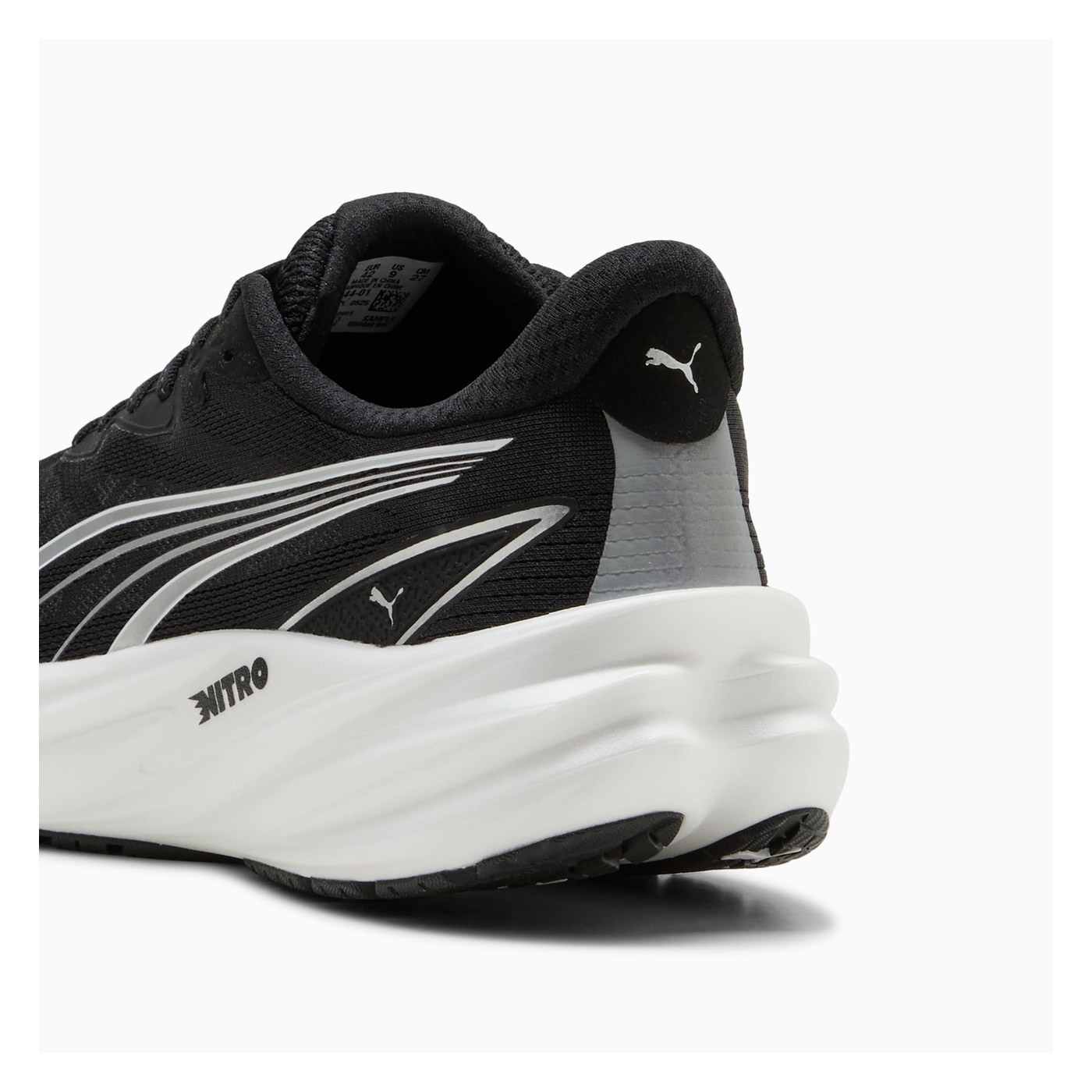
Puma quotes a lifespan of about 800 km for the Velocity NITRO 5. At €130, that puts the cost per kilometer at €0.163, compared to €0.207 per kilometer calculated for the La Sportiva Akasha II based on a 600 km lifespan at €155. On this front, the Puma holds its own against shoes with higher price tags but shorter lifespans. Independent durability tests confirm a durable heel counter (5 out of 5 rating) but a more vulnerable forefoot (3 out of 5), with outsole wear measured at 0.9 mm after standard testing, right in line with the segment average. Forefoot strikers can therefore expect faster wear than the advertised 800 km average.
Our road verdict: who it is for, and how to fit it into your training
The Velocity NITRO 5 is primarily aimed at runners wanting a single, versatile pair to handle the bulk of their weekly mileage, from easy runs to long runs, without expecting it to pace speed workouts. It slots naturally into 10K to half marathon training focused on volume, but fits less comfortably into full marathon prep where max cushioning over the final three hours matters more than overall shoe weight.
RunMorph Coach Verdict
The Velocity NITRO 5 does exactly what Puma built it to do: deliver a lightweight, grippy, and affordable daily trainer that fills an obvious blank in the brand's lineup. Independent tests back up above-average energy return and outstanding grip, two objective, data-backed strengths. The flip side, just as clearly measured, is a consistently narrow fit and propulsion that stalls once you run faster than easy pace. Overall score: 8.9/10, weighting its weight-to-price-to-grip ratio heavily for its primary purpose, daily mileage, while deliberately docking points for high-pace versatility, which was never part of the shoe's core pitch anyway.
FAQ
Is the Puma Velocity NITRO 5 good for beginners?
Yes for high mileage and the €130 price point, but the narrow fit (72.1 mm wide at the toebox vs. 73.2 mm average) warrants trying it on first, especially if this is your first running shoe purchase.
What is the expected lifespan of the Puma Velocity NITRO 5?
Puma claims around 800 km. Independent durability scores (heel 5 out of 5, forefoot 3 out of 5, outsole wear 0.9 mm) suggest this figure is realistic for runners who do not strike heavily on the forefoot.
Does the Puma Velocity NITRO 5 run big or small?
Measured internal length (267.6 mm) is close to the segment average (269.4 mm), so your usual shoe size should fit. Width, not length, is the main question mark with this model.
What is the difference between the Velocity NITRO 5 and the Velocity NITRO 4?
A weight increase of roughly 6% (238 g (8.4 oz) to 242 g (8.5 oz) vs. an estimated 224 g (7.9 oz) for the V4), but traction measured at 0.78, far superior to average, and an upper that fixes the friction points noted on the V4.
Is the Puma Velocity NITRO 5 suitable for marathons?
It can cover the distance, but its flex stiffness, twice as low as the segment average (9.3 N vs. 15.5 N), does not deliver the propulsive drive needed over the final three hours of a full marathon. A more maximalist daily trainer like the Hoka Clifton 11 remains a safer choice for that specific goal.
© Puma, official photo used for editorial purposes