The Torin is the zero-drop daily trainer that has kept Altra going for more than ten years. For this ninth version, the brand changes the foam, switches to a Vibram outsole and trims 2 mm of height. On paper, everything improves. In the lab, energy return drops to 54.7%, against 61.7% for the Torin 8. Here is what that means for you.
© Altra, official photo used for editorial purposes
Altra Torin 9: the classic zero-drop shoe gets closer to the ground
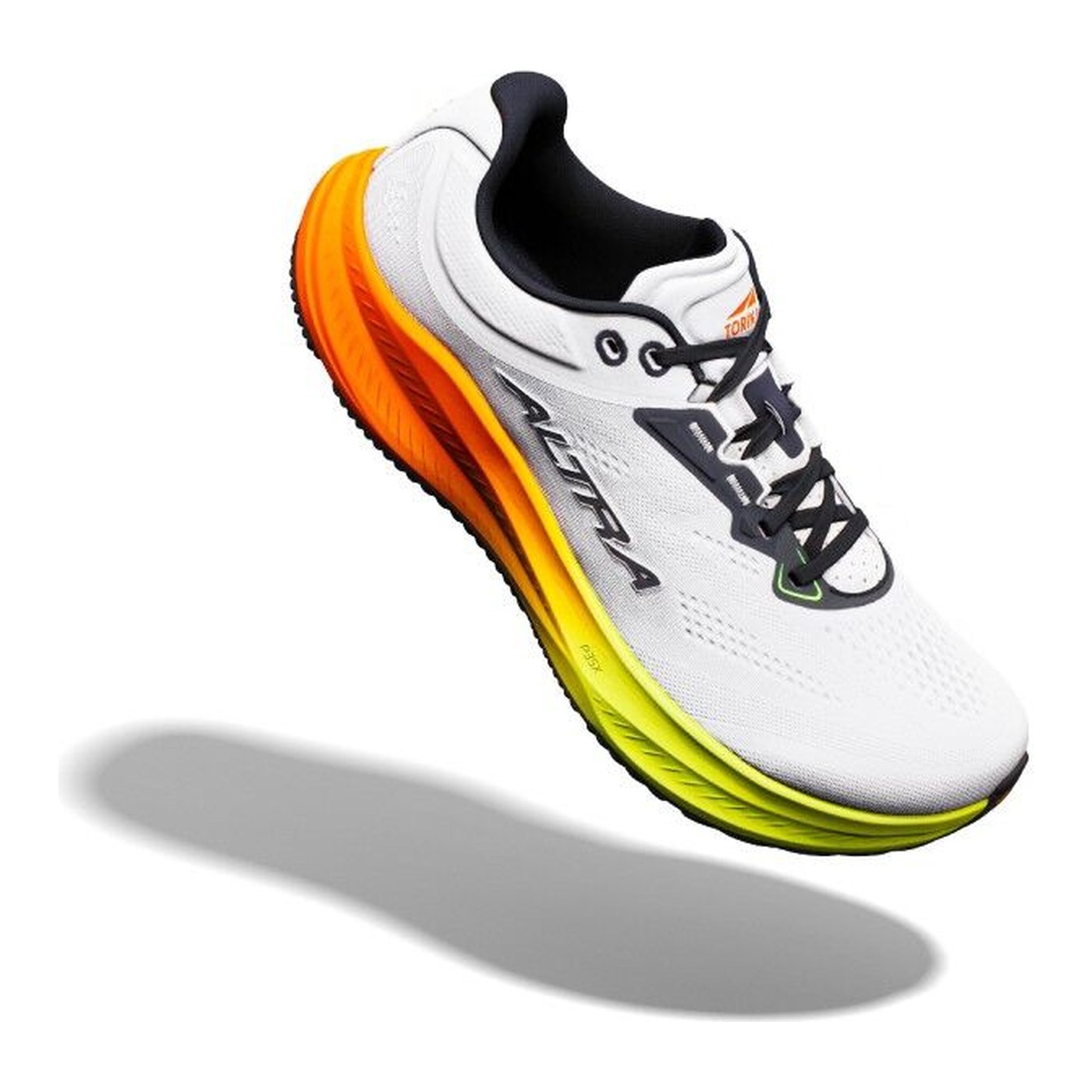
While almost every brand is stacking more foam, Altra does the opposite on its flagship model. The Torin 9 loses 2 mm of claimed height (28 mm against 30 mm). The measurements confirm it: 25.8 mm at the heel and 25.5 mm at the forefoot, against 27.6 and 27.7 mm on the Torin 8. The market average sits around 35.6 mm at the heel. So the Torin 9 is 10 mm lower than a standard training shoe.
That choice makes sense. The Torin targets runners who want to keep the foot flat and close to the ground, with a forefoot where the toes can spread freely. A 40 mm stack with no drop would be an unstable shoe. Altra preferred moderate protection over the height race.
The problem lies elsewhere. To cut weight, the brand replaced its EGO MAX foam with the new EGO P35X, a dual-density foam. It is softer (31.5 AC for the main layer, against 36.6 AC on the Torin 8), but it gives back less. And that is the angle of this review.
RunMorph's advice: if you already run zero drop on trails in an Altra Lone Peak 9+ or an Altra Timp 5, the Torin 9 is the logical road version. If you are coming from a 10 mm drop shoe like the Nike Pegasus 42, plan at least a month of transition, starting with 20 to 30 minute runs.
© Altra, official photo used for editorial purposes
Torin 9: what Altra claims versus what was measured
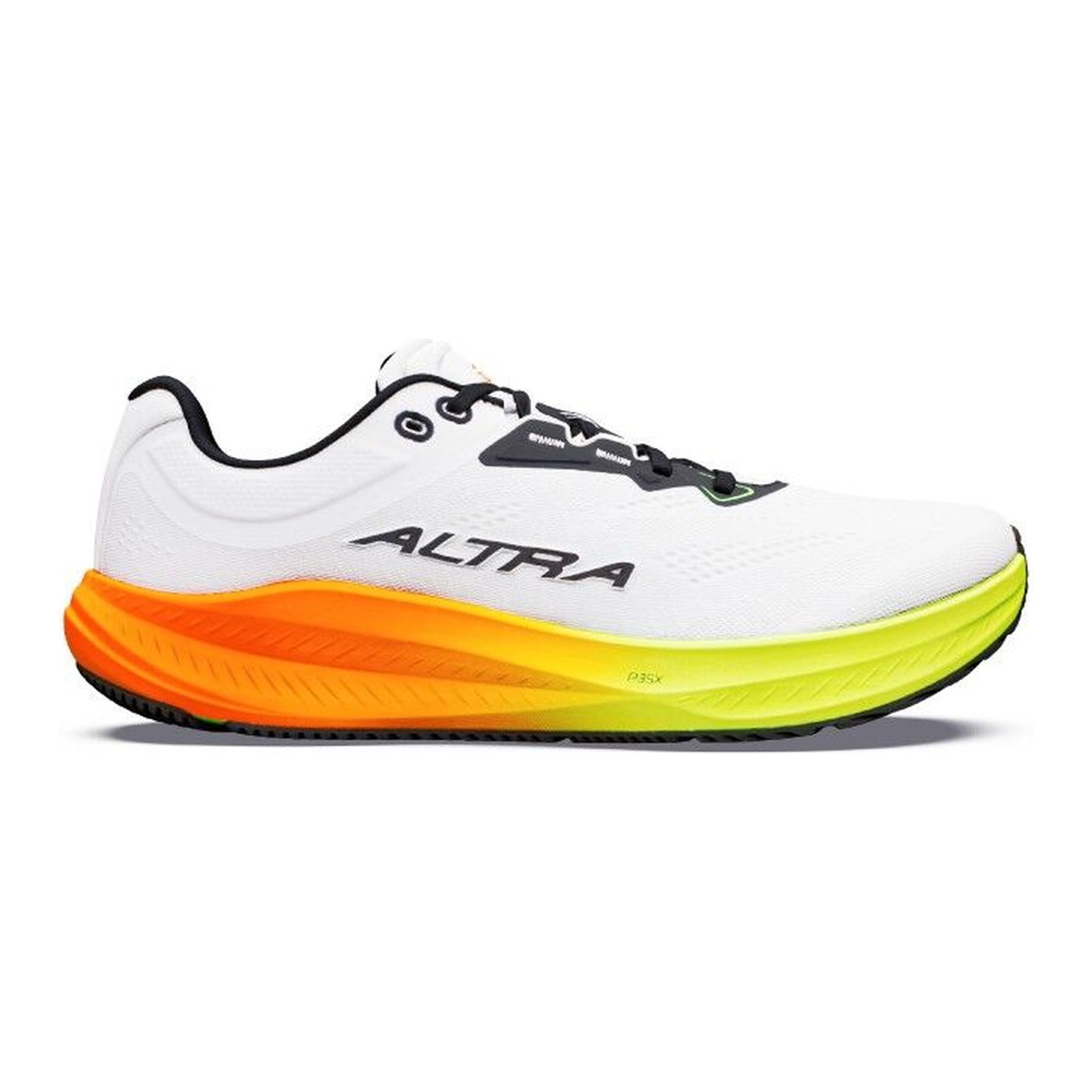
Two labs took the Torin 9 apart and measured it. Their figures match, and they tell the same story: the shoe is lower and slightly lighter than the official spec sheet says.
| Data | Claimed by Altra | Measured |
|---|
| Heel height | 28 mm | 25.8 mm (25.3 mm in a second lab) |
| Forefoot height | 28 mm | 25.5 mm |
| Drop | 0 mm | 0.3 mm (0.2 mm in the second lab) |
| Weight | 269 g | 264 g (260 g in the second lab) |
| Height change vs Torin 8 | minus 2 mm | minus 1.8 mm at the heel, minus 2.2 mm at the forefoot |
Put simply, Altra does not inflate its weight figures. Real stack height, though, is 2.2 to 2.7 mm below the claim. On a shoe that is already low, that matters: you have less foam underfoot than the spec sheet suggests. The zero drop itself is accurate to a tenth of a millimetre.
EGO P35X foam: what does it change underfoot?
EGO P35X is an olefin block copolymer blend, compression-molded. Altra built it in two densities: a soft core and a firmer rim. On the durometer, the core reads 31.5 AC and the firm layer 43.7 AC. The market average is 35.5 AC.
On paper, it is clever. The firm rim frames the foot, the soft core cradles it. In practice, stability improves clearly, but efficiency collapses.
The first lab measures 54.7% energy return at the forefoot and 48.8% at the heel. The average across 420 tested shoes is 61.5%. The Torin 8 managed 61.7%. The second lab gives an energy return score of 3 out of 10. Two measurements, one conclusion: the foam absorbs, but it gives you almost nothing back.
Good news in the cold, though. After 20 minutes in the freezer, the foam only gets 10% firmer. For winter running, that is a real asset: the ride feels the same at 2 °C as at 15 °C.
Fit: 82.2 mm wide, but 25.8 mm tall
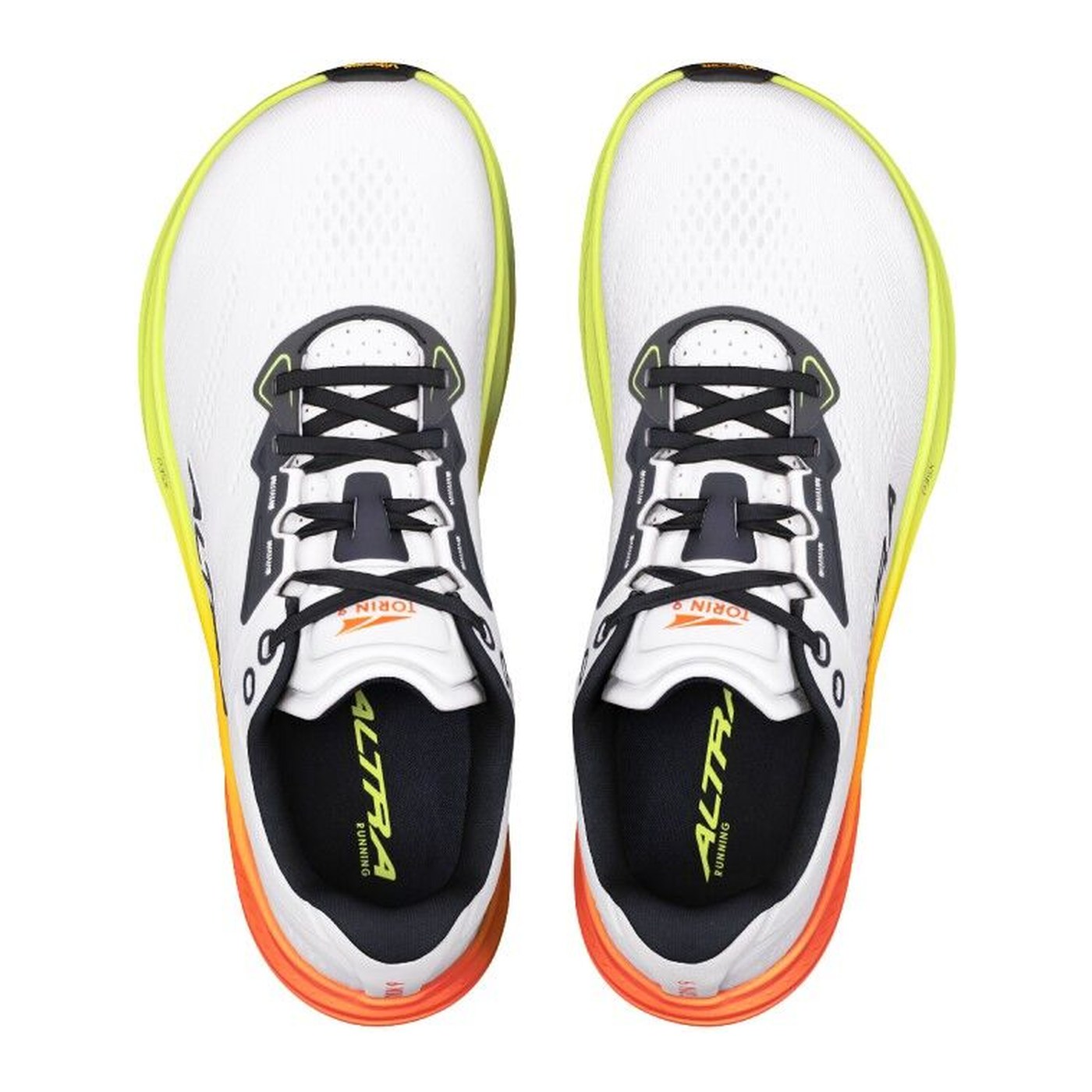
The toe box measures 82.2 mm at its widest point. The market average is 73.2 mm. That is 9 mm more room for your toes, and it is exactly what Altra fans come for.
Vertical volume is less generous: 25.8 mm of height over the toes, against 27.0 mm on average and 26.8 mm on the Torin 8. If you have a high-volume foot or a big toe that points up, you will feel it on top. Testers with slim feet, on the other hand, describe a precise hold without pressure.
Sizing opinions are split. Most buyers polled by the first lab (27 votes) say it runs half a size small. The second lab and an American tester who ran 117 km in it find it true to size. Measured internal length settles it: 265 mm, against 269.3 mm on average. If you are between sizes, go half a size up.
One last annoyance: the tongue is not stitched to the sides. At €160, at least a partial gusset should be standard. Its padding is 5.3 mm, against 10.9 mm on the Torin 8. Altra saved weight where nobody expected it. The tip from the Tonton Outdoor staff points the same way: lace the midfoot firmly to lock the foot in.
© Altra, official photo used for editorial purposes
Road test: what five real reviews say
The Torin 9 came out in July 2026, so it has four months of hindsight. RunMorph cross-checked two lab reports, two English-language field tests and the opinion of a specialist French retailer. No full French review had been published at the time of writing.
First point of agreement: stability. The first lab gives it 86 out of 100, the second 8.2 out of 10. The low base, firm rim and 117.6 mm wide forefoot make it very planted. A Canadian tester even notes that it helps runners who roll their ankles in tall shoes.
Responsiveness, however, splits the sources sharply. Both labs describe a flat, dull shoe. The Canadian tester describes the opposite: a livelier ride than the Torin 8 and a hint of fast-shoe personality on his tempo runs. Who is right? Honestly, it depends on your stride. The Torin 9 bends with 11.6 N of force, against 15.6 N on average. If you land midfoot and push off with your toes, that flexibility gives a direct, almost fast feel. If you wait for the foam to spring you forward, you will feel nothing. The efficiency data are solid and consistent. The liveliness comes from your foot, not the foam.
Cushioning gets more agreement. The first lab records 108 SA at the heel, against 131 SA on average. In plain terms, impact protection is moderate. The second lab finds it too thin beyond an hour. Yet an American tester completed two runs of 21 and 24 km without trouble. The difference? He deliberately rotates a zero-drop shoe into his week and is used to this kind of platform.
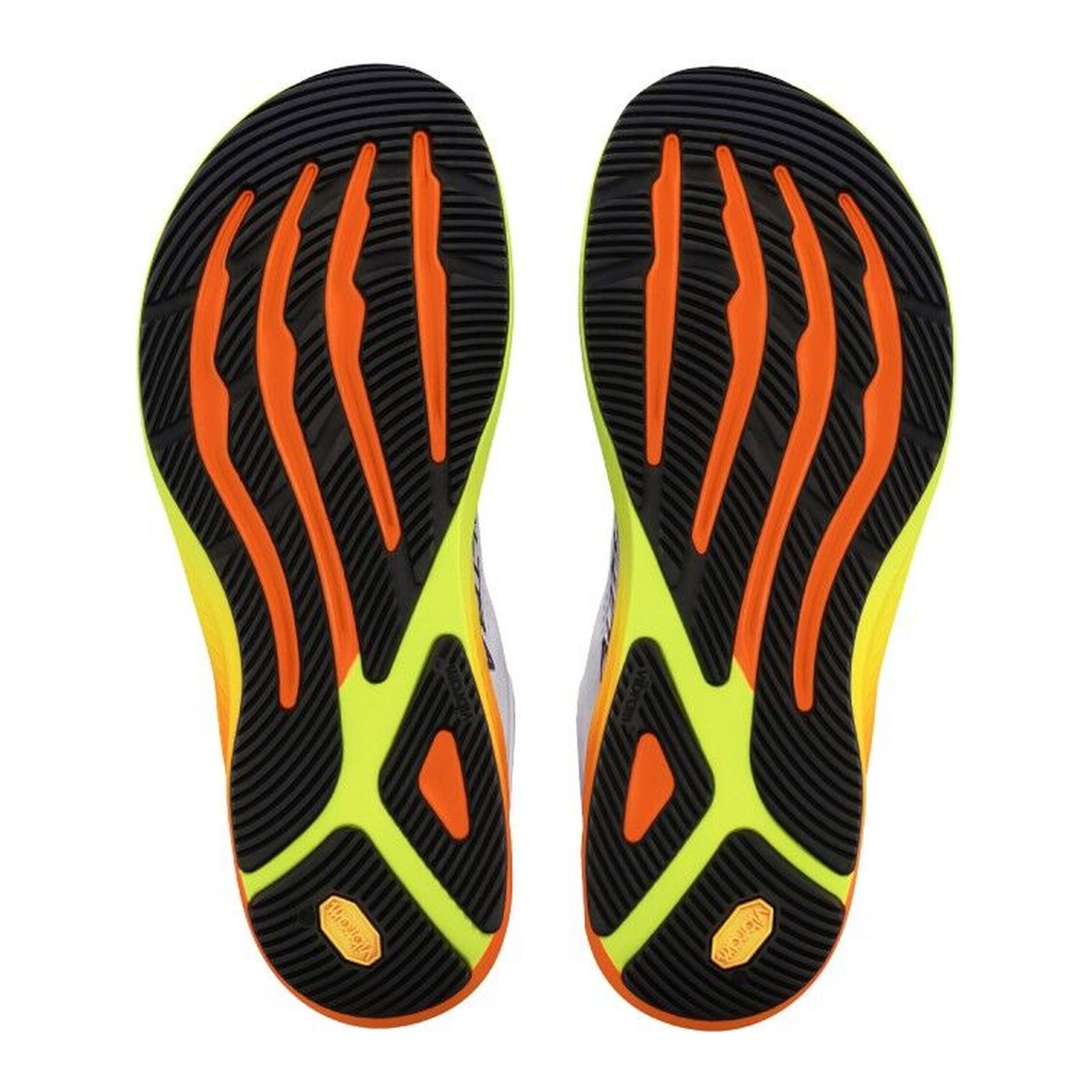
The Vibram rubber, finally, is a real success. Measured friction on wet concrete reaches 0.73, against 0.53 on average and 0.55 for the Torin 8. The American tester ran on dry and wet concrete, asphalt and light trail without ever slipping.
© Altra, official photo used for editorial purposes
At what pace the Torin 9 works, and where it falls short
Easy runs and aerobic base: this is its home. The planted base and easy flex (11.6 N) make your stride feel natural between 5'30 and 6'30/km.
Long run: fine up to about 1h15, then it gets harder. With 25.8 mm of foam and 108 SA at the heel, protection fades fast once your legs tire.
Marathon pace: disappointing. The second lab rates it 4.8 out of 10 for half and full marathon racing. A 54.7% energy return will not help you hold a pace over 30 km.
Threshold and half-marathon pace: possible if you have an efficient forefoot stride. The firm toe-off and flex give a direct push, but the foam does not rebound.
Short intervals: avoid. At 264 g for only 25 mm of midsole, it is heavy for what it offers, and nothing propels you.
Major flaw #1: energy return down 7 points
Going from 61.7% to 54.7% energy return is a step back of a full generation. The Torin 9 sits near the bottom of the first lab's ranking, all models included. On a relaxed easy run, you will not notice. In a session where you want to pick up the pace, it feels like running on a sole that absorbs without giving back.
For a runner who wants one shoe to do everything, that is a deal-breaker. For someone who wants an easy-day pair alongside a faster shoe, it is acceptable.
Major flaw #2: a narrow heel that rules out heel strikers
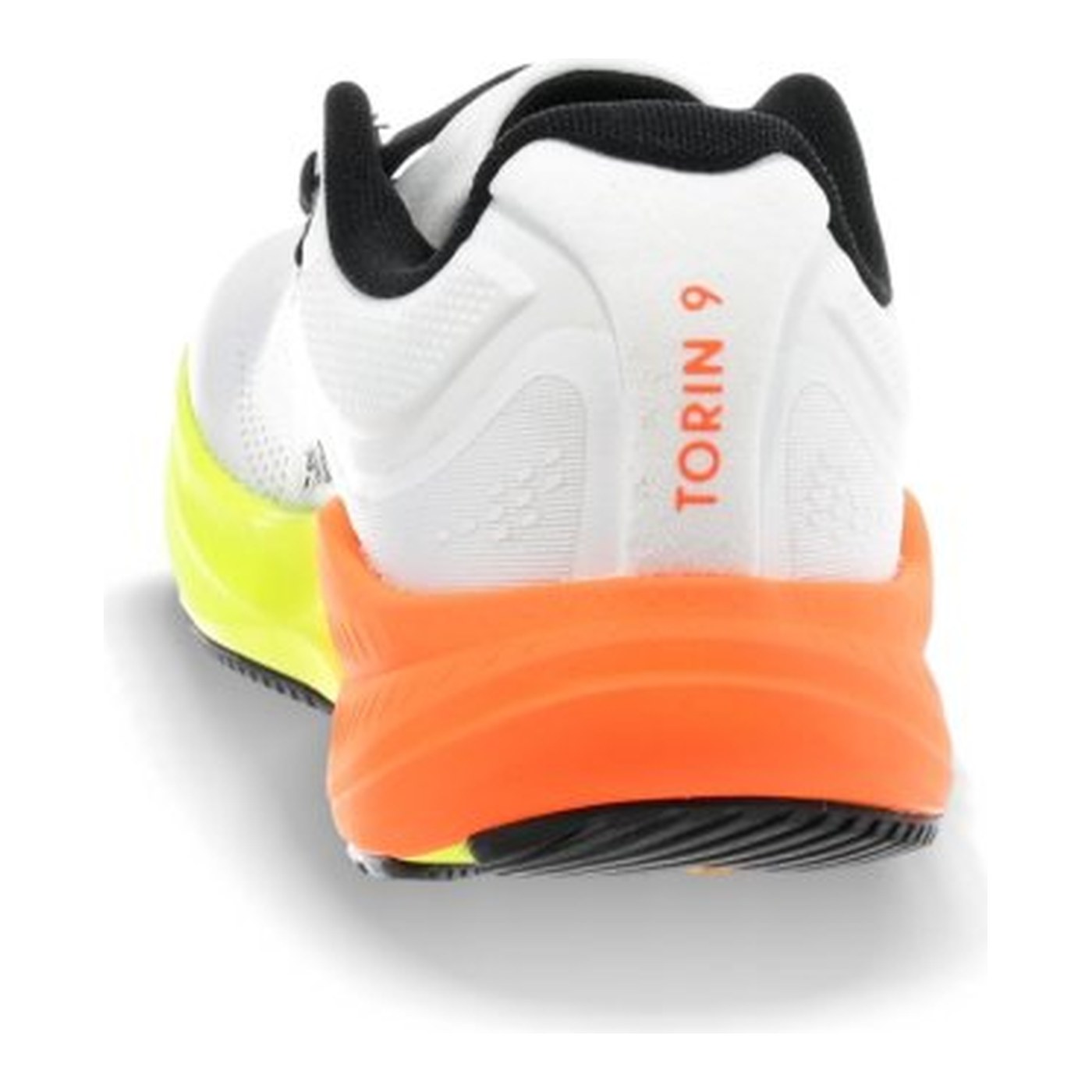
The midsole is 85.4 mm wide at the heel, against 91.1 mm on average. The heel counter scores 2 out of 5 for stiffness, against 4 out of 5 on the Torin 8. Combined with zero drop, that makes a shoe that does not forgive a heel strike: no extra foam at the back, no structure to guide you.
Both labs and both field testers reach the same conclusion. If you land hard on your heel, the Torin 9 will tire your calves and Achilles tendons. The first lab even recommends other models with a moderate drop in that case.
© Altra, official photo used for editorial purposes
Altra Torin 9 vs Torin 8: should you upgrade?
| Measurement | Torin 8 | Torin 9 |
|---|
| Measured weight | 275 g | 264 g |
| Heel / forefoot stack | 27.6 / 27.7 mm | 25.8 / 25.5 mm |
| Forefoot energy return | 61.7% | 54.7% |
| Foam firmness | 36.6 AC | 31.5 AC |
| Flex (force at 30°) | 14.0 N | 11.6 N |
| Wet grip | 0.55 | 0.73 |
| Rubber thickness | 2.5 mm | 3.6 mm |
| Toe box width / height | 83.6 / 26.8 mm | 82.2 / 25.8 mm |
| Heel counter stiffness | 4 / 5 | 2 / 5 |
| First lab score | 80 / 100 | 81 / 100 |
If you loved the Torin 8 for its bounce and secure heel, keep it or grab one on clearance. If you wore through the rubber too quickly or slipped on wet roads, the Torin 9 fixes exactly those two points.
Torin 9 vs Saucony Kinvara 16 and Topo Specter 3: the comparison
| Model | Weight | Drop | Profile | Price |
|---|
| Altra Torin 9 | 264 g | 0 mm | Stable, roomy, little bounce | €160 |
| Saucony Kinvara 16 | 206 g | 4 mm | Light, responsive, narrow fit | €130 |
| Topo Athletic Specter 3 | 218 g | 5 mm | Plateless super trainer, wide forefoot | €194.95 |
The simple rule: if you want strict zero drop and lots of toe room, it is the Torin 9 and nothing else. If you can accept 4 to 5 mm of drop, the Kinvara 16 is 58 g lighter and €30 cheaper, but much narrower. The Specter 3 keeps a wide Topo forefoot and adds bounce, for €35 more.
Grip and durability: what does each kilometre cost?
The Vibram XS Dura rubber is the real win of this version. It is 3.6 mm thick, against 3.1 mm on average, and loses 1.0 mm in the abrasion test, which is average. An American tester had worn out his Torin 7 in 305 km. After 117 km in the Torin 9, he sees far less wear on his usual high-wear zone.
The upper is less tough: 3 out of 5 on the toe box wear test and 3 out of 5 at the heel, against 4 out of 5 for the Torin 8. Altra saved weight partly at the expense of durability.
Putting this data together, a lifespan of 600 to 800 km looks realistic for a 70 kg runner. That works out at €0.20 to €0.27 per kilometre, against €0.18 to €0.24 for the Nike Pegasus 42. It is an estimate, not a measurement, but it shows the price is justified mainly by the outsole.
Our take: which runners and which distances?
The committed zero-drop runner
Already running in Altra on trails, or in a Torin 7 or 8? This is your road easy-run shoe, with rubber that will last longer.
The runner who wants stronger feet and calves
Like the American tester, you can slot the Torin 9 into your rotation once or twice a week to work your lower legs. Start with 30 minutes.
Walkers and casual runners with wide feet
Several testers find it excellent for walking and long days on your feet. With 82.2 mm of width up front, it relieves cramped toes.
Your plan with the Torin 9: use it for the easy aerobic runs of your build-up, and keep a livelier shoe for intervals. To structure your weeks, check out the RunMorph 10K training plan, or the half marathon plan if you are aiming longer.
How to fit the Torin 9 into your RunMorph training plan
In a 10K plan, the Torin 9 covers the two or three easy runs of the week. Threshold and interval sessions deserve a livelier shoe, like the Asics Novablast 6. If you are training for a half, save the long run for a more protective shoe, the Brooks Ghost 18 for example.
RunMorph Coach verdict
The Torin 9 is the best Torin yet for stability, grip and outsole lifespan. It is also the least responsive of the last three versions. Both are true at the same time.
The 8,1/10 score weighs what the shoe is built for: zero-drop easy running. Stability, rubber and toe box count for most of it, responsiveness for little. If you land midfoot and want a shoe that lets you run flat, buy it. If you heel strike or want a single do-it-all shoe, skip it: a Brooks Ghost 18 will serve you better. And if you want the same spirit with bounce, keep an eye on the Topo Specter 3.
Altra Torin 9 FAQ
Is the Torin 9 really zero drop?
Yes. Two labs measure 0.3 and 0.2 mm of difference between heel and forefoot, for 0 mm claimed.
Should I take my usual size?
Internal length is 265 mm, against 269.3 mm on average. Most buyers recommend going half a size up.
Can I run a marathon in it?
Not recommended for most runners: the second lab rates it 4.8 out of 10 for that use, because of its 25.8 mm midsole and 54.7% energy return.
How many kilometres will it last?
With 3.6 mm of Vibram rubber and 1.0 mm of wear in the abrasion test, 600 to 800 km is a realistic estimate.