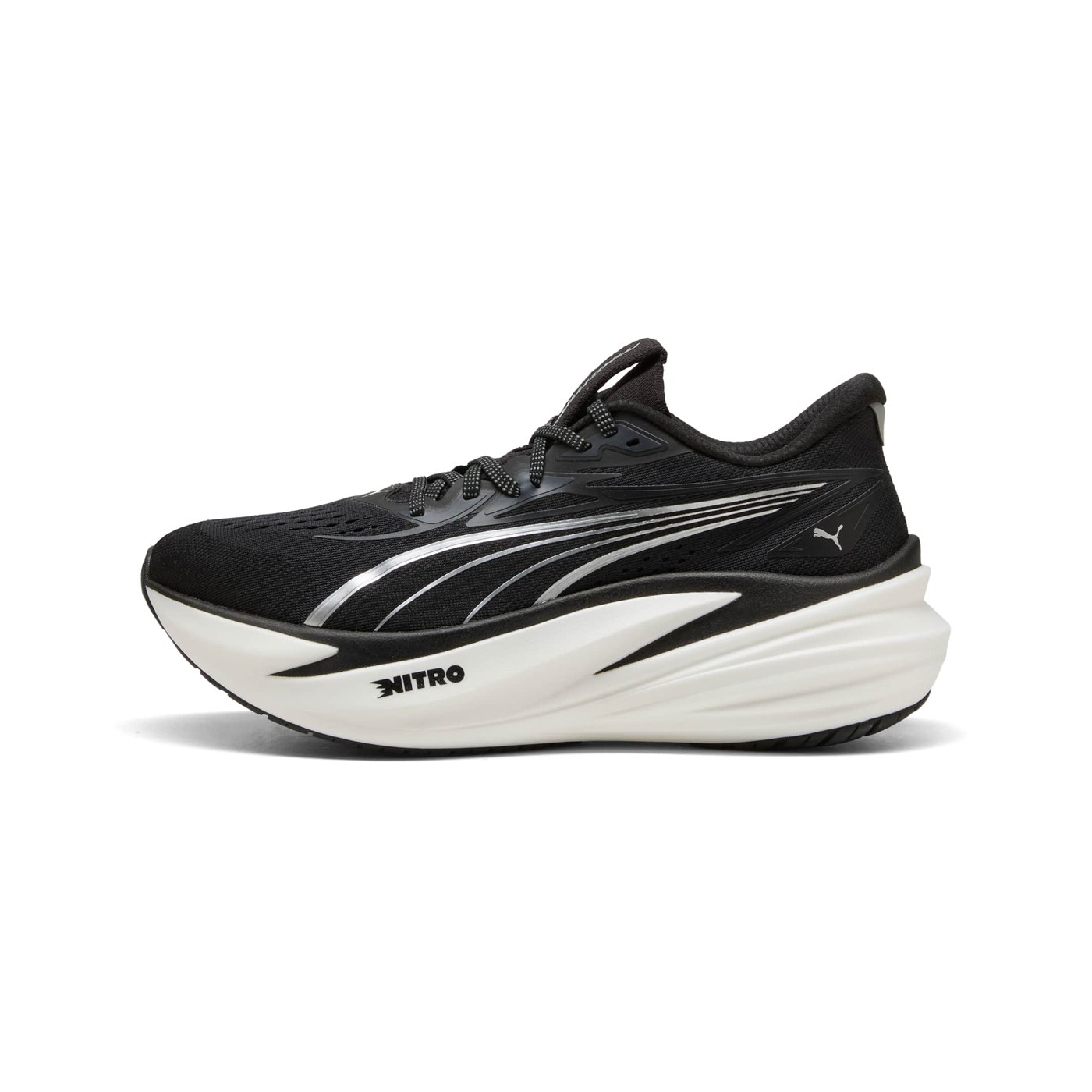
Puma claims 46 mm of foam at the heel and an 8 mm drop. Two labs got the calipers out: they found 10,5 mm and 8,8 mm of drop. The MagMax Nitro 2 is a very stable mountain of foam, lighter than the first version, and a real pleasure on easy runs. It doesn't bounce much, though. At €190, you need to know what you're buying.
© Puma, official photo used for editorial purposes
Puma MagMax Nitro 2: Puma's max-cushion shoe goes on a diet
Puma took its time to matter in the max-cushion category. The first MagMax Nitro had the volume, but it weighed around 290 g. Too heavy and too mushy, according to most testers. Version 2, released on 1 December 2025, fixes the weight first: 268 to 269 g measured by two labs in a men's US 9, against Puma's claimed 275 g.
It sits just above the Velocity Nitro 5 in the lineup, and goes up against the Nike Vomero Plus or the Hoka Bondi 9. The problem is that the market has moved on. At this price, several rivals have far more bounce. So the whole question is this: are stability and cushioning enough to justify €190?
RunMorph's advice: if you want one shoe for easy runs, long runs and workouts, the Asics Megablast does it all better, for more money. On a tight budget, the Kiprun Kipride Max gives you comparable cushioning for €149,99. The MagMax Nitro 2 makes sense for one specific profile: a steady heel striker who runs slowly and wants to feel planted.
MagMax Nitro 2: what Puma claims versus what was measured
Two labs measured the shoe. They don't get the same numbers, and neither matches Puma's.
| Data | Claimed by Puma | Lab 1 | Lab 2 |
|---|
| Heel stack | 46 mm | 45,5 mm | 44,9 mm |
| Forefoot stack | 38 mm | 35,0 mm | 36,1 mm |
| Drop | 8 mm | 10,5 mm | 8,8 mm |
| Weight (US 9) | 275 g | 269 g | 267,7 g |
The heel matches. The forefoot doesn't: it's missing 2 to 3 mm of foam. As a result, the real drop goes up. One lab measures 10,5 mm, the other 8,8 mm. The gap between the two probably comes down to exactly where they measured, on a heavily beveled heel. Here's the takeaway: the shoe behaves more like a 9 to 10 mm drop than an 8 mm one. For a heel striker, that's good news. For a midfoot striker used to 4 or 6 mm, it's a real change.
To put those 45,5 mm in context: the market average is 35,6 mm at the heel and 27,2 mm at the forefoot. So you get 10 mm more foam than on a standard shoe.
Nitro foam: what does it change underfoot?
Puma doesn't disclose what the MagMax foam is made of. One tester suspects a Peba-based blend. The measurements tell a different story. At the heel, shock absorption reaches 141 SA, against an average of 131. Put simply, the shoe soaks up impact very well.
Energy return is the letdown. One lab measures 54,6 % at the forefoot, against a 61,5 % average. The second lab gives it 2,3 out of 10 for energy return, one of the lowest scores in its panel. Both readings point the same way: the MagMax's Nitro has little in common with the much livelier Nitro in the Velocity.
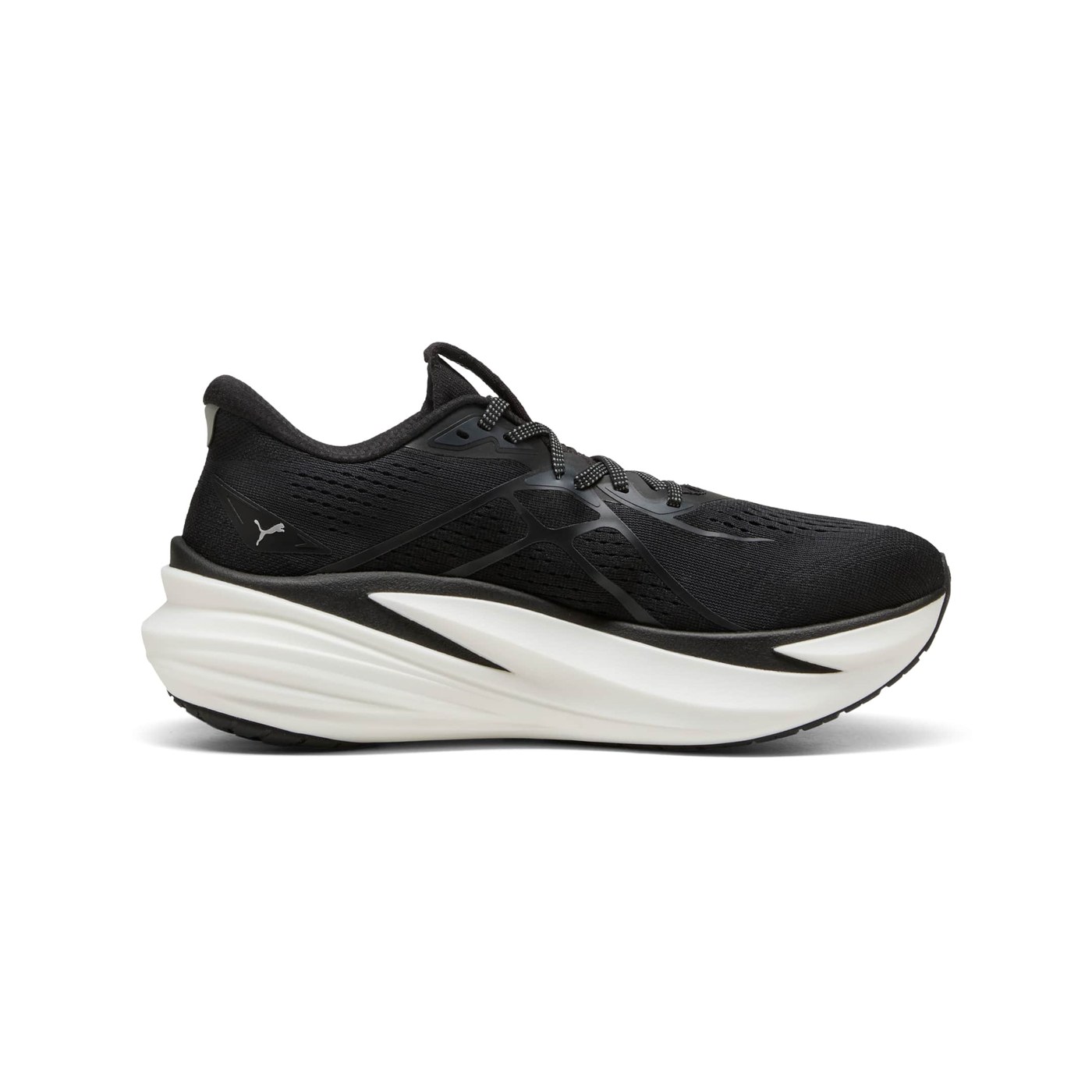
The foam is also firmer than in version 1: 38,1 on the AC scale, against a 35,4 average. Finally, the shoe is stiff in flex, at 22,0 N against a 15,6 N average. It's the rocker, more pronounced than before, that rolls your foot forward.
© Puma, official photo used for editorial purposes
Fit: true to length, but a narrow forefoot
Length is not an issue: three sources out of four recommend your usual size. Only one tester went down half a size. Width is another story. At its widest, the forefoot measures 70,4 mm, against a 73,2 mm average. That's narrow.
Vertical volume makes up for it in part: 29,3 mm of toe box height, against a 27,0 mm average. Your toes aren't squashed from above, which explains why some testers find it roomy. The midfoot, on the other hand, is snug. A physiotherapist tester flags it as the main fit flaw, especially if you wear orthotics.
The tongue is 9,1 mm thick, against a 5,8 mm average. Even so, one tester complains about lace bite on the top of the foot: the laces are thin, and you have to pull them tight to lock the foot in.
On the road: from 5'00 to 6'30/km, what testers say
Three real-world tests and two lab reports form the basis of this review. On cushioning, everyone agrees. The heel gets "an amazing amount" of foam according to one lab, which rates it ahead of the Brooks Glycerin Max 2 on that point. One tester, after 56 km, describes it as soft without being mushy.
On responsiveness, opinions split sharply. One tester, over 40 km of easy runs and a long run, finds the toe-off "energetic" thanks to the rocker. Another, a 2:25 marathoner who ran 56 km in it, finds the ride dull and says he wouldn't buy it. The first lab sums it up well: 89 out of 100 for daily running, 38 out of 100 for tempo. What does it depend on? Your pace. Faster than 5'00/km, the rocker can no longer hide a foam that gives back little.
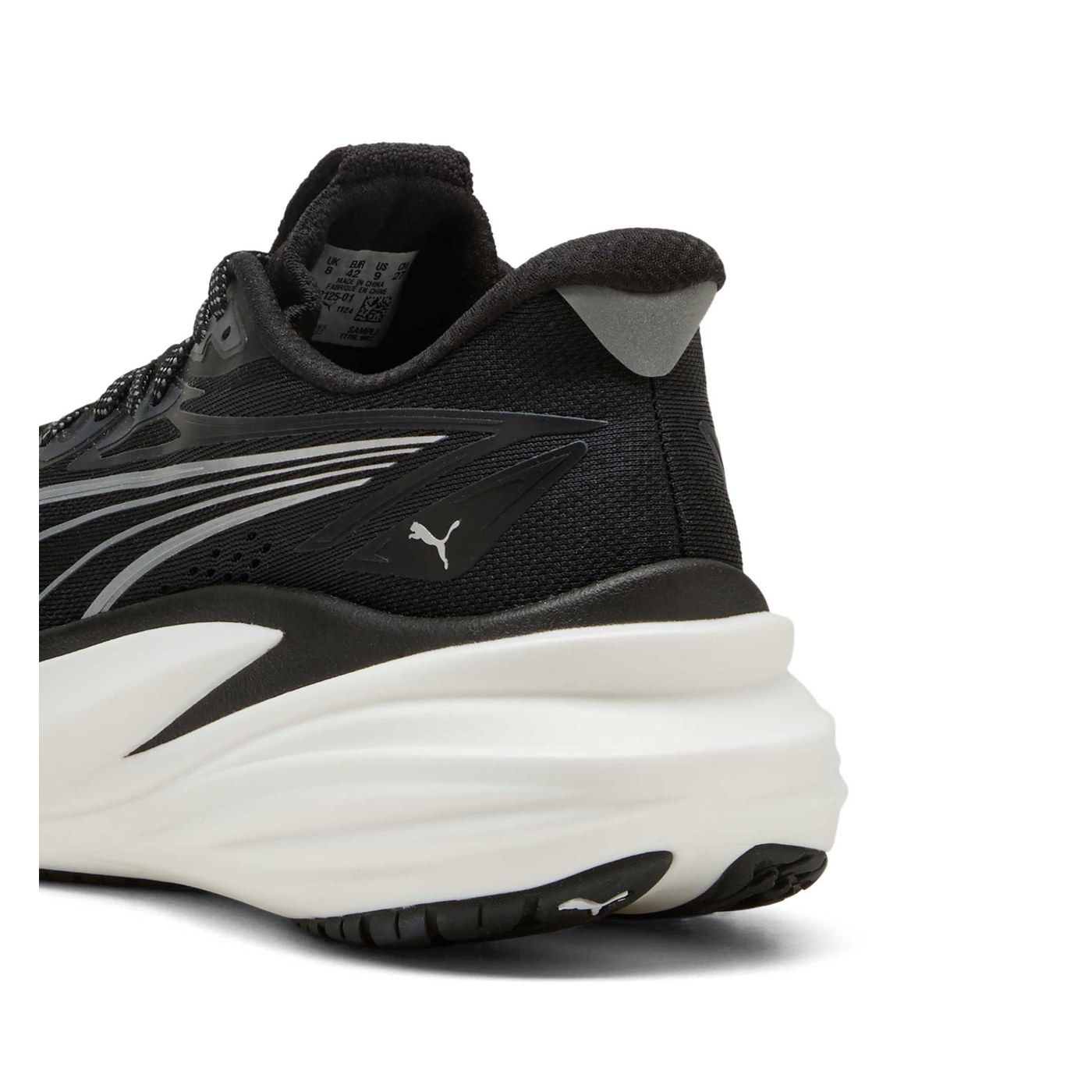
Stability is divisive too, and here your stride decides. The first lab gives it 88 out of 100, with a base of 122,9 mm at the forefoot and 96,7 mm at the heel, against averages of 115,2 and 91,1. Yet one experienced tester feels a slight heel wobble when he speeds up. He points to a 75 mm wide midfoot and little rubber at the back. If you land hard on the outside of your heel, be careful. If your stride is neutral, the shoe feels very planted for its height.

© Puma, official photo used for editorial purposes
Flaw #1: a foam that cushions but gives almost nothing back
It's the most common complaint. 54,6 % energy return at the forefoot, against a 61,5 % average. And 2,3 out of 10 from the second lab. For a €190 shoe, that's weak. The Vomero Plus, within €10 of the price, is rated "much livelier" by every tester who compared the two.
In practice, you lose nothing on easy runs. But if you hoped for a shoe for long runs with marathon-pace blocks, it will hold you back. You'll need a second pair for workouts.
Flaw #2: a 70,4 mm forefoot on a long-distance shoe
On a 2-hour run, your feet swell. At 2,8 mm under the average at its widest point, wide feet will suffer. Puma doesn't offer a wide version. Lab 1 also rates the toe box as "narrow", the only fit measurement below average. If you usually wear a 2E width, move on.
© Puma, official photo used for editorial purposes
MagMax Nitro 2 vs MagMax Nitro: should you upgrade?
| Spec | MagMax Nitro (v1) | MagMax Nitro 2 |
|---|
| Measured weight (US 9) | around 290 g | 268 to 269 g |
| Foam | Softer | Firmer (38,1 AC) |
| Rocker | Subtle | More pronounced |
| Midfoot | Wider | Narrower |
| Flex stiffness | More flexible | 22,0 N, about 23 % stiffer |
If your v1 works for you and you have a wide midfoot, run it into the ground. If you found it heavy and too soft, the v2 fixes both. One thing to know: one tester finds the v2 livelier, while one lab sees no gain in bounce. Don't pay for extra speed.
MagMax Nitro 2 vs Nike Vomero Plus vs Kiprun Kipride Max
| Spec | Puma MagMax Nitro 2 | Nike Vomero Plus | Kiprun Kipride Max |
|---|
| Price | €190 | around €180 | €149,99 |
| Weight | 269 g measured | 275 g claimed | 271 g claimed |
| Heel stack | 45,5 mm measured | 45 mm claimed | 42 mm claimed |
| Bounce | Low | High | Livelier than the Puma |
| Stability | Very good | Good | Very good |
The simple read: if you want bounce, get the Vomero Plus. If you want to pay less for comparable cushioning, get the Kipride Max, which one lab rates as more stable and more lively. The MagMax Nitro 2 wins on just one point, how well its cushioning holds up over distance, which lab 2 rates better than the Vomero Plus.
Grip and durability: what does a kilometer cost?
The PumaGrip rubber is the real good surprise. Two testers praise its grip on wet roads, and the lab measures a 0,77 traction coefficient against a 0,53 average. In the abrasion test, the rubber loses 0,9 mm, against a 1,1 mm average. After 40 km, one tester sees no visible wear.
The only catch: the foam is exposed at the midfoot, and one tester wanted more rubber at the heel. Assuming 600 to 800 km, the MagMax Nitro 2 works out to €0,24 to €0,32 per kilometer. That's slightly better than the Nike Pegasus Premium (€0,26 to €0,35), and worse than the €150 Kipride Max. This is an estimate, not an end-of-life measurement.

© Puma, official photo used for editorial purposes
Our take: who is the MagMax Nitro 2 for?
The runner coming back or running slowly
If you run your easy runs slower than 6'00/km, the MagMax Nitro 2 will give you plenty of comfort without making you sway. Its low bounce won't bother you.
The marathoner in a high-mileage block
For recovery runs between two workouts, it's an excellent rotation shoe. Keep a livelier pair for threshold sessions.
The heavier heel striker
The 141 SA at the heel and a wide 96,7 mm heel base protect you well. If you weigh over 85 kg and land on your heel, this is one of its best profiles.
To build your mileage without getting hurt, pair it with a RunMorph half marathon plan or a RunMorph marathon plan. It will handle your easy runs and the slow part of your long runs. A livelier shoe will take care of threshold work.
RunMorph Coach's verdict
The MagMax Nitro 2 gets right what the first version got wrong: it has lost around twenty grams and no longer wobbles. On an easy run, it's one of the most protective and planted shoes on the market. But its foam gives back little, and you pay for it as soon as the pace picks up.
The score reflects that weighting: cushioning and stability count double for an easy-run shoe, responsiveness less. RunMorph score: 8,3/10. Buy it if you're a heel striker who runs slowly. If you want one pair to do everything, go for the Asics Megablast instead, or the Kipride Max if your budget is tight.
Puma MagMax Nitro 2 FAQ
Does the MagMax Nitro 2 run large?
No, it fits true to length for three sources out of four. It is narrow, though, with 70,4 mm at the forefoot against a 73,2 mm average.
Can you run a marathon in the MagMax Nitro 2?
Yes, if your goal is slower than 3 h 45, about 5'20/km. Below that, its tempo score of 38 out of 100 makes it too sluggish to pick up.
How is it different from the Velocity Nitro 5?
The Velocity Nitro 5 weighs 238 g and costs €130. It's firmer, livelier and more versatile. The MagMax adds a lot more foam and about 30 g, all for comfort.
How many kilometers does the MagMax Nitro 2 last?
Between 600 and 800 km by estimates. The rubber loses only 0,9 mm in the abrasion test, against a 1,1 mm average.