Saucony Endorphin Pro 5 Review: Saucony's Carbon Bet on PWRRUN HG
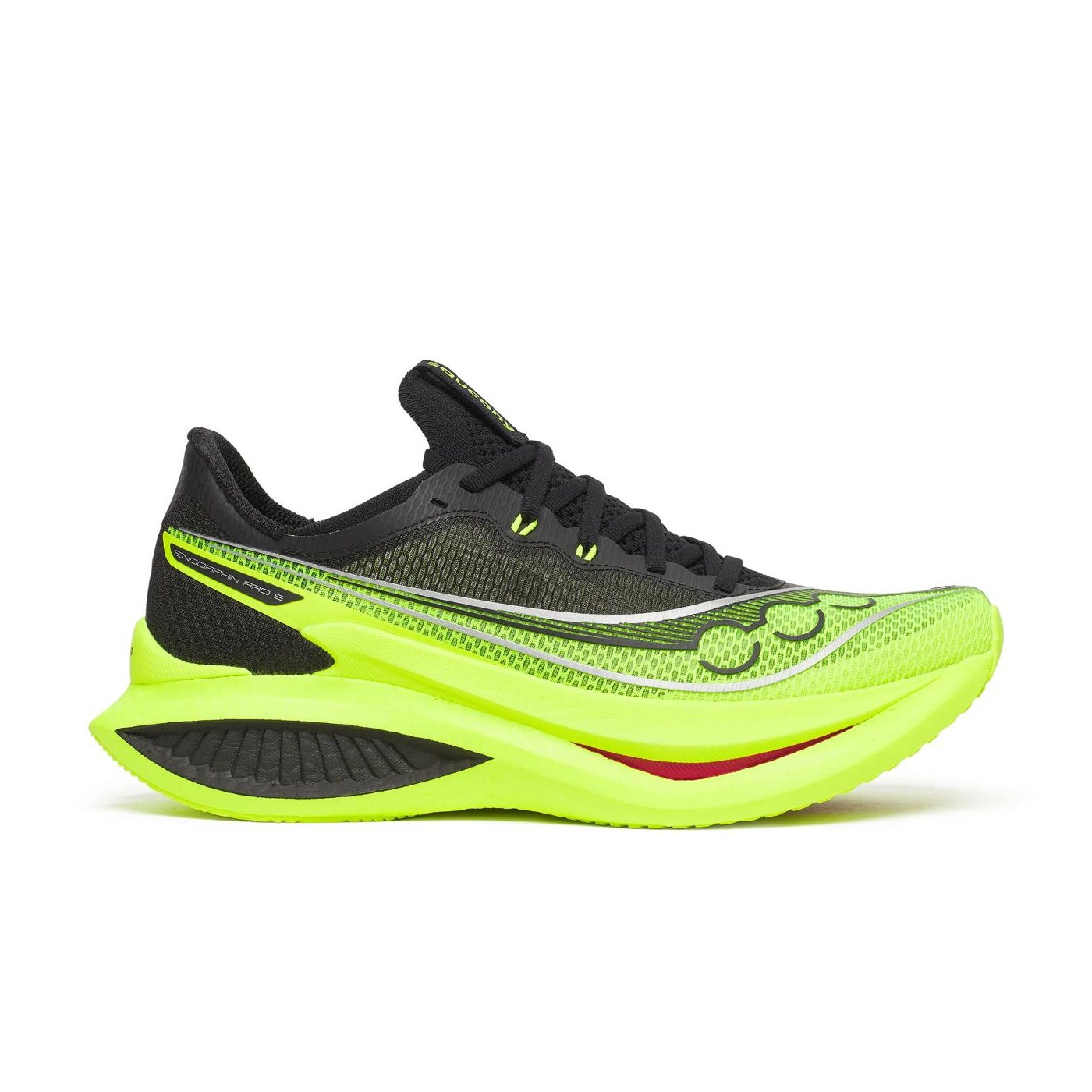
The Endorphin Pro 5: the carbon super shoe you don't have to run flat out to get your money's worth.
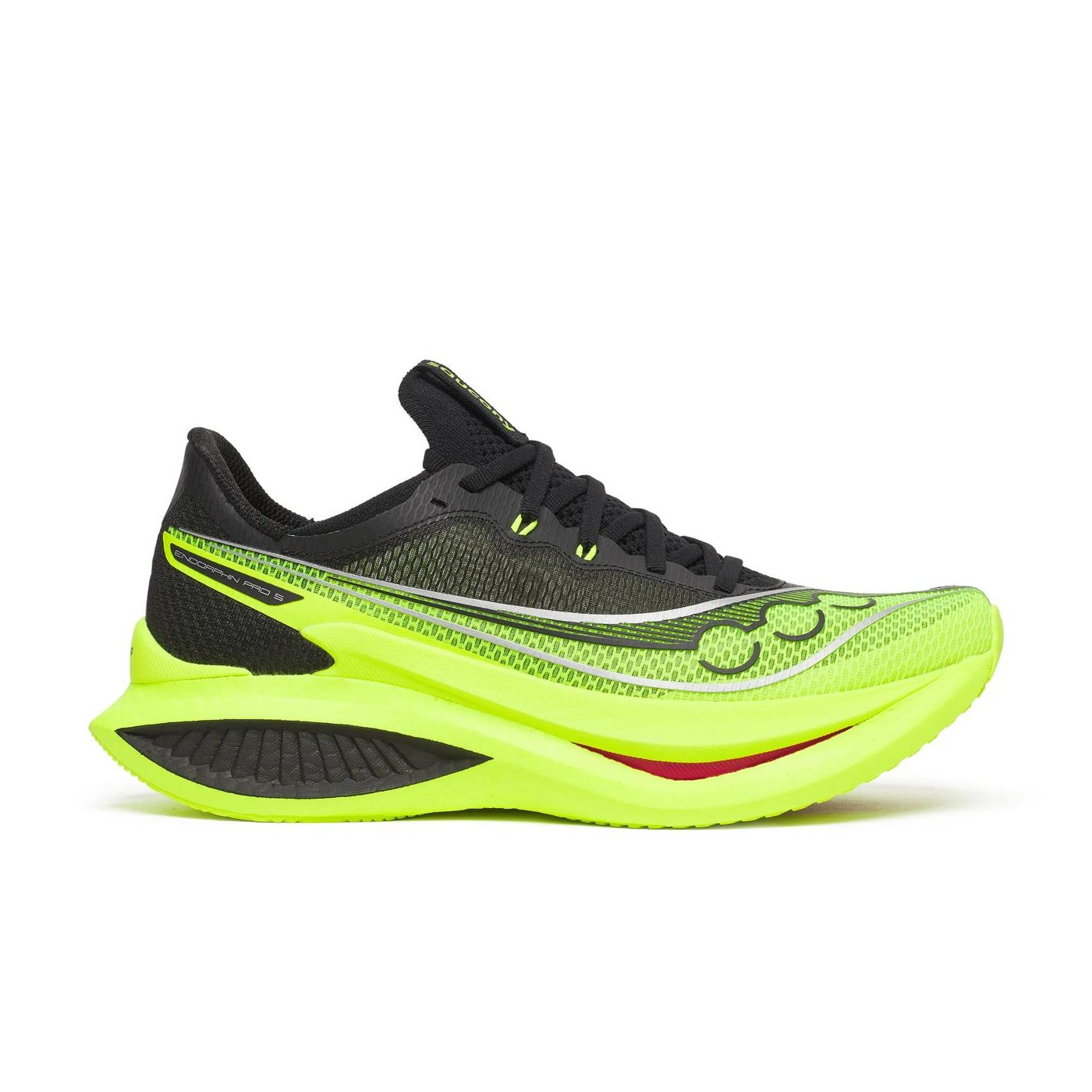
A carbon-plated racing shoe at €220 is an investment. And most super shoes on the market are built for one target: elite runners going under 3:30/km. The Saucony Endorphin Pro 5 takes the opposite approach. It's still a real race-day shoe, lively and fast, but designed to be more accessible. More stable, more versatile, more forgiving at moderate paces.
With this fifth version, Saucony didn't reinvent the formula. Weight, stack height and drop are identical to the V4. But the brand reworked the carbon plate (now "slotted" for a more natural feel) and the outsole rubber (much better grip on wet surfaces). Let's see whether these tweaks make it the go-to super shoe for the intermediate to advanced competitive runner.
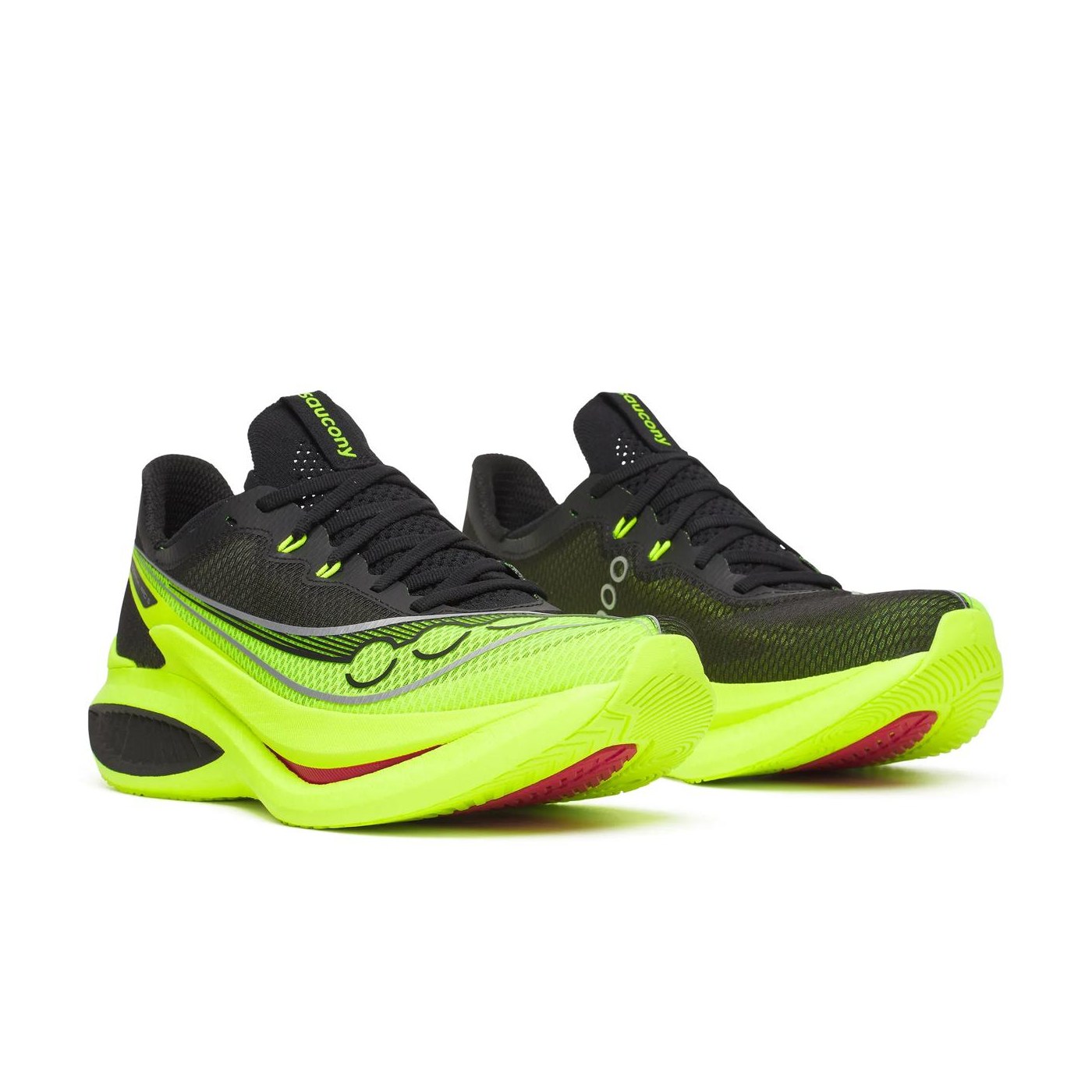
Saucony Endorphin Pro 5 specs
| Brand | Saucony |
| Model | Endorphin Pro 5 |
| Release date | January 15, 2026 |
| Use | Road, carbon-plated racing |
| Drop | 8 mm |
| Stack height forefoot / heel | 31.5 mm / 39.5 mm |
| Weight (men's size 42) | 206 g |
| Foam | PWRRUN PB + supercritical PWRRUN HG |
| Carbon plate | Yes, slotted carbon plate (new design) |
| Upper | Ultra-breathable engineered mesh |
| Recommended distance | 10K to marathon |
| Retail price | €220 |
| RunMorph score | 9.0 / 10 |
The Endorphin Pro 5: for the runner who wants to perform without breaking down
Chasing an ambitious time goal but not (yet) at the level of a sub-elite athlete? The Endorphin Pro 5 was designed for you. Here's what defines it:
- Max stack with a high drop: 39.5 mm of stack height at the heel with an 8 mm drop. That's one of the highest drops in the super shoe category (the Nike Vaporfly 4 sits at 6 mm, the Adios Pro 4 at 6 mm too). This drop protects heel strikers and eases the transition for runners who aren't 100% midfoot strikers.
- A redesigned "slotted" carbon plate: Saucony cut longitudinal slots into the plate, and that changes everything. You get the propulsion of a carbon plate with a less "aggressive" ride: the shoe flexes more naturally under your foot. For a runner new to super shoes, that's a major stability asset.
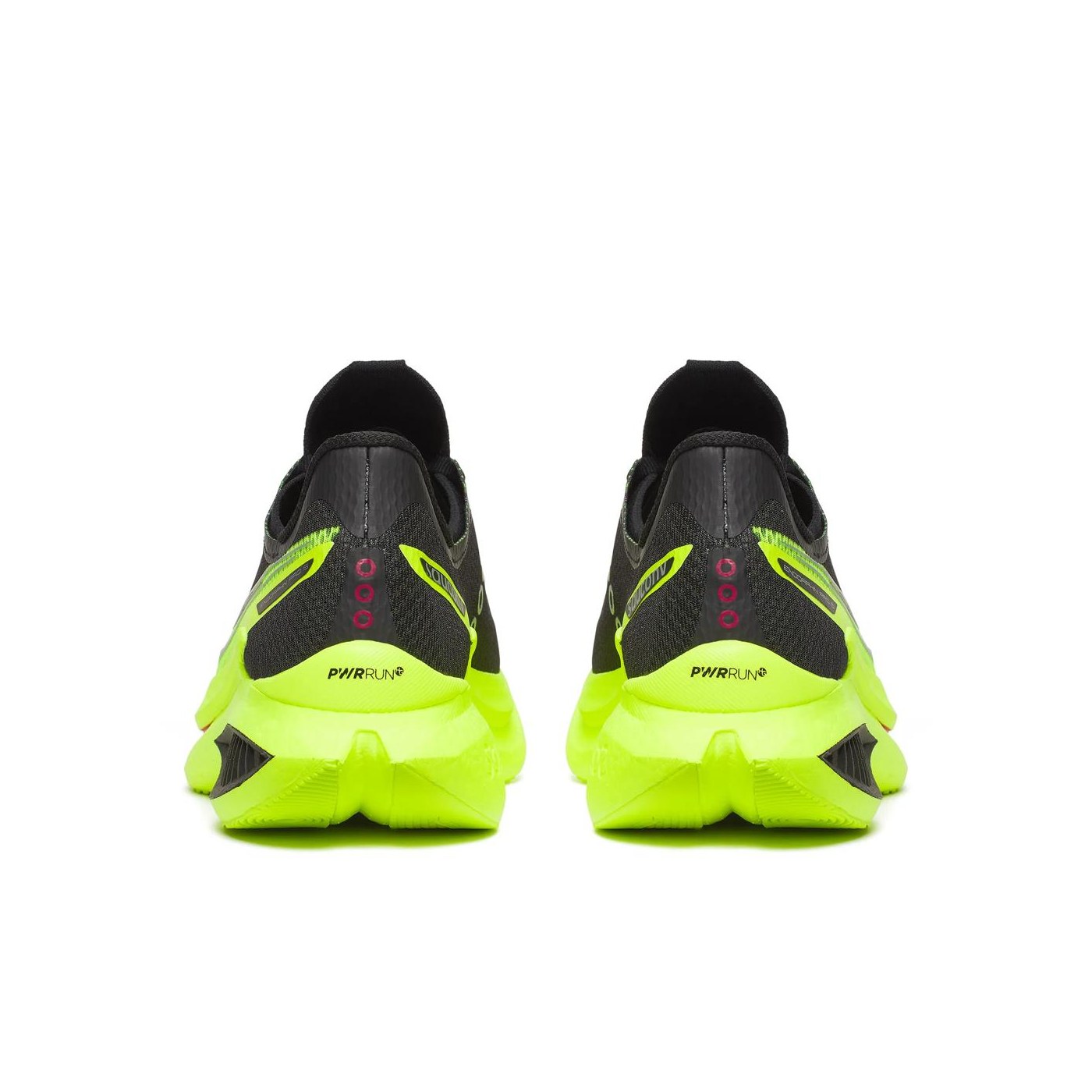
- A dual-layer PWRRUN foam: Saucony pairs PWRRUN PB (lively PEBA) with supercritical PWRRUN HG. You get a textbook compromise: strong bounce on impact, efficient energy return, and better durability than pure-PEBA super shoes.
RunMorph's tip: the Endorphin Pro 5 is probably the most accessible super shoe for an intermediate to advanced runner. If you're training for your first marathon under 3:45 or a sub-1:45 half, it's an excellent choice. For more ambitious goals (sub-3 marathon, sub-1:25 half), you can step up to more aggressive models like the Vaporfly 4.
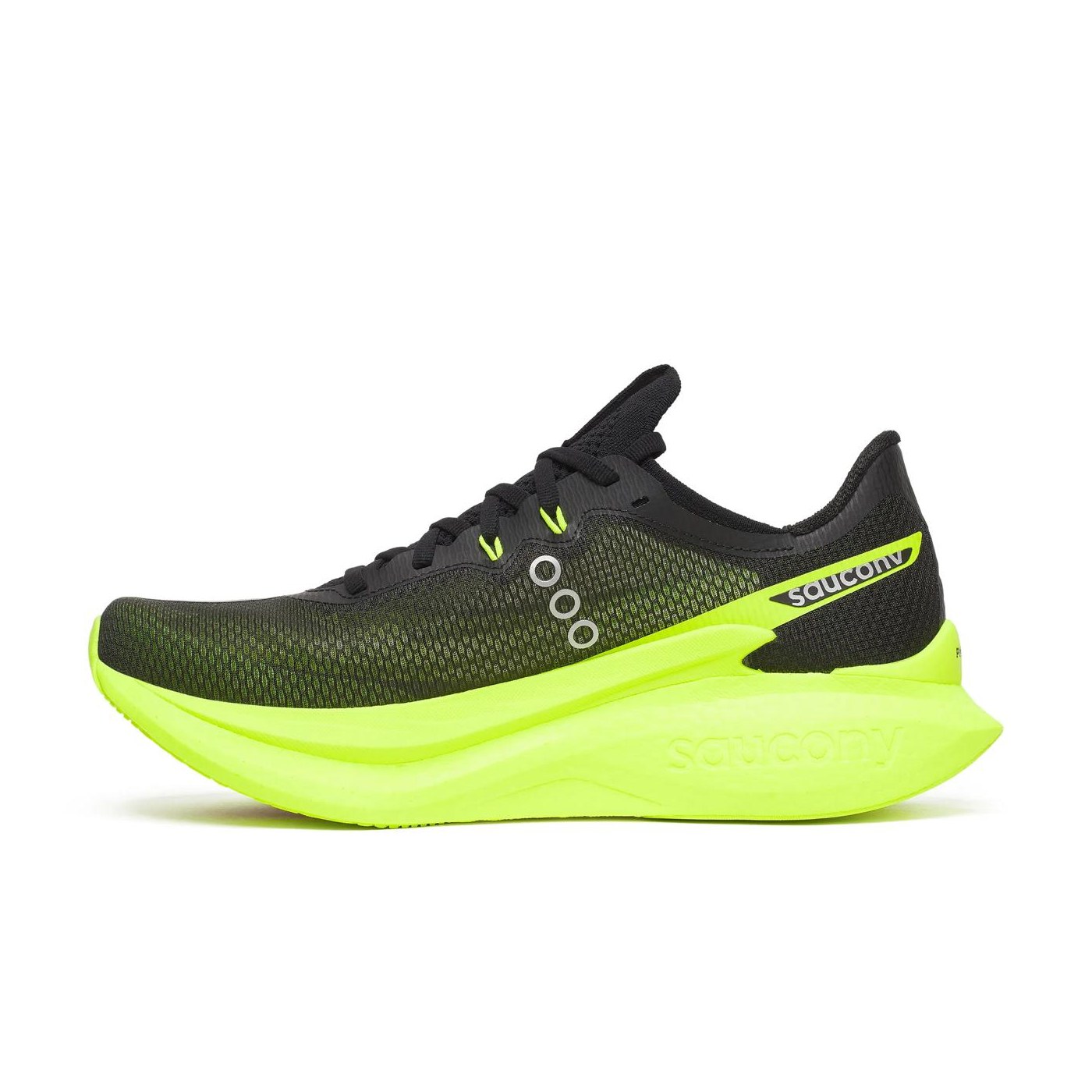
Who is the Saucony Endorphin Pro 5 for?
Here's our coaching take, profile by profile.
Verdict: the Endorphin Pro 5 is the most accessible super shoe on the market. It suits the intermediate to advanced runner who wants to discover carbon plates without taking on the biomechanical demands of a Vaporfly 4. Elite runners targeting sub-3 may find it a bit too planted; the Endorphin Elite 2 (also in Saucony's lineup) will be more aggressive for that profile.
Under the hood: the tech in detail
PWRRUN PB + PWRRUN HG foam: the double stack
Layering two Saucony foams is one of the signatures of the Endorphin Pro line. PWRRUN PB is a very lively PEBA placed close to the foot for immediate energy return. PWRRUN HG is a firmer supercritical compound used as the outer layer, bringing stability and durability. The result: you get the strong bounce of a premium PEBA without the "wobbly" feel of some single-foam super shoes.
Independent lab measurements confirm the shoe holds its energy return over time, a clear edge over competing models that pack out quickly.
Slotted carbon plate: a quiet but decisive innovation
This is probably the biggest change on the V5. Saucony cut longitudinal slots into the carbon plate. In practice, the plate keeps its bending stiffness (rocker effect, propulsion) but gains torsional flexibility. You feel the difference in corners or when your stride isn't perfectly linear: the shoe adapts to you instead of correcting you. That's a huge comfort gain for runners who aren't biomechanical metronomes.
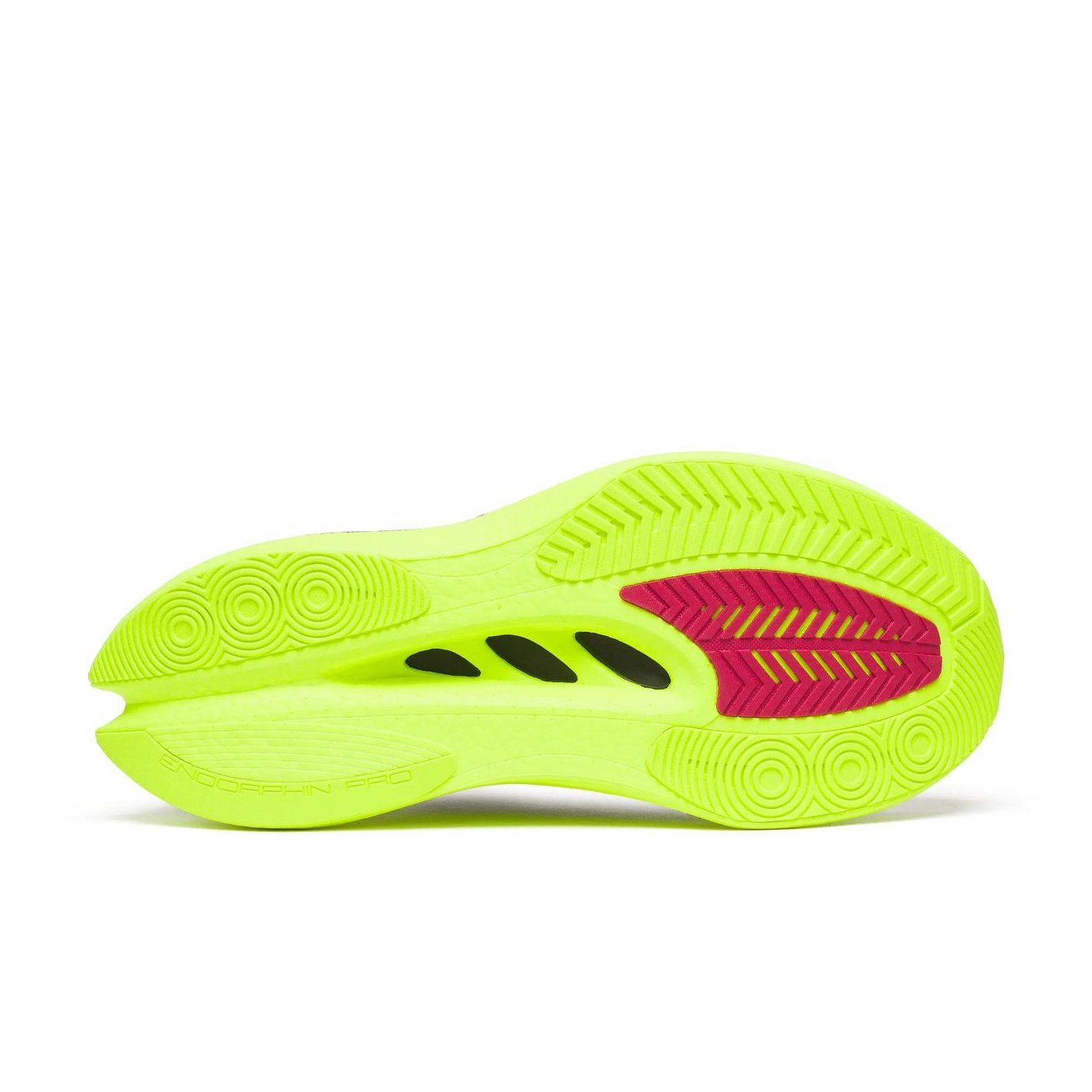
SpeedRoll geometry: Saucony's rocker
Saucony made its SpeedRoll geometry popular with the very first Endorphin Pro. It's a pronounced rocker that rolls your stride forward with every footstrike. On the V5, the geometry stays true to itself: at fast paces (under 4:00/km), you feel that propulsive effect pushing you from one stride to the next. At slower paces, the rocker fades into the background and the shoe stays perfectly usable, unlike some super shoes that demand a minimum speed.
PWRTRAC outsole: better grip on wet surfaces
The second major improvement: the PWRTRAC rubber has been reworked. Lab tests measure a wet traction score 30% higher than the V4. In a rainy race or a damp morning warm-up, you feel the difference right away. On dry asphalt, grip remains excellent, in line with category standards.
What French reviewers say
Wanarun stresses that the Endorphin Pro 5 is the most accessible super shoe in its category, with better stability than its rivals and real pop at sustained paces. The review does point out it gives up a little "edge" to the Vaporfly 4 over very short distances.
Lepape-Info highlights the dual-layer foam and the slotted plate as welcome innovations that put performance within reach of more runners. The verdict: probably the best super shoe for an intermediate to advanced runner looking to perform in the marathon or half.
Running Lab confirms the model's benchmark status in the "accessible super shoe" segment, pointing to its balance of versatility and performance and its better durability than pure-PEBA shoes. Value for money is rated excellent at €220, and even better on sale.
Our RunMorph coaching take. The consensus is clear: Saucony pulled off the feat of refining without diluting. The V5 stays true to the Endorphin Pro DNA built over five versions: a fast shoe that isn't elitist, made for serious runners but not exclusively for the elite.
Quick comparison
Endorphin Pro 5 vs Nike Vaporfly 4. Two opposite philosophies. The Vaporfly 4 is lighter (169 g), more aggressive, more biomechanically demanding, and faster for an elite runner. The Endorphin Pro 5 is more stable, more forgiving, and better suited to the intermediate to advanced runner. Verdict: Vaporfly if you run a sub-3 marathon with a controlled stride, Endorphin Pro 5 otherwise.
Endorphin Pro 5 vs Adidas Adios Pro Evo 3. The Adios Pro Evo 3 is an ultra-specialized elite marathon shoe (97 g, fragile, good for 1-2 races). The Endorphin Pro 5 is the opposite: tough, durable, versatile from 10K to the marathon. Verdict: Adios Pro Evo 3 for chasing an all-out record, Endorphin Pro 5 for reliable performance.
Endorphin Pro 5 vs Hoka Cielo X1 3.0. The Cielo X1 bets on long-distance comfort with its generous PEBA foam. The Endorphin Pro 5 is snappier and more precise at pace. Verdict: Cielo X1 if marathon comfort is your priority, Endorphin Pro 5 for precision from 10K to the half marathon.
Fitting the Endorphin Pro 5 into your training strategy
A €220 super shoe deserves to be used wisely. Here's our game plan:
- Your daily base: keep a durable daily trainer like the Nike Pegasus 42 or the Hoka Clifton 10. They soak up your weekly mileage without wearing down your race pair.
- Your fast sessions: for tempo runs and intervals, use a lively super trainer like the Hoka Mach 7, the Asics Superblast 3 or the Adidas Adizero EVO SL. You get plate-like sensations without burning through your Pro 5.
- Your key sessions and races: 2-3 race-pace sessions in the Pro 5 during the 4 weeks before your race to get used to the shoe, then race day. An Endorphin Pro 5 easily lasts 400-500 km in total, or 2-3 racing seasons for an amateur runner.
RunMorph's tip: plenty of runners buy the most expensive, most extreme super shoe on the market thinking it will save them more time. That's rarely true. An Endorphin Pro 5 you know how to use will save you more minutes than a Vaporfly 4 you can't get the most out of. Your gear should match your level, not the other way around.
The RunMorph coach's verdict
As a coach, the Endorphin Pro 5 is the super shoe I recommend most often to my ambitious runners. Why? Because it pulls off delivering 90% of a Vaporfly 4's performance with 50% of the biomechanical demands. For a runner chasing a serious time goal who isn't a pro athlete, it's exactly the right tool.
The move from V4 to V5 is smart: Saucony didn't break the formula, it refined the details that matter (a more forgiving slotted plate, much better grip, durability intact). If you loved the Pro 4, get the Pro 5 without hesitation: you'll find the same sensations, only better.
The only real drawback: at €220, it's expensive. But it costs less than the Vaporfly 4 and Alphafly 3 (€260-290), for very similar performance on the target profile. Value for money remains among the best in the super shoe category.
RunMorph score: 9.0 / 10. Buy it if you're chasing a serious time goal and want an accessible, durable super shoe. Look elsewhere if you're aiming for the very top level (Vaporfly 4, Adios Pro Evo 3) or if you're new to running (Pegasus 42, Clifton 10).
Key takeaways for your next race
- Accessible super shoe: designed for the intermediate to advanced runner who wants to perform over 10K, the half or the marathon.
- Slotted carbon plate: a major innovation that brings stability and forgiveness, ideal for discovering super shoes.
- Dual PWRRUN foam: PEBA bounce + the stability of a supercritical foam, with better durability.
- 8 mm drop: one of the highest in the category, protects heel strikers and makes adapting easier.
- 206 g in size 42: average for a stable super shoe, heavier than the Vaporfly 4 but more reassuring.
- Grip up 30%: on wet surfaces, a real step forward vs the V4. A plus for rainy races.
- 400-500 km durability: 2-3 racing seasons for an amateur runner. Excellent lifespan for the price.
FAQ
Is the Saucony Endorphin Pro 5 good for beginners?
No. Like any carbon-plated shoe, it's designed for runners with steady weekly mileage (40 km/week minimum) and several structured training cycles behind them. To get started, pick a daily trainer like the Nike Pegasus 42 or the Hoka Clifton 10.
How durable is the Pro 5 really?
Count on 400 to 500 km of real running. That's well beyond the Vaporfly 4 (200-300 km), thanks to a dual-layer foam that's less fragile than pure PEBA. So you can use it for 2-3 full racing seasons if you rotate it with a daily trainer.
Does the Pro 5 run large or small?
It fits true to size, with a comfortable forefoot volume that's roomier than the Vaporfly 4. If in doubt, go with your usual size. For the marathon, you can consider going up half a size if your feet swell over the distance.
What's the difference between the Pro 5 and the Pro 4?
Three major changes: a "slotted" carbon plate (cut with longitudinal slots) for more torsional forgiveness, reworked PWRTRAC rubber for +30% wet grip, and small tweaks to the upper. Weight, stack height and drop stay the same. If you loved the Pro 4, you'll love the Pro 5 even more.
Is the Pro 5 a good marathon shoe?
Yes, especially for a marathon with a time goal between 2:45 and 3:45. Its stability and dual-layer foam protect you over the distance, while the carbon plate gives you the energy return you need. For more ambitious goals (sub-2:45), the Endorphin Elite 2 or the Vaporfly 4 will be more effective.
Recommended articles
- Nike Vaporfly 4: the full RunMorph review
- Preparing for your first marathon in 16 weeks
- Half marathon training plan: the complete guide